
供应链

Search documents
X @外汇交易员
外汇交易员· 2025-11-12 06:17
Supply Chain Strategy - General Motors (GM) has instructed its suppliers to remove components sourced from China from their supply chains [1] - The ultimate goal is for GM to completely move its supply chain out of China to avoid geopolitical disruptions [1] - GM has set a deadline of 2027 for some suppliers to end procurement relationships with China [1] - The directive was initially issued in 2024 and has become more urgent due to escalating US-China trade tensions [1] Leadership Change - John Roth, Cadillac Global Vice President, has been appointed as President of General Motors China [1]

FedEx (NYSE:FDX) FY Conference Transcript
2025-11-11 17:50
FedEx FY Conference Summary Company Overview - **Company**: FedEx (NYSE: FDX) - **Date of Conference**: November 11, 2025 Key Points Industry Context - FedEx operates in the logistics and transportation industry, which has seen significant changes due to the pandemic and evolving global supply chain dynamics [5][6][7] - The company moves $2 trillion worth of commerce and connects 3 million shippers to 225 million consumers, positioning itself as a central player in global supply chains [5][6] Strategic Strengths and Changes - FedEx has built a robust network over 50 years, which is difficult to replicate, and has become integral to global supply chains [5][6] - The pandemic has shifted supply chain discussions to boardroom levels, highlighting FedEx's role in the industrial economy [6][7] - The company has successfully reduced structural costs, achieving operating income growth even with declining revenue, marking a historical first for FedEx [8][9] - FedEx is evolving its networks to be more flexible and intelligent, referred to as Network 2.0 and Tricolor [9][10] Technological Advancements - FedEx is leveraging its data from 17 million packages processed daily to enhance logistics intelligence and support AI applications [10][37] - The company is focusing on automation in its operations, particularly in its ground hubs, to improve efficiency and reduce manual handling [35][36] Market Adaptability - FedEx is adapting to changing global supply chain patterns, with a notable shift in traffic from Trans-Pacific routes to Intra-Asia routes [15][16] - The company is the largest broker in America, emphasizing its operational capabilities to provide seamless customer experiences [16][17] Financial Performance and Guidance - In Q1, FedEx reported a $150 million adjusted operating income impact and anticipates a total of $1 billion impact due to trade policy headwinds [19][21] - U.S. outbound air freight volumes increased by 22%, contributing approximately $40 million to revenue [19][20] - The company expects modest demand for the peak season, with improvements in operational metrics compared to previous years [25][27] Trade Policy Impact - The recent U.S.-China trade deal is expected to provide some certainty, but its immediate impact on FedEx's operations remains unclear [21][22] - FedEx is focused on managing the $1 billion headwind while continuing to leverage its strengths in the industrial economy [23][22] Spin-off Plans - FedEx plans to spin off its freight division to create two independent companies, aiming to unlock value for shareholders and allow each entity to focus on its core strengths [40][41] - The management team for the freight division has been assembled, emphasizing experienced leadership to drive growth [41] Upcoming Events - FedEx will hold two investor days: one for FedEx Corporation (excluding freight) on February 11-12, 2026, in Memphis, and another for FedEx Freight in the spring of 2026 in New York [43] Additional Insights - FedEx's commitment to safety is highlighted in its handling of aircraft inspections amid regulatory challenges [28][30] - The company is actively working with partners to enhance its service offerings, particularly in healthcare logistics, where it has seen significant growth [37][39]

第八届进博会收官:光明食品集团签约金额近20亿元
Zheng Quan Ri Bao Zhi Sheng· 2025-11-11 04:09
Core Insights - The 8th China International Import Expo (CIIE) concluded with a record intended transaction amount of $83.49 billion, marking a 4.4% increase from the previous year [1] - Bright Food Group achieved an intended procurement amount of nearly 2 billion yuan during the expo, showcasing its strong performance and commitment to international trade [1][3] Group 1: Bright Food Group's Participation - Bright Food Group participated as an exhibitor, purchaser, and service provider, integrating deeply into the CIIE's platform [1] - The group's exhibition area covered 3,096 square meters, making it the largest single booth in the agricultural and food products section [2] - The group showcased over 400 product categories from more than 60 overseas companies, representing 30 countries and regions [2] Group 2: Strategic Focus and Innovations - Bright Food Group emphasized a three-chain integration model focusing on industry, supply, and service chains, aiming to create a symbiotic relationship between industry and services [2] - The group presented an immersive experience from farm to table, enhancing consumer engagement through interactive displays [2][4] - The exhibition featured a strong focus on sustainable supply chains, with live demonstrations from New Zealand ranchers [4] Group 3: Product Offerings and Collaborations - Bright Food Group's booth included a variety of products such as Angus beef, New Zealand grass-fed meats, and other gourmet items, enhancing the sensory experience for visitors [3] - The group collaborated with various partners, including the film "Cai Rou Hun Tun," to launch new products, reinforcing its brand identity [5] - The Sugar and Wine Group showcased a diverse range of products, integrating global selections with local brands, highlighting its strength in global sourcing and channel collaboration [6]
波音(BA.US)拟向南卡罗来纳州工厂投超10亿美元扩产 旨将787梦想客机产量翻番
智通财经网· 2025-11-10 01:40
Core Points - Boeing plans to invest over $1 billion to expand its 787 Dreamliner factory in South Carolina to double the production capacity in response to global demand growth [1] - The expansion is expected to create over 1,000 jobs within five years, nearly doubling the current workforce of approximately 8,200 employees at the facility [1] - Boeing's total investment in the South Carolina facility is projected to reach about $3.5 billion over 15 years [1] - The new assembly line is expected to be operational by 2028, with a production target of around 16 Dreamliners per month, exceeding pre-pandemic peak levels [1] - Analysts indicate that this move will help Boeing capitalize on record orders for its 787 and 737 Max projects, but caution that the company remains dependent on a strained supply chain for critical materials [1] - Boeing is currently addressing quality issues at the South Carolina plant, where inspections have revealed minor structural defects in some aircraft [1] Additional Information - U.S. Treasury Secretary and South Carolina Governor attended the groundbreaking ceremony, highlighting Boeing's CEO's praise for President Trump’s role in promoting aircraft sales [2] - Boeing plans to begin hiring mechanics, engineers, and logistics experts next summer to support the increased production, with new employees undergoing a year of training before production scale-up [2] - Despite controversies surrounding delays in the delivery of the "Air Force One" aircraft, Trump has been one of Boeing's most vocal supporters [2]

美国脖子没那么好卡,稀土还是中国的王牌,这张牌最好用
Sou Hu Cai Jing· 2025-11-09 21:22
Core Viewpoint - China's export control on rare earths has become a significant tool in the ongoing US-China rivalry, marking a shift from passive to active defense strategies [1] Group 1: Export Control and Economic Warfare - The recent export control measures on rare earths are seen as a direct response to aggressive US policies, including the "50% ownership penetration" rule and exorbitant fees for Chinese ships entering US ports [1] - The "long-arm jurisdiction" policy not only restricts the export of raw materials but also applies to processed rare earth products that utilize Chinese technology, effectively controlling global supply chains [1] Group 2: Dependency on Chinese Supply Chains - The US estimates that it will take at least seven to eight years to completely eliminate dependence on Chinese rare earths, requiring hundreds of billions in federal investment annually [4] - Key industries such as lithium batteries, semiconductors, and pharmaceuticals are heavily reliant on Chinese materials, with over 70% of basic pharmaceutical raw materials sourced from China [7][8] Group 3: Challenges in Alternative Supply Chains - The US attempts to build alternative supply chains for rare earths face significant challenges, particularly in refining capabilities, where China holds a monopoly on advanced processing techniques [1][4] - The semiconductor industry is also at risk, with China capturing 31% of the market share in mature processes, and US manufacturers relying on Chinese firms for critical components [5] Group 4: Broader Implications of the US-China Rivalry - The geopolitical landscape is shifting, with the potential for resource management strategies extending beyond rare earths to include nickel, cobalt, and lithium [10] - The competition is not just about technology but also about systemic resilience, with China demonstrating a strong ability to adapt and innovate under pressure [15]




(第八届进博会)“全勤生”话进博:长期深耕 与中国市场双向奔赴
Zhong Guo Xin Wen Wang· 2025-11-08 13:36
Core Insights - The eighth China International Import Expo (CIIE) featured 170 companies and 27 institutions that have consistently participated, referred to as "full attendance" companies, demonstrating a commitment to the Chinese market through long-term engagement [1] Group 1: Shared Consumption New Dividends - Companies participating in the expo are capitalizing on diverse consumer demands in China, benefiting from the growth of a large-scale market [2] - Nestlé's CEO for Greater China highlighted that China is the company's second-largest market, with new consumer demands providing growth opportunities [2] - Brother (China) introduced a computer embroidery sewing machine to cater to the personalized needs of young consumers, emphasizing the importance of brand influence through continuous participation [2] - New Zealand's牧怡食品集团 is meeting the increasing food quality demands of Chinese consumers by introducing high-quality sheep milk [2] Group 2: Co-building Innovation Ecosystem - The Chinese market is increasingly seen as a strategic choice for foreign companies to establish R&D centers in collaboration with local partners [3] - Qualcomm's China Chairman noted the expo as a vital platform for communication within China's industrial ecosystem, witnessing the evolution of technologies like 5G and AI [3] - Siemens has developed a comprehensive ecosystem in China, comprising 20 R&D centers and over 20 digital innovation empowerment centers [3] Group 3: Strengthening Supply Chain Layout - The focus of U.S. companies has shifted from merely entering the Chinese market to deepening their engagement with local talent and supply chains [4] - Schneider Electric has been operating in China for 38 years, recognizing it as a key market and supply chain base [4] - The Swiss Center organized over 100 Swiss companies to participate in the expo, with a record exhibition area of 290 square meters, showcasing the establishment of stable supply chains by companies like Migros in China [4]

印度要和中国“并肩作战”,美国成了“小丑”
Sou Hu Cai Jing· 2025-11-08 07:45
Group 1 - The core viewpoint of the articles is that after the US-China "reconciliation," India is perceived as a "loser" in the trade dynamics, particularly due to the aggressive tariff policies imposed by the Trump administration [1][3][5] - The US has imposed a 50% tariff on Indian goods and increased application fees for H1B work visas, significantly impacting India's foreign trade [3][5] - India's refusal to acknowledge Trump's mediation in the India-Pakistan conflict has led to increased tariffs, making it one of the most affected countries by global tariff policies [5][7] Group 2 - The US has attempted to persuade India to stop importing oil from Russia by promising to reduce tariffs to 15%, but this promise was not fulfilled, leading to India's disillusionment [7][10] - India's economic reliance on China is growing, as it recognizes the need for a stable supply chain amidst uncertainties created by US policies [8][10] - The articles suggest that India's future cooperation with China may be more reliable than its past partnerships with the US, as India seeks to find a balance between the two powers [8][10]
特朗普按时兑现中美会晤诺言,美国领头降低关税,放出合作信号
Sou Hu Cai Jing· 2025-11-07 21:06
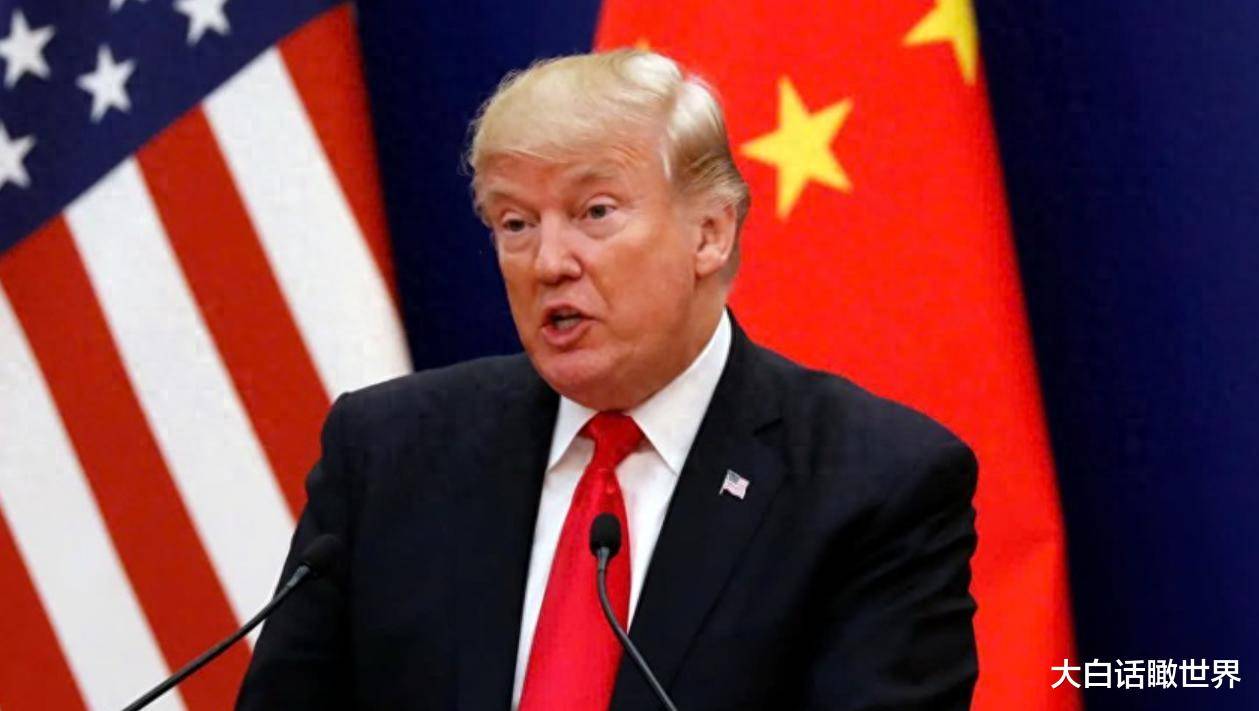
Group 1 - The Trump administration's decision to significantly reduce tariffs on certain Chinese goods is portrayed as a cooperative gesture, but it is primarily a response to inflation, supply chain issues, and electoral pressures [1][3] - The reduction in tariffs specifically targets products that are critical to the U.S. supply chain, such as fentanyl raw materials, circuit components, and battery components, indicating a tactical compromise rather than a strategic shift [3][5] - The U.S. inflation rate reached a 2008 high, with the Consumer Price Index (CPI) rising 4.8% year-on-year and core CPI at 6.8%, leading to increased financial burdens on American households [5] Group 2 - The U.S. has faced challenges in its manufacturing return efforts, with companies like Apple and Intel experiencing setbacks, while China has diversified its trade through initiatives like the Belt and Road and RCEP, increasing exports to ASEAN and Africa [7][14] - A significant percentage of U.S. small businesses are at risk of bankruptcy due to tariffs, prompting pressure from retail associations on the White House to adjust policies [7][14] - China has strategically managed its response to U.S. tariff adjustments, leveraging its dominance in rare earth exports and agricultural procurement to exert pressure on U.S. industries [11][14] Group 3 - The resilience of China's supply chain has become a competitive advantage, with companies like Tesla and Nvidia seeking exemptions from U.S. restrictions, highlighting the unintended consequences of U.S. policies [12][14] - China's approach to negotiations emphasizes the removal of all sanctions as a prerequisite, while simultaneously expanding its domestic market and regional supply chains [14][16] - The U.S. is shifting towards a more targeted approach in trade policy, forming alliances with countries like Japan and South Korea to create a semiconductor "small circle" [15][16]
冤大头国家出现,特朗普乐坏了:一年后,美国的稀土会多到用不完
Sou Hu Cai Jing· 2025-11-06 08:40
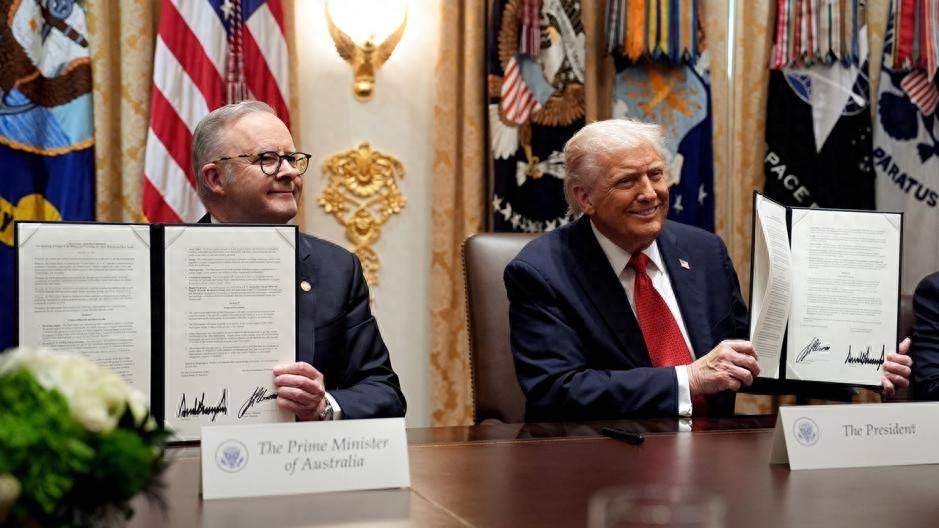
Core Viewpoint - The recent developments in the rare earth market highlight the strategic maneuvers between the U.S. and Australia, with the U.S. seeking to secure its supply chain amid China's export restrictions on rare earth processing technologies [1][9][49]. Group 1: U.S. and Australia Cooperation - The U.S. has signed an $8.5 billion deal with Australia to secure rare earth supplies, aiming to alleviate its critical shortages in heavy rare earth elements [3][10]. - This cooperation is seen as a response to China's recent export controls on several heavy rare earths and their processing technologies, which have limited Western countries' ability to independently develop their supply chains [7][9]. - The U.S. Department of Defense has raised alarms about dwindling heavy rare earth inventories, indicating a pressing need for alternative sources [10][11]. Group 2: Australia's Position - Australia, despite being a major resource holder with 3-4% of global rare earth reserves, lacks the necessary refining and processing capabilities, leading to a reliance on China for these processes [23][29]. - The deal with the U.S. may not be a mutually beneficial partnership, as Australia risks becoming overly dependent on U.S. technology and support without developing its own industrial capabilities [21][31]. - The agreement is perceived as Australia trading its resource wealth for U.S. military protection, potentially compromising its long-term economic sovereignty [35][39]. Group 3: Future Implications - The U.S. aims to stabilize its supply chain and may view Australia merely as a temporary supplier rather than a long-term partner in developing a robust rare earth industry [44][46]. - If the U.S. successfully secures its rare earth needs, Australia's role could diminish, leaving it vulnerable with unprocessed resources and no developed technology [46][49]. - The overarching theme suggests that true national security and strategic autonomy stem from a complete and independent industrial chain, rather than reliance on external partners for resource management [50][52].
光大证券:维持百胜中国(09987)“买入”评级 两大核心品牌在渠道下沉方面仍具备一定增长空间
智通财经网· 2025-11-06 06:41
Core Viewpoint - Company maintains profit forecasts for Yum China (09987) with net profit estimates of $1.002 billion and $1.074 billion for 2026 and 2027 respectively, translating to EPS of $2.53, $2.77, and $2.97 for 2025-2027, with current stock price reflecting PE ratios of 17x, 16x, and 15x for the same periods, highlighting its strong digital and supply chain capabilities as a leading Western fast-food enterprise [1] Financial Performance - In Q3 2025, the company achieved revenue of $3.21 billion, a year-on-year increase of 4% (or 4% excluding foreign currency effects), with adjusted net profit of $282 million and core operating profit of $399 million, reflecting a core operating profit margin of 12.5%, up 0.4 percentage points year-on-year [2] Same-store Sales and Expansion - Same-store sales increased by 1% year-on-year in Q3 2025, with KFC and Pizza Hut showing growth of 2% and 1% respectively; KFC's same-store transaction volume rose by 3%, while Pizza Hut's increased by 17%, marking the eleventh consecutive quarter of growth for Pizza Hut [3] - The company opened 536 new stores in Q3 2025, bringing the total to 17,514 restaurants, with KFC and Pizza Hut netting 402 and 158 new locations respectively; the company aims to add 1,600-1,800 new stores in 2025 [3] Operational Efficiency - In Q3 2025, the proportion of food and packaging costs to restaurant revenue was 31.3%, benefiting from supply chain efficiency and lower raw material prices; labor costs accounted for 26.2% of revenue, up 1.1 percentage points year-on-year due to increased delivery business [4] - The overall restaurant profit margin improved to 17.3%, up 0.3 percentage points year-on-year, with KFC and Pizza Hut margins at 18.5% and 13.4% respectively [4] New Business Initiatives - The company has made significant progress with new business initiatives, including over 1,800 KFC coffee locations, more than 100 KPRO stores in high-tier cities, and 250 WOW stores for Pizza Hut, expanding into 40 new cities [5] Product Strategy - The company focuses on core products, limited-time offerings, and entry-level products to drive sales growth; KFC's new crispy chicken wings and Pizza Hut's hand-tossed pizzas have seen strong sales, with limited-time products like spicy beef dishes also performing well [6] - Entry-level products have achieved double-digit sales growth, with KFC exploring options for meals under $20 to attract a broader customer base [6]
