
信用风险

Search documents
周二直播 | 解构资产证券化系列:林深岂惧风摧木——2025年下半年车贷ABS信用风险展望
Xin Lang Cai Jing· 2025-08-11 10:43
Core Viewpoint - The core feature of auto loan ABS is the presence of collateral, with underlying assets characterized by high homogeneity, a large number of transactions, and short durations, resulting in very low credit risk. However, current investor concerns about asset quality have significantly impacted the issuance scale of auto loan ABS. Despite this, the default risk remains low, and the existing tiered structure provides strong support for priority levels. In the medium to long term, the automotive industry, including humanoid robots, has a promising outlook and could potentially replace real estate in the economy, making auto loan ABS a leading securitization product [2]. Group 1 - The issuance scale of auto loan ABS has been significantly affected by investor concerns regarding asset quality [2] - The default risk of auto loan ABS remains low, supported by a robust tiered structure [2] - The automotive industry, including humanoid robots, has a broad outlook and may replace real estate's position in the economy [2] Group 2 - An online seminar titled "Deconstructing Asset Securitization Series: Standing Tall Against the Wind - Credit Risk Outlook for Auto Loan ABS in the Second Half of 2025" is scheduled for August 12, 2025 [2] - The seminar will cover forecasts for the second half of the year, analysis of the automotive industry, the status of auto loans, and key points for credit analysis of auto loan ABS [2] - The event will be broadcasted live on multiple platforms, welcoming participation from issuers, investors, intermediaries, and media [2]


银行理财有哪些常见风险?
Sou Hu Cai Jing· 2025-08-05 17:18
Core Viewpoint - Bank wealth management serves as a common investment method, providing investors with opportunities to participate in financial markets and achieve asset preservation and appreciation. However, understanding the common risks associated with bank wealth management is crucial for investors [1] Market Risk - Market risk is a significant risk faced by bank wealth management products, influenced by changes in financial markets such as interest rates, exchange rates, and stock and bond market fluctuations. Interest rate risk is a key component; when market interest rates rise, the attractiveness of fixed-income wealth management products declines, potentially lowering their prices. Conversely, when market interest rates fall, the performance of wealth management products may improve. Exchange rate risk mainly affects wealth management products involving foreign exchange, where fluctuations can lead to losses during currency conversion. Additionally, volatility in stock and bond markets can impact related wealth management products, particularly those invested in stocks or equity funds, which may face asset value depreciation during stock market downturns [2] Credit Risk - Credit risk refers to the risk of default or deterioration in the credit status of the entities in which wealth management products invest, leading to potential losses of expected returns or principal for investors. Funds from bank wealth management products may be directed towards various entities, such as corporations and government agencies. If a corporation performs poorly and cannot repay its debts, or if a government faces fiscal difficulties and fails to meet its debt obligations, the returns on wealth management products may be negatively affected. Banks conduct credit assessments and screenings of investment targets when issuing wealth management products, but even with rigorous evaluations, credit risk cannot be entirely eliminated [3] Liquidity Risk - Liquidity risk manifests when investors cannot timely liquidate wealth management products when needed or suffer losses during the liquidation process. Some bank wealth management products have fixed investment terms, preventing investors from redeeming funds early during the product's duration. Even if early redemption is allowed, it may incur fees or be redeemed at prices lower than the purchase price, reducing actual returns for investors. Furthermore, during periods of overall market liquidity stress, banks may face funding pressures, making it difficult to meet investors' early redemption requests, thereby exacerbating liquidity risk [4] Operational Risk - Operational risk encompasses losses arising from inadequate or problematic internal processes, human errors, system failures, or external events during the operation of wealth management products. For instance, bank staff may fail to adequately explain the risk terms and return structures of products during the sales process, leading to misjudgment by investors. In the operational phase, if a bank's internal risk management system malfunctions, it may miss optimal investment opportunities or fail to effectively control risks. Additionally, external factors such as cyberattacks or natural disasters can disrupt normal bank operations, negatively impacting the investment returns of wealth management products [5] Policy Risk - Policy risk arises from changes in national macroeconomic policies and financial regulatory policies. Adjustments in government fiscal and monetary policies can have widespread effects on financial markets. For example, changes in tax policies may affect the return levels of wealth management products, while loose monetary policies may lead to declining market interest rates, impacting the yields of fixed-income wealth management products. Changes in financial regulatory policies are also significant; adjustments by regulatory agencies regarding banks' business scopes and risk management requirements may compel banks to modify the design and investment strategies of wealth management products, potentially affecting their return and risk characteristics, leading to discrepancies between actual investment returns and expectations [6]
First Commonwealth (FCF) Q2 EPS Up 36%
The Motley Fool· 2025-07-31 03:49
Core Insights - First Commonwealth Financial (FCF) reported a non-GAAP earnings per share of $0.38 for Q2 2025, exceeding analyst estimates of $0.28, representing a 35.7% improvement [1] - Non-GAAP revenue was $58.68 million, significantly below the Street estimate of $125.88 million, indicating a mixed performance despite operational strengths [1] Financial Performance - EPS (Non-GAAP) increased by 5.6% year-over-year from $0.36 in Q2 2024 [2] - Non-GAAP revenue for Q2 2025 was $131.3 million, up 9.0% from $120.5 million in Q2 2024 [2] - Net interest margin improved to 3.83%, up 0.26 percentage points from Q2 2024 [2] - Noninterest income rose to $24.7 million, although it was slightly below the previous year's figure [7] Loan and Asset Quality - Total loans increased by $183.7 million, or 8.1% annualized, with notable growth in commercial real estate and equipment finance [5] - Nonperforming loans surged to $99.5 million, representing 1.04% of total loans, up from 0.65% in the previous quarter [9] - Net charge-offs decreased to $2.8 million, or 0.12% of average loans, indicating improved credit quality despite the rise in nonperforming loans [10] Capital Position and Dividends - The total capital ratio stood at 14.4%, well above the regulatory minimum of 10% [11] - The bank's board authorized a 3.7% increase in the quarterly dividend to $0.135 per share, with an annualized yield of 3.3% [13][18] Strategic Initiatives - The bank is focusing on expansion through strategic acquisitions and organic loan growth, with the recent acquisition of CenterBank contributing positively to its capital base [4][6] - Management aims to enhance fee-based income to reduce reliance on traditional net interest income, with ongoing efforts to improve fee generation [14][15] Outlook - The company did not provide updated financial guidance for the remainder of fiscal 2025, but management anticipates a potential expansion in net interest margin by approximately 0.10 percentage points by year-end [16] - Investors are advised to monitor asset quality metrics and the integration of the CenterBank acquisition, which is expected to enhance per-share earnings from 2026 [17]


信托产品的收益稳定吗?
Sou Hu Cai Jing· 2025-07-29 06:13
Core Viewpoint - Trust products occupy a unique position in the financial market, and their yield stability is a key concern for many investors. Understanding the factors influencing the stability of trust product yields requires a comprehensive analysis [1][2]. Group 1: Factors Affecting Yield Stability - Trust products are based on trust and are a property management system where investors entrust funds to trust companies for management and operation, targeting specific projects such as infrastructure, business operations, and real estate development [1]. - Credit risk is a significant factor in assessing the yield stability of trust products. The credit risk primarily depends on the credit status and repayment ability of the financing party. A financially sound and stable financing party can ensure timely and full payment of yields, thus enhancing yield stability [1]. - Market risk also significantly impacts the yield stability of trust products. Changes in the macroeconomic environment, industry development cycles, and interest rate fluctuations can cause yield volatility. During economic prosperity, trust products often achieve better yields, while economic downturns can adversely affect yield stability [2]. - Policy risk is an unavoidable factor as well. Different industries are affected by policies to varying degrees. For instance, strict real estate regulations can limit financing and development progress for real estate trust projects, impacting their yields [2].
科创债ETF,科技含量居然有点低
Hu Xiu· 2025-07-28 06:30
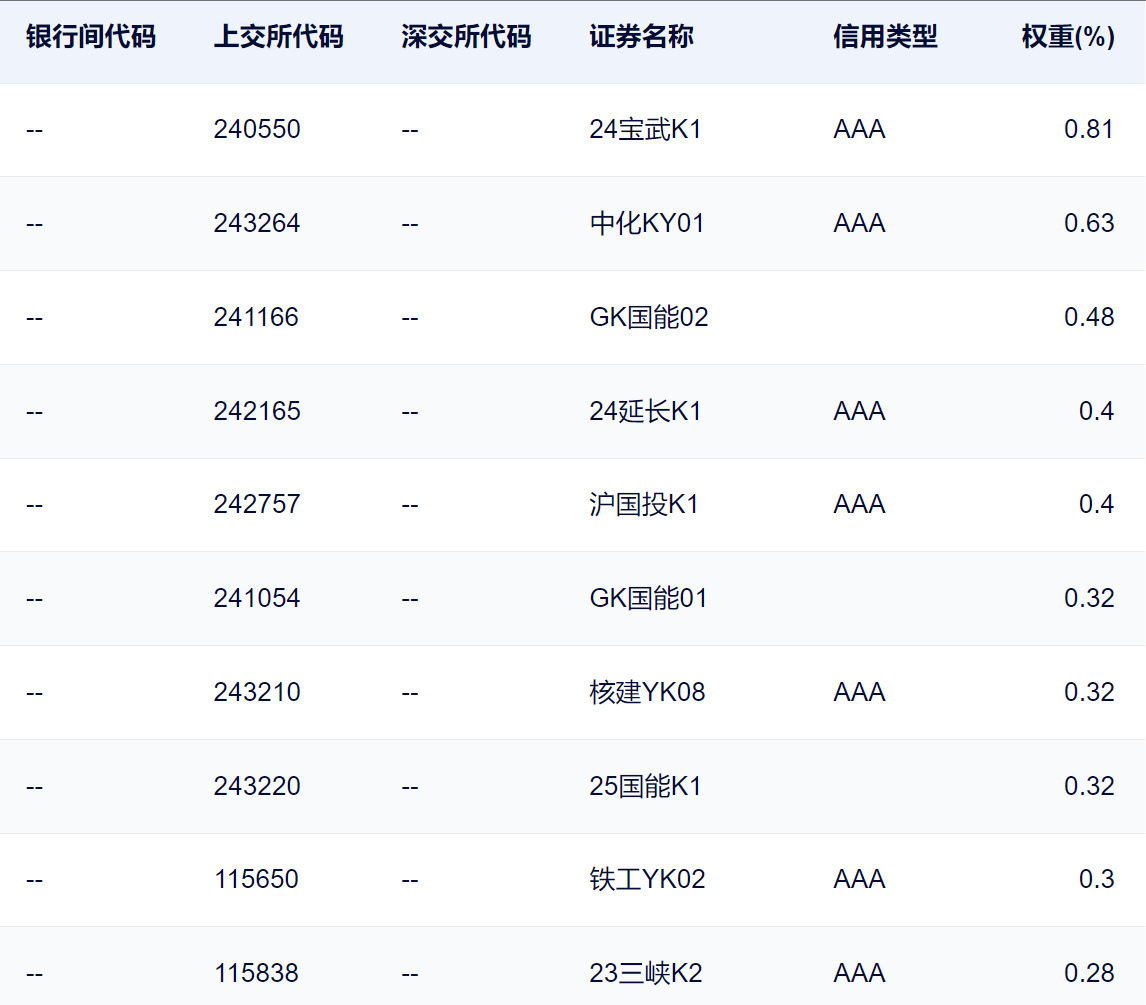
Core Viewpoint - The newly launched Science and Technology Innovation Bond ETFs (科创债ETF) have gained significant popularity in the public fund market, raising nearly 29 billion yuan and approaching a total scale of 100 billion yuan, with five of the ten ETFs exceeding 10 billion yuan in size [1][19]. Group 1: Market Performance and Structure - The first batch of ten Science and Technology Innovation Bond ETFs was listed on July 17, with strong buying interest, indicating high market acceptance [1][19]. - The underlying indices of these ETFs primarily track bonds issued by central and state-owned enterprises rather than technology companies, with the top ten components of the CSI AAA Science and Technology Innovation Bond Index being bonds from major state-owned enterprises [2][4]. - The overall issuance structure of Science and Technology Innovation Bonds is dominated by central and state-owned enterprises, which account for over 85% of the total issuance, leading to a lower credit risk profile compared to traditional industry bonds [6][12]. Group 2: Investment Characteristics - Science and Technology Innovation Bonds are not equivalent to high-risk assets, as they are primarily issued by strong central and state-owned enterprises, resulting in a lower risk of default [3][9]. - The average yield of Science and Technology Innovation Bonds is comparable to that of other types of bonds issued by the same entities, with the yield spread between Science and Technology Innovation Bonds and non-Science and Technology Bonds being minimal [9][20]. - The annualized returns of the CSI Science and Technology Innovation Bond Index have outperformed the broader bond market indices, indicating a favorable investment profile [26][34]. Group 3: Future Outlook and Challenges - The future of Science and Technology Innovation Bonds may see an increase in the proportion of technology-related issuances, as recent regulatory changes aim to enhance support for technology innovation financing [15][17]. - Despite the potential for growth, the current issuance landscape remains heavily skewed towards central and state-owned enterprises, which may limit opportunities for private technology firms [14][18]. - There are concerns regarding the actual use of funds raised through Science and Technology Innovation Bonds, with some issuers diverting funds for general corporate purposes rather than direct investment in technology innovation [13][15].
消费金融存在哪些风险?
Sou Hu Cai Jing· 2025-07-18 23:30
Group 1: Core Insights - Consumer finance plays a significant role in modern economic life by providing diverse financial services to individual consumers, facilitating consumption upgrades [1] - Credit risk is a key concern in consumer finance, as financial institutions rely on consumer-provided credit information to assess repayment ability and willingness, which can be affected by information asymmetry [1] - Market risk is also critical, with fluctuations in interest rates impacting borrowing costs and repayment burdens, potentially leading to increased default rates during economic downturns [1] Group 2: Operational and Liquidity Risks - Operational risk is present throughout consumer finance operations, arising from poorly designed business processes, non-compliance by employees, and inadequate internal controls, which can lead to significant losses [2] - External fraud is a notable aspect of operational risk, where criminals may use forged identities and false transactions to obtain consumer loans, resulting in direct losses for financial institutions [2] - Liquidity risk is a vital consideration, as financial institutions must maintain sufficient liquidity to meet consumer demands for withdrawals and loans, especially during periods of unstable funding sources [2]
25%关税足以痛击风险偏好 瑞银“防御三盾”策略布局股市
智通财经网· 2025-07-16 09:20
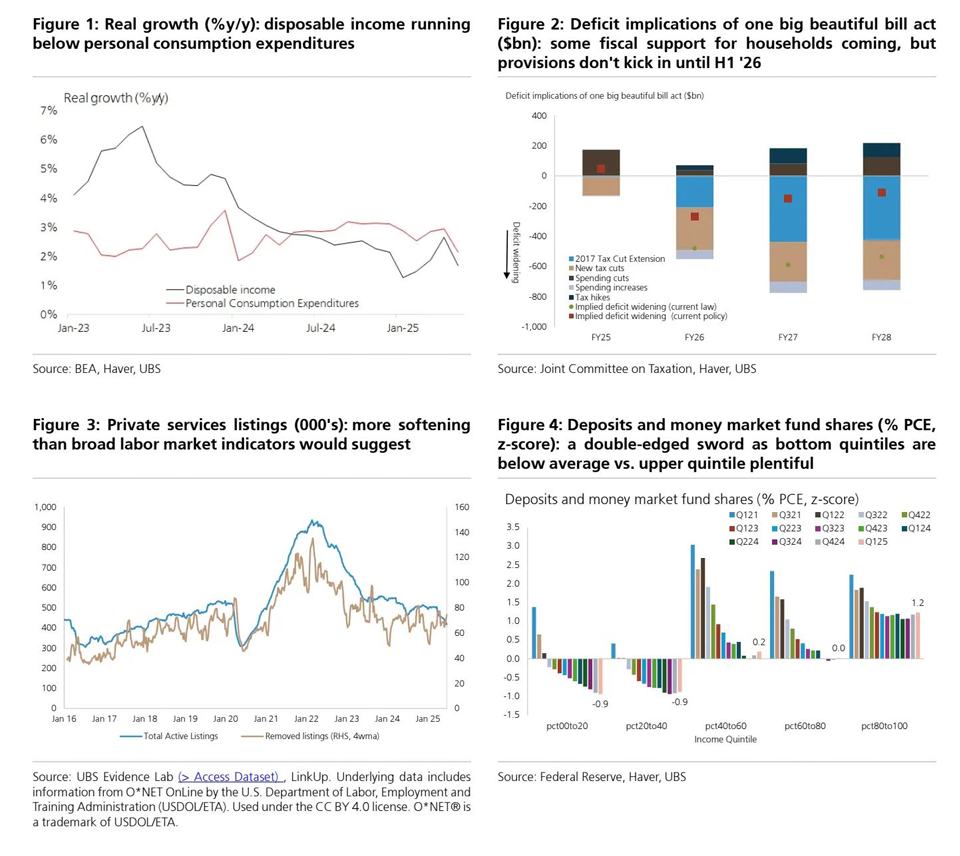
Group 1 - UBS expresses caution regarding the outlook for U.S. consumers and the economy, anticipating significant pressure on risk appetite in financial markets due to new tariffs and inflationary pressures [1][2][3] - The firm predicts a decline in U.S. GDP growth to approximately 1% in 2025, influenced by delayed fiscal stimulus and a cautious consumer environment [2][3] - UBS highlights rising loan delinquency rates and weakened consumer spending intentions, indicating tightening credit conditions and increased potential credit risks [1][3][17] Group 2 - The macroeconomic environment is unfavorable for consumers, with slowing economic growth and a projected unemployment rate of about 4.6% in 2025 [3][4] - UBS forecasts core PCE inflation to remain around 3.4% by the end of 2025, contributing to sustained high interest rates that will burden household debt repayment [4][9] - The impact of increased tariffs is expected to erode consumer purchasing power, with 68% of respondents indicating inflation negatively affects their economic outlook [9][16] Group 3 - UBS recommends a defensive investment strategy, focusing on high-quality, cash-flow stable companies and essential consumer goods, while avoiding high-debt and cyclical sectors [21][22] - The firm identifies a "trade-down" trend among consumers, benefiting large discount retailers like Walmart and Costco, which dominate U.S. retail spending [22] - UBS emphasizes the importance of monitoring credit cycles, as rising delinquency rates in student loans and mortgages signal increasing financial pressure on consumers [17][21]

美股债券投资指南:收益与风险的动态平衡
Sou Hu Cai Jing· 2025-07-15 11:08
Core Viewpoint - The U.S. bond market is becoming a crucial asset allocation choice for investors to manage stock market volatility, especially as the Federal Reserve's interest rate hike cycle approaches its end [1] Group 1: Market Structure and Characteristics - The multi-tiered market structure meets diverse needs, with U.S. Treasuries serving as the risk-free rate benchmark, influencing global asset pricing [3] - Investment-grade corporate bonds offer a credit premium of 150-250 basis points over Treasuries, while high-yield bonds provide an 8%-12% coupon to compensate for default risk [3] - Inflation-protected securities (TIPS) and convertible bonds are emerging as new tools to combat volatility, with TIPS linked to the CPI index [3] Group 2: Risks and Challenges - Interest rate risk is a core challenge, as bond prices move inversely to yields; a 1% increase in the 10-year Treasury yield could lead to a price drop of over 10% for long-term bonds [3] - The yield curve is currently deeply inverted, indicating recession risks while providing a window for positioning in medium to long-term bonds [3] - Credit risk requires dynamic assessment, with default rates for investment-grade bonds typically below 0.5%, while high-yield bonds can see rates of 5%-8% during economic downturns [5] Group 3: Currency and Liquidity Considerations - Currency fluctuations significantly impact cross-border returns, with a 14% appreciation of the dollar in 2022 leading to negative real returns for RMB-denominated holdings of U.S. Treasuries [5] - Daily trading volume for Treasuries exceeds $600 billion, with minimal bid-ask spreads, while high-yield corporate bonds may face 2%-5% price spread losses [5] - Retail investors are advised to use bond ETFs to mitigate liquidity shocks associated with individual bonds [5] Group 4: Strategic Recommendations - Current strategies for U.S. Treasury allocation should focus on a threefold balance: employing a barbell strategy with short-term and ultra-long-term Treasuries to address interest rate uncertainty [7] - Credit risk exposure should be limited to 20% of the portfolio, prioritizing corporate bonds with cash flow coverage ratios exceeding three times [7] - For holdings exceeding one year, hedging tools are recommended to manage currency risk, especially during periods of anticipated shifts in Federal Reserve policy [7]

为何不建议存“大额存单”?看完这四点理由再决定也不迟
Sou Hu Cai Jing· 2025-07-10 06:54
Core Viewpoint - The article discusses the allure and hidden risks of large-denomination certificates of deposit (CDs) in China, highlighting the significant growth in their balance and the potential pitfalls for investors [3][5]. Summary by Sections Liquidity Risk - Large-denomination CDs have a liquidity risk that many investors overlook, with high penalties for early withdrawal. For instance, early withdrawal can reduce a 3.85% annual yield to as low as 0.3% [3][5]. In 2024, 32% of large-denomination CDs were withdrawn early due to cash flow issues, resulting in an average loss of 8,500 yuan per investor [3]. Interest Rate Risk - High interest rates on large-denomination CDs often reflect banks' pressure to attract deposits. A report indicated that a city commercial bank offered an average rate of 4.2%, while its non-performing loan rate rose to 1.78%, indicating potential risks in fulfilling high-interest commitments [5][9]. Inflation Risk - Inflation significantly impacts the real returns on large-denomination CDs. With the Consumer Price Index (CPI) rising from 2.8% in 2024 to 3.2% in early 2025, the actual yield on three-year CDs, which range from 3.6% to 4.0%, is only 0.6% to 1.0% after accounting for inflation [5][6]. Asset Allocation Risk - Concentrating funds in large-denomination CDs contradicts basic asset allocation principles. The annualized return of the A-share market index was 12.7%, significantly higher than the returns from large-denomination CDs, which suggests a lack of portfolio flexibility [6][14]. Credit Risk - Large-denomination CDs carry credit risk, as the deposit insurance system only covers up to 500,000 yuan per depositor per bank. In 2024, 28% of investors in a failing local bank had funds exceeding this limit, facing potential losses [9][10]. Interest Rate Change Risk - The fixed income nature of large-denomination CDs limits investors' ability to benefit from rising interest rates. Data shows that investors who purchased three-year CDs in 2024 lost approximately 0.8% in potential returns by 2025 due to rate increases [10][12]. Diversified Investment Strategy - A diversified investment strategy is recommended, with emergency funds in liquid accounts, mid-term funds in bond funds, and long-term investments in equities. A survey indicated that a balanced asset allocation model achieved an annual return of 8.2% with reasonable risk levels [14][15]. Conclusion - The article concludes that while large-denomination CDs may seem attractive, their associated risks necessitate a careful evaluation of personal financial goals and risk tolerance, advocating for rational investment and risk diversification [15].

惠誉:美国稳定币立法可能会解决一些关键信用风险并提高其使用率。
news flash· 2025-07-09 06:58
Core Insights - Fitch Ratings indicates that U.S. stablecoin legislation could address key credit risks and enhance usage rates [1] Group 1 - The potential legislation may provide a regulatory framework that mitigates existing credit risks associated with stablecoins [1] - Improved regulation could lead to increased adoption and trust in stablecoins among users and investors [1] - The move towards stablecoin regulation reflects a broader trend in the financial industry to ensure stability and security in digital assets [1]