
原油供需平衡

Search documents
原油月报:短期地缘风险支撑油价,中期基本面仍偏宽-20251014
Ping An Securities· 2025-10-14 05:56
Investment Rating - The report maintains an investment rating of "Outperform" for the oil and petrochemical sector [1]. Core Viewpoints - Short-term geopolitical risks provide some support for oil prices, while the medium-term fundamentals remain relatively loose [2][5]. Summary by Sections Oil Price Review - In September 2025, international oil prices fluctuated, influenced by several key events, including OPEC's decision to increase production by 137,000 barrels per day starting in October and ongoing geopolitical tensions in the Middle East and Ukraine [4]. - The report notes that while geopolitical conflicts support oil prices in the short term, the transition from peak to off-peak season for refined oil consumption, combined with OPEC+'s production increases, may lead to further downward pressure on prices in the medium term [4]. OPEC Production Insights - OPEC+ countries are expected to continue increasing production, with plans to restore previously cut production levels ahead of schedule. In August 2025, OPEC's production was reported at 27,948 thousand barrels per day, an increase of 478 thousand barrels per day from July [9][11]. - The report highlights that OPEC+ aims to increase production by 547,000 barrels per day in September and 137,000 barrels per day in October, indicating a significant ramp-up in output [9]. Global Oil Demand Forecast - OPEC maintains its forecast for global oil demand in 2025 at 105.1 million barrels per day, with a year-on-year increase of 1.29 million barrels per day. The demand from China is projected at 16.9 million barrels per day, also reflecting a year-on-year increase [25]. - The report anticipates that the demand for refined oil products will continue to grow, driven by transportation fuels, gasoline, diesel, and aviation kerosene [25]. EIA Projections - The EIA predicts a significant increase in global oil supply, with a projected surplus of 173,000 barrels per day in 2025 and 156,000 barrels per day in 2026, primarily due to OPEC+ production increases and rising output from non-OPEC countries [28][33]. - The EIA also forecasts that global oil demand will increase by 89,000 barrels per day in 2025 and 128,000 barrels per day in 2026, with China and India being the main contributors to this growth [34][36].
南华期货原油产业周报:关税风波再起,原油跌至五个月低点-20251013
Nan Hua Qi Huo· 2025-10-13 08:32
Report Industry Investment Rating - The investment rating for the crude oil industry is "Oscillating Weakly" [7] Core Views - The core contradiction in the current crude oil market is the resonance mismatch between short - term demand concerns triggered by economic and trade frictions and the long - term fundamental situation of supply - demand surplus. The short - term shock amplifies the decline, but the fundamental situation is the core suppressing force [1] - In the short term, the contradiction focuses on "whether the economic and trade frictions can ease" and "the rhythm of the slowdown in the decline". In the long term, the core game lies in "the digestion speed of the supply surplus" and "the recovery strength of global demand" [1] Summary by Directory Chapter 1: Core Contradiction and Strategy Suggestions 1.1 Core Contradiction - The core contradiction is the resonance mismatch between short - term demand concerns from economic and trade frictions and long - term supply - demand surplus fundamentals. Trump's tariff threat, reduction of Brent speculative net long positions, and EIA's warning of supply surplus led to a more than 5% plunge in WTI crude oil, breaking below $60 per barrel. OPEC+ increased production by 400,000 barrels per day in September, the US export was nearly 5 million barrels per day, and China's imports in September decreased by 1.2 million barrels per day month - on - month to the lowest level of the year [1] 1.2 Speculative Strategy Suggestions - The market is expected to be oscillating weakly, and the recommended month - spread strategy is backwardation arbitrage [7] Chapter 2: This Week's Important Information and Next Week's Focus Events 2.1 This Week's Important Information - **Negative Information**: Geopolitical risk premium subsided as the cease - fire between Israel and Hamas took effect, reducing concerns about Middle East supply disruptions. Trump's tariff policy upgrade on October 10 triggered a sharp decline in crude oil prices. OPEC+ production increased by 400,000 barrels per day in September, and the restart of oil exports in the Iraqi Kurdish region is expected to increase production in October. US crude oil exports reached nearly 5 million barrels per day, and the increase in water - borne crude oil will boost visible inventory. Asian demand, especially China's, weakened, with China's imports in September dropping to 9.6 million barrels per day [8][9] 2.2 Next Week's Focus Events - Monitor the progress of Red Sea shipping recovery, Trump's tariff policy developments, and the OPEC+ informal meeting on October 17 to see if production cuts or increases will occur [11] Chapter 3: Disk Interpretation 3.1 Volume, Price, and Capital Interpretation - The crude oil futures market has been weak recently. Trump's tariff threat and supply - demand imbalance due to OPEC+ production increase and US exports led to price declines. The market sentiment is bearish, with a significant reduction in Brent speculative net long positions [13] 3.2 Inner and Outer Disk Analysis - **Inner Disk**: The SC crude oil futures main contract 2511 closed at 466.2 yuan per barrel, down 3.71% for the week. The MACD indicator shows weak momentum, and the price has broken below multiple moving averages. The trading volume was 112,232 lots, and the open interest increased by 3,872 lots to 28,515 lots [15][16] - **Outer Disk**: On October 10, the WTI main contract settled at $58.9 per barrel, down 3.25% from the previous week, and the Brent main contract settled at $62.73 per barrel, down 2.79%. As of October 7, the Brent crude oil futures open interest decreased by 78,946 lots week - on - week, and the managed funds' net long positions decreased by 60,824 lots [17] Chapter 4: Valuation and Profit Analysis 4.1 Crude Oil Market Month - Spread Tracking - The current Brent and WTI crude oil month - spreads maintain a slight backwardation structure, which is expected to deepen in the context of a weak fundamental situation and falling oil prices [25] 4.2 Crude Oil Regional Spread Tracking - The spread between SC and Brent crude oil has recovered, with the outer disk falling more this week [29] 4.3 Crude Oil Downstream Valuation Tracking - Recently, the crude oil cracking spread shows a clear differentiation of "strong diesel, weak gasoline". Diesel spreads are supported by winter demand, while gasoline spreads are pressured by weak demand. This differentiation is a result of energy transformation and geopolitical games [42] Chapter 5: Supply - Demand and Inventory Deduction 5.1 Supply - Side Tracking - From September 27 to October 3, US crude oil production was 13.629 million barrels per day, up 124,000 barrels per day week - on - week. From October 4 to 10, the number of active oil rigs in the US was 418, down 4 rigs week - on - week [65] 5.2 Demand - Side Tracking - From September 27 to October 3, US refinery crude oil input was 16.297 million barrels per day, up 129,000 barrels per day week - on - week, and the refinery utilization rate was 92.4%, up 1 percentage point. From October 3 to 9, the capacity utilization rate of independent refineries in China was 62.24%, down 0.52 percentage points week - on - week, and that of major refineries was 82.26%, up 0.98 percentage points [67] 5.3 Inventory - Side Tracking - As of October 3, US commercial crude oil inventory increased by 3.715 million barrels week - on - week, strategic petroleum inventory increased by 285,000 barrels, and Cushing oil inventory decreased by 763,000 barrels [69] 5.4 Balance Sheet Tracking - EIA's September report predicts that global oil demand will increase by 740,000 barrels per day in 2025. Global oil supply reached a record 106.9 million barrels per day in August. Refinery throughput is expected to decline in October due to seasonal maintenance. Global oil inventory increased in July, and the benchmark crude oil price continued to fall in August [71][72][73]
【石油化工】OPEC+持续增产,地缘风险有望缓和——行业周报第423期(20251006—1012)(赵乃迪/蔡嘉豪/王礼沫)
光大证券研究· 2025-10-12 23:08
Group 1 - The core viewpoint of the article highlights the geopolitical risks in the oil market, particularly the impact of the Israel-Hamas ceasefire and ongoing sanctions against Iran and Russia [4][5]. - The ceasefire agreement between Israel and Hamas is expected to reduce geopolitical tensions in the Middle East, potentially leading to a decrease in the geopolitical risk premium on oil prices [4]. - OPEC+ plans to increase production by 137,000 barrels per day in November, but actual production increases may fall short of targets due to limited spare capacity among member countries [5]. Group 2 - The announcement of new tariffs on imports from China by the U.S. could negatively impact global oil demand, with the IEA projecting a growth of 740,000 barrels per day in global oil demand by 2025 [6]. - There is a risk of inventory accumulation in the fourth quarter as oil supply is expected to exceed demand, which may exert downward pressure on oil prices [7]. - The article notes that upstream capital expenditure growth may not meet expectations, and there could be significant volatility in oil and gas prices [8].


原油周度报告-20251012
Guo Tai Jun An Qi Huo· 2025-10-12 06:28
Group 1: Report Industry Investment Rating - Not provided in the document Group 2: Core Views of the Report - This week, crude oil prices tumbled due to macro - sentiment and may continue to be weak in the short term. The global crude oil supply is in a pattern of cautious growth under "tight balance". The OPEC + alliance will increase production slightly in November, while non - OPEC + supply, such as US shale oil, faces bottlenecks. Global crude oil demand shows resilience but with a changing internal structure. The growth of demand is shifting from gasoline to diesel and aviation fuel. There are uncertainties in future demand due to the overall economic outlook. [6][7] - Short - term, the price may continue to decline by $2 - 3 per barrel. By the end of this year and the beginning of next year, Brent and WTI may test $50 per barrel, and SC may test 420 yuan per barrel. Although the price decline has accelerated under the influence of trade frictions, it is difficult to decline continuously in the medium - long term. Attention should be paid to potential reversals in macro - expectations, which may amplify price fluctuations. [7] - The logic behind the views includes the intensification of Sino - US trade frictions, continuous OPEC + production increases and the start of seasonal inventory accumulation. There is a large long - term oversupply pressure, and inventory accumulation in the fourth quarter is hard to disprove. Attention should also be paid to the risk of a decline in Russian oil exports due to potential sanctions, and the increase in oil freight rates may stimulate the expansion of cross - regional spreads. [8] - In terms of valuation, the short - term valuation is at a medium - low level, and the oil price has fallen close to the cost of shale oil and is near the low point of this year. The strategy is to remain on the sidelines for single - sided trading and not to bottom - fish for now. Hold a light long - spread position (buy SC11, sell SC12) and add positions opportunistically in the future. The EFS spread and SC - Dubai spread may reverse. [8] Group 3: Summary According to Relevant Catalogs 1. Macro - Sino - US trade frictions have escalated again, and the gold - oil ratio has increased. Overseas PPI has risen, and attention should be paid to inflation transmission. The RMB exchange rate has weakened slightly, and social financing has declined. [13][19][24] 2. Supply - OPEC +: The core supply side, the OPEC + alliance, adheres to its market - stabilizing strategy. In November, it will only increase production by 137,000 barrels per day, and the actual incremental supply flowing into the market is more limited due to compensatory production cuts and capacity bottlenecks. The future policy of OPEC + will highly depend on whether the expected supply surplus in 2025 - 2026 will materialize. [6] - Non - OPEC +: US shale oil production is facing bottlenecks. Investment is restricted due to oil price uncertainty and rising costs, and production growth has significantly slowed down or even declined. Geopolitical events such as the Ukrainian attack on Russian refineries have continuously disrupted Russian refined oil exports, while the return of Iraqi Kirkuk crude oil has provided a new source of medium - sulfur crude oil. The US Strategic Petroleum Reserve (SPR) repurchase plan will absorb more than 17 million barrels of crude oil from the market, further tightening the supply. [6] 3. Demand - Global demand shows resilience, but the internal structure is changing. US demand is an important support, with strong diesel consumption but weak gasoline demand. Emerging markets are showing differentiation. Indian demand has rebounded rapidly, while Chinese refineries have adjusted their procurement strategies. Jet fuel has become a new bright spot in global demand. However, the global refinery maintenance season has temporarily suppressed direct crude oil demand. [7] 4. Inventory - US commercial inventories have stabilized, and inventories in the Cushing area have also stabilized but are significantly lower than historical averages. European diesel inventories have rebounded, and gasoline inventories have decreased. Domestic refined oil profit margins have declined. [76][80][88] 5. Price and Spread - The global crude oil spot market has no obvious highlights. In the Middle East, Aramco's November OSP was not raised as expected. In the Americas, high - sulfur crude oil has strengthened, while low - sulfur crude oil is slightly weak. In the North Sea, there are differences in price trends. In the Mediterranean, there is still a bearish sentiment for low - sulfur crude oil. In West Africa, there is no obvious bullish sentiment. [92][94][95]
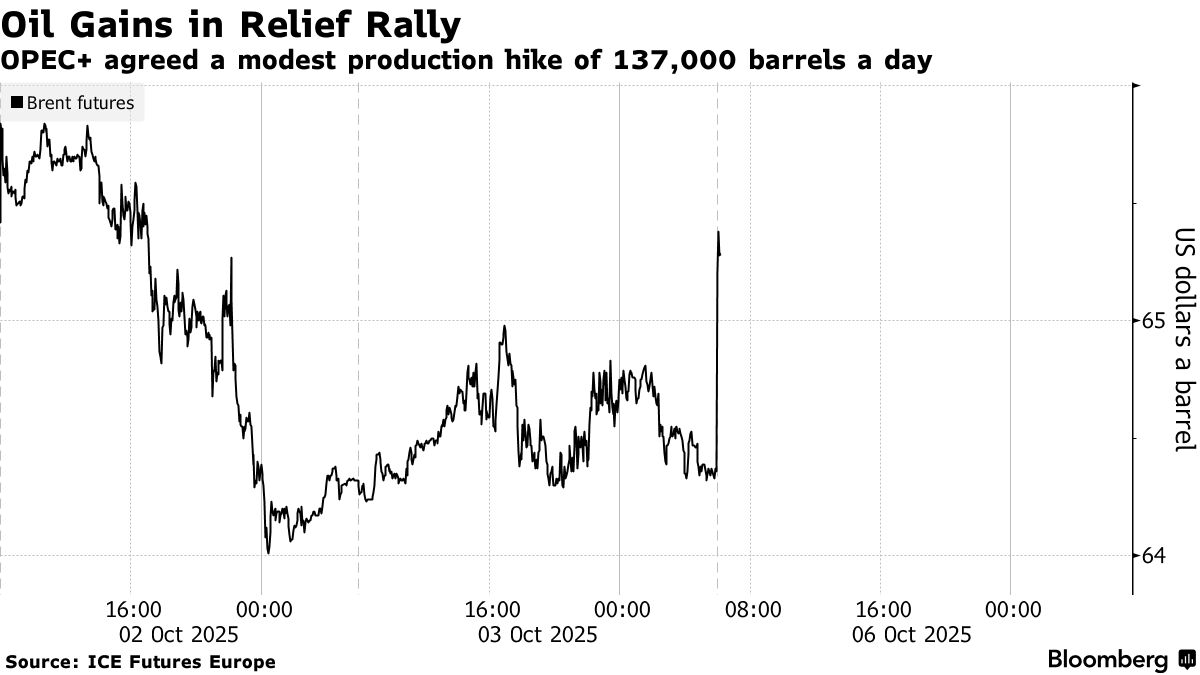
OPEC+ 11月谨慎增产13.7万桶/日 油价小幅走高
智通财经网· 2025-10-05 23:36
Group 1 - OPEC+ agreed to increase oil production by 137,000 barrels per day starting in November, alleviating concerns of a large-scale production increase [1][3] - The decision to maintain a moderate monthly increase aligns with ongoing worries about potential supply surplus in the market [3] - Internal disagreements were noted between key OPEC+ members, Russia favored a smaller increase while Saudi Arabia initially sought a much larger increase [3] Group 2 - Despite the increase in supply, global summer demand has helped absorb the additional supply, keeping oil prices relatively stable [3] - However, a slowdown in consumer demand may alter market dynamics in the coming months, with predictions of a record surplus in global oil supply by 2026 [3] - Analysts predict a shift towards oversupply, with oil prices facing downward pressure in the latter half of 2025 due to weakening demand [4]
原油季报:基本面支撑,油价有望反弹
Hua Lian Qi Huo· 2025-09-29 02:50
1. Report Industry Investment Rating - Not provided in the content 2. Core View of the Report - The low crude oil inventory levels in the US and OECD countries, combined with OPEC+'s less - than - expected production increase, support oil prices. On the supply side, OPEC+ plans to increase production again in October, but the actual increase is lower than expected, and the progress of production increase is uncertain. On the demand side, US crude oil demand is better than in previous years, and domestic crude oil processing demand has increased significantly month - on - month. With the boost of travel consumption, crude oil demand is expected to be further stimulated. The recommended strategy is to hold long positions [4]. 3. Summary According to Relevant Catalogs 3.1 Quarterly View and Strategy 3.1.1 Inventory - Due to rising demand, US crude oil and refined oil inventories decreased. Crude oil inventories decreased by 607,000 barrels to 414.8 million barrels, contrary to the market expectation of a 235,000 - barrel increase. Cushing's crude oil inventories increased by 177,000 barrels. US net crude oil imports increased by 1.6 million barrels per day, while exports decreased by 793,000 barrels per day to 4.48 million barrels per day. Gasoline inventories decreased by 1.1 million barrels to 216.6 million barrels, against the expected 150,000 - barrel increase. Distillate inventories, including diesel and heating oil, decreased by 1.7 million barrels to 123 million barrels, more than the expected 494,000 - barrel decrease [4][20]. 3.1.2 Supply - Last week, US crude oil production remained at 13.4 million barrels per day. OPEC+ decided to increase the oil production target again in October, starting to lift the second - layer production cut plan (with a cut of about 1.65 million barrels per day, 1.6% of global demand) more than a year earlier than planned. Previously, OPEC+ had agreed to increase the production target by about 2.2 million barrels per day from April to September. However, there are uncertainties on the supply side: OPEC+'s actual production increase is lower than expected; Russia's oil supply is tightened due to sanctions; US shale oil production has reached its ceiling [4][32][41]. 3.1.3 Demand - Refinery crude oil processing volume increased by 52,000 barrels per day, but the capacity utilization rate decreased by 0.3 percentage points to 93%. The total refined oil supply, as a demand indicator, increased by 156,000 barrels per day to 2.079 million barrels per day, 190,000 barrels per day higher than the four - week average of the same period last year. In China, the crude oil processing growth rate accelerated in August, with the industrial crude oil processing volume of 63.46 million tons, a year - on - year increase of 7.6%, and the daily processing volume of 2.047 million tons [4]. 3.1.4 Strategy - Hold long positions [4]. 3.2 Balance Sheet and Industrial Chain Structure 3.2.1 Global Supply - Demand Balance Sheet - The document provides detailed data on global oil production, consumption, inventory net withdrawals, and end - of - period commercial inventories from January 2024 to December 2025, including breakdowns by OPEC, non - OPEC, OECD, and non - OECD regions [6]. 3.2.2 Industrial Chain Structure - Illustrates the process from crude oil to various refined products such as ethylene, propylene, diesel, gasoline, etc., through different processing devices like atmospheric and vacuum distillation units, ethylene cracker, and catalytic cracker [9]. 3.3 Futures - Spot Market - Presents multiple charts related to the futures - spot market, including domestic - foreign price spreads, monthly spreads, INE crude oil futures - spot price spreads, BRENT crude oil term spreads, freight indices, and port freight rates [11][15][16]. 3.4 Inventory 3.4.1 US Inventory - US crude oil and refined oil inventories decreased due to rising demand. Charts show historical trends of US crude oil and refined oil inventories from 2019 - 2025 [18][20]. 3.4.2 China Inventory - China's inventory increment declined from June - August due to increased domestic crude oil processing demand. Charts show historical trends of China's crude oil inventory increment [22][25]. 3.4.3 Crude Oil Warehouse Receipts - INE crude oil warehouse receipts have recently remained at a low level, indicating a low inventory level of deliverable oil depots [28][29]. 3.5 Supply Side 3.5.1 OPEC Production - OPEC+ decided to increase production in October, starting to lift the second - layer production cut plan. In August, OPEC+ crude oil production averaged 42.4 million barrels per day, an increase of 509,000 barrels per day from July. OPEC's 12 - member countries' crude oil production increased by 478,000 barrels per day in August [32][33]. 3.5.2 US Production - Last week, US crude oil production remained at 13.4 million barrels per day. US shale oil production has reached its ceiling, and the growth space is limited due to reduced capital expenditure by oil companies. The number of US oil rigs, a leading indicator of future production, is decreasing [36]. 3.5.3 Global Production - There are uncertainties on the global supply side, including OPEC+'s lower - than - expected production increase, Russia's supply tightening due to sanctions, and the limited growth of US shale oil production [41]. 3.6 Demand Side 3.6.1 China Demand - In August, China's crude oil processing volume increased rapidly, with the industrial crude oil processing volume of 63.46 million tons, a year - on - year increase of 7.6%. China's travel demand is strong, which is expected to drive crude oil consumption. China's 8 - month crude oil imports and refined oil exports data are also provided [47][52][55]. 3.6.2 US Demand - US refinery crude oil processing volume increased by 52,000 barrels per day, but the capacity utilization rate decreased by 0.3 percentage points to 93%. The total refined oil supply increased by 156,000 barrels per day, higher than the same period last year. US demand is slightly better than last year seasonally [59][62].
大越期货原油早报-20250926
Da Yue Qi Huo· 2025-09-26 02:09
2025-09-26原油早报 大越期货投资咨询部 金泽彬 从业资格证号:F3048432 投资咨询证号: Z0015557 联系方式:0575-85226759 交易咨询业务资格:证监许可【2012】1091号 重要提示:本报告非期货交易咨询业务项下服务,其中的观点和信息仅作参考之用,不构成对任何人的投 资建议。 我司不会因为关注、收到或阅读本报告内容而视相关人员为客户;市场有风险,投资需谨慎。 CONTENTS 目 录 1 每日提示 2 近期要闻 3 多空关注 4 基本面数据 5 持仓数据 原油2511: 1.基本面:国际文传电讯社援引俄罗斯副总理诺瓦克报道,俄罗斯政府计划禁止不生产柴油的供应商 出口柴油,禁令将持续到今年年底,诺瓦克表示政府还考虑将目前的汽油出口禁令延长至今年年底; 乌方消息人士称,袭击行动导致位于俄罗斯新罗西斯克港口附近的石油装运设施以及终端设备瘫痪, 相关设施每日出口原油约200万桶;印度官员再次向特朗普政府表明,若要该国炼油商大幅削减俄罗斯 石油进口,美方需允许其从受制裁的伊朗和委内瑞拉购买原油;中性 2.基差:9月25日,阿曼原油现货价为70.83元/桶,卡塔尔海洋原油现货价为69 ...
原油周报:风险偏好回落,供需压力逐渐兑现-20250923
Yin He Qi Huo· 2025-09-23 05:10
1. Report Industry Investment Rating No information provided in the content. 2. Core Viewpoints of the Report - Last week, oil prices initially strengthened due to market pricing of the Fed's interest - rate cut and geopolitical tensions, but then sharply corrected as the rate cut met expectations, the dollar index rebounded, and there were no more geopolitical positives. Brent's main contract fluctuated between $65 - 67 per barrel. The oil price is expected to maintain a weak and volatile pattern. Upside risks come from geopolitical risk escalation, and downside risks come from increased recession expectations [4]. - Unilateral trading: Expect a weak and volatile trend. Arbitrage: Domestic gasoline and diesel cracks are weak. Options: Hold a wait - and - see attitude [5]. 3. Summary According to the Directory 3.1 Chapter 1: Comprehensive Analysis and Trading Strategies 3.1.1 Comprehensive Analysis - At the beginning of last week, influenced by the expected Fed rate cut and geopolitical tensions, oil prices were strong. After the Fed cut rates by 25BP, the dollar index rebounded, and oil prices corrected significantly. By the weekend, Brent's main contract fell to around $66 per barrel [4]. - In terms of supply and demand, OPEC increased production in August and September. The end of the peak demand season in the Middle East, the weakening of the Dubai spread, and the high volume of crude oil shipments all indicate rising supply pressure. Crude oil satellite inventories increased in late September, and there may be an inventory build - up in Q3 and Q4. In the short term, overseas refined oil demand is stable, and refinery profits support crude oil procurement demand. There is still room for the overseas diesel crack spread to ferment at the end of the year [4]. 3.1.2 Trading Strategies - Unilateral trading: Weak and volatile [5]. - Arbitrage: Domestic gasoline and diesel cracks are weak [5]. - Options: Wait - and - see [5]. 3.2 Chapter 2: Core Logic Analysis 3.2.1 Macro - The Fed cut rates by 25BP, which did not exceed market expectations. Macro risk appetite cooled. The yields of short - and long - term US Treasuries rebounded, and the dollar index rebounded from 96.6 to around 97.6 [8][9]. - The Fed's dot - plot median shows that it expects to cut rates two more times this year, one more time than the June expectation [11]. 3.2.2 Supply - Russian oil exports decreased by 934,000 barrels per day in the week ending September 14, the largest decline since July last year. Ukrainian drone attacks on Russian ports and energy facilities affected oil exports [15]. - In the week of September 19, the number of active US oil rigs increased by 2 to 418. In the week of September 12, US crude oil production decreased by 13,000 barrels per day to 13.482 million barrels per day [18]. 3.2.3 Inventory - In 2024, the global crude oil inventory decreased by 71.09 million barrels year - on - year. In Q1, the full - scale inventory increased by 890,000 barrels per day, and in Q2, the global satellite inventory increased by 1.05 million barrels per day. As of September 17 in Q3, the satellite inventory showed an increase of 4,400 barrels per day [22]. 3.2.4 Balance - The IEA slightly raised the global oil demand growth forecast for 2025 to 740,000 barrels per day. It is expected that global oil supply will increase by 2.3 million barrels per day in 2025 and 2.1 million barrels per day in 2026. The balance sheet still points to a significant surplus in the long - term [25]. 3.2.5 Spot Market - The Middle East market weakened, with the Dubai swap first - to - third - line spread falling from over $3 per barrel to around $2.6 per barrel. The North Sea market stabilized, with DFL rebounding from less than $0.5 per barrel to around $0.65 per barrel, and EFS rebounding to around $0.45 per barrel [27][29]. 3.3 Chapter 3: Weekly Data Tracking - **Crude Oil Price and Spread**: Data on the prices and spreads of Brent, WTI, and Dubai are presented [33]. - **Crude Oil Spot**: Data on the spot prices and spreads of European, West African, Middle Eastern, Mediterranean, and North American crude oils are provided [36][40][45]. - **US Weekly Crude Oil Supply and Demand**: Data on US crude oil production, feedstock volume, imports, and exports are presented [48]. - **EIA Weekly Data**: Data on US refinery operations, gasoline, distillates, jet fuel production, inventory, and net imports are provided [51][55][58][61]. - **US Weekly Crude Oil Inventory**: Data on US commercial crude oil inventory, Cushing inventory, and strategic inventory are presented [64][66]. - **Crude Oil Floating Storage**: Data on global, Asian, European, and West African crude oil floating storage are provided [69][70][71][73]. - **European Refined Oil Inventory**: Data on ARA gasoline, diesel, jet fuel, naphtha, and fuel oil inventories are presented [80][82][84]. - **Singapore and Middle East Refined Oil Inventory**: Data on Fujeirah and Singapore's heavy, medium, and light refined oil inventories are presented [86]. - **Tanker Freight**: Data on the freight rates of heavy - oil tankers on different routes are presented [89]. - **Cracking and Profits**: In Northwest Europe, diesel cracking strengthened, and gasoline cracking strengthened slowly. In the Asia - Pacific region, diesel cracking remained high, gasoline cracking strengthened, and naphtha cracking was strong. In North America, diesel cracking strengthened. In China, domestic refined - oil crack spreads weakened overall but rebounded near the weekend, and the export profits of gasoline and diesel continued to rise [93][100][107][118]. - **Oil Price vs. Position**: Data on the relationship between Brent, WTI, gasoil, RBOB, and HO prices and their managed - money net positions are presented [119][122][125].
建信期货原油日报-20250923
Jian Xin Qi Huo· 2025-09-23 01:46
Group 1: Report Overview - Report Title: Crude Oil Daily [1] - Report Date: September 23, 2025 [2] - Research Team: Energy and Chemical Research Team [4] Group 2: Investment Rating - No investment rating provided in the report Group 3: Core View - The increase in US crude oil exports has led to a significant reduction in crude oil inventories, but the weekly export volume fluctuates greatly. Refinery crude oil input has started to decline, and refineries will enter the maintenance season, resulting in a phased decline in demand. Distillate inventories have been increasing since July, and diesel consumption is weak. EIA and IEA have raised global crude oil supply expectations, and oil prices will continue to be under pressure in the medium term. Adopt a short - selling strategy and short on rallies [6] Group 4: Market Review and Operation Suggestions Market Review | Futures | Opening Price ($/barrel) | Closing Price ($/barrel) | High Price ($/barrel) | Low Price ($/barrel) | Change (%) | Trading Volume (10,000 lots) | | ---- | ---- | ---- | ---- | ---- | ---- | ---- | | WTI | 63.28 | 62.36 | 63.35 | 62.2 | -1.42 | 24.97 | | Brent | 66.94 | 66.05 | 67.05 | 65.85 | -1.3 | 32.86 | | SC (Yuan/barrel) | 485.2 | 483 | 487.4 | 481.8 | -1.67 | 9.61 | [6] Operation Suggestions - Oil prices are under medium - term pressure. Adopt a short - selling strategy and short on rallies [6] Group 5: Industry News - Kuwait's oil minister: Kuwait will increase oil production to 2.559 million barrels per day in October 2025 according to the OPEC+ agreement. OPEC+ production increases since April have improved the supply - demand balance, and the production increase can be suspended or reversed. Global oil demand is recovering as inventories fall below the five - year average. Kuwait's crude oil production capacity is 3.2 million barrels per day [7] - Trump pressured European countries to stop buying Russian oil [7] - French President Macron: Europe imports very little oil and gas from Russia [7] Group 6: Data Overview - The report provides figures on global high - frequency crude oil inventories, EIA crude oil inventories, US crude oil production growth rate, Dtd Brent price, WTI spot price, Oman spot price, US gasoline consumption, and US diesel consumption, with data sources from EIA, Bloomberg, Wind, and Jianxin Futures Research and Development Department [10][11][14][21]
大越期货原油早报-20250922
Da Yue Qi Huo· 2025-09-22 05:59
1. Report Industry Investment Rating - Not provided in the given content 2. Core Viewpoints of the Report - Investor concerns about demand outlook are dragging down oil prices. As the summer consumption peak season ends, refineries' demand for crude oil will continue to decline, and the refinery maintenance season will further reduce demand [3]. - The EU is considering trade measures against its remaining Russian oil imports, and the next round of EU sanctions on Russia will target the oil - industry institutions in so - called "third countries" [3]. - Short - term geopolitical concerns support oil prices, but the supply - side pressure is gradually emerging, and oil prices are under downward pressure in the medium and long term. The short - term trading range for oil prices is between 480 - 490, and long - term long positions should be held for observation [3]. - Citi analysts believe that Brent crude oil prices will gradually fall to around $60 per barrel from the end of this year to 2026, with expected daily increases in global crude oil inventories of 1.1 million barrels in 2025 and 2.1 million barrels in 2026 [5]. 3. Summary by Directory 3.1 Daily Tips - For crude oil 2511, the fundamentals are neutral; the basis shows that the spot is at a premium to the futures, which is bullish; inventory data is bullish; the disk is neutral; the main positions are bullish. The short - term trading range is 480 - 490, and long - term long positions should be held for observation [3]. 3.2 Recent News - Citi analysts predict that Brent crude oil prices will decline, with expected increases in global crude oil inventories in 2025 and 2026. "Pessimistic scenarios" may be triggered by weak macro - economy and trade or excessive supply growth, while "optimistic scenarios" may be driven by geopolitical events [5]. - A US House of Representatives delegation visited China, and China and the US expressed the need to strengthen contact and promote the healthy development of bilateral relations [5]. - The US government faces an increased threat of shutdown as the Senate rejected a temporary appropriation bill, and the Republicans may vote again on September 29 [5]. 3.3 Bullish and Bearish Concerns - Bullish factors are not mentioned. Bearish factors include weak institutional monthly report expectations for the future market and continued tension in US trade relations with other economies. The market is driven by a short - term reduction in geopolitical conflicts and an increased risk of trade tariff issues, with supply expected to increase after the peak season in the medium and long term [6]. 3.4 Fundamental Data - Futures prices of various crude oils (Brent, WTI, SC, Oman) have declined, with decreases of - 1.32%, - 1.36%, - 1.03%, and - 1.63% respectively [7]. - Spot prices of various crude oils (UK Brent Dtd, WTI, Oman, Shengli, Dubai) have also declined, with decreases ranging from - 0.23% to - 1.07% [9]. - API crude oil inventories decreased by 3.42 million barrels in the week ending September 12, more than the expected decrease of 1.565 million barrels [3][10]. - EIA inventories decreased by 9.285 million barrels in the week ending September 12, far more than the expected decrease of 0.857 million barrels [3][14]. 3.5 Position Data - As of September 16, WTI crude oil's main position was long, with an increase in long positions; Brent crude oil's main position was also long, with an increase in long positions [3]. - The net long positions of WTI and Brent crude oil funds also changed. For example, the net long position of WTI crude oil funds increased by 16,865 on September 16 compared to the previous period, and the net long position of Brent crude oil funds increased by 22,593 on September 16 [17][20].