
品牌转型

Search documents
猝不及防!将关闭中国全部门店,陆续清仓打折
Sou Hu Cai Jing· 2025-11-04 06:07
盛开的小雏菊和腊肠犬 是韩国潮流服饰品牌Mardi Mercredi 最具辨识度的设计符号 不过,自9月以来 该品牌正在中国大规模撤店 北京、上海、长沙、沈阳、温州 等多地门店陆续清仓打折 近日,经品牌客服确认 其位于中国的所有门店都将被关闭 11月3日 有媒体从MardiMercredi 天猫旗舰店客服获悉 因品牌线下业务优化调整 品牌门店已停止运营 但线上旗舰店铺正常运营 商品及其售后均不受影响 据智通财经报道 该品牌的中国代理商 曼多亚(上海)品牌管理有限公司 (MANTOVA ,下称"曼多亚" ) 向记者回应称 关闭线下门店系集团对店铺的优化调整 集团未来将把更多资源投向旗下Raive、 RestRecreation等新品牌的建设 北京西单大悦城原Mardi Mercredi店址,如今已变为RestRecreation的围挡。(中国商报记者 于佳鑫/摄) 在线上渠道,该品牌小程序官方商城也发布通知称,商城将于10月31日起停止运营,同时同步中止小程序及线下门店的会员体系服务。 会员需在10月31日前完成会员等级及积分向RAIVE、RestRecreation两个品牌的迁移,逾期未操作则等级、积分自动失 ...


羽绒服转型户外品牌IPO,你听说过坦博尔吗?
Xin Lang Cai Jing· 2025-10-31 14:28
Core Viewpoint - Following the National Day holiday, a significant drop in temperature in northern regions has led to an increase in demand for winter clothing, coinciding with major e-commerce promotions, which is boosting the consumer market [2] Group 1: Company Overview - Tambor Group, a veteran down jacket manufacturer, has submitted an IPO application to the Hong Kong Stock Exchange, aiming to transition into the outdoor products sector [2][4] - The company previously listed on the New Third Board in February 2015 and delisted in December 2017, focusing primarily on down jackets at that time [2] Group 2: Market Potential - The outdoor apparel market in China is projected to grow from 68.8 billion yuan in 2019 to 131.9 billion yuan by 2024, with a compound annual growth rate (CAGR) of 13.9% [3] - The down jacket market is expected to reach 162 billion yuan by 2024, with a CAGR of 8.5%-10% from 2025 to 2030, which is lower than the growth rate of the outdoor apparel market [3] Group 3: Financial Performance - Tambor's revenue has shown steady growth from 732 million yuan in 2022 to 1.302 billion yuan in 2024, with a significant increase of 85.03% in the first half of 2025 [4][5] - The gross profit for the same periods has also increased, maintaining a gross margin above 50% [5] - However, net profit has declined from 139 million yuan in 2024 to 107 million yuan, with a net margin dropping from 13.6% to 8.2% [5] Group 4: Product Line and Sales Channels - Tambor has positioned itself as a "professional outdoor apparel brand," offering three main product lines: top outdoor series, sports outdoor series, and urban light outdoor series [4] - The urban light outdoor series has been the primary revenue driver, contributing 82.7% of total revenue in 2022, though this percentage has decreased over the years [6] - Online sales have increased significantly, with revenue rising from 226 million yuan in 2022 to 626 million yuan in 2024, accounting for 52.7% of total sales in the first half of 2025 [7][8] Group 5: Challenges and Strategic Adjustments - The offline sales channel has seen a decline in revenue contribution, dropping from 62.7% in 2022 to 43.3% in the first half of 2025, despite an increase in the number of physical stores [8][9] - The company has faced rising management costs for offline stores, which increased from 57 million yuan in 2022 to 127 million yuan in 2024 [9] - In response, Tambor has begun closing underperforming stores and optimizing its operational strategy [10][11] Group 6: Brand Recognition and Marketing - Despite significant marketing expenditures, which rose from 31.8 million yuan in 2022 to 113 million yuan in 2024, brand recognition remains low compared to competitors [12][17] - The average selling price of Tambor's products is significantly lower than the suggested retail prices, indicating potential issues with pricing strategy [15] - Customer complaints regarding product quality have been prevalent, indicating challenges in brand perception [19] Group 7: Financial Strategy and IPO Justification - Tambor's cash flow from operating activities has decreased from 250 million yuan in 2024 to a net outflow of 89 million yuan in the first half of 2025, raising concerns about liquidity [22] - The company has distributed substantial dividends, totaling 325 million yuan, which is close to its net profit over the same period, raising questions about the rationale behind its IPO fundraising [22][25]

普兰店:纺织服装产业向好发展 激发区域经济新动能
Sou Hu Cai Jing· 2025-10-31 10:51
Core Insights - Dalian's Pulandian District textile and apparel industry has been recognized as a provincial-level characteristic industrial cluster for small and medium-sized enterprises by 2025, showcasing a successful transformation of traditional industries and injecting strong momentum into regional economic resilience and vitality [1] Group 1: Industry Cluster Development - The textile and apparel industry is one of the six traditional pillar industries in Pulandian District, with over 400 enterprises and an annual production capacity of 82 million garments [1] - In the first three quarters of this year, the total output value of the district's textile and apparel enterprises reached 1.125 billion yuan [1] - The industry has formed a cluster led by major players like Dayang Group, establishing a new model of "demand customization + big data marketing + participation in manufacturing" amidst the wave of intelligent manufacturing [1] Group 2: Brand Transformation and Value Addition - The region is shifting from "OEM" to "creating its own brands," with significant achievements in brand innovation driven by leading enterprises [2] - Dayang Group, the largest suit exporter in China, holds 109 effective trademarks and has received national honors for its TRANDS brand, which operates over 1,000 stores globally [2] - The establishment of the first fashion designer brand incubation base in Northeast China, "Design World," is nurturing new talent in the regional apparel industry [2] Group 3: Foreign Trade Expansion - The textile and apparel industry in Pulandian District is embracing global markets, with trade covering over 40 countries and regions, including Japan, South Korea, Europe, and Southeast Asia [2] - Approximately 90% of local apparel enterprises focus on foreign trade processing, establishing a strong reputation in the international market for high-end custom products [2] - Events like Dalian Fashion Week and the Pulandian Fashion Night are creating platforms for showcasing products, while cross-border e-commerce is linking global resources, enhancing the recognition of Pulandian apparel products worldwide [2]

报喜鸟业绩亮红灯:前三季度归母净利降超四成,现金流持续承压
Xin Jing Bao· 2025-10-31 06:52
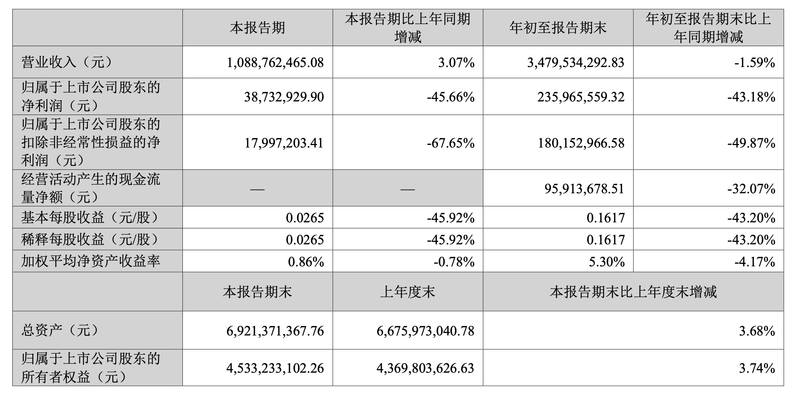
Core Insights - The traditional menswear brand Baoxiniang is facing significant performance pressure, with a notable decline in net profit despite stable revenue [1][2][4] - The company reported a net profit of 236 million yuan for the first three quarters of 2025, a year-on-year decrease of 43.18%, while total revenue was 3.48 billion yuan, down 1.59% [2][4] - Baoxiniang's strategic investments have not yet translated into revenue growth, indicating that the transformation story is still in its early stages [1][4][8] Financial Performance - For Q3 2025, Baoxiniang achieved revenue of approximately 1.09 billion yuan, a slight increase of 3.07% year-on-year, but net profit fell to 38.73 million yuan, down 45.66% [4][5] - The company's management expenses reached 226 million yuan in the first half of 2025, an increase of 26.87% year-on-year, while advertising expenses rose by 8.85% to 138 million yuan [5][6] - Cash flow from operating activities decreased by 32.07% year-on-year, amounting to 95.91 million yuan [6] Strategic Challenges - The traditional formal wear market is experiencing structural challenges due to a shift towards casual and athletic wear, impacting Baoxiniang's core business [7][8] - The company is investing in multiple leisure and outdoor brands, including a 384 million yuan acquisition of the global intellectual property rights for the American outdoor brand Woolrich, excluding Europe [7][8] - Despite some positive performance from the brands HAZZYS and Lafuma, which saw revenue growth, the overall revenue from Baoxiniang's core brand declined by 9.6% [7][8] Future Outlook - The brand authorization periods for HAZZYS and Lafuma present uncertainties for future growth, with HAZZYS authorized until December 2031 and Lafuma until December 2026 [8] - The current performance reflects a state of "investment ahead, returns yet to materialize," with increasing pressure on expenses and asset impairment [8]

哈尔斯前三季度实现营收24.37亿元,双轮驱动迎接挑战未来可期
Zheng Quan Shi Bao Wang· 2025-10-30 12:47
Core Viewpoint - Hars (002615.SZ) reported a revenue of 2.437 billion yuan for the first three quarters, reflecting a year-on-year growth of 2.94% despite facing short-term fluctuations due to international trade tensions, changes in customer structure, and exchange rate volatility [1] Group 1: Financial Performance - The company achieved a revenue of 2.437 billion yuan in the first three quarters, marking a 2.94% increase year-on-year [1] - The management acknowledged that while terminal demand remains strong, the company's performance has been impacted by external factors [1] Group 2: Operational Challenges - The company is experiencing short-term performance fluctuations due to international trade friction, customer structure changes, and exchange rate fluctuations [1] - There is a significant cost increase due to supply chain restructuring and labor reserves, alongside ongoing capacity ramp-up and fixed asset depreciation [1] Group 3: Strategic Focus - The management emphasized the importance of international business as a cornerstone, with a focus on enhancing the international team's capabilities and establishing the Thailand base as a strategic support point [1] - Domestic operations are encouraged to continue brand transformation, focusing on a series and family product matrix, and enhancing brand value through IP collaboration strategies [1] Group 4: Future Outlook - The company believes that external challenges are temporary and do not diminish its growth potential [1] - It is expected that as overseas factory capacities are fully released and domestic teams mature, the company's performance will gain new momentum [1]

宗馥莉罕见公开见面
盐财经· 2025-10-30 09:41
Core Viewpoint - The article discusses the recent developments at Wahaha Group and its transition under the leadership of Zong Fuli, who has stepped down as chairman of Wahaha and is now the president of Hongsheng Group. The article highlights the challenges faced by Wahaha, including a decline in employee numbers and uncertainty in brand strategy, particularly regarding the "Wawa Xiaozong" brand and its impact on distributors and supply chains [3][4][9]. Group 1: Leadership Changes and Company Structure - Zong Fuli has returned to Hongsheng Group as president and is no longer serving as chairman of Wahaha [4]. - Wahaha employees have been transitioning to work at Hongsheng Group's headquarters, leading to a significant reduction in Wahaha's workforce [6][8]. - The employee count at Wahaha has decreased from 403 in 2022 to 217 in 2024, indicating a loss of 186 employees over two years [9]. Group 2: Brand Strategy and Market Challenges - The upcoming distributor conference in November is seen as a critical test for Wahaha's brand strategy and market competitiveness [5][14]. - There is uncertainty among distributors regarding the future of the Wahaha brand, with some expressing confusion over whether to continue selling Wahaha products or switch to the new "Wawa Xiaozong" brand [18]. - The decision to continue selling Wahaha products has led some distributors to submit their deposits, but concerns remain about the brand's market competitiveness and internal management issues [18][19]. Group 3: Supply Chain and Operational Impact - The brand transition has caused disruptions in the supply chain, particularly in material procurement and production planning [19]. - Due to the uncertainty surrounding the brand, procurement departments are now hesitant to stock up on materials, leading to increased costs [19]. - The anticipated sales volume for "Wawa Xiaozong" is expected to be significantly lower than that of the original Wahaha brand, causing delays in planned production capacity expansions [19].

讨好年轻人,布局多品牌,海澜之家困在转型中?
3 6 Ke· 2025-10-30 01:02
Core Viewpoint - Haian Home, once known as the "first stock in men's clothing," is facing anxiety over expansion as it attempts to penetrate the younger market while dealing with growth challenges and financial pressures [1][3][10] Group 1: Market Expansion Efforts - The company is shifting its marketing strategy to attract younger consumers by collaborating with popular young celebrities for brand promotion [1] - As of October 28, Haian Home's official Douyin account has 5.7 million followers, and a collaboration with a celebrity for a live-streaming event garnered over 140 million views [1] - The company is also focusing on enhancing its online presence, with online sales reaching 2.3 billion yuan in the first half of 2025, a year-on-year increase of 4.36% [5] Group 2: Financial Performance - In 2024, Haian Home reported a net profit of 2.16 billion yuan, a year-on-year decline of 26.88%, while the first half of 2025 saw a slight revenue increase of 1.73% to 11.57 billion yuan [3][4] - The main brand's revenue accounted for 72.58% of total revenue in the first half of 2025, showing a decline of 5.86% [4] Group 3: Store Operations and Inventory Management - The company is transitioning from a franchise model to a direct sales model, with direct stores increasing to 2,099, representing 29.12% of total stores [4] - As of the first half of 2025, inventory reached 10.26 billion yuan, a year-on-year increase of 7.35%, with an inventory turnover period of 323 days [7][8] - The company faces significant inventory pressure due to its traditional bulk ordering model, which contrasts with the agile "fast fashion" approach of competitors [8][9] Group 4: Brand Diversification and Challenges - Haian Home has launched multiple sub-brands, including the high-end women's brand OVV, which is positioned in premium shopping areas [5] - Despite efforts to diversify, the main brand still dominates revenue, while new brands are gradually becoming growth drivers, with a 65.57% year-on-year increase in revenue from other brands [4] Group 5: Marketing and Sales Strategy - The company has significantly increased its sales and marketing expenses, which reached 2.47 billion yuan in the first half of 2025, accounting for 21.37% of revenue [10] - Despite these efforts, the company struggles to break into new consumer segments, indicating that its transformation journey remains challenging [10]

宗馥莉罕见公开露面!多人确认:她没有继续任职于娃哈哈
Mei Ri Jing Ji Xin Wen· 2025-10-29 13:16
Core Points - Zong Fuli has resigned as the chairman of Wahaha Group and is now the president of Hongsheng Group, indicating a significant leadership change within the company [1][2] - The upcoming dealer conference in November is critical for Wahaha, as it will assess market expectations and the potential launch of competitive new products [11][14] Group 1: Leadership and Structural Changes - Zong Fuli's return to Hongsheng Group's headquarters has led to a consolidation of staff from both Wahaha and Hongsheng, with many Wahaha employees now working at Hongsheng's headquarters [2][4] - There has been a significant reduction in Wahaha's employee count, dropping from 403 in 2022 to 217 in 2024, indicating a rapid downsizing [7] - The transfer of labor contracts from Wahaha to Hongsheng has caused discontent among employees, leading to a wave of resignations [4][7] Group 2: Brand and Market Dynamics - The brand "Wahaha" has faced challenges, with dealers expressing uncertainty about future product lines and brand direction, particularly with the introduction of "Wawa Xiaozong" [3][15] - The decision to continue selling "Wahaha" products has been met with mixed reactions from dealers, with some expressing concerns over the brand's market competitiveness [15][16] - Supply chain operations have been disrupted due to uncertainty regarding product branding and procurement strategies, leading to a cautious approach in inventory management [16]

关键时刻,宗馥莉罕见公开露面!多人确认:她没有继续任职于娃哈哈
Mei Ri Jing Ji Xin Wen· 2025-10-29 13:03
Core Points - The article discusses the transition of Zong Fuli from the position of Chairman of Wahaha Group to President of Hongsheng Group, highlighting the ongoing changes within both companies and their implications for the market [1][2][3]. Group 1: Leadership Changes - Zong Fuli has stepped down from her role at Wahaha Group and is now serving as President of Hongsheng Group, with no indication of returning to her previous position [1][2]. - Employees from Wahaha Group have been transferring their contracts to Hongsheng Group, leading to a significant reduction in Wahaha's workforce [3][5]. Group 2: Market Dynamics - The Wahaha brand is facing challenges as it navigates a shift in market strategy, with dealers expressing uncertainty about future product offerings and brand direction [2][9]. - The upcoming dealer conference in November is critical for assessing market expectations and the potential introduction of competitive new products [9][13]. Group 3: Employee Impact - There has been a notable decline in Wahaha's employee numbers, dropping from 403 in 2022 to 217 in 2024, indicating a significant workforce reduction [5]. - Departures among key staff, including long-term employees, have raised concerns about the stability and operational efficiency of both Wahaha and Hongsheng [6][8]. Group 4: Supply Chain Concerns - The uncertainty surrounding the Wahaha brand has disrupted supply chain operations, with procurement strategies being adjusted due to anticipated lower sales volumes [14][15]. - Suppliers are now cautious, leading to reduced inventory levels and increased costs, as they navigate the unpredictability of product demand [14][15].

VF(VFC) - 2026 Q2 - Earnings Call Transcript
2025-10-28 13:02
Financial Data and Key Metrics Changes - Total revenue increased by 2% in reported dollars but decreased by 1% in constant dollars, showing an improving trend compared to the previous quarter [6][19] - Operating income reached $330 million, exceeding guidance of $260 to $290 million [6][19] - Net debt, excluding lease liabilities, decreased by $1.5 billion year-over-year, a reduction of 27% [6][23] - Adjusted earnings per share was $0.52, down from $0.60 in the same quarter last year [22] Business Line Data and Key Metrics Changes - The North Face revenue grew by 4%, with growth in both wholesale and direct-to-consumer channels [8][19] - Timberland also saw a 4% revenue increase, driven by strong demand in the Americas [10][19] - Altra experienced significant growth, with revenue up over 35% year-over-year [12] - Vans revenue declined by 11%, impacted by channel rationalization actions [19][33] Market Data and Key Metrics Changes - The Americas region revenue decreased by 1%, EMEA was flat, and APAC saw a 2% decline [19] - Direct-to-consumer sales were down 2%, while wholesale remained flat [20] Company Strategy and Development Direction - The company is focused on returning to growth and has made progress in its turnaround strategy [5][26] - Plans to divest the Dickies brand for $600 million to pay down debt and focus on core brands [7][17] - Emphasis on product innovation and marketing strategies to drive brand engagement and growth across all brands [9][10][11] Management's Comments on Operating Environment and Future Outlook - Management acknowledged a challenging and unpredictable global environment but expressed confidence in the company's strategy and execution capabilities [5][26] - The company expects Q3 revenue to decline by 1% to 3% in constant dollars, with a focus on the upcoming holiday season [23][24] - Management remains optimistic about the consumer's resilience despite macroeconomic uncertainties [68] Other Important Information - The company is on track to achieve medium-term targets of $500 to $600 million in operating income expansion by fiscal 2028 and a leverage ratio of 2.5 times or below [25][26] - Free cash flow through Q2 was negative $453 million, consistent with expectations due to seasonal working capital needs [22] Q&A Session Summary Question: Path back to growth for Vans - Management indicated that increasing product newness and improved marketing strategies are key to returning Vans to growth, with expectations for better performance in upcoming quarters [31][33] Question: Gross margins and cost discipline - Management noted that gross margins were impacted by FX and lower promotions, but overall cost discipline initiatives are on track [39][42] Question: Promotional recapture and pricing strategies - Management confirmed that they are operating in a lower promotional environment and are strategically planning pricing actions for the holiday season [47][49] Question: Health of The North Face brand - Management expressed confidence in The North Face's brand health and market share opportunities, emphasizing the importance of product execution [98][100] Question: Ongoing debt deleveraging - Management is focused on achieving a leverage ratio of 2.5 times by 2028 through operational improvements and divestitures [122]
