
教育公平

Search documents
专访|“我对中国女性取得的成就深表钦佩”——访秘鲁前国会主席玛尔塔·查韦斯
Xin Hua Wang· 2025-10-11 05:56
Core Viewpoint - The interview highlights the significant achievements of Chinese women and the impact of the 1995 Beijing World Conference on Women in elevating global attention to women's issues [1][2] Group 1: Historical Context - The 1995 Beijing World Conference on Women was a milestone event that greatly enhanced international focus on women's issues [1] - The conference provided an opportunity to push women's development topics onto the international platform, especially for countries like Peru that were undergoing significant transitions [1] Group 2: Current Achievements - China has established a positive cycle where women's development is closely linked to national progress, with notable representation of women in various fields such as government, scientific research, and space exploration [2] - The proportion of women among Chinese scientific workers is reported to be 45.8%, which is a remarkable statistic [2] Group 3: Global Governance and Education - The global governance initiative proposed by China emphasizes a people-centered approach aimed at enhancing human welfare, particularly for vulnerable groups like women and children [2] - China is recognized for promoting educational equity through initiatives like smart campuses and digital education, reflecting the principle of inclusive development [2]
县中振兴:让县中“找回底气”
Xin Hua She· 2025-10-10 06:36
Core Insights - The revitalization of county-level high schools is crucial for the growth and success of students, particularly in rural areas, reflecting China's commitment to educational equity and reducing urban-rural disparities [1][2] Group 1: Current Situation and Challenges - As of 2024, there are approximately 29.22 million students enrolled in regular high schools in China, with nearly 60% attending county-level schools, which play a vital role in connecting urban and rural education [2] - County high schools face unprecedented challenges due to urbanization, with over 66% of the population now living in urban areas, leading to a concentration of quality student resources in "super schools" and resulting in issues like overcrowded classrooms and teacher shortages in some counties [2][3] - The perception that county high schools do not lead to good university admissions has led to a loss of trust among students and parents, creating a vicious cycle of declining enrollment and quality [2] Group 2: Government Initiatives and Actions - The State Council has initiated a revitalization action for county high schools, emphasizing the need for scientific resource allocation and the construction of county-level high schools to adapt to urbanization and population flow trends [2][4] - Since the implementation of the "14th Five-Year Plan" for county high school development in 2021, various regions have taken targeted actions to stabilize enrollment and improve conditions, such as regulating admissions and curbing the "siphoning" of students by larger schools [4][5] Group 3: Resource Allocation and Support - The Ministry of Education has launched a project to support county high schools in underdeveloped regions through partnerships with universities, focusing on teacher training, curriculum development, and school management [5] - Central government funding has been directed towards improving infrastructure in county high schools, including the renovation of school buildings and the enhancement of teaching facilities [5][7] Group 4: Future Directions and Reforms - The upcoming "National County High School Revitalization Action Plan" aims to address existing shortcomings in county high school development, focusing on both hardware and software improvements [7][8] - Recommendations include establishing a financial support mechanism that involves both central and local governments, increasing investment in teacher training, and enhancing teacher compensation to retain talent [7] - There is a need to reform teaching and evaluation methods to move away from exam-oriented education, promoting a more holistic approach to student development [8]
腾讯青科实训营开启,十月十营解锁科技未来
Sou Hu Cai Jing· 2025-09-29 09:55
Core Insights - Tencent's "Tech for Good" initiative has evolved into a significant educational movement, focusing on technology education for youth and community engagement [1] - The Tencent Youth Science Training Camp launched ten online thematic camps in October, covering popular topics such as AI app development and AIGC creation, catering to diverse student interests [1][3] Group 1: Educational Initiatives - The Tencent Youth Science Training Camp offers accessible learning experiences, allowing students to create projects like AR greeting cards without prior programming knowledge, completing them in just 30 minutes [3] - Courses are designed for various age groups, with middle school students engaging in AI-generated storytelling and high school students participating in specialized technical classes to prepare for careers in the internet industry [3][10] - All course materials are derived from Tencent's real business scenarios, providing students with practical experience that can enhance their resumes [3] Group 2: Community and Ecosystem Development - The initiative emphasizes improving the educational ecosystem, with events like "Youth Science Open Day" allowing educators to collaborate with Tencent's technical experts on diverse technology education topics [4] - Students engage in hands-on projects with engineers, fostering innovation and creativity while broadening their technological perspectives [4] Group 3: Addressing Educational Equity - Tencent's training camp includes a "multi-dimensional coverage" mechanism, offering advanced technology camps for students in developed areas and science popularization camps for those in underdeveloped regions [6] - Special programs like the "AI Cultural Creation Spring Class" have been established to introduce AI tools to students from less privileged backgrounds, promoting interest in technology [6] Group 4: Broader Impact and Future Plans - The training camp aligns with the Ministry of Education's requirements for core competencies in information technology education, aiming to provide enriching non-academic growth options for youth [5] - The program has attracted over 600,000 participants and collaborated with over 2,000 schools, indicating its significant reach and impact [10] - Future plans include expanding the "4 + 2" layered training model to better meet the needs of students at different growth stages and to enhance the educational ecosystem [10]


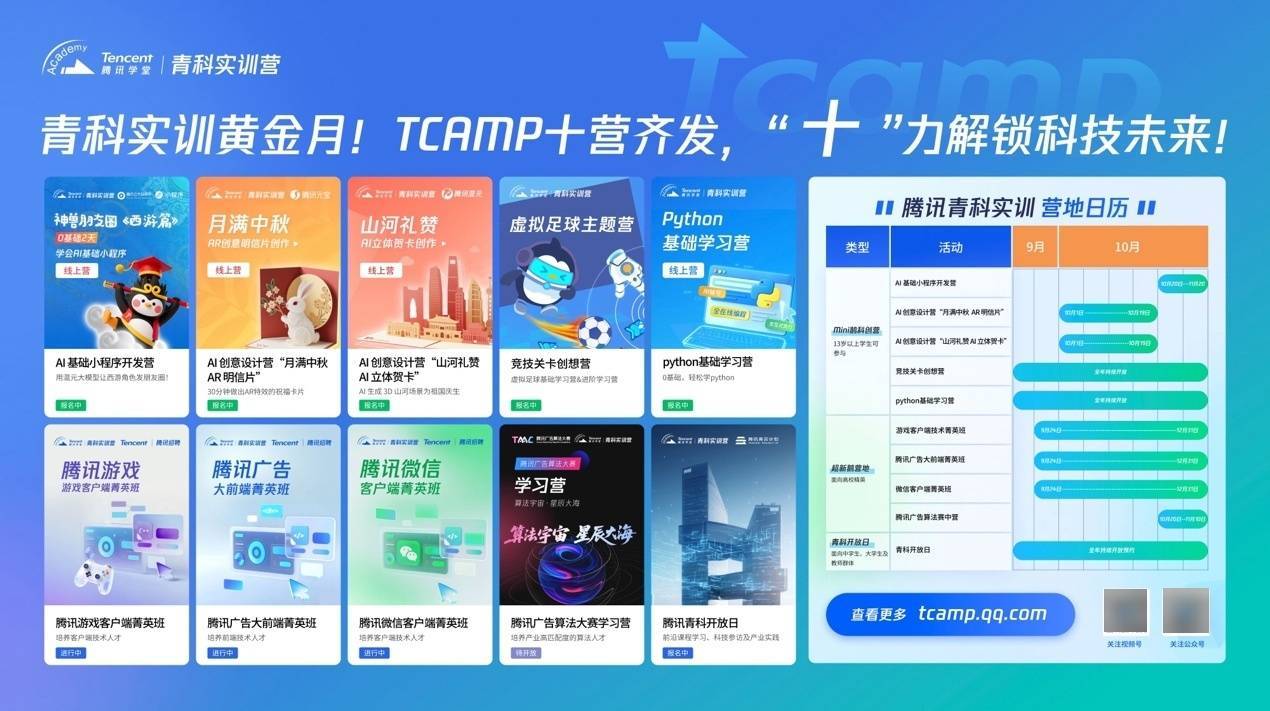
腾讯青科实训营:十月十营,多元营地解锁科技未来
Huan Qiu Wang· 2025-09-29 05:32
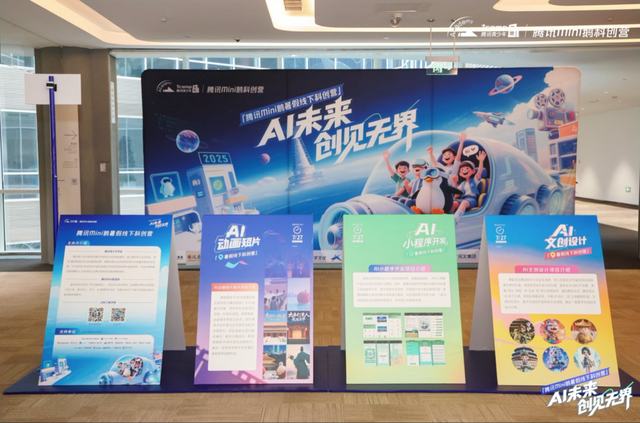
Core Insights - Tencent's Qingshi Training Camp has launched its October program, featuring ten online thematic camps focused on popular areas such as AI mini-program development and AIGC creation, catering to diverse student interests in technology [1][2] Educational Initiatives - The program allows students to create projects like AR greeting cards without prior programming knowledge, completing them in just 30 minutes, and offers official certification for completed works [2] - Different age groups are targeted with tailored designs, including AI-generated storytelling for middle schoolers and specialized courses for college students, providing real-world experience through Tencent's business scenarios [2][10] Community Engagement - Tencent emphasizes improving the educational ecosystem by hosting events like "Qingshi Open Day," where educators can engage with technology experts and students can participate in hands-on projects with engineers [3] Social Impact - The training camp addresses the "double reduction" policy by providing enriching non-academic growth options, focusing on skills like AIGC creation and AI mini-program development, which align with the Ministry of Education's standards [4] - The program includes initiatives for underprivileged areas, such as the "AI Cultural Creation Spring Bud Class," which introduces AI tools to students from less developed regions, fostering interest in technology [6] Technological Integration - The camp promotes a collaborative experience where students use technology to solve real-world problems, emphasizing that the ultimate goal of technology is to serve as a bridge rather than a barrier [9] Program Expansion - Tencent's Qingshi Training Camp has attracted over 600,000 youth participants and collaborated with over 2,000 schools, offering 438 camp classes and nurturing numerous tech projects [10] - The program will continue to evolve, expanding its "4 + 2" layered training system to better meet the needs of students at different growth stages [11]
县中振兴,这次不一样
2 1 Shi Ji Jing Ji Bao Dao· 2025-09-25 12:31
Core Viewpoint - The "County Middle School Revitalization Action Plan" has been officially issued to improve educational equity and address the over-concentration of resources on a few top students, which undermines educational fairness and violates educational principles [1][2]. Group 1: Educational Policy and Reform - The plan aims to shift the resource allocation from an exam-oriented approach to a more balanced educational model, reducing competition and anxiety among students [2][12]. - The initiative emphasizes the need to correct the excessive pursuit of enrollment rates and to ensure that educational practices align with established policies and educational laws [12][14]. Group 2: Digital Education and "Cloud Classes" - "Cloud classes" are introduced as a means to connect students in county schools with renowned high schools through online learning, but they risk diluting local teaching quality and interaction [5][7]. - Some county schools have reported high average scores in "cloud classes," with one class achieving an average score of 623, indicating a focus on elite student performance [4][3]. Group 3: Talent Development and Competition - There is a trend of establishing "youth classes" in high schools that recruit elementary students based on competition results, which undermines policies aimed at reducing academic pressure [9][11]. - High salaries are being offered to competition coaches in county schools, with some earning over 300,000 yuan, reflecting a shift towards a competitive, results-driven educational environment [11]. Group 4: Holistic Education Approach - Experts advocate for a diversified development approach in county schools, emphasizing the importance of physical education, arts, and vocational training alongside academic subjects [15][16]. - The evaluation of county schools should transition from solely focusing on enrollment rates to a more comprehensive assessment of educational quality and student development [16].
“十四五”期间高等教育累计向社会输送5500万人才——办好人民满意的教育
Ren Min Ri Bao· 2025-09-24 04:12
Core Insights - The "14th Five-Year Plan" period has seen significant progress in building a strong education system in China, focusing on moral education and integrating various educational approaches [1][2][3] Group 1: Education Quality and Accessibility - China has established the largest and high-quality education system, ensuring equal access to education for children [2] - By the end of 2024, 246 districts and counties are expected to achieve quality balanced education, with 2895 county-level administrative units already reaching basic balanced education [2] - The proportion of migrant children attending public and government-subsidized schools has increased to over 97%, up by 11.2 percentage points since the end of the 13th Five-Year Plan [2] Group 2: High School and Higher Education Development - The revitalization of county-level high schools is a key focus for ensuring equitable and quality basic education [3] - The gross enrollment rate for higher education has increased from 30% in 2012 to 60.8%, marking a significant advancement towards universal access [3] - A total of 123.5 million students from rural and impoverished areas have been admitted to key universities through targeted enrollment plans [3] Group 3: Contribution to Economic Development - During the "14th Five-Year Plan," higher education institutions have trained 55 million talents to support national innovation and modernization [4] - Over 75% of national natural science awards and more than 50% of national technological advancement awards have been attributed to universities [4] - A new ecosystem for technology transfer from universities has been established, with 28 public transformation platforms created, facilitating the transfer of over 4800 research outcomes [4] Group 4: Vocational Education and Skills Development - Vocational education contributes over 70% of the newly added high-quality skilled talents in modern industries [5] - China has built the world's largest vocational education system, with 9302 secondary vocational schools and 3400 million students enrolled [5] - In the past five years, 12,000 new vocational programs have been added, with 50% focused on engineering and technology [5] Group 5: Comprehensive Educational Reform - The "14th Five-Year Plan" coincides with the second round of "Double First-Class" construction, enhancing the development of universities and disciplines [6] - Significant reforms in graduate evaluation methods have been implemented, allowing for innovation achievements to be considered for degree applications [6] - The national digital education strategy has been fully implemented, with a smart education public service platform covering over 200 countries and regions [7]
从“有学上”到“上好学”!福建教育改革与教育公平跑出加速度
Zhong Guo Chan Ye Jing Ji Xin Xi Wang· 2025-09-04 01:40
Group 1 - The core viewpoint of the news is the emphasis on the high-quality development of education in Fujian Province, highlighting the achievements and future plans in the context of the "14th Five-Year Plan" and China's modernization efforts [1][2][3][4][5][6][7] Group 2 - Since the beginning of the "14th Five-Year Plan," Fujian Province has expanded its education scale, with a total of 14,200 schools and 9.21 million students enrolled [1] - Key educational indicators have steadily improved, with preschool enrollment rates and nine-year compulsory education retention rates exceeding 99%, and high school gross enrollment rates above 97% [1] - The province has prioritized education in its fiscal budget, with education spending being the largest expenditure, accounting for over 20% of the general public budget [2][3] Group 3 - The province has made significant progress in basic education, increasing preschool education coverage from 92.18% in 2020 to 94.97%, and ensuring that 100% of small rural schools meet provincial standards [3] - The proportion of migrant children enrolled in public compulsory education schools rose from 92.76% in 2020 to 95.38% [3] - A comprehensive financial aid system has been established, with approximately 2.7 billion yuan allocated annually to support around 1 million students [3] Group 4 - Fujian Province has adjusted its academic programs to meet industry needs, optimizing 1,589 undergraduate and associate degree programs, which accounts for 44.46% of total programs [4] - The province has established new educational institutions and improved the overall strength of higher education, with several universities included in national "Double First-Class" initiatives [4] Group 5 - The number of doctoral degree-granting institutions increased from 8 to 11, and master's degree-granting institutions rose from 13 to 20, achieving full coverage of graduate education across the province [5] - The province has implemented various reforms to enhance the quality of education and teacher training, recognizing 1,189 outstanding teachers at the provincial level [6] Group 6 - Digital education initiatives have been launched to enhance teaching and learning efficiency, with full multimedia teaching equipment coverage in primary and secondary schools [7] - The education system aims to align with national strategies for building a strong education system, focusing on nurturing responsible citizens and enhancing public service quality [7]
教辅“收紧”,开学季的第一道考题
3 6 Ke· 2025-09-02 01:13
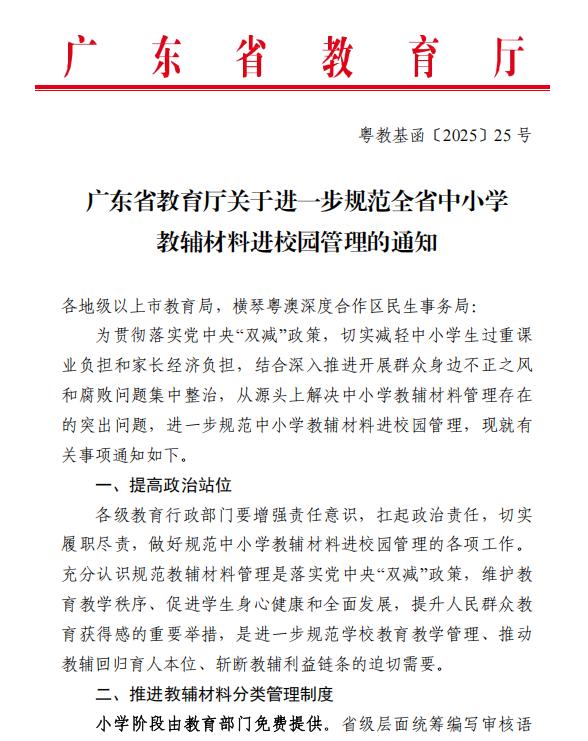
Core Viewpoint - Guangdong's education department has issued a notification to regulate the management of supplementary materials in schools, prohibiting unauthorized recommendations and purchases, and enforcing a "one subject, one supplement" policy [1][5][6] Group 1: Policy Implementation - The notification mandates that primary school supplementary materials will be provided for free by the education department, while middle school materials must come from an official evaluation directory [1][3] - High schools can select their own materials but must adhere to the "one subject, one supplement" rule and publicly disclose their selections [1][5] Group 2: Market Impact - The new regulations aim to dismantle the gray market surrounding supplementary materials, which has thrived in the context of exam-oriented education, with parents previously spending over 800 yuan annually on such materials [5][6] - The policy is expected to significantly reduce the market size for traditional supplementary materials, as many previously popular products will no longer be included in school procurement lists [10] Group 3: Educational Equity Concerns - The ban on supplementary materials may exacerbate existing disparities in educational resources, particularly between urban and rural schools, as some institutions may struggle to provide adequate learning materials [7][9] - Parents' demand for additional practice has not diminished but has shifted to alternative channels, potentially leading to a more unequal distribution of educational resources [8][9] Group 4: Publishing Industry Response - The tightening of supplementary material regulations has led to a significant decline in revenue for traditional publishers and educational companies, with some facing the risk of being eliminated from the market [9][10] - Publishers may pivot towards digital education products and customized resources for affluent schools, which could further entrench resource inequality [10][11] Group 5: Future Challenges - The challenge lies not only in prohibiting certain practices but also in providing better alternatives for educational resources, as the current policy may inadvertently lead to a more covert market for educational materials [11][12] - The situation in Guangdong reflects broader challenges in China's education governance, balancing the need for quality education with the reduction of parental anxiety and ensuring diverse resource availability [12]
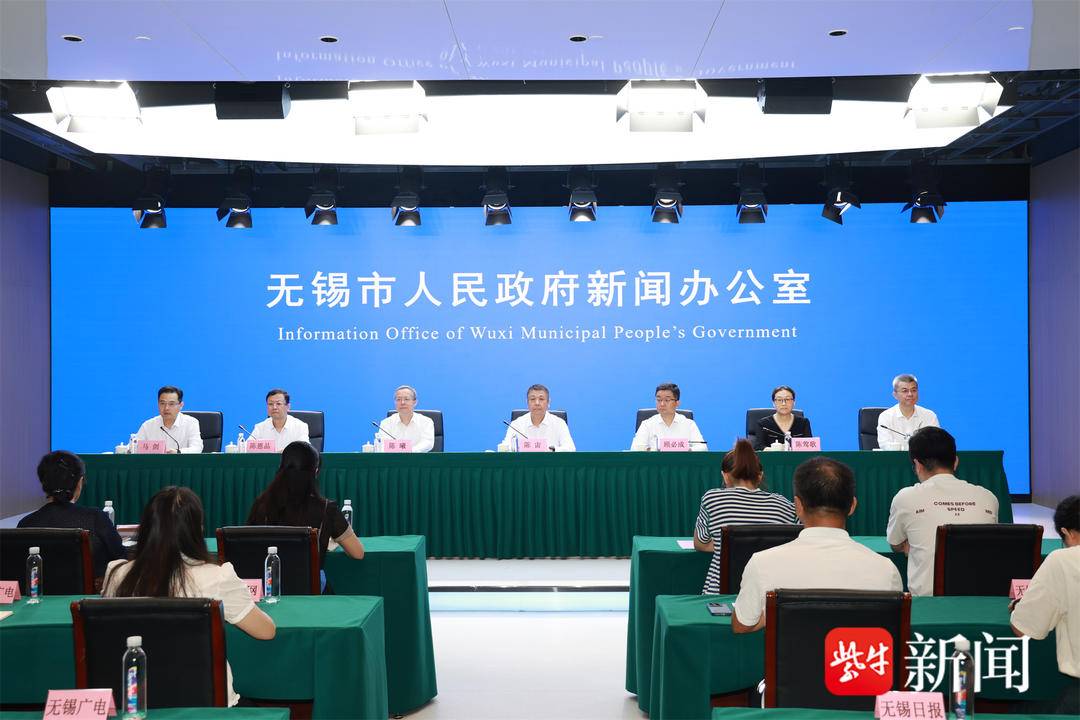
聚焦“民生实事”……无锡举行“切实扛好经济大市挑大梁责任”首场系列主题新闻发布会
Yang Zi Wan Bao Wang· 2025-08-29 09:04
Group 1: Public Health Initiatives - Wuxi has initiated a comprehensive cancer prevention and control action, becoming the first city in the province to implement such a program, which includes cancer screening as a key project for three consecutive years [3] - A total of 1.1619 million residents have participated in cancer screenings, with 274,400 high-risk individuals assessed, leading to the diagnosis of 3,323 cases of precancerous lesions and "five cancers" [3] - The standardized cancer mortality rate in Wuxi has decreased from 95.34 per 100,000 in 2020 to 80.80 per 100,000 in 2024, significantly lower than the national average [3] Group 2: Elderly Care Services - Wuxi has 150 elderly care institutions with approximately 40,000 beds, over 80% of which are nursing beds, addressing the needs of the aging population [4] - The "Xixin Medical and Nursing" community home-based service initiative has been implemented, providing integrated medical and nursing services to the elderly [4] - The city has established 157 meal assistance centers and 709 community meal service facilities, with differentiated subsidies linked to service performance [4] Group 3: Employment and Economic Stability - Jiangyin City has maintained stable employment, with 18,200 new urban jobs created by the end of July this year [5] - Various measures have been taken to stabilize employment, including providing over 44,000 job opportunities and issuing 2.3 million yuan in entrepreneurial subsidies [5] - The city has established 66 talent recruitment stations and introduced 10,200 new college graduates into the workforce [5] Group 4: Urban Environment Improvement - Wuxi's urban management department has launched 1,319 special improvement projects across 151 areas, focusing on enhancing public spaces and facilities [6] - Initiatives include upgrading street scenery, waste collection systems, and public restrooms, aiming for significant improvements with minimal investment [6] - The city has supported the establishment of 432 seasonal fruit and vegetable stalls, enhancing local commerce while maintaining ecological aesthetics [6] Group 5: Education Resource Expansion - Wuxi has achieved a high school enrollment rate of 68.23% and is expanding educational resources through various initiatives [9] - New high school branches have been established, and transportation services have been improved with 117 customized bus routes for students [9] - The city is focused on promoting educational equity and quality through infrastructure development and resource allocation [9] Group 6: Cultural Enrichment - Wuxi is developing cultural facilities, including a new art museum and concert hall, with the art museum expected to open by the end of this year [10] - The city has hosted over 1,200 cultural events and is promoting grassroots cultural engagement through various programs [10] - The upcoming "Taihu Cultural Arts Season" will feature nearly 160 events, expected to benefit over one million residents [10]
免费学前教育释放“幼有所育”新利好
Xin Hua She· 2025-08-29 06:10
Core Viewpoint - The implementation of free preschool education in China is a significant step towards reducing family education costs and promoting educational equity, benefiting approximately 12 million children and reducing family expenses by about 20 billion yuan in the upcoming semester [1][2]. Group 1: Policy Implementation - Starting this autumn, both public and private kindergartens will waive care and education fees for children in their final year, marking a crucial advancement in free preschool education [1]. - The government aims to gradually implement free preschool education by the fall semester of 2025, as outlined in recent policy documents [1][3]. - The initiative is part of a broader effort to enhance the accessibility and quality of preschool education, addressing issues such as high costs and limited availability [1][2]. Group 2: Societal Impact - High-quality preschool education is essential for children's development and can significantly improve the return on human capital investment, particularly benefiting low-income families and children in underdeveloped areas [2]. - Successful pilot programs in regions like Liangshan Yi Autonomous Prefecture have demonstrated the positive effects of free preschool education, including improved language skills and academic performance among children [2]. - The initiative is seen as a vital measure to break the cycle of poverty and reinforce the achievements of poverty alleviation efforts [2]. Group 3: Implementation Challenges - The rollout of free preschool education is a complex process that requires tailored approaches in different regions, ensuring a steady and orderly implementation [3]. - Financial support for the initiative will be shared between central and local governments, with a focus on providing additional resources to central and western regions [3]. - Effective execution of the policy is crucial, necessitating the development of specific implementation plans and stringent oversight to prevent misuse of funds [3].