智能化升级

Search documents
恒逸石化前三季度归母净利润2.31亿元 全产业链协同效应凸显
Quan Jing Wang· 2025-10-29 11:44
Core Viewpoint - Hengyi Petrochemical reported a slight increase in net profit for the first three quarters of 2025, indicating stable operational performance and a positive outlook for the petrochemical industry [1] Group 1: Financial Performance - The company achieved a net profit attributable to shareholders of 231 million yuan, a year-on-year increase of 0.08% [1] - The net profit after deducting non-recurring gains and losses was 78.8 million yuan, reflecting a significant year-on-year growth of 273.30% [1] Group 2: Industry Position and Operations - Hengyi Petrochemical's refining segment benefits from the successful operation of the Brunei refining project, which is the largest single investment project by a private enterprise in China [2] - The company has established a unique dual business model of "polyester + nylon" by integrating the entire industrial chain from crude oil processing to chemical fiber products [2] - The polyester segment is experiencing a slowdown in production capacity growth, but demand remains stable, leading to an improved industry outlook [2] Group 3: New Projects and Strategic Developments - The trial production of the Guangxi new materials project has commenced, which includes a comprehensive production setup for caprolactam and polyamide, enhancing the company's vertical integration [3] - The project is expected to leverage synergies with the Brunei refining project, promoting resource sharing and cooperation between China's and ASEAN's petrochemical industries [3] - Hengyi Petrochemical aims to strengthen its vertical integration and value creation capabilities across the entire "refining-aromatic-polyester" chain [3] Group 4: Future Strategies - The company plans to deepen its development strategy of "one drop of oil, two strands of silk," focusing on quality improvement and efficiency enhancement of existing capacities [4] - Hengyi Petrochemical is committed to advancing its "Technology Hengyi" strategy, exploring digitalization and intelligent upgrades in the chemical fiber industry [4] - The recent government initiative to control supply-side capacity in the petrochemical sector is expected to further enhance the company's competitive advantages in differentiated product development and intelligent production [4]

研判2025!中国电磁铁行业发展历程、产业链、发展现状、竞争格局和发展趋势分析:智能化升级推动行业需求不断增加[图]
Chan Ye Xin Xi Wang· 2025-10-29 01:11
Core Insights - The Asia-Pacific region, particularly China, is experiencing significant growth in the electromagnet market, driven by technological advancements and increasing demand for automation and digitalization [1][6] - The Chinese electromagnet industry has reached a market size of 10.98 billion yuan, with a year-on-year increase of 10.2%, and is expected to continue growing rapidly due to advancements in 5G, IoT, and big data technologies [1][6] Industry Overview - Electromagnets are devices that generate magnetic fields when electric current passes through coils wrapped around a core, with applications in various industries [3] - The industry has evolved through four stages: initial stage (1950s), early development (1980s-1990s), rapid development (21st century), and is now focusing on high-end products and green technologies [4][5] Industry Chain - The electromagnet industry chain consists of upstream materials (magnetic, conductive, and insulating materials), midstream manufacturing, and downstream applications in sectors like industrial automation, power systems, transportation, home appliances, and medical devices [5][6] Current Market Status - The global electromagnet market is projected to reach $2.57 billion by 2024 and $4.10 billion by 2030, with increasing demand in automotive, electronics, and medical sectors [6] Competitive Landscape - The electromagnet industry is competitive, with major players including Hunan Zhongke Electric Co., Ltd. and Ningbo Yunsen Electronic Technology Co., Ltd., among others [8][9] - Zhongke Electric, a leading company, reported a revenue of 166 million yuan from its electromagnetic equipment in the first half of 2025, a decrease of 9.7% year-on-year [9] Development Trends - Future trends in the electromagnet industry include technological innovation for product upgrades, a shift towards high-end applications, and a focus on sustainable development practices [11][12][13]


普莱得(301353) - 301353普莱得投资者关系管理信息20251028
2025-10-28 12:00
Group 1: Acquisition and Market Strategy - The acquisition of BATAVIA B.V. aims to leverage its product design capabilities and local sales channels to create a comprehensive "R&D-design-manufacturing-marketing" synergy, establishing a strong foothold in overseas markets [1][2] - Post-acquisition, the company enhances BATAVIA B.V. with its manufacturing capabilities, cost control systems, and stable supply chain, enabling it to respond quickly to orders and deliver high-quality products, thus expanding market coverage [1][2] Group 2: Internal and External Supply Chain - The subsidiary, Pucheng Electronics, established in 2023, has developed a specialized production facility and advanced equipment, enabling it to serve both internal and external markets effectively [3] - Internally, Pucheng Electronics meets customized needs of the group, while externally, it has successfully entered the supplier systems of major clients like Stanley Black & Decker and Makita, creating a dual-channel business model [3] Group 3: Production Capacity and Operations - The Thai subsidiary is currently ramping up production capacity and is expected to reach full capacity by the end of the year, benefiting from the company's production, technology, talent, and quality advantages [4] - The company maintains a dynamic alignment between personnel size and business development needs, avoiding significant increases in staff numbers despite business expansion, thanks to automation and smart management systems [6][7] Group 4: Share Repurchase and Employee Incentives - The company has completed its share repurchase plan, with shares to be used for employee stock ownership or incentive plans, adhering to relevant legal and disclosure requirements [5]
智慧物流 “一站”链接——新松亮相2025 CeMAT ASIA亚洲国际物流展
机器人圈· 2025-10-28 10:25
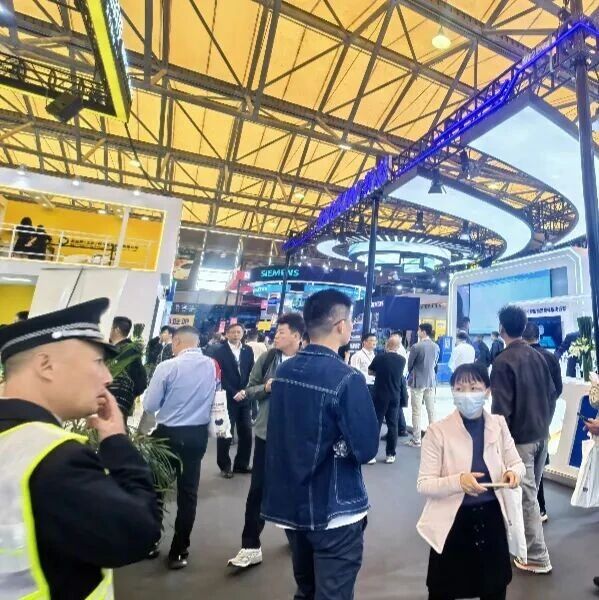
Core Viewpoint - The article highlights the advancements in intelligent logistics and manufacturing driven by new-generation artificial intelligence, showcasing innovative solutions and applications in the lithium battery industry and beyond [4][5][6]. Group 1: Event Overview - The 2025 CeMAT ASIA exhibition will take place from October 28 to 31 at the Shanghai New International Expo Center, covering over 80,000 square meters and attracting over 900 exhibitors [2]. - The exhibition focuses on robotics, smart warehousing, green logistics, and digital innovation, serving as a significant platform for the logistics and transportation industry in Asia [2]. Group 2: New Innovations - New松 showcased its cutting-edge mobile robots and intelligent logistics solutions, particularly in the lithium battery sector, demonstrating a new generation scheduling system for efficient robot coordination [4][5]. - The悬臂轴移动机器人 is designed for high-precision positioning and flexible navigation in narrow spaces, suitable for various materials in lithium battery production [5][6]. - The叉式移动机器人 integrates forklift and mobile robot technologies, offering autonomous navigation and adaptability for different material handling scenarios [9]. Group 3: Cleaning Solutions - The星卫来 industrial cleaning robots address traditional cleaning challenges in industrial settings, enabling simultaneous cleaning and production operations [11][16]. - The KD450C and D700C models are designed for effective cleaning in various industrial environments, utilizing advanced technologies to enhance cleaning efficiency and reduce maintenance costs [11][13]. Group 4: Digital Transformation - The logistics digital twin system and MR mixed reality system are highlighted as key drivers for digital transformation in warehousing and logistics, providing immersive experiences and real-time data analysis [21][22]. - These systems facilitate better interaction and operational efficiency, supporting the integration of warehouse management systems for synchronized data management [22]. Group 5: Future Collaboration - New松 aims to strengthen partnerships across industries to promote digital and intelligent upgrades, fostering new productive capabilities and supporting high-quality development [28].

春风动力(603129):2025Q3业绩快速增长,关税等因素致使净利率短期波动
Tai Ping Yang Zheng Quan· 2025-10-27 15:38
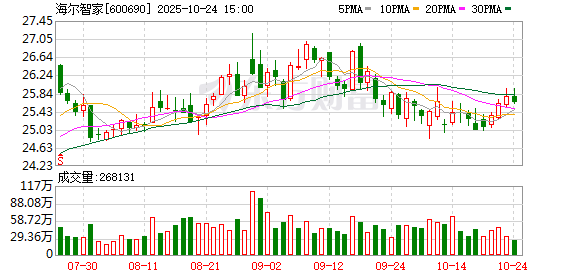
Investment Rating - The report maintains a "Buy" rating for the company [1][5] Core Views - The company reported a revenue of 14.896 billion yuan for the first three quarters of 2025, representing a year-on-year increase of 30.10%, and a net profit of 1.415 billion yuan, up 30.89% [3][4] - In Q3 2025, the company achieved a revenue of 5.041 billion yuan, reflecting a growth of 28.56%, while the net profit reached 413 million yuan, marking an 11.00% increase [4] - The company's gross margin in Q3 2025 was 26.14%, down 5.43 percentage points, attributed to fluctuations in raw material prices and tariff policies [4] - The net profit margin for Q3 2025 was 8.76%, a decrease of 0.98 percentage points, indicating effective control over operating expenses despite the pressure on profitability [4] Summary by Sections Financial Performance - The company is projected to achieve net profits of 1.954 billion yuan in 2025, 2.443 billion yuan in 2026, and 3.062 billion yuan in 2027, with corresponding EPS of 12.81, 16.01, and 20.07 yuan respectively [5][7] - Revenue growth rates are expected to be 32.50% in 2025, 24.70% in 2026, and 22.40% in 2027 [7] Market and Industry Outlook - The global all-terrain vehicle market is expected to maintain stable growth, supported by consumer education and demand for motorcycle exports [5] - The company is positioned as a domestic industry leader, focusing on expanding its product matrix and enhancing its market presence [5] Strategic Initiatives - The company aims to increase the output of products from its Mexican and Thai bases to the U.S. market, while also enhancing local component manufacturing and procurement [5]

新股前瞻|智汇矿业二次递表:凭矿“吃饭”,毛利率维持在30%-40%
智通财经网· 2025-10-27 08:53
Core Viewpoint - Zhihui Mining, a mining company from Tibet, has submitted its IPO application to the Hong Kong Stock Exchange, providing an opportunity to observe the growth logic of zinc concentrate enterprises and industry trends [1] Company Overview - Zhihui Mining operates in the mining sector, covering exploration, mining, and production of zinc, lead, and copper concentrates, ranking fifth, fourth, and fifth in Tibet for these products respectively [1] - The company has two mining operations: an open-pit mine in commercial operation since 2007 and an underground mine that began operations in the second quarter of 2025 [2] Financial Performance - The company's revenue and profit have shown significant volatility, with revenues of 482 million, 546 million, and 301 million yuan from 2022 to 2024, and net profits of 118 million, 155 million, and 55.85 million yuan during the same period [3] - In 2024, revenue decreased by 44.8% and net profit dropped by 63.9% due to production delays caused by weather and temporary halts in production lines for upgrades [3] - Despite a rise in average selling prices, total sales volume of concentrates fell sharply, with a 56.33% decrease in the quantity sold in 2024 [3] Revenue Structure - The company's revenue primarily comes from the sale of zinc concentrates, which accounted for approximately 61.4%, 50.1%, and 71.6% of total revenue from 2022 to 2024 [4] - Following the resumption of full operations and completion of processing upgrades in April 2025, revenue increased significantly to 257 million yuan, a 253.4% year-on-year growth [4] Industry Context - The zinc industry is experiencing strong demand driven by infrastructure and construction, with domestic consumption of refined zinc reaching 6,642 thousand tons in 2024 [6] - China faces a supply shortage in the zinc concentrate market, necessitating imports due to domestic production declines, which presents a favorable opportunity for Zhihui Mining [7] Strategic Challenges - The company must focus on cost reduction and efficiency improvements to maintain competitiveness amid market fluctuations and high production costs [6][8] - The mining sector is influenced by various factors, including global economic conditions, commodity prices, and regulatory policies, which can impact profitability and cash flow [8]
高质量发展看亮点·读数丨从制造到智造,轻工业向新而行
Ren Min Ri Bao· 2025-10-27 03:05
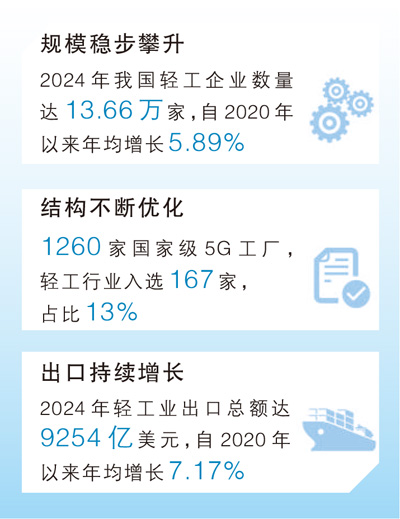
Core Insights - The light industry in China has shown significant growth during the "14th Five-Year Plan" period, with key metrics indicating a robust performance in terms of enterprise numbers, retail sales, and export volumes [3][12]. Industry Scale - By 2024, the number of light industry enterprises in China is projected to reach 136,600, with an average annual growth rate of 5.89% since 2020 [3]. - Retail sales of key light industry products are expected to reach 7.93 trillion yuan, accounting for 16.2% of total retail sales of consumer goods [3]. - The total export volume of light industry products is anticipated to hit 925.4 billion USD, with an average annual growth rate of 7.17% since 2020 [3]. Technological Advancements - The light industry is undergoing a dual transformation driven by smart upgrades and green transitions, with significant advancements in automation and AI technologies [4][6]. - As of now, 1,260 national-level 5G factories exist, with 167 in the light industry, representing 13% of the total [6]. - The proportion of smart home appliances has increased from 38% to 62% during the "14th Five-Year Plan" period, contributing to a projected revenue of 1.95 trillion yuan in 2024, a 31.6% increase from 2020 [5]. Innovation and R&D - The light industry has seen a continuous increase in innovation investment, with R&D expenditure intensity rising from 1.72% at the end of the "13th Five-Year Plan" to 2.31% in 2023, reflecting an annual growth rate of 9.2% [8]. - The number of authorized invention patents in the light industry has exceeded 1.79 million, with effective invention patents increasing from 127,000 in 2020 to 214,000 in 2024, showing an annual growth rate of 12.3% [8]. Market Competitiveness - The light industry has strengthened its market competitiveness through supply innovation, channel upgrades, and open cooperation [11]. - In 2024, the export volume of the light industry is expected to account for 25.9% of the national total, maintaining the top position for five consecutive years [12]. - The retail sales of key light industry products have grown from 5.98 trillion yuan in 2020 to 7.93 trillion yuan in 2024, with an average annual growth rate of 7.29% [12].
高质量发展看亮点·读数|从一粒酵母看轻工业之变
Bei Jing Ri Bao Ke Hu Duan· 2025-10-27 02:29
Core Insights - The "14th Five-Year Plan" for the light industry in China shows significant achievements, with the number of light industry enterprises reaching 136,600 by 2024, an average annual growth of 5.89% since 2020 [3] - Retail sales of key light industry products reached 7.93 trillion yuan, accounting for 16.2% of total retail sales of consumer goods [3] - The total export value of light industry products reached 925.4 billion USD, with an average annual growth of 7.17% since 2020 [3] Industry Structure Optimization - The light industry is undergoing a dual transformation driven by intelligent upgrades and green transitions, with significant advancements in smart factories and AI applications [4] - The proportion of smart home appliances increased from 38% to 62% during the "14th Five-Year Plan," contributing to a 31.6% growth in the main business income of the home appliance industry, reaching 1.95 trillion yuan by 2024 [4] - By 2024, 1,321 light industry enterprises were recognized as national green factories, covering various sectors including home appliances, paper, food, and batteries [4] Innovation and Technology - Continuous innovation investment has led to a significant increase in research and development intensity, rising from 1.72% at the end of the "13th Five-Year Plan" to 2.31% in 2023, with an annual growth rate of 9.2% [6] - The number of authorized invention patents in the light industry exceeded 1.79 million, with effective invention patents increasing from 127,000 in 2020 to 214,000 in 2024, reflecting an annual growth rate of 12.3% [6] Market Competitiveness - The light industry has strengthened its market competitiveness through supply innovation, channel upgrades, and open cooperation, with exports of bicycles reaching 259 million units and an export value of 17.71 billion USD from 2020 to 2024 [8][10] - The export share of light industry products accounted for 25.9% of the national total in 2024, maintaining the top position for five consecutive years [10] - Domestic retail sales of key light industry products grew from 5.98 trillion yuan in 2020 to 7.93 trillion yuan in 2024, with an average annual growth of 7.29% [10]
从制造到智造,轻工业向新而行
Xin Hua Wang· 2025-10-26 23:54
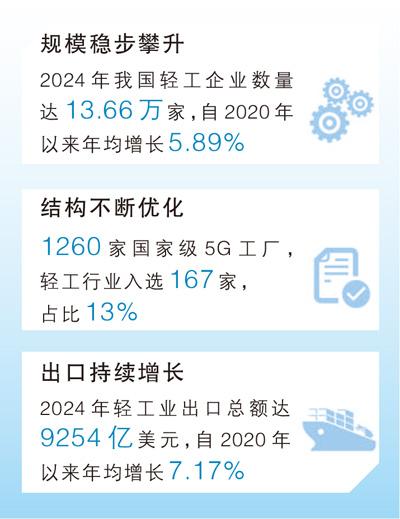
Core Insights - The light industry in China has established itself as the largest producer and exporter of light industrial products globally, with significant growth in production scale, market performance, and export volume since 2020 [1][10]. Industry Scale and Market Performance - By 2024, the number of light industry enterprises in China is projected to reach 136,600, with an average annual growth rate of 5.89% since 2020 [1]. - Retail sales of key light industry products are expected to reach 7.93 trillion yuan, accounting for 16.2% of total retail sales of consumer goods [1]. - The total export value of light industry products is anticipated to be 925.4 billion USD, with an average annual growth rate of 7.17% since 2020 [1]. Technological Advancements and Upgrades - The light industry is undergoing a dual transformation driven by intelligent upgrades and green transitions, with significant improvements in smart manufacturing capabilities [3][4]. - As of now, 1,260 national-level 5G factories exist, with 167 in the light industry, representing 13% of the total [4]. - The proportion of smart home appliances has increased from 38% to 62% during the "14th Five-Year Plan" period, contributing to a projected revenue of 1.95 trillion yuan in 2024, a 31.6% increase from 2020 [3]. Innovation and R&D Investment - The light industry is witnessing a continuous increase in innovation investment, with R&D expenditure intensity rising from 1.72% at the end of the "13th Five-Year Plan" to 2.31% in 2023, reflecting an annual growth rate of 9.2% [5][6]. - The number of authorized invention patents in the light industry has exceeded 1.79 million, with effective invention patents increasing from 127,000 in 2020 to 214,000 in 2024, showing an annual growth rate of 12.3% [7]. Market Competitiveness and Export Performance - The light industry has strengthened its market competitiveness through supply innovation, channel upgrades, and open cooperation, with exports accounting for 25.9% of the national total in 2024, maintaining the top position for five consecutive years [10]. - From 2020 to 2024, the export of light industrial products to countries involved in the Belt and Road Initiative increased from 30% to 33%, and exports to ASEAN countries rose from 13.7% to 15% [10]. Future Outlook - Looking ahead to the "15th Five-Year Plan," the light industry aims to enhance innovation capabilities, brand influence, and sustainable development, with goals to cultivate over 10 globally recognized brands and maintain the highest international market share by 2030 [11].
我国稳居全球最大轻工产品生产国和出口国 从制造到智造,轻工业向新而行(高质量发展看亮点·读数)
Ren Min Ri Bao· 2025-10-26 21:42
Core Insights - The light industry in China has shown significant growth and resilience, becoming the largest producer and exporter of light industrial products globally, with key metrics indicating a steady increase in enterprise numbers, retail sales, and export volumes [2][5][10]. Industry Scale - By 2024, the number of light industry enterprises in China is projected to reach 136,600, with an average annual growth rate of 5.89% since 2020 [2]. - The retail sales of key light industry products are expected to reach 7.93 trillion yuan, accounting for 16.2% of the total retail sales of consumer goods [2]. - The total export volume is anticipated to be 925.4 billion USD, with an average annual growth rate of 7.17% since 2020 [2]. Technological Advancements - The light industry is undergoing a dual transformation driven by smart upgrades and green transitions, with significant advancements in automation and artificial intelligence [4][5]. - As of now, 1,260 national-level 5G factories exist, with 167 in the light industry, representing 13% of the total [5]. - The proportion of smart home appliances has increased from 38% to 62% during the "14th Five-Year Plan" period, contributing to a projected revenue of 1.95 trillion yuan in 2024, a 31.6% increase from 2020 [4]. Innovation and R&D - The light industry has seen a substantial increase in innovation investments, with R&D expenditure intensity rising from 1.72% at the end of the "13th Five-Year Plan" to 2.31% in 2023, reflecting an annual growth rate of 9.2% [7]. - The number of authorized invention patents in the light industry has exceeded 1.79 million, with effective invention patents increasing from 127,000 in 2020 to 214,000 in 2024, showing an annual growth rate of 12.3% [7]. Market Competitiveness - The light industry has strengthened its market competitiveness through supply innovation, channel upgrades, and open cooperation, with exports to countries involved in the Belt and Road Initiative increasing from 30% to 33% from 2020 to 2024 [11]. - The export share of the light industry accounted for 25.9% of the national total in 2024, maintaining the top position for five consecutive years [10]. - Domestic retail sales of key light industry products have grown from 5.98 trillion yuan in 2020 to 7.93 trillion yuan in 2024, with an annual growth rate of 7.29% [11]. Future Outlook - Looking ahead to the "15th Five-Year Plan," the light industry aims to enhance innovation capabilities, brand influence, and sustainable development, with goals to cultivate over 10 globally recognized brands and 50 regional specialty brands by 2030 [11].