智能化转型

Search documents
我们都低估了奇瑞做新能源的决心
雷峰网· 2026-01-09 11:13
Core Viewpoint - Chery is entering a "golden decade" after years of groundwork, showcasing significant growth in both traditional and new energy vehicle sectors, with a strong focus on innovation and technology [2][3][16]. Group 1: Sales Performance - In 2025, Chery achieved total sales of 2.806 million vehicles, a year-on-year increase of 7.8%. Among these, new energy vehicle sales reached 903,847 units, up 54.9%, and exports totaled 1,344,020 units, growing by 17.4% [2][3]. - Chery set records for monthly, annual, and cumulative exports, maintaining its position as the top Chinese brand in passenger car exports for 23 consecutive years [3][4]. Group 2: Technological Innovation - Chery has established a comprehensive R&D framework with over 30,000 personnel, including more than 10,000 software developers, across global centers [16][19]. - The company has developed a multi-path technology matrix that includes hybrid, pure electric, and hydrogen energy solutions, showcasing its commitment to innovation [7][19]. - Chery's self-developed hybrid system, Kunpeng Super Electric Hybrid CDM6.0, has been recognized at national exhibitions, highlighting its technological strength [9]. Group 3: Strategic Positioning - Chery is actively embracing new energy and technology, positioning itself as a reference model for traditional automakers undergoing transformation [4][19]. - The company has launched a series of popular new energy models, including the Fengyun A9L and iCAR V23, which have contributed significantly to its sales growth [6][8]. - Chery's strategy includes a focus on both fuel and electric vehicles, ensuring it meets diverse consumer needs while maintaining competitive advantages in the market [15][19]. Group 4: Smart Driving and Automation - Chery has committed to integrating smart driving features across its entire vehicle lineup, including entry-level models, thus democratizing access to advanced technology [12][15]. - The launch of the Falcon Smart Driving system, which includes various levels of automation, reflects Chery's long-term commitment to smart technology [13][14]. Group 5: Future Growth Trajectories - Chery has outlined three growth curves for the next decade: its core automotive business, future technologies in various sectors, and expansion into robotics and autonomous vehicles [16][18]. - The company aims to leverage its technological advancements to enhance customer experiences and drive innovation across its product lines [19].

海康观澜大模型落地见效 覆盖工业质检、新能源电力等多领域
Jing Ji Guan Cha Wang· 2026-01-09 03:06
Core Insights - Hikvision focuses on technological innovation in IoT perception, artificial intelligence, and big data, providing a comprehensive range of smart IoT hardware and software products, as well as services for complex intelligent IoT system construction [1] Group 1: Technology and Product Offerings - The company offers perception technologies that extend from visible light to millimeter waves, infrared, X-rays, and sound waves, integrating AI and big data into its smart IoT products, IT infrastructure, platform services, data services, and application services [1] - The "Guanlan" large model framework consists of a foundational model, industry models, and scenario application models, integrating multimodal data such as visual, acoustic, thermal, and X-ray data, and has been recognized for its maturity and reliability in model development [1] Group 2: Applications in Industrial Manufacturing - In the industrial manufacturing sector, the application of the Guanlan large model effectively addresses efficiency bottlenecks in traditional production processes, achieving an 80% increase in detection efficiency for soldering defects in circuit board production compared to traditional methods [2] - The model aids in real-time analysis of the entire product packaging process at Hikvision's manufacturing base, addressing common industry pain points related to flexible manufacturing and component misplacement [2] Group 3: Applications in Renewable Energy - In the renewable energy sector, the Guanlan large model's wind power prediction unit exemplifies its practical application, predicting future power generation based on wind direction and speed, with a 1% increase in prediction accuracy translating to significant revenue changes [3] - The wind power prediction unit utilizes a self-developed time series model that reduces long-term prediction errors, maintaining high accuracy for forecasts ranging from 15 minutes to ten days ahead, which lowers management and scheduling costs for the grid [3] - In a 300MW offshore wind farm in East China, the annual reduction in power prediction deviation assessment costs exceeded 1.2 million yuan, a decrease of over 15%, while in an 80MW mountainous wind farm in South China, the reduction exceeded 800,000 yuan, a decrease of over 46% [3] Group 4: Future Focus - The company aims to continue focusing on technological innovation and promote the large model's large-scale application across more industry scenarios, providing technical support for digital and intelligent transformation in various industries [3]

记者手记:从两个“百万”看中国新能源汽车产业的量质齐升
Xin Hua Wang· 2026-01-09 02:10
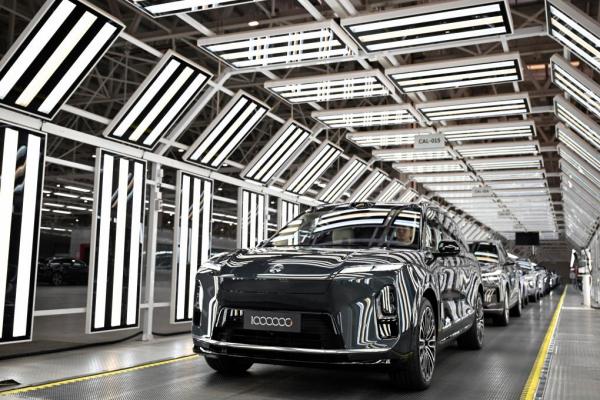
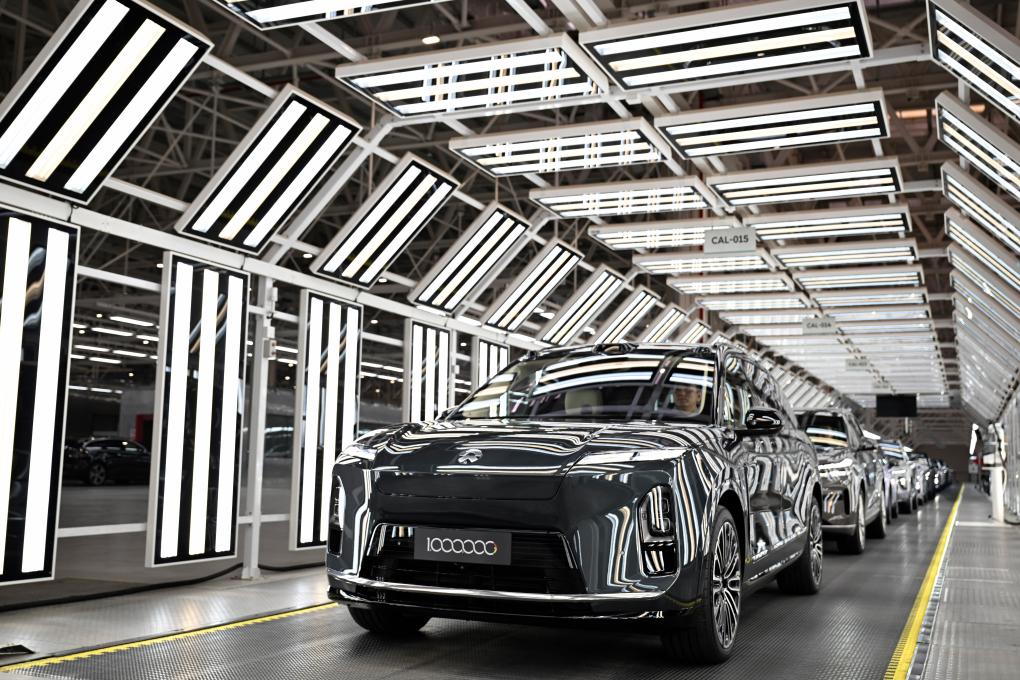
Group 1 - The core message highlights the dual breakthroughs in scale and brand for China's new energy vehicle (NEV) industry, marked by the production of the one-millionth vehicle by companies like NIO, Leap Motor, and Xpeng [1][3] - The NIO ES8, as the one-millionth vehicle, symbolizes the significant progress made in the NEV sector, showcasing a shift from traditional fuel vehicles to electric and intelligent models [3] - The collaboration between Huawei and JAC Motors to produce the high-end S800 model, priced over 1 million yuan, signifies a breakthrough in the luxury electric vehicle market, indicating a trend towards high-end positioning in the NEV industry [1][5] Group 2 - The data from the China Association of Automobile Manufacturers shows strong performance in NEV production and sales, with 14.907 million units produced and 14.78 million units sold from January to November 2025, reflecting year-on-year growth of 31.4% and 31.2% respectively [5] - The emergence of new players like NIO, Li Auto, and Xpeng is seen as a transformative force in the automotive industry, redefining business models and user relationships through a focus on experience and data [3] - The S800's launch represents a new collaborative model in the automotive industry, where technology companies provide the technical foundation, allowing traditional manufacturers to focus on production and integration [5]


笃行与锐进 || 2026全球汽车业八大猜想
Zhong Guo Qi Che Bao Wang· 2026-01-09 01:21
Group 1: Global Automotive Trade Tensions - The global automotive industry is facing increased trade tensions, with predictions of further escalation in 2026 due to rising protectionism and unilateral trade measures by various countries [2][3] - The World Trade Organization has significantly lowered its forecast for global goods trade growth in 2026 to 0.5%, while Allianz Trade predicts only 0.6%, both well below the 2.4% expected for 2025 [2][3] Group 2: Slowdown in International Electric Vehicle Sales - The global electric vehicle market is expected to experience a slowdown in sales growth in 2026, with Benchmark Mineral Intelligence reporting a decline in growth rates since November 2025 [4][5] - The U.S. market outlook is particularly bleak, with the cancellation of electric vehicle incentives leading to a significant drop in consumer purchasing intentions [4] - In China, the growth forecast for electric vehicle sales has been revised down from 16% to 14% for 2026, attributed to high base effects and the reintroduction of purchase taxes [5][6] Group 3: Acceleration of Localization by Chinese Automakers - Chinese automakers are accelerating their localization strategies overseas, driven by high export volumes and increasing trade barriers [7][8] - Companies like BYD and Changan are establishing local production facilities in markets such as Thailand and Hungary, indicating a strategic shift from simple vehicle exports to localized production [7][8] Group 4: Transformation of Sino-Foreign Automotive Cooperation - The cooperation model between Chinese and foreign automakers is evolving from "market for technology" to a deeper collaboration focused on technology output and resource sharing [9][10] - Chinese automotive brands are increasingly leading in technology development, with foreign partners seeking to leverage their advancements in electric vehicle technology for global expansion [9][10] Group 5: Commercialization of Robotaxi Services - 2026 is projected to be a pivotal year for the commercialization of Robotaxi services, with advancements in technology and regulatory environments facilitating large-scale operations [11][12] - Companies like Tesla and Waymo are expanding their Robotaxi services, marking a significant step towards widespread adoption [11][12] Group 6: Emergence of Solid-State Batteries - 2026 is recognized as a critical year for the validation of solid-state battery technology, with multiple automakers planning to conduct vehicle testing [13][14] - Chinese automakers are actively pursuing solid-state battery production, with several companies announcing plans for testing and production timelines [13][14] Group 7: Integration of AI in Automotive Industry - The integration of AI models into vehicles is expected to redefine the automotive industry, with significant advancements in smart driving and intelligent cockpit technologies anticipated in 2026 [15][16] - The market for AI-driven automotive services is projected to grow significantly, with estimates suggesting it could exceed 100 billion yuan by 2028 [15][16] Group 8: Rise of Humanoid Robots in Automotive Sector - 2026 is set to be a key year for the mass production and commercialization of humanoid robots by automotive companies, with many firms planning to launch their products [17][18] - Companies like Tesla and Xpeng are leading the charge in humanoid robot development, with plans for large-scale deployment in various sectors [17][18]

【开局“十五五” 奋进正当时·一线报道】以“智控”谋双赢:沾化汇宏新材料为传统生产装上“智慧大脑”
Xin Lang Cai Jing· 2026-01-08 16:57
Core Insights - The company is undergoing a comprehensive digital transformation, focusing on smart manufacturing to enhance production efficiency and safety [1][2] Group 1: Automation and Smart Control - The company has achieved a 90% automation coverage in key production processes, significantly reducing manual intervention and enhancing operational stability [1] - The transition from manual to automated control has transformed employee roles, allowing for centralized monitoring and optimization of production systems [1] Group 2: Advanced Technologies - The company has implemented advanced online detection technologies, such as sonar flow meters and infrared thermal imaging, to monitor production processes and mitigate risks associated with traditional instruments [2] - Real-time data from production lines is centralized in a visual control center, enabling remote monitoring and data-driven decision-making [2] Group 3: Focused Safety and Efficiency Improvements - The company has targeted high-risk areas for automation, such as the chemical unloading zone, where a fully automated system has eliminated safety risks and improved unloading efficiency [3] - The introduction of automated control systems has streamlined operations, enhancing both safety and efficiency in power systems and maintenance processes [3] Group 4: Future Goals - The company aims to further explore the core value of industrial data to optimize process parameters and continue its journey towards smarter, greener, and more efficient operations [3]
从“百万辆量产”到“百万元定价”,新能源汽车产业传递出这样的信号
Bei Jing Ri Bao Ke Hu Duan· 2026-01-08 15:19
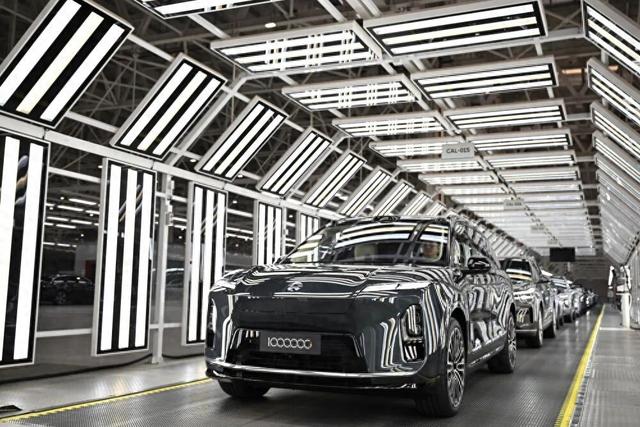
Core Insights - The Chinese electric vehicle (EV) industry is experiencing a dual breakthrough in scale and brand, as evidenced by multiple companies reaching the milestone of producing their one-millionth vehicle [1][3]. Group 1: Milestones in Production - NIO's one-millionth vehicle, a green ES8, was produced at its advanced manufacturing facility in Hefei and donated to the Mozi Quantum Technology Foundation [1]. - Other companies like Leap Motor and Xpeng have also announced their one-millionth vehicle production, indicating a significant trend in the industry [1][3]. Group 2: Market Dynamics and Innovations - The collaboration between Huawei and JAC Motors to produce the high-end S800 model, priced over 1 million yuan, signifies a breakthrough in the luxury EV segment [1][3]. - The entry of tech companies like Huawei and Xiaomi into the automotive sector is reshaping the industry by integrating technology and manufacturing, thus enabling traditional automakers to focus on production and integration [5]. Group 3: Industry Growth Statistics - According to the China Association of Automobile Manufacturers, from January to November 2025, the production and sales of new energy vehicles reached 14.907 million and 14.78 million units, respectively, marking year-on-year growth of 31.4% and 31.2% [5]. - The Chinese EV industry is transitioning from survival mode to a phase focused on value creation, indicating a maturation of domestic brands [5].
从两个“百万”看中国新能源汽车产业的量质齐升
Xin Hua She· 2026-01-08 13:58
Group 1 - The core message of the articles highlights the significant milestones achieved by Chinese electric vehicle manufacturers, particularly NIO, which recently produced its one-millionth vehicle, symbolizing a dual breakthrough in scale and brand for the industry [1][3] - The emergence of new energy vehicle companies like NIO, Li Auto, and Xpeng has redefined the automotive industry in China, moving away from traditional fuel vehicles to electric and intelligent models, thus reshaping business models and user relationships [3][4] - The collaboration between Huawei and JAC Motors to create the high-end vehicle, the ZunJie S800, signifies a shift in the automotive industry towards high-end and intelligent vehicles, showcasing a new model of cooperation between technology companies and traditional automakers [4] Group 2 - Data from the China Association of Automobile Manufacturers indicates strong performance in the new energy vehicle sector, with production and sales reaching 14.907 million and 14.78 million units respectively from January to November 2025, reflecting year-on-year growth of 31.4% and 31.2% [4] - The launch of the ZunJie S800 is seen as a starting point for Chinese manufacturing to move towards high-end markets, providing a reference for traditional automakers seeking breakthroughs in their own intelligent transformation [4] - Chinese new energy vehicle brands are transitioning from survival mode to a new journey focused on value creation, indicating a maturation phase for the industry as it aims for global competitiveness [4]
市场最前沿丨记者手记:从两个“百万”看中国新能源汽车产业的量质齐升
Xin Hua Wang· 2026-01-08 11:52
Group 1 - The core message highlights the dual breakthroughs in scale and brand for China's new energy vehicle (NEV) industry, marked by the production of the one-millionth vehicle by companies like NIO, Leap Motor, and Xpeng [1][3] - The NIO ES8, as the one-millionth vehicle, symbolizes the significant progress made in the NEV sector, showcasing a shift from traditional fuel vehicles to electric and intelligent models [3] - The collaboration between Huawei and JAC Motors to produce the high-end S800 model, priced over 1 million yuan, signifies a breakthrough in the luxury electric vehicle market, indicating a trend towards high-end positioning in the NEV industry [1][3] Group 2 - The NEV production and sales figures for January to November 2025 reached 14.907 million and 14.78 million units, respectively, reflecting year-on-year growth of 31.4% and 31.2% [5] - The emergence of new players like NIO, Li Auto, and Xpeng has redefined the automotive industry in China, moving away from traditional models and focusing on user experience and data-driven approaches [3] - The partnership between technology companies and traditional automakers is reshaping the industry, creating a new ecosystem that enhances innovation and manufacturing capabilities [5]
市场最前沿|记者手记:从两个“百万”看中国新能源汽车产业的量质齐升
Xin Hua She· 2026-01-08 11:49
Core Insights - The Chinese electric vehicle (EV) industry is experiencing a dual breakthrough in scale and brand, as evidenced by multiple companies, including NIO, Leap Motor, and Xpeng, each producing their one-millionth vehicle [1] - The collaboration between Huawei and JAC Motors to create the high-end model, the Zunji S800, signifies a shift in the luxury EV market, breaking the price barrier of 1 million yuan [1] Industry Overview - The production of one million vehicles by new energy vehicle manufacturers marks a significant milestone, reflecting both the growth of individual companies and the overall advancement of the Chinese EV sector [1] - The Chinese automotive industry is undergoing a transformation, with new players like NIO, Li Auto, and Xpeng leading the charge by moving away from traditional fuel vehicles and embracing electric and intelligent technologies [1] Technological Advancements - Huawei's comprehensive smart vehicle solutions, including the Harmony cockpit and advanced driving systems, position the Zunji S800 at the forefront of automotive intelligence [1] - The partnership between technology firms and automotive manufacturers is reshaping the industry, creating a new ecosystem that enhances manufacturing and innovation [1] Market Performance - In the first eleven months of 2025, China's new energy vehicle production and sales reached 14.907 million and 14.78 million units, respectively, reflecting year-on-year growth of 31.4% and 31.2% [1] - The Chinese EV market is transitioning from survival mode to a focus on value creation, indicating a maturation of domestic brands [1]
供应商遭索赔,极氪品牌增速承压!一场23亿元电池纠纷的双重冲击
Xin Lang Cai Jing· 2026-01-08 10:04
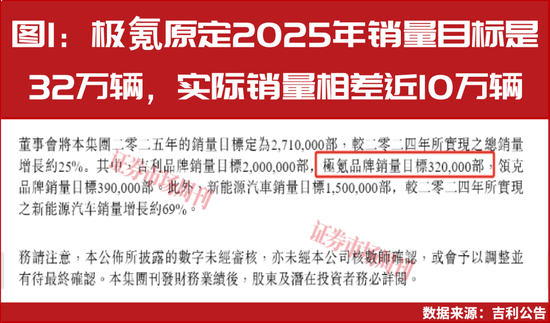
Group 1 - Zeekr's subsidiary, Weirui, has filed a lawsuit against Aisin Wanda for 2.314 billion yuan due to battery quality issues [1][2][13] - The lawsuit claims that the battery cells delivered from June 2021 to December 2023 had quality problems that caused financial losses [2][15] - Aisin Wanda is currently undergoing IPO guidance while also pursuing a Hong Kong IPO [1][13] Group 2 - The lawsuit is based on numerous complaints from owners of the Zeekr 001 model, reporting issues such as reduced charging speed and inaccurate battery capacity [3][16] - In response, Zeekr initiated a "Winter Care Activity" to offer free battery health checks for affected vehicle owners [4][17] Group 3 - Prior to the lawsuit, the partnership between Geely and Aisin Wanda was seen as a model of industry collaboration, with significant awards and recognition for their joint efforts [5][18] - Aisin Wanda's financial performance has raised regulatory concerns, with reported revenues of 11.12 billion yuan in 2023 and a net loss of 1.56 billion yuan [5][18] Group 4 - Analysts had previously viewed the collaboration with Geely as a positive factor for Aisin Wanda's future performance, with expectations of significant growth in their battery business [6][19] - Following the lawsuit, optimistic profit forecasts for Aisin Wanda may need to be reassessed, as the case has been accepted by the court but not yet formally heard [6][19] Group 5 - Zeekr aims for a 34% increase in sales for 2026, targeting 300,000 units, following a disappointing 2025 performance where actual sales were only 70% of the target [10][21] - The latest subsidy policies for 2026 are expected to positively impact Zeekr, particularly for mid-to-high-end electric vehicles [11][25]