
碳排放权交易

Search documents
持续深化气候投融资,建议从这些方面着力
Zhong Guo Huan Jing Bao· 2025-08-26 00:19
Core Viewpoint - Climate investment and financing are crucial for achieving China's "dual carbon" strategic goals, with a focus on developing a comprehensive policy framework and innovative financing models to support climate projects [1][4][6] Group 1: Climate Investment and Financing Framework - The Ministry of Ecology and Environment and other departments have issued guidelines to promote climate investment and financing, with pilot projects initiated in 23 locations showing preliminary success [1] - A collaborative policy system is necessary to address the investment return mechanism challenges faced by various climate projects across sectors such as industry, construction, and transportation [4][5] Group 2: Carbon Emission Data Management - The establishment of an application-oriented carbon emission database is essential, emphasizing the need for a clear roadmap and integration with various application scenarios to enhance data quality and reduce costs [2] - The carbon emission data linkage mechanism should be effectively applied in market transactions, collateral loans, and other areas, ensuring that the cost-benefit ratio of these applications is reasonable [3] Group 3: Policy and Market Mechanisms - Fiscal policies should leverage investment subsidies and risk compensation funds to attract social capital for climate projects, while monetary policies must provide targeted financing support to reduce project costs [5] - A multi-layered carbon trading system needs to be developed, enhancing both mandatory and voluntary carbon markets to reflect true emission reduction costs and environmental values [5] Group 4: Innovation in Financing Models - Innovative financing models for climate projects should focus on integrating various funding sources and enhancing the attractiveness of investment returns, utilizing methods like Public-Private Partnerships (PPP) [6]
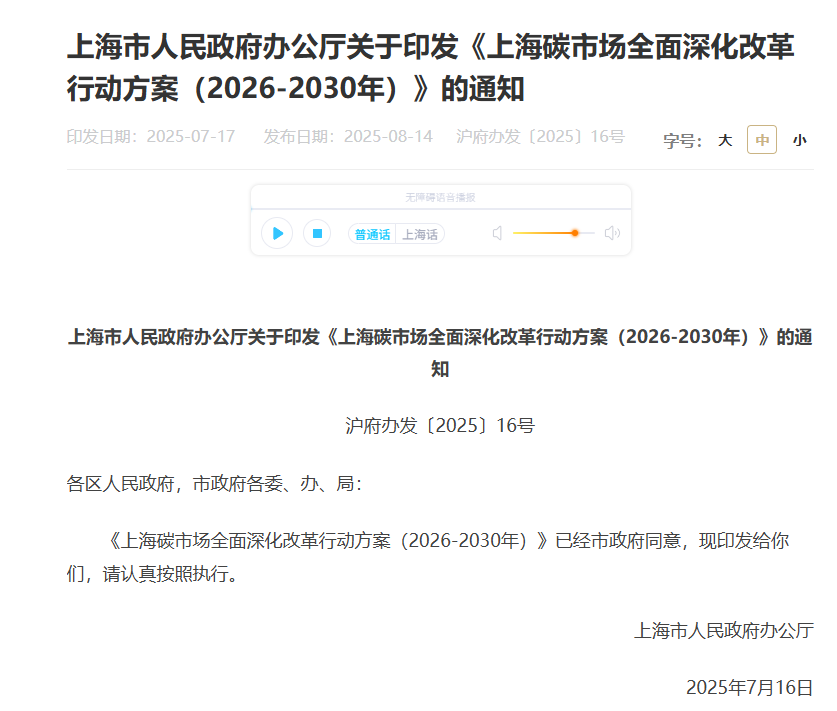
上海:丰富碳金融产品和服务体系
Zhong Guo Zheng Quan Bao· 2025-08-14 20:16
Core Viewpoint - The Shanghai Municipal Government has issued the "Action Plan for Comprehensive Deepening Reform of the Shanghai Carbon Market (2026-2030)" aimed at establishing a carbon pricing mechanism centered around the carbon market, with the goal of making Shanghai a significant international hub for carbon trading, finance, pricing, and innovation [1] Group 1: Carbon Market Development - The action plan emphasizes the enhancement of the carbon emission trading market, including the establishment of a total quota management system and a reserve quota adjustment mechanism [1] - It proposes a dual control system for carbon emissions, linking total emissions and intensity, and aims to reserve development space for strategic emerging industries [1] - The market coverage will be gradually expanded, with reduced thresholds for high-energy industries and public institutions starting from 2026 and 2028 respectively [1] Group 2: Voluntary Emission Reduction Initiatives - The plan encourages enterprises to establish product carbon footprint management systems and set greenhouse gas emission control targets to achieve net-zero emissions [2] - It aims to create a sustainable management mechanism for carbon inclusivity, focusing on areas like green travel and resource recycling [2] - The action plan also seeks to innovate carbon inclusivity incentive mechanisms, including the development of a personal carbon credit assessment system [2]
上海:合理确定碳排放配额总量 为战略性新兴产业和未来产业预留发展空间
Xin Hua Cai Jing· 2025-08-14 05:26
Core Viewpoint - The Shanghai Municipal Government has issued the "Action Plan for Comprehensive Deepening Reform of the Shanghai Carbon Market (2026-2030)", focusing on enhancing the carbon emissions trading market and promoting voluntary greenhouse gas reduction initiatives [1] Group 1: Key Actions in Carbon Emissions Trading Market - The action plan includes four innovative measures: 1. Total management linking quota allocation with carbon emission total and intensity control, allowing stable industries to implement total quota control while reserving space for emerging strategic industries [2] 2. Market expansion by lowering entry thresholds for high-energy industries and extending coverage to buildings like universities and hospitals, while considering the inclusion of non-CO2 greenhouse gases [2] 3. Paid allocation to establish a low-carbon development awareness, with a target of keeping paid allocation ratio within 8% by 2027 and further increasing it by 2030 [2] 4. Quota transfer management to ensure alignment with the national carbon market, allowing three-year transfers for units entering the national market [2] Group 2: Key Actions in Voluntary Greenhouse Gas Reduction - The plan outlines three innovative measures: 1. Promoting sustainable carbon management through refined classification and management, emphasizing a closed-loop consumption system supported by blockchain and AI [3] 2. Innovating carbon incentive mechanisms to foster a user growth system and attract diverse participants for carbon credit initiatives [3] 3. Standardizing carbon neutrality for large events, with government and state-owned enterprises leading by example [3] Group 3: Key Actions in Carbon Financial Development - Three innovative measures are highlighted: 1. Expanding market participants under controlled risks, including financial institutions and qualified foreign investors [3] 2. Supporting the inclusion of carbon assets in the collateral for financial institutions [3] 3. Establishing information exchange mechanisms between the carbon market and green finance [3] Group 4: Other Innovative Measures - Four additional innovative measures include: 1. Supporting the development of technical service institutions in carbon management [3] 2. Implementing socialized skill certification for carbon emission managers [3] 3. Seeking to establish an international carbon trading platform under the Paris Agreement in Shanghai [3] 4. Enhancing dialogue and exchange with international carbon markets [3]
上海:自2026年起,石化等高载能行业、数据中心的纳管门槛降至年排放1万吨二氧化碳当量
Xin Hua Cai Jing· 2025-08-14 05:18
Core Viewpoint - Shanghai has issued the "Action Plan for Comprehensive Deepening Reform of the Shanghai Carbon Market (2026-2030)", focusing on enhancing the carbon emission trading market and promoting voluntary greenhouse gas reduction initiatives [1][2]. Group 1: Key Actions - The Action Plan emphasizes three main actions: improving the carbon emission trading market, promoting voluntary greenhouse gas reduction, and enhancing innovation capabilities within the carbon market [1]. - It outlines 16 key reform tasks, including establishing a total quota management system, gradually expanding market coverage, optimizing greenhouse gas emission accounting and reporting methodologies, and increasing the proportion of paid allocation [1][2]. Group 2: Market Coverage Expansion - The plan aims to lower the entry threshold for high-energy-consuming industries, such as petrochemicals and data centers, to an annual emission of 10,000 tons of CO2 equivalent starting in 2026 [2]. - By 2028, public institutions like universities and hospitals with emissions of 10,000 tons or more will be included in the market management and gradually implement carbon emission quota management [2].

TransAlta (TAC) - 2025 Q2 - Earnings Call Transcript
2025-08-01 16:02
Financial Data and Key Metrics Changes - The company reported adjusted EBITDA of CAD 349 million, an increase of CAD 33 million compared to 2024, driven by favorable ancillary service pricing and asset optimization [12][14] - Free cash flow for the quarter was CAD 177 million, consistent with the same period last year, translating to CAD 0.60 per share [8][14] - Average fleet availability was reported at 91.6% [8] Business Line Data and Key Metrics Changes - Hydro segment adjusted EBITDA increased to CAD 126 million from CAD 83 million in the previous year, attributed to higher intercompany sales and emissions credits [12] - Wind and solar segment adjusted EBITDA remained stable at CAD 89 million, with higher environmental revenue offset by lower pricing from Oklahoma assets [12] - Gas segment adjusted EBITDA decreased to CAD 128 million from CAD 142 million, primarily due to lower realized power prices and higher carbon costs [12] - Energy Transition segment adjusted EBITDA rose to CAD 19 million, a CAD 17 million increase year-over-year [12] - Energy Marketing adjusted EBITDA decreased by CAD 13 million to CAD 26 million due to subdued market volatility [12] Market Data and Key Metrics Changes - The average spot price in Alberta for the second quarter was CAD 40 per megawatt hour, down from CAD 45 per megawatt hour in 2024 [14] - The company realized an average price of CAD 111 per megawatt hour produced, benefiting from hedging strategies [16] Company Strategy and Development Direction - The company is focused on delivering adjusted EBITDA and free cash flow within 2025 guidance ranges, improving safety performance, and maximizing the value of legacy thermal energy campuses [17][19] - There is a strong emphasis on pursuing strategic M&A opportunities and maintaining financial strength through credit facility extensions [18][19] - The company aims to repurpose legacy thermal sites to meet the growing demand for reliable generation [19] Management's Comments on Operating Environment and Future Outlook - Management expressed confidence in meeting 2025 guidance and highlighted the positive impact of Alberta's data center strategy on future investments [10][19] - The company remains committed to achieving its 2026 CO2 emissions reduction target and sees significant value in its legacy thermal sites [19] Other Important Information - The company successfully recontracted its wind facilities in Ontario, extending contract dates to 2031 and 2034 [9] - The Alberta government is supportive of developing a data center industry while ensuring an affordable and reliable electricity system [10] Q&A Session Summary Question: Data center discussions and MOU execution - Management indicated that there are no significant impediments to finalizing the MOU, but it requires time to finalize terms and work with customers [23][25] Question: Midlife natural gas M&A focus - Management confirmed that there is an increasing focus on natural gas opportunities, particularly in core markets like the Pacific Northwest and Desert Southwest [26][27] Question: Phase one timeline and Alberta's capacity for data centers - Management noted that while the timeline for MOU has evolved, they remain confident in Alberta's ability to support gigawatt-scale data centers [34][36] Question: Carbon credit sales and their relevance - Management emphasized the value of their environmental attribute portfolio and its importance in maintaining competitiveness and supporting data center discussions [58][59]

三大行业将迎首次碳排放配额分配和履约清缴
Zhong Guo Chan Ye Jing Ji Xin Xi Wang· 2025-07-30 22:23
Group 1 - The core viewpoint is that the national carbon emissions trading market will expand to include the steel, cement, and aluminum smelting industries, with a total annual carbon emissions quota and distribution plan to be publicly solicited soon [1] - The expansion is expected to add 1,500 key emission units to the national carbon market, covering an additional greenhouse gas emission volume of approximately 3 billion tons of CO2 equivalent, which will enable effective control of over 60% of national carbon emissions [1] - Currently, the national carbon emissions trading market covers 2,200 key emission units in the power generation industry, managing over 5 billion tons of CO2 emissions, which accounts for about 40% of the national total [1] Group 2 - The steel, cement, and aluminum smelting industries are significant contributors to carbon emissions, accounting for over 20% of the national total CO2 emissions [1] - The Ministry of Ecology and Environment emphasizes the need for enterprises to strengthen their awareness of responsibilities and improve data quality management in accordance with the "Interim Regulations on Carbon Emission Trading Management" [1] - The Ministry plans to accelerate the improvement of the national carbon market, promoting more high-emission industries to enter the carbon market while combining free and paid quota distribution methods to enhance market vitality [2]
复旦大学可持续发展研究中心公布2025年8月复旦碳价指数
Zheng Quan Ri Bao Wang· 2025-07-29 07:11
Group 1 - The Fudan University Sustainable Development Research Center released the carbon price index for August 2025, including national carbon emission allowance (CEA) prices and China Certified Emission Reduction (CCER) prices [1] - The expected buy price for CEA in August 2025 is 71.25 CNY/ton, with a sell price of 76.04 CNY/ton, resulting in a midpoint price of 73.65 CNY/ton [1] - The expected buy price for CCER in August 2025 is 76.25 CNY/ton, with a sell price of 83.59 CNY/ton, resulting in a midpoint price of 79.91 CNY/ton [1] Group 2 - The research center also published green certificate prices for centralized projects, distributed projects, and biomass power generation for 2024 and 2025 [2] - The expected price for green certificates from centralized projects for 2025 is 7.82 CNY/unit, while distributed projects are expected to be 6.94 CNY/unit, and biomass power generation is expected to be 6.77 CNY/unit [2] - Compared to July 2025, the prices of green certificates for 2024 and 2025 show mixed trends, with some prices increasing and others decreasing [2] Group 3 - In July, the average closing price for CEA was 73.64 CNY/ton, an increase of approximately 3% compared to June's average of 71.51 CNY/ton [3] - The average daily trading volume for carbon allowances in July was 51.03 million tons, a decrease of 35.75% from June's 79.42 million tons, ending a four-month increase in trading volume [3] - Despite the decrease in trading volume, it remains at a high level, showing a year-on-year increase of nearly 236%, indicating enhanced trading activity in the national carbon emissions trading market [3]
“碳账单”变收益单 全国碳市场运行四年来市场交易日趋活跃
Yang Shi Xin Wen· 2025-07-15 23:57
Market Overview - The national carbon emissions trading market in China has been operational for four years, showing healthy and orderly functioning with significantly enhanced trading activity [1] - Cumulative trading volume has surpassed 670 million tons, with total transaction value exceeding 46.2 billion yuan, indicating continuous market expansion [1] - In 2024, the annual transaction value exceeded 18 billion yuan, marking a nearly 25% year-on-year increase and setting a historical high [1] Price Trends - Carbon emission allowance prices exceeded 100 yuan per ton in November 2024, with recent market prices stabilizing between 70 to 80 yuan per ton, nearly doubling compared to the initial trading period [1] Technological Advancements - The first batch of over 2,000 coal-fired power enterprises participating in the national carbon market has adopted the mindset of "emissions have costs, and reductions have benefits," leading to technological upgrades that enhance efficiency and reduce costs [1] Case Studies - Xiamen Huaxia Power's Songyu Power Plant faced significant emission reduction pressure, purchasing approximately 150,000 tons of carbon allowances last year, which motivated the company to phase out outdated capacity [2] - The plant recently commissioned a state-of-the-art 660,000 kW reheat power generation unit, replacing two 30-year-old units, saving over 90,000 tons of standard coal and reducing CO2 emissions by more than 250,000 tons annually [2] - Huaneng Hubei Power's Xiangyang Power Plant implemented biomass gasification coupled with coal-fired generation, utilizing agricultural waste to generate 59 million kWh annually, replacing 18,000 tons of standard coal and reducing CO2 emissions by approximately 50,000 tons [2] Industry Impact - The carbon emissions trading market has led to a reduction in carbon intensity for key power generation units by approximately 8.78% from 2018 to 2023, with total carbon emissions decreasing by about 2.8% [2] - The average annual reduction in emission costs is estimated to be around 12 to 13 billion yuan [2]
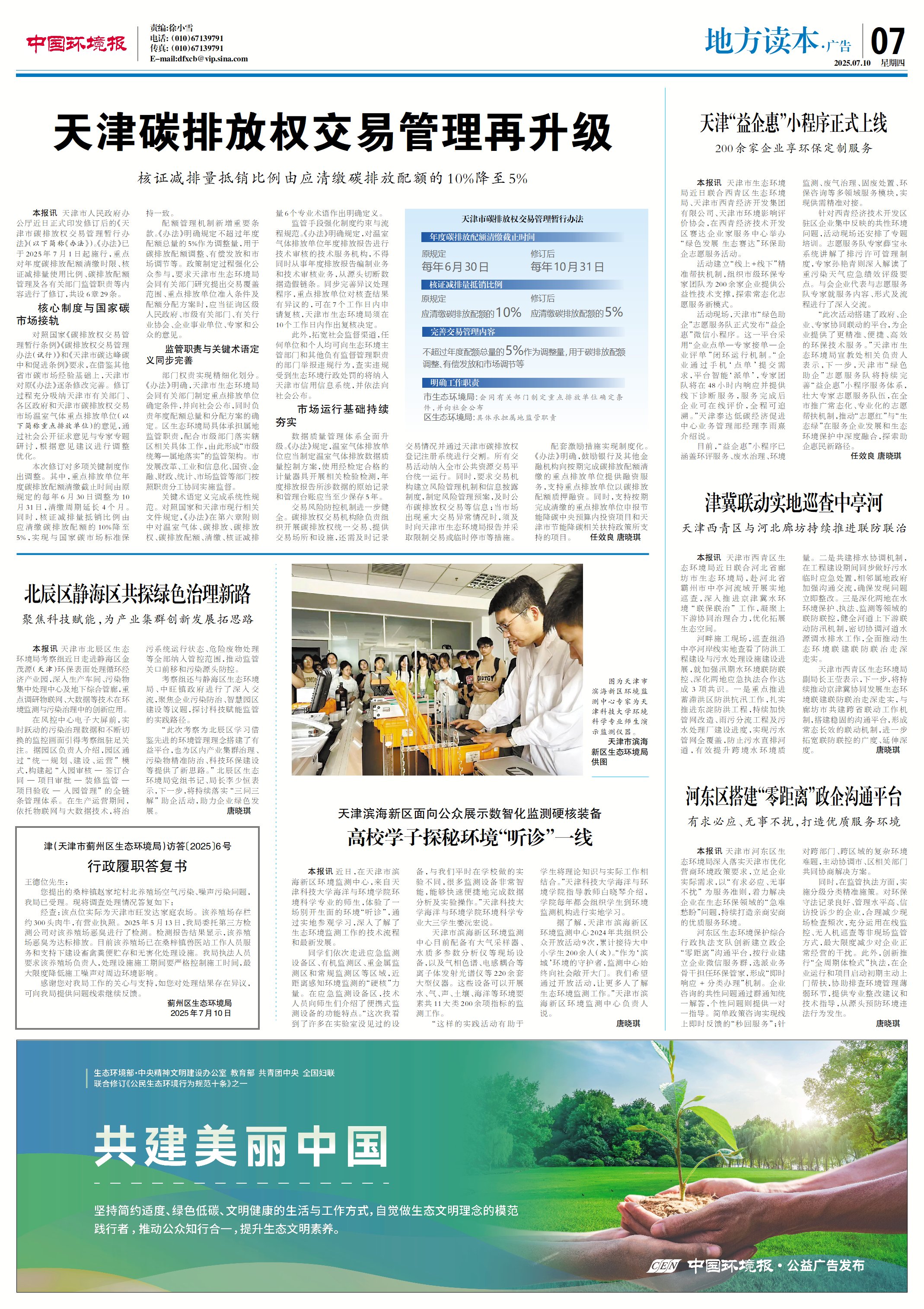
天津碳排放权交易管理再升级
Zhong Guo Huan Jing Bao· 2025-07-10 02:45
Core Viewpoint - The Tianjin Municipal Government has officially issued the revised "Interim Measures for the Management of Carbon Emission Rights Trading in Tianjin," which will take effect on July 1, 2025, focusing on adjustments to carbon emission quota compliance deadlines, the use ratio of certified emission reductions, and the management of carbon emission quotas, among other aspects [1][9]. Group 1: Key Adjustments in Regulations - The deadline for annual carbon emission quota compliance for key emission units has been extended from June 30 to October 31, increasing the compliance period by four months [2][11]. - The offset ratio for certified emission reductions has been reduced from 10% to 5% of the required carbon emission quotas, aligning with national carbon market standards [2][11]. - A new provision allows up to 5% of the total annual quota to be used for adjustments, paid issuance, and market regulation [2][11]. Group 2: Regulatory Responsibilities and Definitions - The Tianjin Municipal Ecology and Environment Bureau is responsible for determining the conditions for key emission units and the total annual quota and distribution plan [3][12]. - The regulatory framework has been refined to establish a "city-level coordination and local implementation" structure, with various departments collaborating on supervision [3][12]. - Key terms such as greenhouse gases, carbon emissions, and carbon emission rights have been clearly defined in the revised measures [3][12]. Group 3: Strengthening Oversight and Public Participation - The revised measures enhance public participation in policy formulation, requiring the Tianjin Municipal Ecology and Environment Bureau to consult with various stakeholders when proposing trading coverage and quota distribution plans [2][11]. - Any individual or organization can report violations to the relevant ecological environment authorities, with confirmed violations being recorded in the Tianjin credit information system [4][13]. Group 4: Market Operation and Risk Management - The measures mandate that greenhouse gas emission units develop data quality control plans and maintain original records for at least five years [5][14]. - Carbon emission trading institutions are required to establish risk management mechanisms and report significant trading anomalies to the Tianjin Municipal Ecology and Environment Bureau [5][14]. - Financial institutions are encouraged to provide financing services to key emission units that comply with carbon emission quota requirements [5][14].
圆桌|新碳信用标准通过后,全球碳市场的“梦想”会实现吗?
Sou Hu Cai Jing· 2025-06-29 23:51
Group 1 - The introduction of international emissions trading at COP3 in 1997 aimed to help countries meet their emission reduction commitments through the purchase of carbon credits [1] - The carbon market is divided into mandatory and voluntary types, with Europe leading the establishment of emissions trading systems, followed by countries like China, South Korea, Japan, and Australia [1][3] - The lack of a unified international standard has hindered the establishment of a robust market, with the Paris Agreement's Article 6 still facing challenges in implementation due to verification method issues [1][8] Group 2 - The UN approved the "Paris Agreement Carbon Credit Mechanism" (PACM) in May 2025, providing guidance for evaluating the effectiveness of emission reduction projects [1] - The new standards include a baseline standard to estimate potential emissions without the mechanism and a leakage standard to account for unintended emissions increases [1][15] - The establishment of the "Development Carbon Market Alliance" by Singapore, Kenya, and the UK signifies a government-led initiative to advance carbon markets [2] Group 3 - Carbon markets help achieve emission reduction goals at lower costs, enhancing economic efficiency and promoting energy conservation awareness [3] - Major carbon markets include the EU carbon market and China's national carbon market, with the EU market being a mature example using an absolute cap-and-trade model [3][4] - China's carbon market, launched in July 2021, covers approximately 5.1 billion tons of CO2 emissions and includes 2,257 key emitting units [4] Group 4 - The Kyoto Protocol established the Clean Development Mechanism (CDM) in 2005, allowing developed countries to obtain certified emission reductions (CERs) through projects in developing countries [5] - The carbon market's core function is to create a carbon price signal that guides emission reduction actions, with the expectation that carbon prices will rise as emission caps tighten [5][6] Group 5 - The EU carbon market has seen a significant price increase, with expectations that prices will exceed €120 per ton by 2030 and €400 by 2040, reflecting the costs of advanced reduction measures [6] - The demand for carbon markets from countries is driven by the need to achieve climate goals cost-effectively, with different mechanisms in place across regions [6][7] Group 6 - The establishment of national carbon markets is crucial for countries to meet their Nationally Determined Contributions (NDCs) under the Paris Agreement [7][9] - The EU's carbon market has undergone structural reforms to recover carbon prices after a prolonged period of low prices due to oversupply [7][9] Group 7 - The challenges in creating a global carbon market include historical issues with previous mechanisms and differing national interests between developed and developing countries [9][11] - The complexity of mechanism design and the need for clarity in methodologies and standards are significant barriers to establishing a unified global carbon market [9][10] Group 8 - The implementation of new standards aims to enhance the quality of carbon credits and ensure the authenticity of emission reductions, promoting high-quality development in global carbon markets [15][16] - Future directions include improving verification processes, enhancing international cooperation, and integrating carbon markets with global climate actions [15][17] Group 9 - China's transition from a seller to a buyer in the international carbon market poses challenges in aligning domestic mechanisms with international standards [19][20] - The national carbon market's tightening control over emissions will support China's dual carbon goals while balancing domestic and international climate trade requirements [20][21]