
育儿补贴

Search documents
多地育儿补贴已到账!你家申领了吗?一图看攻略→
Xin Lang Cai Jing· 2025-12-21 09:22
| (来源:经济日报) | | --- | | 转自:经济日报 | | 临近年末 | | 有人惊喜地发现 | | 银行账户上多出了一笔钱 | | 原来是育儿补贴到账了 | +3,600.00 余额:1 | 交易时间 | 2025-12-12 11:15 | | --- | --- | | 交易卡号 | | | 业务摘要 | 他行汇入 | | 交易详情 | 育儿 | | 交易国家或地区 简称 | CHN | | 交易金额 | 3,600.00 | | 附言 | 育儿 | | 记账金额 | 3,600.00 | | 记账币种 | 人民币 | 2025年11月中下旬起 各地陆续启动育儿补贴发放 12月进入集中发放高峰期 北京、重庆、湖北、浙江、江苏 广东、陕西、广西、四川等多地 都已开始派发这份"大红包" 育儿补贴由家长申领 审核通过后分批次发放 尚未收到的家庭 可能属于后续批次,不要着急! 育儿补贴主要通过 全国统一育儿补贴信息管理系统申领 依托各地省级政务服务平台 设置育儿补贴申领专区 目前,支付宝、微信申请入口均已上线 搜索"育儿补贴"即可找到官方小程序 特别提醒 2022年1月1日至2024年12月31日出 ...

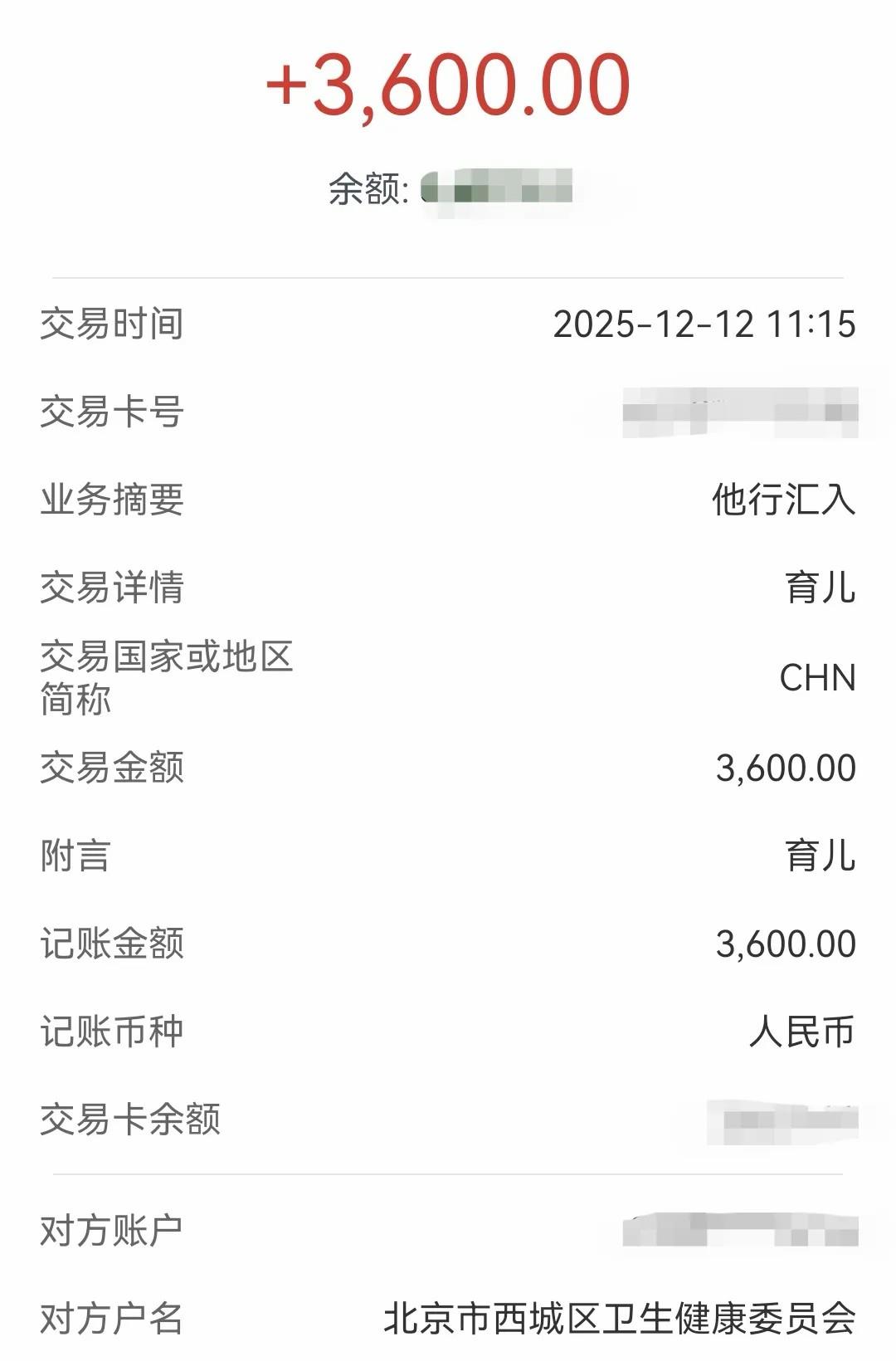
育儿补贴已到账!
Xin Lang Cai Jing· 2025-12-21 05:42
转自:珠海发布 年关将近, 不少人惊喜地发现, 自己的银行账户上 多出了一笔钱, 原来是育儿补贴到账了! @珠海宝爸宝妈 快来查查你的到账了没有! | 交易时间 | 2025-12-12 11:15 | | --- | --- | | 交易卡号 | | | 业务摘要 | 他行汇入 | | 交易详情 | 育儿 | | 交易国家或地区 简称 | CHN | | 交易金额 | 3,600.00 | | 附言 | 育儿 | | 记账金额 | 3.600.00 | | 记账币种 | 人民币 | | 交易卡余额 | | | 对方账户 | | 2025年11月中下旬起, 各地陆续启动育儿补贴发放, 12月进入集中发放高峰期, 广东等多地 都已开始派发育儿"大红包"。 小布获悉, 珠海已有不少宝爸宝妈, 收到第一批育儿补贴。 育儿补贴由家长申领, 审核通过后分批次发放, 尚未收到的家庭, 可能属于后续批次, 不要着急! 如何申请育儿补贴? 育儿补贴主要通过全国统一 育儿补贴信息管理系统申领, 依托各地省级政务服务平台, 设置育儿补贴申领专区。 目前,支付宝、微信等 申请入口均已上线, 搜索"育儿补贴" 即可找到官方小程序。 ...
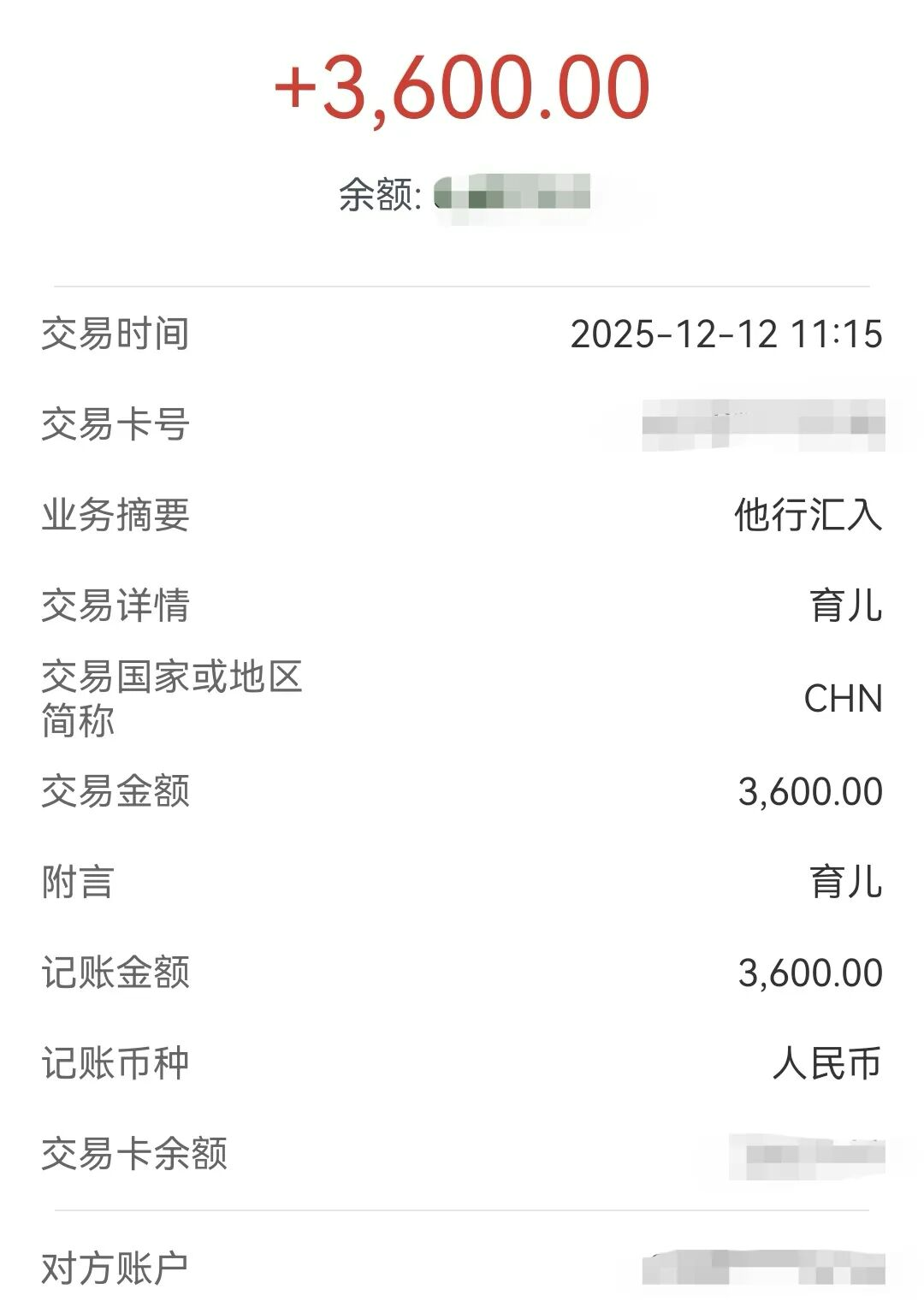
多地育儿补贴已到账 还没申领的家庭速来了解→
Xin Lang Cai Jing· 2025-12-20 20:03
临近年末 有人惊喜地发现 银行账户上多出了一笔钱 原来是育儿补贴到账了 2025年11月中下旬起 各地陆续启动育儿补贴发放 12月进入集中发放高峰期 北京、重庆、湖北、浙江、江苏 广东、陕西、广西、四川等多地 都已开始派发这份"大红包" 育儿补贴由家长申领 审核通过后分批次发放 尚未收到的家庭 可能属于后续批次,不要着急! 育儿补贴主要通过 全国统一育儿补贴信息管理系统申领 依托各地省级政务服务平台 设置育儿补贴申领专区 目前,支付宝、微信申请入口均已上线 搜索"育儿补贴"即可找到官方小程序 特别提醒 2022年1月1日至2024年12月31日出生 符合申领条件的婴幼儿 须于2025年12月31日前提交申请 监制丨王元主编丨米莎编辑丨杨惠珺 ©2025中央广播电视总台版权所有。未经许可,请勿转载使用。 ...
多地育儿补贴已到账!
Xin Lang Cai Jing· 2025-12-20 12:58
临近年末 有人惊喜地发现 银行账户上多出了一笔钱 原来是育儿补贴到账了 | 交易时间 | 2025-12-12 11:15 | | --- | --- | | 交易卡号 | | | 业务摘要 | 他行汇入 | | 交易详情 | 育儿 | | 交易国家或地区 简称 | CHN | | 交易金额 | 3,600.00 | | 附言 | 育儿 | | 记账金额 | 3.600.00 | | 记账币种 | 人民币 | 2025年11月中下旬起 各地陆续启动育儿补贴发放 12月进入集中发放高峰期 北京、重庆、湖北、浙江、江苏 广东、陕西、广西、四川等多地 都已开始派发这份"大红包" 育儿补贴由家长申领 审核通过后分批次发放 尚未收到的家庭 可能属于后续批次,不要着急! 育儿补贴主要通过 全国统一育儿补贴信息管理系统申领 依托各地省级政务服务平台 设置育儿补贴申领专区 目前,支付宝、微信申请入口均已上线 搜索"育儿补贴"即可找到官方小程序 特别提醒 2022年1月1日至2024年12月31日出生 符合申领条件的婴幼儿 须于2025年12月31日前提交申请 > 对于2025年1月1日之前出生、 不满3周岁的婴幼儿,按应补贴 ...

股东拟减持套现1.3亿元!阳光乳业业绩承压,连续七个季度营收增速下滑
Da Zhong Ri Bao· 2025-12-16 05:07
Core Viewpoint - The National Healthcare Security Administration aims to achieve a situation where childbirth costs are essentially "zero" by next year, which has positively impacted the stock performance of the dairy industry, particularly Sunshine Dairy, whose stock price has increased over 44% this year. However, the company is facing performance pressures and development bottlenecks, with significant share reductions by its major shareholders [1][6]. Shareholder Actions - Sunshine Dairy's second-largest shareholder, Nanchang Zhihui, announced a plan to reduce its holdings by up to 3% due to funding needs, which could result in cashing out over 130 million yuan [2][4]. - The controlling shareholder, Sunshine Group, has also been reducing its stake, selling 921,700 shares on June 27, 2025, and 2,676,800 shares between July 29 and August 1, 2025, collectively cashing out over 56 million yuan [4][5]. Financial Performance - Sunshine Dairy has experienced a decline in revenue for seven consecutive quarters, with a reported revenue of 5.19 billion yuan in 2024, down 8.86% year-on-year, and a net profit of 1.15 billion yuan, down 1.09% [7][10]. - The company's main product, low-temperature dairy products, accounted for 78.37% of revenue in the first half of the year, but saw a revenue decline of 9.61% [13]. - The company is facing increased operating expenses, with sales, management, and financial costs rising by 1.01%, 6.39%, and 11.44% respectively, further compressing profits [13]. Industry Context - The Chinese dairy industry is undergoing a phase of adjustment and challenges, with declining consumption growth rates and revenue drops reported by major players like Yili and Mengniu. Sunshine Dairy, as a regional player, is particularly affected by local market conditions [10][13].
我市首批育儿补贴月底前完成发放
Xi An Ri Bao· 2025-12-16 03:36
12月15日,记者从西安市卫生健康委获悉,即日起,西安市全面启动育儿补贴发放工作。我市提交 申请330592人,审核通过326601人。首次发放将在2025年12月底前完成。 据了解,育儿补贴方面我市执行国家统一标准和政策,即从2025年1月1日起,对具有本市户籍、符 合法律法规规定生育或收养的3周岁以下婴幼儿,按照每孩每年3600元发放补贴,至其年满3周岁。对于 2025年1月1日及以后出生的婴幼儿,可连续申领3年补贴,共计10800元。对于2025年1月1日之前出生且 不满3周岁的婴幼儿,按应补贴月数折算计发补贴。 截至2025年12月10日24:00时,我市提交申请330592人,审核通过326601人。首次发放在2025年12 月底前完成,以后每年度原则上按照以季度为周期集中发放,当该季度已发放完毕后审核通过或提交申 请的,补贴将在下一季度发放。 我市育儿补贴的发放遵循便民、普惠和安全的原则。主要通过申领人或婴幼儿的银行卡(包含"一 卡通"或婴幼儿的社会保障卡)发放,不限定申领人提供指定银行卡,不要求申领人在已有银行卡且能 正常使用的情况下办理新卡。儿童福利机构申领的育儿补贴发放至机构对公账户。 按照 ...
苏超、票根经济等入选2025年度十大新词语
Zhong Guo Xin Wen Wang· 2025-12-16 02:55
Core Insights - The "Top Ten New Words of 2025" highlights significant trends in various sectors, including sports, technology, economy, and culture, reflecting a year of innovation and development [1][2] Group 1: Sports and Economy - "苏超" (Su Super League) emerges as a notable urban sports league, enhancing regional culture and serving as a new engine for city branding [1] - The rise of "票根经济" (Ticket Root Economy) revitalizes traditional ticketing through the integration of AR technology and blockchain, unlocking new consumption potential [1] Group 2: Technology and Urban Development - "杭州六小龙" (Hangzhou Six Little Dragons) represents a group of cutting-edge tech companies making breakthroughs in AI, robotics, and game development [1] - The concept of "现代化人民城市" (Modernized People's City) is advancing, utilizing big data and cloud computing for refined and intelligent urban management [1] Group 3: Social Policies and International Trade - "育儿补贴" (Childcare Subsidy) is being upgraded to alleviate pressure on young families, contributing to population structure optimization and family stability [1] - The "跨境支付通" (Cross-Border Payment System) is being fully upgraded, enhancing efficiency and security in international trade and investment [2] - New agreements on "对等关税" (Reciprocal Tariffs) are being established, injecting vitality into the open world economy [2] Group 4: Culture and Lifestyle - "新大众文艺" (New Mass Culture) continues to thrive, with innovations in online literature, short videos, and live streaming, allowing amateur creators to shine [2] - The "轻体" (Light Lifestyle) concept promotes simplicity, environmental consciousness, and health as new trends [2] - The trend of "拉布布" (Labubu) toys, characterized by unique design and multicultural elements, becomes popular among youth as a means of self-expression [2]
【8点见】住建局局长回应评审名单照搬人名大全
Yang Shi Wang· 2025-12-06 00:07
央视网消息:每天8点,央视网为您梳理24小时内发生在咱们身边的大小事儿。 ·国家发展改革委全年下达以工代赈中央投资355亿元。 ·保障冬季采暖,11月份国家铁路累计发送煤炭1.84亿吨。 ·"双十二"临近,中国消费者协会、中国市场监督管理学会发布消费提示。 ·中国疾控中心病毒病所研究员王大燕:预计全国流感在12月上中旬达峰可能性较大。 ·交通运输部原党组成员,国家铁路局原党组书记、局长费东斌严重违纪违法被开除党籍和公职。 "2025年度中国媒体十大热词"发布,分别是:"十五五"规划、九三阅兵、全球治理倡议、DeepSeek(深度求索)、人形机器人、苏超、票根经济、育儿补贴、 科学素养、网络生态治理。 ·直达中越边境,南宁至凭祥高铁全线贯通运营。 ·侵华日军南京大屠杀遇难同胞纪念馆公布一批最新文物史料。 ·美国国土安全部长:计划扩大"旅行禁令"范围至30多个国家。 ·南非外长:美国无权单方面将南非排除在G20框架外。 ·日本启动第17次核污染水排海。 ·美海军公布三起"超级大黄蜂"战机坠机事故原因。 ·巴拿马航空公司:往返委首都航班停飞延至12日。 ·日媒:山上彻也首次向安倍遗属道歉。 ·米兰冬奥会火种抵达意大 ...

2025年度中国媒体十大热词发布
Xin Hua She· 2025-12-05 14:43
国家语言资源监测与研究中心12月5日发布"2025年度中国媒体十大热词",分别为:"十五五"规 划、九三阅兵、全球治理倡议、DeepSeek(深度求索)、人形机器人、苏超、票根经济、育儿补贴、 科学素养、网络生态治理。 "2025年度中国媒体十大热词"是基于国家语言资源监测语料库,利用语言信息处理技术,结合人工 后期处理提取、筛选而获得,语料规模达10余亿字次。本次发布是"汉语盘点2025"活动的重要组成部 分,活动期间还将陆续发布"年度十大网络用语""年度十大新词语",揭晓年度字词。(记者 杨湛菲) ...
“2025年度中国媒体十大热词”发布
Zhong Guo Xin Wen Wang· 2025-12-05 07:57
"2025年度中国媒体十大热词"发布 中新社北京12月5日电 (记者 应妮)"2025年度中国媒体十大热词"5日发布,分别是:"十五五"规划、九三 阅兵、全球治理倡议、DeepSeek(深度求索)、人形机器人、苏超、票根经济、育儿补贴、科学素养、网 络生态治理。 中国国家语言资源监测与研究中心发布上述热词并予以注解:2025年,是谋划"十五五"规划之年,编制 和实施"十五五"规划,对于全面落实中共二十大战略部署、推进中国式现代化意义重大。 九三阅兵向世界宣示了中国坚决捍卫国家主权、安全、发展利益的坚定决心,以及维护世界和平的大国 担当。 2025年,中国国家主席习近平在"上海合作组织+"会议上提出全球治理倡议。 来源:中国新闻网 编辑:王永乐 广告等商务合作,请点击这里 2025年,"苏超"通过城市间的精彩角逐,激发了地域认同感,带动了从门票到文旅的庞大消费链条,成 为"体育+"融合发展的生动实践。 2025年,中国初创企业自主研发的大语言模型"DeepSeek"(深度求索)凭借"好用、开源、免费、低成 本"等特点展现了中国AI科技企业的创新性和包容性。 这一年,打通消费环节的"票根经济"应时而生,为消费升级 ...