住房公积金

Search documents
别墅增设电梯不能提取公积金
Xin Lang Cai Jing· 2026-02-24 19:18
Group 1 - The Hunan Provincial Housing Fund Management Center clarified that employees cannot withdraw housing provident fund for adding elevators to villas with three floors or below [1] - For existing multi-story residential buildings, owners can apply to withdraw housing provident fund for elevator installation, limited to one withdrawal per employee for the same property [1][2] - The total amount withdrawn by all property owners cannot exceed the self-paid cost allocated to them, and the withdrawal amount is calculated to the nearest hundred [2] Group 2 - From February 1, 2026, the maximum loan amount for housing provident fund loans will be calculated as 15 times the combined balance of the borrowers' housing provident fund accounts [3] - For families with two or three children, the maximum loan amounts will be 960,000 and 1,040,000 yuan respectively [3] - For employees with housing provident fund contributions of 1,500 yuan per month, the maximum loan amount after one year of contributions will be 540,000 yuan, an increase of 36,000 yuan compared to 2024 [3]
“十四五”期间全国住房公积金累计发放贷款6.5万亿元
Sou Hu Cai Jing· 2026-01-25 16:01
Core Insights - During the "14th Five-Year Plan" period, a total of 6.5 trillion yuan in personal housing loans from the housing provident fund has been issued nationwide, supporting 9.4 trillion yuan in withdrawals for housing consumption by contributors [1] - A pilot program has been launched in 36 cities to allow flexible employment individuals to participate in the housing provident fund system [1]
公积金超10万亿资金或将被激活
21世纪经济报道· 2026-01-16 13:56
Core Viewpoint - The article discusses the urgent need for reform in China's housing provident fund system, which has over 10 trillion yuan in dormant funds, to better support housing needs, including rental and affordable housing, and to adapt to the changing housing market dynamics [1][12][18]. Historical Context - The housing provident fund system was established in the early 1990s to address urban housing shortages, with Shanghai being the first city to implement it in 1991 [4][5]. - Over the past 30 years, the system has played a crucial role in facilitating home purchases for urban workers through mandatory savings and low-interest loans [6][9]. Current Status - As of the end of 2024, there are over 1.76 billion contributors to the housing provident fund, representing approximately 12.5% of the national population [3][6]. - The total accumulated withdrawal amount from the housing provident fund has exceeded 21.8 trillion yuan, accounting for 67% of the total contributions [6]. Challenges - There is a significant amount of dormant funds, with the balance increasing from approximately 3.7 trillion yuan in 2014 to about 10.9 trillion yuan by the end of 2024, marking a nearly 195% increase over ten years [8][9]. - The current regulations restrict the withdrawal and usage of funds, leading to a situation where funds are "stored but not used" [8][9]. Reform Directions - The central economic work conference in 2025 emphasized the need to deepen reforms in the housing provident fund system, marking the first such directive in a decade [12]. - Proposed reforms include expanding the coverage to flexible employment groups, adjusting withdrawal conditions, and creating a more unified national market to facilitate population mobility [10][12][13]. Policy Adjustments - Various local governments have begun optimizing housing provident fund policies, with over 280 related adjustments made in 2025, focusing on increasing loan limits and expanding the range of permissible uses for the funds [15][16]. - Specific examples include increased loan limits for families with multiple children and allowing withdrawals for home renovations and property management fees [16][17]. Key Issues to Address - The article highlights two critical issues: the need for cross-regional recognition and lending of provident funds, and the narrowing interest rate gap between provident fund loans and commercial loans, which may affect the attractiveness of the former [19][20]. - Solutions proposed include establishing a demand-driven fund allocation mechanism and ensuring that the provident fund remains a competitive financial tool in the housing market [20][21].


深化住房公积金制度改革,怎么做?
Jing Ji Ri Bao· 2026-01-14 02:24
Core Insights - The housing provident fund system is set to undergo reforms in 2025, aiming to enhance its role in expanding domestic demand and stabilizing the market, benefiting more contributors and better meeting housing needs [1] - The housing provident fund will continue to support residents in purchasing homes, with policies in place to increase loan limits and optimize processes for converting commercial loans to provident fund loans [1] - The reform is expected to provide greater support for housing consumption, particularly in urban renewal and improving living conditions [1] Group 1 - The number of contributors to the housing provident fund is projected to reach 176.29 million by 2024 [1] - The housing provident fund will expand its funding usage to include flexible employment workers, with 23 new pilot cities added, increasing the total to 36 cities [2] - By the end of 2024, over 1 million flexible employment workers are expected to contribute to the housing provident fund, with 240,000 already utilizing it for housing [2] Group 2 - In 2024, 81.27 million people are expected to withdraw from the housing provident fund, representing 46.10% of contributors [3] - The fund can be used for both home purchases and rentals, with a significant increase in withdrawals for rental purposes [3] - The total balance of the housing provident fund is projected to reach 10.93 trillion yuan by the end of 2024, with various cities exploring its use for public services like property fees and elevator installations [3][4] Group 3 - The efficiency of housing provident fund services is expected to improve through enhanced data governance and standardized service levels [4]
一线城市公积金归集齐破“万亿”:深圳起步最晚却最快冲刺达标
Mei Ri Jing Ji Xin Wen· 2025-10-25 00:42
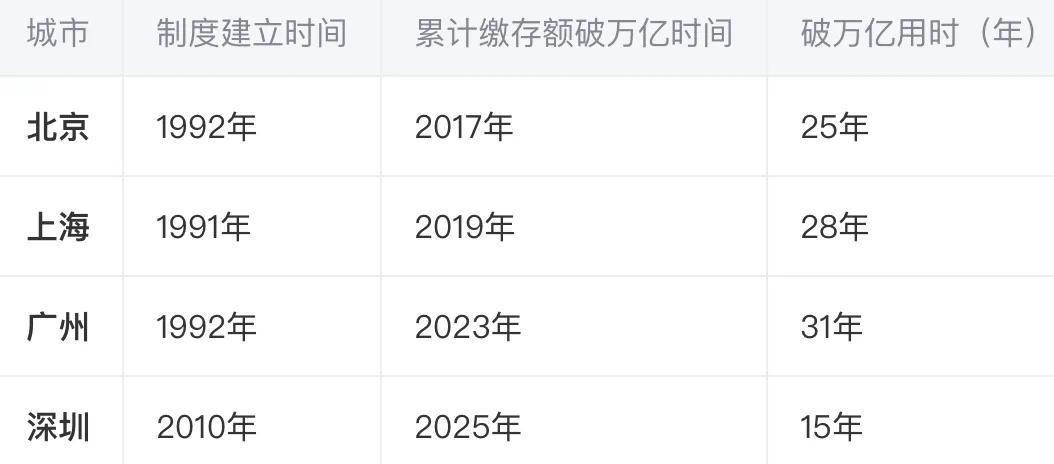
Core Viewpoint - Shenzhen has achieved a historic milestone by accumulating over 1 trillion yuan in housing provident fund contributions in less than 15 years, significantly faster than other major cities in China [1][4]. Group 1: Accumulation Timeline - Beijing established its housing provident fund system in 1992 and reached the 1 trillion yuan mark in 2017, taking 25 years [2]. - Shanghai implemented its system in 1991 and achieved the same milestone in 2019, taking 28 years [2]. - Guangzhou, also starting in 1992, reached 1 trillion yuan in 2023, taking 31 years [2]. - Shenzhen, which began its system in 2010, is projected to reach this milestone by 2025, taking only 15 years [2]. Group 2: Factors Contributing to Rapid Growth - Shenzhen's rapid accumulation is attributed to two main pillars: continuous expansion of the coverage of the system and ongoing upgrades in management capabilities [3]. - The city has adopted a "willing to contribute" approach to broaden the contributor base, including non-public enterprises and flexible employment groups [5]. - The demographic structure in Shenzhen, with a young population and many new residents, contributes to a "net contributor" status, where contributions exceed withdrawals and loans [5]. Group 3: Fund Management and Utilization - The Shenzhen housing provident fund management center primarily manages surplus funds through fixed-term deposits [3]. - As of September 2025, over 2.6 billion yuan has been withdrawn for rent payments, with total withdrawals reaching 600 billion yuan, of which over 87% is for housing consumption [7]. - Shenzhen has innovated in loan policies, including a "zero materials" process for converting commercial loans to public loans, enhancing efficiency [8]. Group 4: Loan Issuance and Risk Management - By September 2025, Shenzhen had issued over 530,000 housing provident fund personal loans totaling more than 380 billion yuan, supporting approximately 51 million square meters of housing [9]. - A comprehensive risk prevention and control system has been established to safeguard the funds, utilizing information technology to enhance effectiveness [9]. Group 5: Value-Added Earnings - The value-added earnings from housing provident funds in major cities vary, with Shanghai leading at 13.71 billion yuan in 2024, followed by Beijing at 11.77 billion yuan, Guangzhou at 4.69 billion yuan, and Shenzhen at 4.57 billion yuan [11]. - The distribution of these earnings primarily supports risk reserves for withdrawals and management costs, with a significant portion allocated to public rental housing construction [11].
中美元首通话;北京、上海同日宣布调整住房公积金缴存基数上下限|每周金融评论(2025.9.15-2025.9.21)
清华金融评论· 2025-09-22 11:08
Core Viewpoint - The article discusses recent developments in China-US relations, regulatory changes in the banking sector, adjustments in housing policies, and economic measures aimed at supporting families and the real estate market, highlighting the importance of cooperation between the two largest economies and the implications of domestic policies on economic stability and growth [4][6][8][12]. Group 1: China-US Relations - On September 19, Chinese President Xi Jinping and US President Trump held a phone call to discuss the current state of China-US relations, emphasizing the importance of cooperation for mutual prosperity and global stability [4]. - This call followed four rounds of economic talks, indicating a commitment to addressing outstanding issues and fostering a constructive relationship [5]. Group 2: Banking Sector Regulation - The State Council, led by Premier Li Qiang, approved the draft revision of the "Banking Supervision Law of the People's Republic of China," aimed at enhancing the regulatory framework for the banking sector [6]. - The revision is intended to address market irregularities and financial risks, ensuring the healthy development of the banking industry [6]. Group 3: Housing Policies - On September 18, new regulations for housing provident fund contributions were announced in Beijing and Shanghai, adjusting the contribution limits to support housing affordability [9][11]. - The adjustments include a maximum contribution base of 35,811 yuan in Beijing and 37,302 yuan in Shanghai, with minimums set at 2,540 yuan and 2,690 yuan respectively [9]. Group 4: Economic Measures - The introduction of a new childcare subsidy management regulation aims to streamline the application process and enhance support for families, indicating a shift towards a more structured national policy [7][8]. - The Federal Reserve's decision to lower interest rates by 25 basis points to a range of 4.00%-4.25% is seen as a response to economic concerns, potentially benefiting the Chinese market through increased foreign investment [12]. Group 5: Market Developments - Four A-share companies were flagged for financial misconduct, reflecting a stringent regulatory stance against fraud in the capital markets [13]. - The latest Loan Prime Rate (LPR) remains unchanged at 3.0% for one year and 3.5% for five years, indicating stability in lending rates amidst market expectations for potential future adjustments [14].



“五险一金”对普通人到底有什么用?一文说清楚
Sou Hu Cai Jing· 2025-08-17 14:51
Group 1 - The concept of "Five Insurances and One Fund" includes pension insurance, medical insurance, unemployment insurance, work injury insurance, maternity insurance, and housing provident fund [7] - Pension insurance provides basic living security, allowing individuals to receive monthly pensions after contributing for 15-20 years and reaching retirement age [3][4] - Medical insurance can be used immediately after purchase, significantly reducing out-of-pocket expenses for medical treatments [5] Group 2 - Unemployment insurance in Shenzhen allows individuals who have contributed for at least one year to apply for benefits if they are involuntarily unemployed, with a maximum benefit period of 24 months [9][11][12] - Work injury insurance covers compensation for injuries sustained during work or commuting, including medical expenses and wage compensation during recovery [13][17] - The housing provident fund can be seen as an additional salary, as both employees and employers contribute, and it can be used for down payments on homes with lower interest rates compared to commercial loans [16][18]

男性延至68岁,女性延至63岁!
Zhong Guo Ji Jin Bao· 2025-07-30 16:03
Core Viewpoint - Multiple regions in China are extending the age limit for housing provident fund loan borrowers, aligning with the national retirement policy adjustments, allowing men up to 68 years and women up to 63 years to apply for loans, or extending up to five years post statutory retirement age [1][9]. Group 1: Policy Changes by Region - **Shandong Province**: Plans to extend the housing provident fund loan maturity age limit to 68 years for men and 63 years for women, or five years post statutory retirement age [1]. - **Zhengzhou, Henan**: Public consultation on adjusting the age limit for housing provident fund loans, allowing men up to 68 years and women up to 63 years, with a maximum loan term of 30 years [2]. - **Jiangmen, Guangdong**: Revised loan management regulations effective from April 1, 2025, allowing the same age limits as above [3]. - **Qingdao, Shandong**: New policy effective March 27, 2025, with similar age limits for loan maturity [4]. - **Kunming, Yunnan**: Policy effective March 24, 2025, allowing loans to mature up to five years post statutory retirement age, with the same age limits [5]. - **Xi'an, Shaanxi**: New policy allows loans to mature up to five years post statutory retirement age, with age limits of 68 for men and 63 for women [6]. - **Harbin, Heilongjiang**: Effective January 1, 2025, the age limit for loan applicants is extended to 68 years for men and 63 years for women [7]. - **Beijing**: New policy effective January 1, 2025, adjusts the age limit to 68 years for loan applicants, maintaining a maximum loan term of 30 years [8]. - **Chongqing**: Policy effective January 1, 2025, extends loan maturity age limits to 68 years for men and 63 years for women [9]. Group 2: Common Features of Policy Adjustments - The adjustments across various regions generally reflect three main characteristics: 1. The age limit is uniformly extended to 68 years for men and 63 years for women [9]. 2. A dual constraint mechanism of "statutory retirement age + 5 years" is established [9]. 3. The changes are synchronized with the national policy on delayed retirement [9].
北京年度公积金结息到账 结息利率维持1.5%
Xin Hua Cai Jing· 2025-07-01 14:03
Core Viewpoint - The Beijing Housing Provident Fund offers a significantly higher interest rate of 1.5% compared to current bank deposit rates, providing a stable and advantageous option for employees' savings [1][2]. Group 1: Interest Rate Comparison - The interest rate for the Housing Provident Fund is set at 1.5%, which is notably higher than the average one-year fixed deposit rate of approximately 0.95% and the savings account rate around 0.05% [1]. - For a deposit of 100,000 yuan, the annual interest from the Housing Provident Fund would be 1,500 yuan, which is 550 yuan more than the one-year fixed deposit interest and 30 times the interest from a savings account [1]. Group 2: Stability and Design - The Housing Provident Fund maintains a stable interest rate of 1.5% even amid declining rates, thanks to the regulatory framework established by the Housing Provident Fund Management Regulations [1]. - The fund employs annual compound interest, allowing interest to be added to the principal each year, which enhances long-term value for contributors [1]. Group 3: Comprehensive Value of the Fund - The Housing Provident Fund not only offers competitive interest rates but also provides low-interest loan rights and flexible withdrawal scenarios, enhancing its overall value [2]. - As of May 2025, the interest rate for first-time home loans from the fund is 2.6%, which is 0.45 percentage points lower than commercial loans, potentially saving borrowers approximately 53,600 yuan in interest over 20 years [2].
沸腾!公积金大消息,热搜第一!
Zhong Guo Ji Jin Bao· 2025-07-01 06:54
Core Viewpoint - The annual housing provident fund interest settlement has generated significant public interest, with many individuals sharing their annual interest statements on social media, highlighting the benefits compared to traditional bank savings [1][5]. Group 1: Interest Settlement Details - The housing provident fund interest is calculated at a rate of 1.5%, based on the People's Bank of China's one-year fixed deposit benchmark rate, which has attracted attention as traditional deposit rates decline [5]. - Interest for the year is credited to accounts on July 1, following the settlement date of June 30, with individuals able to check their interest through official channels [5][11]. - Some local housing provident fund centers have reported completing their annual interest settlement, with notable increases in the total interest distributed compared to previous years [9][11]. Group 2: Growth in Housing Provident Fund - In 2024, the total housing provident fund contributions reached 36,317.83 billion, marking a 4.67% increase from the previous year, with a cumulative total of 327,941.35 billion and a balance of 109,252.79 billion, reflecting an 8.61% year-on-year growth [11]. - The number of active contributing units and individuals has also increased, with 5.29 million units and 17.63 million individuals contributing, representing growth rates of 6.92% and 1%, respectively [11]. - The pilot program for flexible employment individuals has expanded, with over 1 million participants in trial cities, and 240,000 individuals utilizing the fund for housing purposes [11].