
飞行汽车

Search documents
天宜新材跌2.02%,成交额6613.25万元,主力资金净流出1191.98万元
Xin Lang Cai Jing· 2025-11-20 06:34
Group 1 - The core viewpoint of the news is that Tianyi New Materials has experienced a decline in stock price and significant net outflow of funds, indicating potential challenges in the market [1] - As of November 20, Tianyi New Materials' stock price dropped by 2.02% to 5.82 CNY per share, with a total market capitalization of 3.272 billion CNY [1] - The company has seen a year-to-date stock price increase of only 1.22%, but has faced declines of 8.78% over the past five trading days, 16.74% over the past 20 days, and 19.05% over the past 60 days [1] Group 2 - As of September 30, the number of shareholders for Tianyi New Materials increased by 4.61% to 18,400, while the average circulating shares per person decreased by 4.41% to 30,587 shares [2] - For the period from January to September 2025, the company reported operating revenue of 564 million CNY, a year-on-year decrease of 11.69%, while the net profit attributable to the parent company was -371 million CNY, a year-on-year increase of 36.82% [2] Group 3 - Since its A-share listing, Tianyi New Materials has distributed a total of 115 million CNY in dividends, with 36.495 million CNY distributed over the past three years [3]
阿尔特跌2.09%,成交额2295.24万元,主力资金净流出99.57万元
Xin Lang Cai Jing· 2025-11-19 02:31
Group 1 - The core viewpoint of the article highlights the decline in the stock price of Alter, which has dropped 8.58% year-to-date and 2.91% over the past 20 days [2] - As of November 19, Alter's stock price was 10.33 CNY per share, with a market capitalization of 5.145 billion CNY [1] - The company reported a significant increase in revenue for the first nine months of 2025, achieving 736 million CNY, a year-on-year growth of 19.30%, but faced a drastic decline in net profit, with a loss of 151 million CNY, a decrease of 12,246.62% [2] Group 2 - Alter's main business involves the design of fuel and new energy vehicles, with 87.68% of revenue coming from new energy vehicle design [2] - The company is categorized under the automotive services industry and is involved in various concept sectors, including autonomous driving and new energy vehicles [2] - As of September 30, 2025, the number of shareholders increased by 6.69% to 31,500, while the average circulating shares per person decreased by 6.27% to 15,400 shares [2]
不只卖车的小鹏,决心在四季度实现盈亏平衡
3 6 Ke· 2025-11-18 03:20
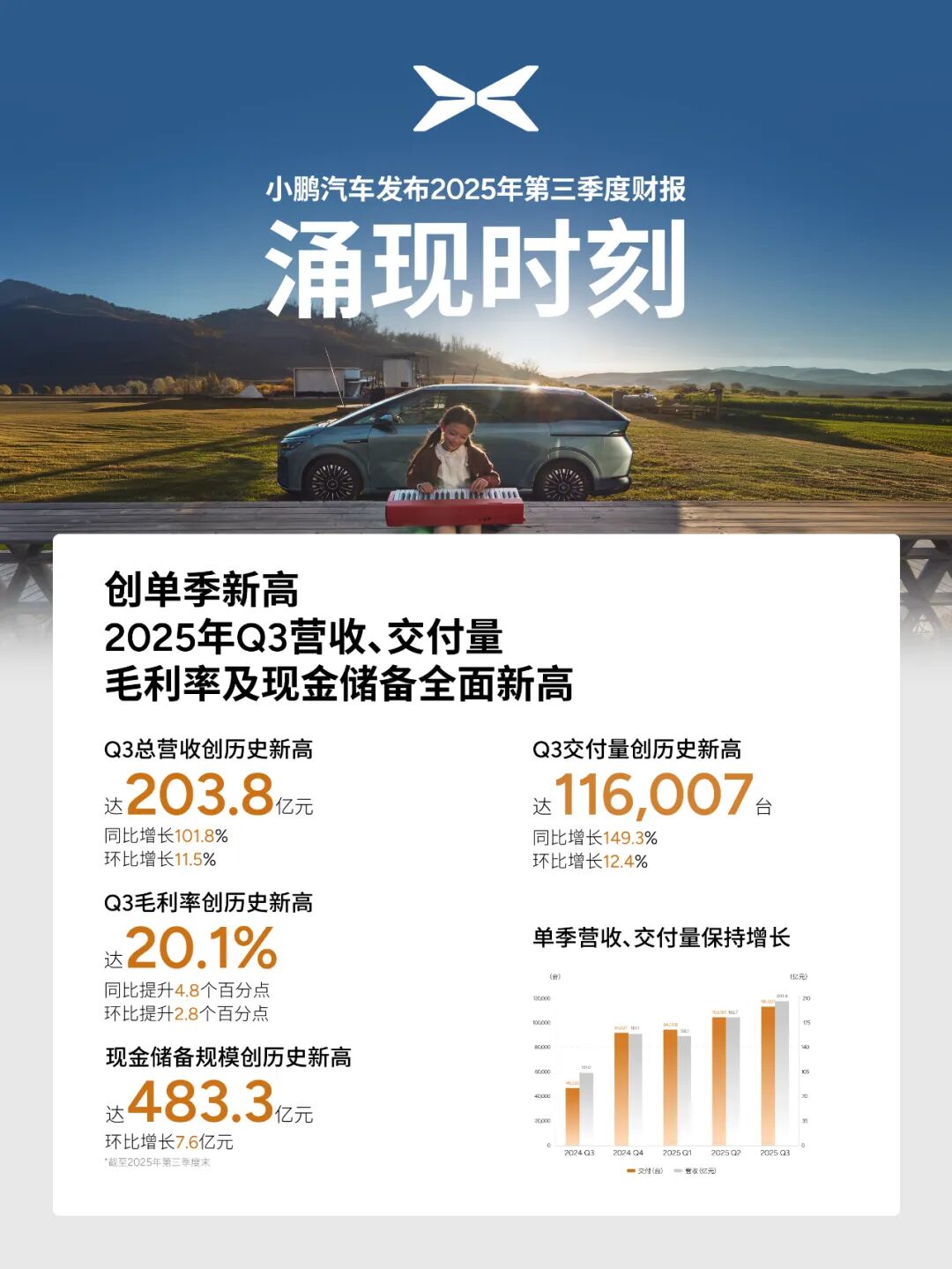
Core Insights - Xiaopeng Motors reported its strongest quarterly financial results to date, with a gross margin exceeding 20% for the first time, surpassing Tesla and BYD [1][2][6] - The company achieved a revenue of 20.38 billion yuan, a year-on-year increase of 102%, while net losses narrowed significantly to 380 million yuan, down 79.01% from the previous year [2][6] - The sales performance was driven by the strong demand for the MONA M03 and new models like the G6, indicating a shift from previous growth stagnation [1][7] Financial Performance - Xiaopeng's gross margin reached 20.1%, an increase of 4.8 percentage points year-on-year, marking a significant improvement in profitability [2][6] - Automotive sales revenue was 18.05 billion yuan, up 105% year-on-year, while service and other income rose to 2.33 billion yuan, a 78% increase [7] - The company delivered 116,000 vehicles in the third quarter, a 149.3% increase from 47,000 vehicles in the same period last year [7] Market Position and Strategy - Xiaopeng's gross margin performance outpaced competitors Tesla (18%) and BYD (17.6%), attributed to effective cost control and revenue from technology development [6][7] - The company aims to achieve breakeven in the fourth quarter, with projected revenue between 21.5 billion and 23 billion yuan, representing a year-on-year growth of 33.5% to 42.8% [8][9] - Xiaopeng is expanding its product lineup, planning to launch seven new models by 2026, including both pure electric and extended-range versions [11] Technological Investments - Significant investments in AI, humanoid robots, and flying cars are ongoing, with a total R&D expenditure expected to reach 9.5 billion yuan by 2025 [12] - The company has begun to see returns from technology licensing, with service and other income contributing significantly to profitability, particularly from collaborations with Volkswagen [11][12] Global Expansion - Xiaopeng is pursuing a detailed global strategy, having established a presence in several European countries and planning to expand its sales network [17][18] - The company aims to localize production, with the first locally produced Xiaopeng X9 delivered in Indonesia and a partnership with Magna in Austria for European production [20] - Xiaopeng's overseas sales exceeded 5,000 units for the first time in September, with plans to cover 60 countries and establish over 300 service outlets [18][20] Competitive Landscape - The global electric vehicle market is becoming increasingly competitive, with numerous Chinese manufacturers entering international markets [16][21] - Xiaopeng is adopting a cautious approach, focusing on maintaining gross margins while optimizing supply chains to remain competitive [21]


硕贝德跌2.04%,成交额1.18亿元,主力资金净流出2075.29万元
Xin Lang Zheng Quan· 2025-11-18 02:15
Company Overview - Shuo Bei De Wireless Technology Co., Ltd. is located in Huizhou, Guangdong Province, established on February 17, 2004, and listed on June 8, 2012. The company specializes in the research, production, and sales of wireless communication terminal antennas [1][2] - The main business revenue composition includes antennas (50.50%), wiring harnesses and connectors (26.34%), smart sensor modules (13.73%), heat dissipation devices and modules (8.86%), and others (0.57%) [1] Financial Performance - For the period from January to September 2025, the company achieved operating revenue of 1.99 billion yuan, a year-on-year increase of 50.25%, and a net profit attributable to shareholders of 50.71 million yuan, a year-on-year increase of 1290.66% [2] - Since its A-share listing, the company has distributed a total of 116 million yuan in dividends, with no dividends distributed in the past three years [3] Stock Market Activity - As of November 18, the company's stock price decreased by 2.04%, trading at 22.09 yuan per share, with a total market capitalization of 10.162 billion yuan [1] - The stock has increased by 68.50% year-to-date, but has seen a decline of 2.69% over the last five trading days, 3.20% over the last twenty days, and 22.46% over the last sixty days [1] - The company has appeared on the "Dragon and Tiger List" four times this year, with the most recent appearance on August 7, where it recorded a net purchase of 533 million yuan [1] Shareholder Information - As of September 30, 2025, the number of shareholders increased by 49.30% to 88,000, with an average of 5,005 circulating shares per person, a decrease of 33.14% [2] - Among the top ten circulating shareholders, Hong Kong Central Clearing Limited is the third-largest shareholder, holding 3.0145 million shares, a decrease of 8.4168 million shares compared to the previous period [3]

天宜新材跌2.03%,成交额2414.13万元,主力资金净流出1.64万元
Xin Lang Cai Jing· 2025-11-18 02:05
Group 1 - The core viewpoint of the news is that Tianyi New Materials has experienced a decline in stock price and financial performance, with a notable drop in revenue and an increase in net loss [1][2]. - As of November 18, Tianyi New Materials' stock price was 6.28 CNY per share, with a market capitalization of 3.531 billion CNY [1]. - The company has seen a year-to-date stock price increase of 9.22%, but has declined by 4.70% in the last five trading days and 11.30% over the last 20 days [1]. Group 2 - For the period from January to September 2025, Tianyi New Materials reported operating revenue of 564 million CNY, a year-on-year decrease of 11.69%, while the net profit attributable to shareholders was -371 million CNY, an increase of 36.82% compared to the previous year [2]. - The company has a total of 18,400 shareholders as of September 30, which is an increase of 4.61% from the previous period, with an average of 30,587 circulating shares per shareholder, a decrease of 4.41% [2]. - Since its A-share listing, Tianyi New Materials has distributed a total of 115 million CNY in dividends, with 36.495 million CNY distributed over the past three years [3]. Group 3 - Tianyi New Materials specializes in the research, production, and sales of powder metallurgy brake pads for high-speed trains, as well as other related products [1]. - The company's main business revenue composition includes components for photovoltaic thermal field systems (39.86%), powder metallurgy brake pads (28.26%), resin-based carbon fiber composite products (14.54%), precision manufacturing of large aerospace structures (10.20%), and other segments [1]. - Tianyi New Materials is categorized under the mechanical equipment industry, specifically in rail transit equipment [1].
【点金互动易】锂电添加剂+氟化工,VC/FEC锂电添加剂产能破万,在建产能5000吨,这家公司氟化液扩产满足数据中心扩张需求
财联社· 2025-11-18 00:59
Group 1 - The article emphasizes the importance of timely and professional information interpretation in investment decision-making [1] - The focus is on identifying investment value from significant events, analyzing industry chain companies, and interpreting key policies [1] - The company has achieved a production capacity of over 10,000 tons for lithium battery additives and is constructing an additional 5,000 tons capacity [1] Group 2 - The expansion of fluorinated liquids is aimed at meeting the growing demand from data center expansions [1] - The company is actively advancing its layout in the solid-state battery industry [1] - Yushu Technology is supplied with reducer joint modules, and the company is the first to supply PEEK materials to leading flying car enterprises [1]

铂力特涨2.07%,成交额1.44亿元,主力资金净流入226.32万元
Xin Lang Cai Jing· 2025-11-11 02:19
Core Viewpoint - The stock of Plater Technology has shown significant growth this year, with a year-to-date increase of 92.91%, indicating strong market performance and investor interest [1][2]. Company Overview - Plater Technology, established on July 6, 2011, and listed on July 22, 2019, specializes in providing comprehensive solutions for metal additive manufacturing (3D printing) and remanufacturing technology [1]. - The company's revenue composition includes 63.33% from customized 3D printing products and technical services, 27.89% from 3D printing equipment, parts, and technical services, and 8.78% from 3D printing raw materials [1]. Financial Performance - For the period from January to September 2025, Plater Technology achieved a revenue of 1.161 billion yuan, representing a year-on-year growth of 46.47%, and a net profit attributable to shareholders of 156 million yuan, reflecting a substantial increase of 234.83% [2]. - The company has distributed a total of 82.67 million yuan in dividends since its A-share listing, with 66.51 million yuan distributed over the past three years [3]. Shareholder Information - As of September 30, 2025, the number of shareholders for Plater Technology increased by 19.49% to 15,700, while the average number of circulating shares per person decreased by 15.52% to 17,462 shares [2]. - Among the top ten circulating shareholders, Hong Kong Central Clearing Limited is a new entrant, holding 4.1088 million shares [3].

对话汇天CEO赵德力:公司要独立IPO 何小鹏试飞后就控股了我们
Sou Hu Cai Jing· 2025-11-10 10:52
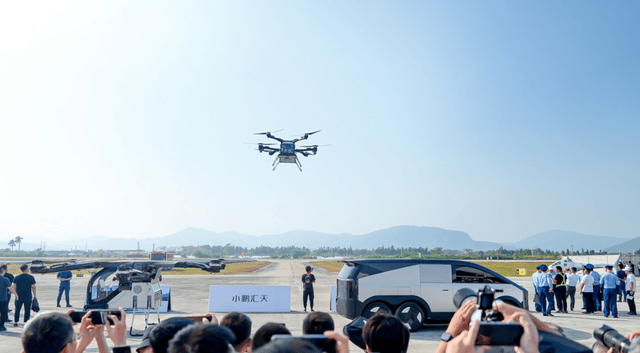
Core Insights - Xiaopeng Huitian recently unveiled its all-tilt hybrid electric flying car A868 and announced plans for mass production and delivery of its land carrier flying car by 2026 [2][16] - Xiaopeng Huitian is an independent company controlled by Xiaopeng Motors, with plans for independent financing, delivery, and future IPO [2][4] Company Developments - Xiaopeng Huitian appointed Du Chao, former CFO of One Education Technology, as CFO and VP, indicating a potential IPO [4] - CEO Zhao Deli confirmed plans for an IPO but did not disclose specific details about the listing location, hinting at a preference for U.S. or Hong Kong markets [5] - The company has experienced rapid growth since Xiaopeng Motors took control, with significant funding rounds including over $500 million in Series A and $250 million in Series B financing [10][12] Product and Market Strategy - Xiaopeng Huitian has achieved significant product development, including obtaining a special flight permit in Dubai and signing a preliminary order for 600 flying cars, potentially worth around 1.2 billion yuan [12][14] - The company aims to produce 10,000 flying cars annually, with an initial capacity of 5,000, and has successfully completed the first test flight of the A868 prototype [16] Leadership and Vision - Zhao Deli emphasized the importance of Xiaopeng's support in securing funding for ambitious projects like flying cars, highlighting the challenges faced by grassroots entrepreneurs [10] - The company has navigated difficulties, including the impact of the pandemic and market fluctuations, but has adapted its strategy to focus on practical applications of flying vehicles [10][11]
长安汽车三季报:新能源销量同比增了超8成,高端化仍需突破
Nan Fang Du Shi Bao· 2025-11-10 09:08
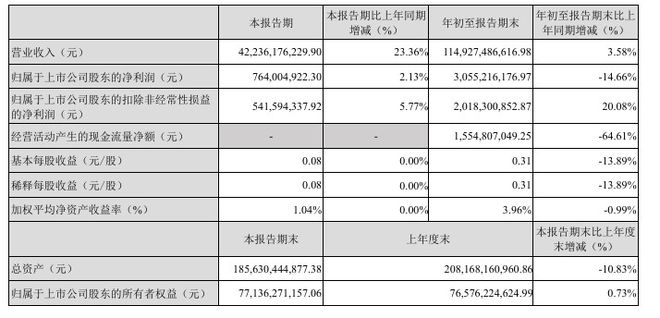
Core Viewpoint - Changan Automobile's third-quarter financial report highlights the company's growth in new energy vehicle sales and overseas markets, while facing significant pressure on profitability due to reduced government subsidies and increased sales expenses [1][2][8] Financial Performance - In Q3, Changan's revenue reached 42.236 billion yuan, a year-on-year increase of 23.36%, while total revenue for the first three quarters was 114.927 billion yuan, up 3.58% [2][3] - The net profit attributable to shareholders for Q3 was 764 million yuan, a 2.13% increase year-on-year, but the net profit for the first three quarters decreased by 14.66% to 3.055 billion yuan [2][3] - The non-recurring net profit for Q3 was 542 million yuan, up 5.77% year-on-year, with a cumulative increase of 20.08% for the first three quarters [2][3] - Government subsidies significantly decreased, with a 67.52% drop in the first three quarters, impacting profit margins [3][4] Sales Performance - Changan's total sales in Q3 reached 711,100 units, a 26.8% year-on-year increase, with cumulative sales for the first three quarters at 2.0661 million units, up 8.46% [7] - New energy vehicle sales in Q3 surged by 81.22% to 272,500 units, with a total of 724,000 units sold in the first three quarters, reflecting a 59.72% increase [7] - Overseas exports in Q3 were approximately 166,000 units, a 96.3% year-on-year increase, with total exports for the first three quarters at 465,000 units, up 10.7% [7] Strategic Insights - Changan's investment in technology is beginning to yield results, with gross margins improving to nearly 15% and showing a positive trend [5] - The company is focusing on transforming into a "smart low-carbon travel technology company," with plans to explore advanced fields such as humanoid robots and flying cars [8] - Despite strong sales in new energy vehicles, challenges remain in achieving high-end market penetration, as seen with the sales performance of specific models [6][7]

小鹏机器人IRON亮相股价连涨 何小鹏称研发更高阶机器人是使命
Chang Jiang Shang Bao· 2025-11-09 23:32
Core Viewpoint - The launch of the new humanoid robot IRON by Xiaopeng has generated significant public interest and skepticism, particularly regarding its capabilities and authenticity as a robot [1][4][6]. Group 1: Product Features and Capabilities - IRON is designed at a 1:1 human scale, standing 178 cm tall and weighing 70 kg, featuring a human-like skeletal and muscular structure [3]. - The robot has 22 degrees of freedom in its hands, allowing it to perform tasks such as holding an egg, folding clothes, and organizing items [3]. - IRON's walking motion mimics human movement, described as a "catwalk," which is more fluid compared to traditional robotic movements [3]. Group 2: Technological Advancements - The robot is equipped with three self-developed AI chips from Xiaopeng, providing three times the computational power of the industry average and 15 times that of Tesla's Optimus chip, enabling independent decision-making without cloud reliance [3]. - It features the world's first all-solid-state battery, which reduces weight by 30% and increases energy capacity by 30%, offering comparable endurance to Tesla's Optimus [3]. Group 3: Market Strategy and Future Plans - Xiaopeng plans to introduce IRON into commercial settings by 2026, initially focusing on roles such as customer service in Xiaopeng's automotive stores rather than household tasks due to safety and cost concerns [6]. - The company aims to produce higher-level humanoid robots by 2025-2027, emphasizing the mission of mass production in the robotics sector [2][6]. Group 4: Recent Developments in Automotive Sector - Xiaopeng announced the launch of the new Kunpeng Super Range Extender technology, addressing common issues faced by traditional range extender users [8]. - In October 2025, Xiaopeng delivered 42,000 new vehicles, marking a 76% year-on-year increase, with a total of 355,200 vehicles delivered from January to October 2025, reflecting a 190% increase [8]. - The A868 flying car prototype successfully completed its first test flight and is expected to achieve mass production by 2026, with a planned annual production capacity of 10,000 units [9].
