机器人技术

Search documents
中国-中东欧博览会迸发中外合作新火花
Zhong Guo Qing Nian Bao· 2025-05-24 06:42
Group 1: Low Altitude Economy - The "low altitude economy" is reshaping human activities and creating new opportunities for international cooperation in resource development [1] - MicroStep Mis, a Slovak company, aims to collaborate with Chinese enterprises in weather monitoring solutions for low-altitude flying, highlighting the need for advanced meteorological equipment [1] - The Chinese company Cangzhou Shark Aircraft Manufacturing Co., Ltd. has partnered with Slovak company Klein Vision to produce the second-generation AirCar, with a projected market of 30,000 flying cars in China over the next 5 to 10 years, valued at over 100 billion yuan [2] Group 2: Robotics and AI - The humanoid robot industry is transitioning from R&D to commercial production, with China emerging as a key player due to policy support and industry advantages [2] - Hangzhou Yushu Technology Co., Ltd. plans to collaborate with universities and research institutions to tackle core technology challenges in humanoid robots and expand into Southeast Asia and the Middle East [2] Group 3: Innovation and Market Expansion - The China-Central and Eastern European Countries Expo features a new digital innovation section showcasing advanced technologies from both regions, attracting numerous exhibitors and visitors [3] - Polish company Biomass Energy Project S.A. is seeking new cooperation opportunities in China, focusing on high-end healthcare projects due to the aging population [4] - Livestocker, a Hungarian company, has introduced its smart farm management system to the Chinese market, which has already been successfully implemented in over 30 large farms in Europe [5]
一批全国头部企业与广东合作
Guang Zhou Ri Bao· 2025-05-22 19:24
Group 1 - The Cultural Industry Expo has officially opened, featuring 6,280 exhibitors from government groups, cultural institutions, and enterprises, with participation from 65 countries and regions, including 305 overseas exhibitors [1] - 18 key projects were successfully signed at the Guangdong exhibition, with a total transaction amount exceeding 1.6 billion yuan, indicating significant collaboration opportunities for leading enterprises and IPs in Guangdong [2] - The partnership between GAC Group, Huawei, and the Central Radio and Television Station's National Key Laboratory was announced, showcasing the launch of the new flagship product, the GAC Trumpchi M8 Qian Kun series, which emphasizes the integration of technology and culture in automotive manufacturing [2][3] Group 2 - The GAC Trumpchi M8 Qian Kun series integrates innovations from Huawei technology, GAC manufacturing, and Eastern culture, aiming to redefine industrial products as cultural carriers and enhance user experience through smart terminal integration [3] - A robot fighting competition, "Mecha King," will be held in Shenzhen, showcasing humanoid robots in competitive scenarios, aimed at demonstrating advancements in artificial intelligence and robotics technology [4]

重磅来袭!全球首个全尺寸“机甲拳王”格斗赛官宣!撬动湾区万亿机器人产业
21世纪经济报道· 2025-05-22 09:36
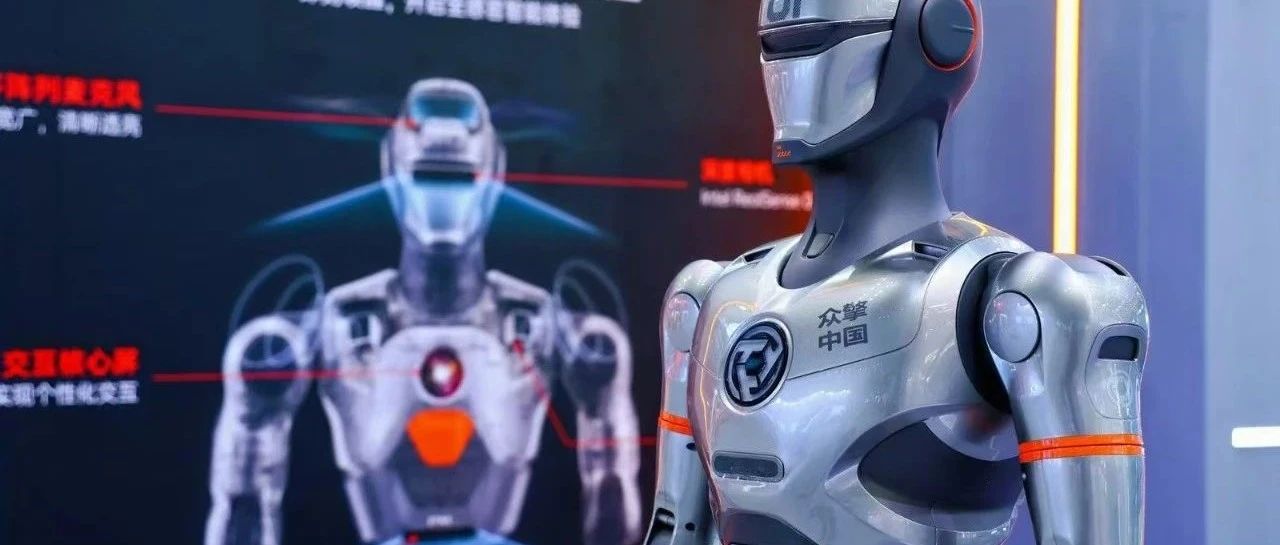
其次,赛事首创人形机器人格斗竞技规则:参赛机器人需模拟人类运动模式,在限定规则下 完成对抗性动作,并通过智能决策系统实时应对复杂环境。 本赛事旨在通过高竞技性、强观赏性的机器人格斗场景,展现人工智能与机器人技术的前沿 突破,推动产业技术升级与规模化应用。 赛事依托粤港澳大湾区全球领先的机器人产业生态,以"体育+科技"跨界融合的创新模式,打 造人形机器人格斗赛文化品牌IP。 据赛事组委会介绍,众擎机器人公司将提供多款不同属性的最新人形机器人,公开源代码, 提供给各参赛队伍,他们将以人形机器人格斗俱乐部的形式参与比赛。接下来,主办方还会 持续升级迭代赛事,目标将机器人竞技项目推进奥运会,开创人机共融的奥林匹克新时代。 赛事开创"智能体育文化"新形态,以"打造更强壮、更敏捷、更聪明的机器人"为口号,以俱 乐部为参赛单位,全面检验机器人的体能极限与智能水平。 作 者丨林典驰 编 辑丨孙超逸 5月2 2日,在第二十一届中国(深圳)国际文化产业博览交易会广东展团主展厅上,深圳众擎 机器人公司等官宣了首个以"全尺寸类人身高"的人形机器人为竞技主体的赛事"众擎机器人自 由格斗赛之'机甲拳王' "。 据赛事组委会介绍,与别的机 ...

美银Computex 2025观察:AI需求、供应链、机器人与技术路线图
Hua Er Jie Jian Wen· 2025-05-22 08:23
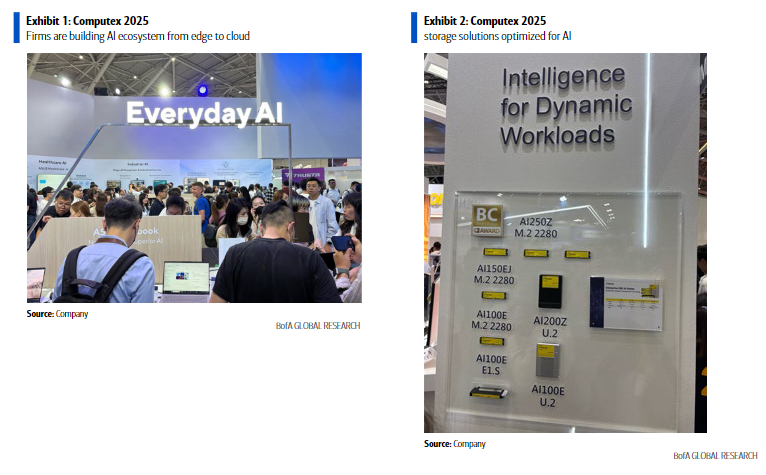
Group 1: Core Insights - The Computex 2025 event, themed "AI Next," focuses on "Smart Computing & Robotics," "Next-Generation Technology," and "Future Mobility" [1] - Strong demand for AI is confirmed, with a shift from experimental to large-scale deployment, highlighting the integration of AI from cloud to edge [3][4] - Major companies like NVIDIA and MediaTek showcased next-generation AI solutions, indicating a transition to widespread physical AI applications and edge computing [1][3] Group 2: Industry Trends - AI infrastructure development continues despite concerns over ROI and capital expenditures, with practical AI applications emerging [4] - The GB200 production has ramped up, alleviating previous supply chain bottlenecks, with NVIDIA confirming the upcoming GB300 model [5] - The focus is shifting from digital AI agents to physical AI, with robotics technology emerging as a significant investment area with trillion-dollar potential [6][7] Group 3: Company Highlights - NVIDIA introduced groundbreaking products at Computex 2025, including the GB300, which boasts 1.5 times the inference performance and double the network performance compared to GB200 [10] - Qualcomm emphasized the transformative impact of AI, with its Snapdragon chips powering over 85 PCs this year, expected to increase to 100 next year [10] - ARM anticipates that by the end of 2025, around 50% of server chips shipped to hyperscale data centers will be ARM-based, highlighting the growing importance of energy efficiency in AI scaling [15]


特斯拉发布“擎天柱”机器人炒菜视频;国内首例闭环脊髓神经接口植入手术成功|数智早参
Mei Ri Jing Ji Xin Wen· 2025-05-21 23:31
Group 1 - Tesla's "Optimus" robot has demonstrated significant advancements in AI and robotics, showcasing its ability to perform household tasks autonomously, such as taking out the trash and cooking [1] - The robot's training utilizes a high-precision virtual environment, allowing it to accumulate years of physical world experience in just hours, indicating a breakthrough in multi-modal perception and complex task planning [1] Group 2 - A successful closed-loop spinal nerve interface implantation surgery has been completed in China, enabling a patient with paraplegia to stand and walk autonomously just 15 days post-surgery [2] - This achievement marks a significant breakthrough in spinal nerve interface and neural function restoration, potentially benefiting the 3.7 million spinal injury patients in China [2] Group 3 - Google has announced a strategic partnership with Chinese AR company XREAL to launch the new generation AR glasses, Project Aura, at the Google I/O developer conference [3] - Project Aura is the first flagship AR glasses designed specifically for the Android XR platform, utilizing Optical See-through technology, marking a pivotal moment for the AR industry [3]

第四届中国—中东欧国家博览会22日开幕 1.5万多名专业观众将参加
Zheng Quan Shi Bao Wang· 2025-05-21 07:04
Group 1 - The Fourth China-Central and Eastern European Countries Expo and International Consumer Goods Expo will be held from May 22 to May 25 in Ningbo, with a theme of "Towards New, Towards Reality, Towards the Future" [1] - The expo is expected to attract over 15,000 professional visitors, including more than 3,000 foreign buyers from 72 countries and regions, with anticipated import procurement intentions exceeding 10 billion yuan from Central and Eastern Europe [1] - The exhibition area covers 80,000 square meters, divided into Central and Eastern European exhibition zones and export consumer goods zones, featuring 435 companies from 14 Central and Eastern European countries and 9 other countries [1] Group 2 - The expo will focus on economic and trade activities, featuring a total of "11+4+N" activities, including key events such as the opening ceremony, trade negotiation activities, investment promotion activities, and cultural exchange activities [2] - A significant feature of this expo is the expansion towards "Central and Eastern Europe+", with participation from companies in countries like the UK, France, Germany, and Italy, aiming to leverage the platform for sharing market opportunities in China [2] - The expo will also include investment activities, such as the "Invest in Zhejiang" series, which will feature major global companies and aim to sign key projects in artificial intelligence, high-end equipment manufacturing, and modern finance [2] Group 3 - The "Smart Central and Eastern Europe" section will showcase 37 companies and nearly 100 cutting-edge technologies and products in artificial intelligence, robotics, and aviation technology, covering an area of 1,400 square meters [3] - Innovations from Central and Eastern European countries will include technologies in aviation and biomedicine, such as diamond aircraft from Austria and medical devices from Slovakia [3] - Notable domestic companies in the humanoid robotics sector, such as Yushu Technology and Xingdong Jiyuan, will present advanced robotic products demonstrating various interactive and industrial applications [3]
阿联酋与中国企业共建智能农业科技中心
news flash· 2025-05-20 09:49
Group 1 - The core viewpoint of the article is the strategic partnership between UAE's Silal and China's Shouguang Vegetable Industry Group to establish a smart agricultural technology center in Abu Dhabi [1] - The total investment for the project is 120 million dirhams, approximately 33 million dollars [1] - The smart agricultural technology center will cover an area of 100,000 square meters and integrate artificial intelligence and robotics technology [1] Group 2 - The center will enhance production efficiency through various processes including precision seeding, intelligent climate control, automated irrigation, and robotic harvesting [1] - The initiative aims to promote sustainable agricultural development in the region [1]
谷歌CEO皮查伊回应“谷歌已死”论:AI决定未来,中国竞争力不容忽视
3 6 Ke· 2025-05-19 10:44
Group 1 - Google and its parent company Alphabet are focusing on redefining the search experience by transitioning from traditional search to an AI-driven intelligent assistant that anticipates user needs [3][6] - CEO Sundar Pichai emphasized the importance of Google's long-term investments in infrastructure, such as self-developed TPU chips and large-scale data centers, which provide a competitive edge in AI model training and deployment [3][6][13] - The company is exploring the future of human-computer interaction, highlighting the shift towards voice, image, and multimodal inputs that are reshaping hardware and product interfaces [3][18] Group 2 - Pichai addressed concerns about whether Alphabet is still seeking the next billion-dollar business, stating that the focus is on maintaining innovation and leadership in an AI-dominated technology cycle [4][6] - The company has seen significant growth, with quarterly revenue increasing from $20 billion to nearly $100 billion, and is positioned to leverage AI for further opportunities [6][10] - Google is testing a new AI-driven search experience called "AI Mode," which allows for conversational queries and has already seen a significant increase in user engagement [7][9] Group 3 - Pichai noted that Google's infrastructure is designed to provide high performance and cost efficiency, allowing the company to offer advanced AI services at competitive prices [13][14] - The company plans to invest $70 billion in capital expenditures, focusing on servers and data centers to support AI infrastructure and model services [14] - Google is committed to maintaining a dual approach by using both its TPU chips and NVIDIA GPUs for AI tasks, ensuring flexibility and efficiency in its operations [15] Group 4 - The company is actively investing in next-generation hardware, including AR glasses and robotics, to enhance its product offerings and explore new computing platforms [19][25] - Pichai believes that the integration of AI and robotics is approaching a breakthrough, with significant advancements expected in the next few years [27][28] - Google is also focused on building a robust ecosystem for AI, leveraging its existing services like YouTube and Google Cloud to create a comprehensive AI product ecosystem [9][31] Group 5 - Pichai highlighted the importance of energy resources for AI development, acknowledging that power supply limitations are currently affecting Google's cloud computing business [22][24] - The company is exploring various energy solutions, including solar and nuclear power, to address future energy demands for AI [23][24] - Google has a long-term strategy of investing in emerging technologies, such as quantum computing and AI, to ensure sustained growth and innovation [25][26]


黄仁勋发力支持Agent、新设中国研发点,贾扬清Lepton被收购后现状曝光!
AI前线· 2025-05-19 09:11
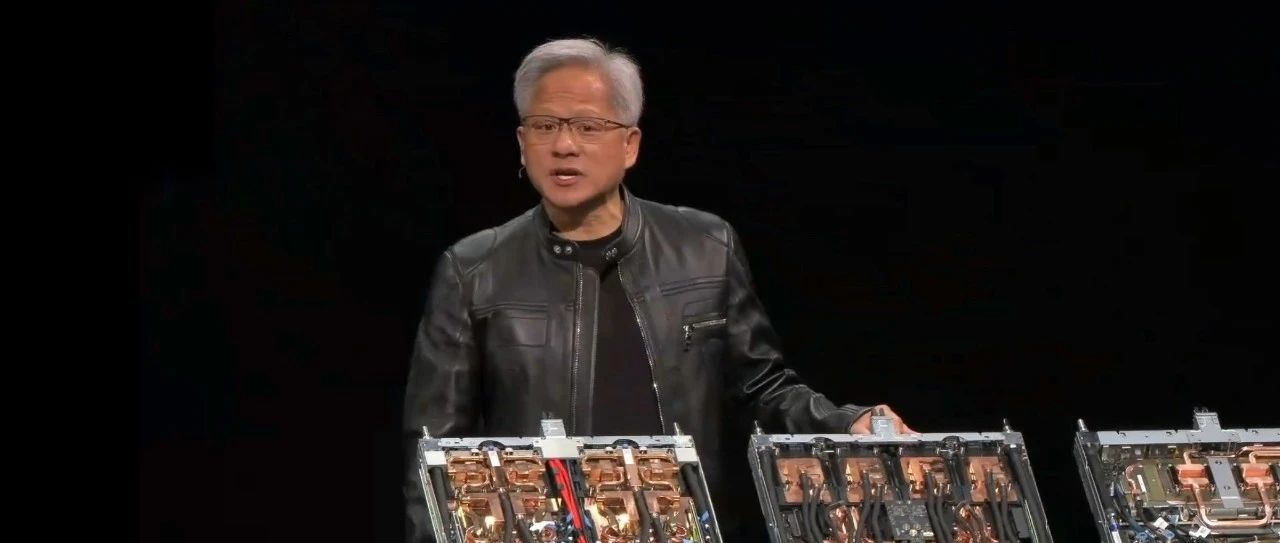
Core Viewpoint - The importance of AI and NVIDIA's role as a foundational infrastructure provider for AI was emphasized by CEO Jensen Huang during his keynote at Computex 2025, highlighting the future necessity of ubiquitous AI similar to the internet and electricity [1]. Group 1: AI Development and Infrastructure - Huang discussed the evolution of AI, introducing concepts like Agentic AI, which possesses reasoning and perception capabilities, allowing it to understand, think, and act [5][6]. - The introduction of Physical AI, which understands the real world and its physical laws, is seen as crucial for the robotics revolution [8]. - NVIDIA's new Grace Blackwell system, which has entered full production, is designed to enhance AI capabilities, with the GB300 version offering 1.5 times the inference performance and doubled network connectivity compared to its predecessor [9][10]. Group 2: Performance and Technological Advancements - The Grace Blackwell GB300 system achieves 40 PFLOPS, equating to the performance of the 2018 Sierra supercomputer, showcasing a 4000-fold performance increase over six years [9]. - NVIDIA's AI computing power is projected to increase by approximately 1 million times every decade, supported by new manufacturing processes in collaboration with TSMC [9]. - The introduction of NVLink Fusion aims to build AI infrastructure that can scale to millions of GPUs, integrating with various cloud service providers [11][13]. Group 3: Robotics and AI Integration - Huang highlighted the need for robots to learn in virtual environments that adhere to physical laws, addressing the challenges of data strategy in robotics [24]. - The GR00T-Dreams system generates synthetic data to train AI models, enhancing the efficiency of robot training through simulated tasks [25]. - NVIDIA's humanoid robot foundational model, Isaac GR00T N1.5, has been updated to improve its adaptability in material handling and manufacturing tasks [28][29]. Group 4: Personal AI Computing - The DGX Spark personal AI computer is set to launch soon, allowing individuals to own a supercomputer, with pricing determined by companies [18]. - The DGX Station, capable of running large models with 1 trillion parameters, is also being introduced, showcasing NVIDIA's commitment to personal AI computing [18]. Group 5: Future Directions in Computing - NVIDIA is developing quantum-classical computing platforms, predicting that future supercomputers will integrate GPU, QPU, and CPU technologies [22]. - Huang emphasized the need for storage systems to evolve, integrating GPU computing nodes to handle unstructured data more effectively [22].
2025年全球矿用机器人行业发展现状 未来将替代人进行高危复杂工作【组图】
Qian Zhan Wang· 2025-05-19 07:18
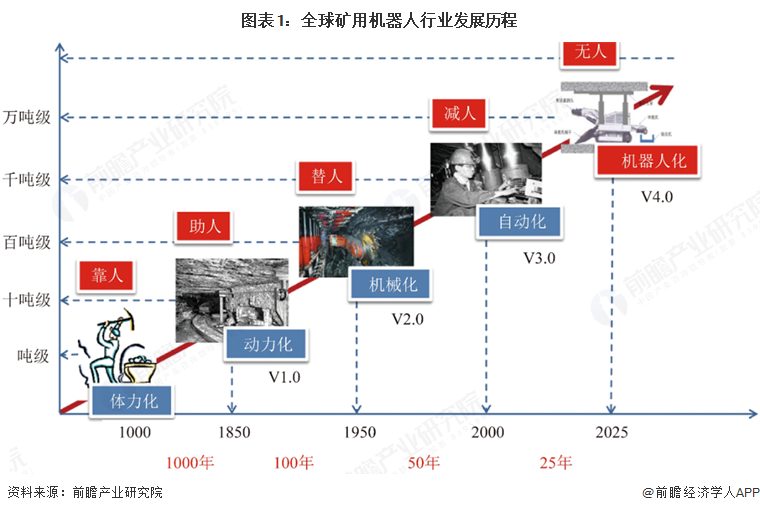
Global Mining Robot Industry Development - The global mining robot industry has evolved through several phases, starting from the mechanization 1.0 period in the 1870s to 1980s, where countries like the USA, UK, Germany, Australia, and South Africa established coal mine auxiliary transport systems [1] - The mechanization 2.0 period began in 1958 with the development of the first underground loader by Wagner in the USA, focusing on remote control and autonomous systems for mining operations [2] - The industry entered the automation 3.0 phase in the 21st century, emphasizing faster, safer, and more efficient mining operations through advanced technologies [2] - The mining robotization 4.0 phase is expected to commence in 2025, where mining robots will be widely adopted for repetitive, hazardous, and technically challenging tasks [2] Market Size and Growth - The global mining robot market reached a size of $1.363 billion in 2021, with a year-on-year growth rate exceeding 20% [6] - In 2022, the market experienced a decline, but it rebounded in 2023, with a market size of $1.28 billion, and is projected to reach $1.4 billion in 2024 [6] - The global special robot market is expected to grow to $14 billion by 2024, reflecting a year-on-year increase of 16.7% [5] Competitive Landscape - The competitive landscape of the global mining robot industry is characterized by companies like Komatsu, Sandvik, and Caterpillar leading in patent applications, while FAMUR excels in sales coverage [9] - Companies such as China Energy Investment Group and Tian Di Shanghai Mining Equipment Technology Co., Ltd. are emerging players, showing good performance in overseas markets despite being behind the leading tier in terms of product diversity and regional sales coverage [9] Future Outlook - The mining robot market is driven by increased investment in robotic mining systems, advancements in digitalization and automation, and the demand for precise and efficient operations [11] - The global energy shortage has renewed interest in traditional energy sources like coal, with mining robots being widely applied in coal mining countries, particularly in developing regions such as China and Southeast Asia [11] - The global mining robot market is projected to reach $3.7 billion by 2030, with a compound annual growth rate (CAGR) of 20% [11]