
脑机接口

Search documents
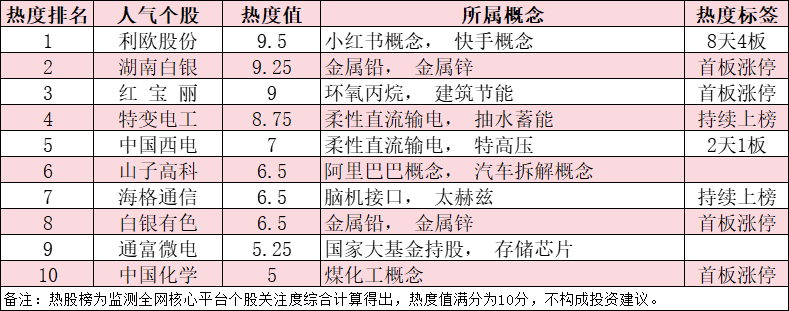
今日十大热股:利欧股份复牌窜至热榜第一,湖南白银、红宝丽首板涨停挤入前三,特变电工等电力股持续爆炒
Jin Rong Jie· 2026-01-21 01:27
Market Overview - A-shares showed divergence on January 20, with the Shanghai Composite Index slightly down by 0.01% at 4113.65 points, while the Shenzhen Component Index fell by 0.97%, the ChiNext Index by 1.79%, and the STAR Market 50 by 1.58% [1] - The total trading volume in the Shanghai and Shenzhen markets reached 2.78 trillion yuan, an increase of approximately 693.72 billion yuan compared to the previous day [1] - A total of 2139 stocks rose, while 2918 stocks declined, indicating a bearish market sentiment [1] Sector Performance - The banking sector and a few other sectors saw net inflows from major funds, while the communication equipment sector experienced the highest net outflow [1] - Epoxy propylene, silver, and precious metals were among the top gainers, while sectors like space computing and Google concepts faced significant declines [1] Company Highlights - Liou Co. resumed trading and announced its ongoing efforts in AI-related business applications, although it has not yet formed a significant profit model, with AI revenue being a small part of overall income [2] - Hunan Silver, a leading silver smelting and deep processing company, benefits from a complete industrial chain and has long-term growth potential in the new energy sector, attracting institutional and foreign capital [2] - Hongbaoli reported double-digit revenue growth, with record sales in polyether and isopropanol amine products, supported by a robust cash flow and alignment with market trends in epoxy propylene and building energy efficiency [2] - TBEA is benefiting from a 4 trillion yuan fixed asset investment policy by the State Grid, with strong order backlogs and significant net profit growth [3] - China XD Electric is experiencing a surge in demand due to accelerated approvals for ultra-high voltage projects and increased investment in the power grid [3] - Shanzi High-Tech is gaining attention due to its transition from real estate to core businesses in new energy vehicle components and semiconductor materials, as well as its involvement in the restructuring of Nezha Automobile [3] - Haige Communication is involved in several high-profile sectors, including brain-computer interfaces and satellite internet, with recent developments causing stock price volatility [3] Popular Stocks - The top ten popular stocks in the A-share market include Liou Co., Hunan Silver, Hongbaoli, TBEA, China XD Electric, Shanzi High-Tech, Haige Communication, Silver Nonferrous Metals, Tongfu Microelectronics, and China National Chemical [5]


翔宇医疗董事长何永正:“脑机接口+”重塑康复新生态 全链条布局领跑新赛道
Zhong Guo Zheng Quan Bao· 2026-01-21 00:28
Core Viewpoint - The rehabilitation industry is viewed as a "golden track" with significant growth potential, driven by brain-computer interface (BCI) technology, which is expected to reshape the industry landscape [1] Group 1: Technological Innovation - The company focuses on three cutting-edge areas: brain-computer interfaces, rehabilitation robots, and AI medical technology, with BCI technology accelerating commercialization [2] - A comprehensive product matrix in rehabilitation robotics has been established, with plans to launch 5-6 medical device registrations by 2026 [2] - The company has initiated a brain science laboratory and developed five technical platforms to enhance BCI technology integration with rehabilitation equipment [3] - Continuous R&D investment is planned to remain above 20% of revenue over the next 3-5 years, with a significant portion allocated to frontier technology research [4] Group 2: Market Transformation - The company has partnered with over 600 leading hospitals to establish BCI rehabilitation treatment and clinical research centers, aiming to create regional treatment benchmarks [5] - The integration of BCI technology into multi-joint exoskeleton robots and various rehabilitation products is expected to enhance treatment precision and effectiveness [6] - A dual strategy of deepening medical institution engagement while expanding into outpatient markets is being implemented, targeting public hospitals, private hospitals, and rehabilitation institutions [6] Group 3: International Expansion - The company is accelerating its international business, with overseas sales expected to double in 2024 compared to 2023, aiming for international revenue to account for over 30% by 2030 [6][7] - Compliance with international certification standards, such as EU CE and US FDA, is being prioritized to facilitate market entry [7] Group 4: Ecosystem Development - The company is focused on building a comprehensive rehabilitation ecosystem, emphasizing the importance of BCI technology in future rehabilitation devices [8] - The trend towards lightweight, portable, and home-based rehabilitation devices is noted, with a vision to integrate rehabilitation equipment into everyday household items [8] Group 5: Industry Integration - Strengthening the supply chain for core components like chips and sensors is a priority, along with plans for mergers and acquisitions to consolidate industry resources [9] - The company aims to establish chain rehabilitation hospitals featuring BCI and rehabilitation robotics, targeting a service revenue contribution of over 20% by 2030 [9]

俞敏洪聘请陈行甲为新东方总顾问,年薪150万元;马斯克称推动特斯拉转型为机器人公司,估值25万亿美元;SK海力士发放巨额年终奖丨邦早报
Sou Hu Cai Jing· 2026-01-21 00:22
Group 1 - New Oriental Education Technology Group has appointed Chen Xingjia as a senior consultant with an annual salary of 1.5 million RMB, following public scrutiny over his previous salary exceeding 700,000 RMB [1] - New Oriental commits to donating no less than 1 million RMB annually to the Henghui Foundation, which focuses on the health and growth of Chinese youth [1] Group 2 - SK Hynix announced a record performance bonus of over 1.36 million KRW (approximately 64,000 RMB) per employee, marking the highest in the company's history, with a stock option plan available for employees [2] - The company's stock performance saw a significant increase of 275% last year [2] Group 3 - Gree Electric Appliances is set to mass-produce silicon carbide chips for automotive applications, with plans to supply half of the chips needed by GAC Group [6] - The company has already begun mass production of silicon carbide chips for home appliances and plans to expand into solar energy and logistics vehicles [6] Group 4 - Xiaomi reported two incidents of vehicle fires, with no injuries reported, and is cooperating with investigations [9] - The company is actively addressing safety concerns related to its vehicles [9] Group 5 - iQIYI announced the resignation of CFO Wang Jun, who will continue to serve as a consultant until May 31, 2026, while the company seeks a suitable replacement [11] - The company is focused on maintaining stability during this transition [11] Group 6 - Netflix has revised its merger agreement with Warner Bros. Discovery to pay a cash-only price of $27.75 per share, instead of a combination of cash and stock [12] - This change reflects Netflix's strategic approach to acquisitions in the current market [12] Group 7 - The 2025 Hurun Global Gazelle Enterprises list shows that the US and China lead with 302 and 278 companies respectively, accounting for 71% of the total [20] - The report highlights a significant number of companies transitioning to unicorn status, with 71 achieving this milestone last year [20]



四大证券报精华摘要:1月21日
Zhong Guo Jin Rong Xin Xi Wang· 2026-01-20 23:53
Group 1 - The Ministry of Finance will continue to implement a more proactive fiscal policy in 2026, focusing on increasing total volume, optimizing structure, improving efficiency, and enhancing momentum to support employment, enterprises, markets, and expectations [1] - The A-share market has seen structural opportunities emerge, particularly in popular sectors such as brain-computer interfaces, commercial aerospace, and embodied intelligence, with several listed companies becoming attractive to institutional investors [1] - Despite recent market fluctuations, industry insiders believe that investment opportunities in sectors like brain-computer interfaces and satellites remain significant due to policy support and technological breakthroughs [1] Group 2 - In 2025, quantitative index enhancement strategies performed exceptionally well in the A-share market, with an average return rate of 45.08%, and nearly 90% of products achieving positive excess returns [2] - Small and mid-cap index enhancement strategies have outperformed, highlighting the continued prominence of industry leaders, while AI integration in strategy design has become mainstream [2] - The private equity industry anticipates structural opportunities in 2026, but also warns of challenges from strategy crowding and style shifts [2] Group 3 - The Ministry of Finance has introduced six policies to support small and micro enterprises, including loan interest subsidies and investment guarantees, aimed at boosting private investment and consumption [3] - Major listed insurance companies are expected to see growth in premium and profit metrics in 2025, benefiting from a strong equity market performance [3] - The overall performance of listed insurance companies is projected to maintain high growth due to favorable market conditions in 2025 [3] Group 4 - Shanghai has launched an action plan to enhance the competitiveness of non-ferrous metal commodities, aiming to strengthen the link between spot and futures markets [4] - The action plan is designed to elevate Shanghai's global pricing influence in the non-ferrous metals sector [4] Group 5 - As of January 20, 2025, 525 A-share companies have disclosed earnings forecasts, with around 200 expecting growth and over 100 projecting net profit increases exceeding 100% [5] - The technology sector, particularly driven by AI, is maintaining high growth, while industries like photovoltaics and liquor are facing performance pressures due to market fluctuations [5] - The global precious metals market has shown strength, with gold and silver prices reaching new historical highs [5] Group 6 - The industrial application of silver is significant, with over 60% of demand coming from industries like photovoltaic energy, which is currently facing cost pressures due to rising silver prices [7] - Companies in the photovoltaic sector are exploring alternatives to silver, such as copper and aluminum, due to cost considerations [7] Group 7 - The high-tech manufacturing sector in China is experiencing robust growth, particularly in robotics, with significant increases in the production of gear reducers and various types of robots [8] - The market for reducers is projected to grow to 151 billion yuan by 2025, with specific increases in the sales of harmonic and RV reducers [8] - Several listed companies are actively expanding their operations in the robotics reducer market [8]
2025年新投放科技贷款超7300亿元
Ren Min Ri Bao· 2026-01-20 23:04
Core Viewpoint - The China Export-Import Bank plans to issue over 730 billion yuan in technology loans by 2025, focusing on sectors such as artificial intelligence, brain-computer interfaces, humanoid robots, and high-end instruments [1] Group 1: Financial Strategy - The bank has developed a specialized financial service plan to optimize the financial service system for technology enterprises throughout their lifecycle [1] - To address the characteristics of technology enterprises, which are often asset-light and require high investment, the bank is implementing differentiated measures to enhance the accessibility and stability of financial services [1] Group 2: Loan Composition - 66% of the technology loans provided by the bank will be credit loans, aimed at alleviating the financing difficulties faced by enterprises [1] Group 3: Innovation Support - The bank is actively exploring new scenarios and models to support innovation platforms such as national laboratories and regional key laboratories, promoting the transformation of technology research and development into practical applications [1] Group 4: International Collaboration - The bank aims to leverage its international business strengths to support technological and digital cooperation along the Belt and Road Initiative, facilitating the global layout of industrial chains and accelerating the international expansion of technology enterprises [1]
密集“打卡”热门标的 机构开年积极掘金A股机遇
Zhong Guo Zheng Quan Bao· 2026-01-20 21:55
Core Insights - Since 2026, sectors such as brain-computer interfaces, commercial aerospace, and embodied intelligence have seen structural opportunities in the A-share market, attracting significant institutional interest [1][5] - Despite recent market fluctuations, the long-term investment value in these sectors remains noteworthy due to policy support, industry events, and ongoing technological breakthroughs [5][6] Group 1: Brain-Computer Interfaces - Xiangyu Medical, a leading company in the brain-computer interface sector, has received 208 institutional visits since the beginning of 2026, indicating strong interest [2] - The company is focused on the commercialization of its brain-computer interface products, which are expected to quickly enter rehabilitation scenarios, supported by collaborations with hospitals [2][3] - Analysts believe that 2026 marks a critical year for the commercialization of brain-computer interfaces, with expectations for non-invasive applications to see significant growth [6] Group 2: Commercial Aerospace - Chaojie Co., Ltd. has also garnered attention, receiving nearly 130 institutional visits in a short span, with a focus on its commercial aerospace rocket structure business [3][4] - The company plans to complete its riveting production line by mid-2024, with an annual capacity of 10 rockets, and is prepared to scale production based on demand [4] - The commercial aerospace sector is expected to benefit from policy support and advancements in technology, with a focus on the development of reusable rocket technology [6] Group 3: Embodied Intelligence - Haitan Ruisheng has received 207 institutional visits, showing strong interest in its embodied intelligence data business [3] - The company is optimistic about the growth potential in the embodied intelligence data field and has established a dedicated team to drive this initiative [3]

翔宇医疗董事长何永正: “脑机接口+”重塑康复新生态 全链条布局领跑新赛道
Zhong Guo Zheng Quan Bao· 2026-01-20 21:08
Core Viewpoint - The rehabilitation industry is viewed as a "golden track" with significant growth potential, and brain-computer interface (BCI) technology is emerging as a disruptive force reshaping the industry landscape [1] Group 1: Technological Innovation - The company focuses on three cutting-edge areas: brain-computer interfaces, rehabilitation robots, and AI medical technology, with BCI technology accelerating commercialization [2] - A comprehensive product matrix in rehabilitation robotics has been established, with plans to launch 5-6 medical device registrations by 2026 [2] - The company has initiated a brain science laboratory and developed five technical platforms to enhance BCI technology integration with rehabilitation equipment [3] - Continuous R&D investment is planned to remain above 20% of revenue over the next 3-5 years, with a significant portion allocated to frontier technology research [4] Group 2: Market Transformation - The company has partnered with over 600 leading hospitals to establish BCI rehabilitation treatment and clinical research centers, enhancing treatment precision and effectiveness [5] - A dual strategy of deepening medical institution engagement and expanding outpatient markets is being implemented, targeting various sectors including private hospitals and rehabilitation institutions [5] - International market expansion is accelerating, with a goal to double overseas sales in 2024 and achieve over 30% of revenue from international markets by 2030 [5][6] Group 3: Ecosystem Development - The company is focused on building a comprehensive rehabilitation ecosystem, emphasizing the importance of BCI technology in future rehabilitation devices [7] - There is a shift towards lightweight, portable, and home-based rehabilitation devices, with a vision to integrate rehabilitation equipment into everyday household items [7] - Industry chain integration is a key strategy for enhancing competitiveness, with plans for mergers and acquisitions to consolidate high-growth startups and expand rehabilitation services [8]
“脑机接口+”重塑康复新生态 全链条布局领跑新赛道
Zhong Guo Zheng Quan Bao· 2026-01-20 21:05
Core Insights - The rehabilitation industry is viewed as a "golden track" with significant growth potential, driven by brain-computer interface (BCI) technology, which is expected to reshape the industry landscape [1][4]. Group 1: Technological Innovation - The company focuses on three cutting-edge areas: brain-computer interfaces, rehabilitation robots, and AI medical technology, with BCI technology accelerating commercialization [1][2]. - A comprehensive product matrix for rehabilitation robots has been established, with plans to obtain medical device registration for 5-6 products by 2026, including various types of therapeutic robots [1][2]. - The company has initiated a dedicated research platform to enhance compatibility between rehabilitation equipment and BCI algorithms, emphasizing the importance of technical collaboration [2]. Group 2: Research and Development Investment - The company plans to maintain R&D investment at over 20% of revenue for the next 3-5 years, with more than 30% allocated to frontier technology research [3]. - In the first three quarters of 2025, R&D investment reached approximately 49.09 million yuan, a year-on-year increase of 27.67%, accounting for 27.58% of quarterly revenue [3]. Group 3: Market Expansion and Strategy - The company has established partnerships with over 600 leading hospitals in China to create centers for BCI rehabilitation treatment and clinical research, enhancing its market penetration [3]. - A dual strategy of deepening relationships with medical institutions while expanding into outpatient markets is being employed, targeting private hospitals, elderly care facilities, and specialized sectors [3][4]. Group 4: International Market Development - The international business of rehabilitation equipment is experiencing rapid growth, with plans to double sales in 2024 compared to 2023 and aim for over 30% of revenue from international markets by 2030 [4]. - The company is working on compliance certifications such as EU CE and US FDA to facilitate international market entry and is exploring partnerships for overseas expansion [4]. Group 5: Ecosystem Development - The company is focused on building a comprehensive rehabilitation ecosystem, leveraging BCI technology as a core driver for industry transformation [4][5]. - There is a shift towards lightweight, portable, and home-based rehabilitation devices, with a vision to integrate rehabilitation equipment into everyday household items [5]. - The company plans to enhance its supply chain for core components and aims to execute 3-5 mergers and acquisitions between 2026 and 2030 to consolidate industry resources [5].
密集“打卡”热门标的机构开年积极掘金A股机遇
Zhong Guo Zheng Quan Bao· 2026-01-20 21:05
Group 1 - The A-share market has seen structural investment opportunities emerge since 2026, particularly in sectors like brain-computer interfaces, commercial aerospace, and embodied intelligence [1][2] - Companies such as Xiangyu Medical and Haitan Ruisheng have become popular among institutional investors, with Xiangyu Medical receiving 208 institutional visits, the highest in its category [1][2] - Haitan Ruisheng is optimistic about the embodied intelligence data sector and has formed a dedicated team to develop related business, collaborating with various robotics manufacturers and tech giants [3] Group 2 - The commercial aerospace sector is also attracting attention, with Chaojie Co. receiving nearly 130 institutional visits in a short period, focusing on its rocket structural components and production capacity [3] - The overall situation shows that 373 listed companies have received institutional research since the beginning of 2026, with electronics and machinery equipment industries being the most popular [4] - Despite recent market adjustments, industry analysts believe that policy support and technological breakthroughs will continue to drive growth in sectors like brain-computer interfaces and commercial aerospace [4][5]

价格立项赋能医疗科技创新发展手术机器人商业化进入加速期
Zhong Guo Zheng Quan Bao· 2026-01-20 21:04
Core Insights - The National Healthcare Security Administration (NHSA) has issued a guideline for pricing surgical and treatment auxiliary medical services, consolidating existing pricing projects into 37 items, which aims to establish a pricing management framework for robotic and remote surgeries [1][2] Group 1: Pricing Framework - The guideline focuses on advanced medical technologies such as 3D printing, imaging enhancement, energy devices, intraoperative imaging guidance, robotic arms, and remote surgeries, leading to a unified pricing structure [1] - It introduces a tiered pricing model for surgical robots based on their participation level and clinical value, allowing for higher fees for more advanced robotic systems [2] - The NHSA will guide local healthcare authorities to set reasonable pricing standards, ensuring accessibility for patients while considering the costs of robotic surgeries [2] Group 2: Industry Impact - The release of the guideline is expected to invigorate research and development among domestic medical device companies, shortening the technology promotion cycle and reducing costs in the supply chain [3] - Companies like Shanghai MicroPort Medical Robotics and Medtronic express optimism that the guideline will facilitate the entry of high-quality surgical robots into the market, benefiting more patients [3] - The clinical value of surgical robots is seen as a key factor for commercialization, with a reported increase in sales and revenue for robotic surgeries, indicating a growing market [3][4] Group 3: Market Trends - In the first 11 months of 2025, surgical robot sales reached 332 units, a year-on-year increase of 3.75%, with total sales amounting to 2.973 billion yuan, showing a slight decline of 0.87% [3] - Laparoscopic surgical robots dominate the market, accounting for 35.8% of total sales volume and 61.3% of sales revenue, while orthopedic surgical robots have shown significant growth in both sales volume and revenue [3] - The NHSA's establishment of a unified pricing framework for robotic surgeries is anticipated to be a breakthrough for commercialization in the industry [3]