
AGI

Search documents
人工智能行业报告(2025.08.25-2025.08.31):阿里Capex超预期,重点发展AI芯片
China Post Securities· 2025-09-01 05:46
Industry Investment Rating - The investment rating for the computer industry is "Outperform the Market" and is maintained [1] Core Insights - The report highlights that Alibaba's capital expenditure (Capex) has exceeded expectations, focusing on AI chip development, with a 26% year-on-year growth in Alibaba Cloud revenue, reaching 333.98 billion yuan [4][5] - Alibaba's overall revenue for Q1 FY26 was 247.65 billion yuan, a 2% increase year-on-year, with a net profit of 42.38 billion yuan, marking a 76% increase, surpassing market expectations [4][5] - The report emphasizes the establishment of a global AI chip supply backup plan to ensure the timely advancement of infrastructure investments [6] Summary by Sections Industry Overview - The closing index for the computer industry is 5755.35, with a weekly high of 5841.52 and a low of 2844.68 [1] Recent Performance - The computer industry has shown a relative performance trend against the CSI 300 index, with fluctuations observed from August 2024 to August 2025 [3] Investment Recommendations - The report suggests focusing on the computing power supply chain, highlighting various companies across different segments, including Huawei chain, Muxi chain, Haiguang chain, and others [7][8]

硅谷 AI 大转弯与二级市场的牛市|42章经
42章经· 2025-08-31 12:35
Core Insights - The core narrative of the article revolves around the rapid development of AI, particularly focusing on the shift from "Scaling Law" to "Token Consumption" as the primary metric for measuring AI progress and application [3][4][10]. Group 1: AI Development Trends - The AI industry has entered a new phase characterized by significant growth in Token consumption, with a notable increase of over 20% from June to July [3]. - Major AI Labs like OpenAI and Anthropic are leading in Token consumption, with their applications, such as ChatGPT, seeing rising daily active users and usage duration [3][4]. - The expectation around AI has shifted from achieving AGI to maximizing the utility of existing AI capabilities in everyday applications [4][5]. Group 2: Application and Infrastructure - AI has progressed beyond mere application to a stage of industrialization, with the emergence of Agents that function similarly to mobile apps in the past [6][7]. - The efficiency of Token utilization in Agents is currently suboptimal, necessitating improvements in infrastructure to enhance user experience [8][9]. - Different players in the AI ecosystem are focusing on various aspects: model companies aim to enhance Token value, infrastructure companies work on improving Token usage efficiency, and application companies seek to convert Token consumption into valuable data feedback [11]. Group 3: Market Dynamics and Company Strategies - The competitive landscape among AI companies is becoming increasingly blurred, with many companies integrating model development, application, and infrastructure optimization [14][20]. - The importance of model intelligence remains, but it must be integrated into commercial environments to provide real value [11][12]. - Companies like OpenAI and Google are actively hiring talent to enhance their product offerings, reflecting a strong FOMO (Fear of Missing Out) sentiment in the market [40][42]. Group 4: Investment and Market Outlook - The growth of companies like NVIDIA is attributed to the continuous increase in Token consumption, driven by both model training and inference demands [29]. - The market is witnessing a trend where companies are exploring cost-effective alternatives to NVIDIA, indicating a shift towards optimizing infrastructure [31][34]. - The article suggests that the AI sector's valuation is high, with a focus on the ability of companies to deliver tangible results and the potential for new applications to stabilize Token consumption [48][52].


23岁被OpenAI开除天才逆袭募资15亿/威尔·史密斯被指用AI「造假」粉丝/马斯克起诉前员工跳槽窃密|Hunt Good周报
Sou Hu Cai Jing· 2025-08-31 10:56
Group 1 - Meta's investment in Scale AI faces challenges, including executive departures and data quality concerns, leading to turmoil in its AI department [1][3] - Scale AI's former VP Ruben Mayer left Meta after two months, citing personal reasons, while internal teams express dissatisfaction with Scale AI's data quality [3][4] - Meta's AI division has become more chaotic since the arrival of new employees from OpenAI and Scale AI, with existing teams feeling marginalized [3] Group 2 - Elon Musk's xAI has filed a lawsuit against a former employee for allegedly stealing trade secrets before joining OpenAI, with claims of downloading sensitive information [5][8] - The former employee sold $7 million worth of xAI stock shortly after leaving and joined OpenAI [8] Group 3 - Leopold Aschenbrenner, a former OpenAI employee, has successfully raised $1.5 billion for his AI investment fund within a year, achieving a 47% return in the first half of the year [9][11] - His investment strategy focuses on AI-related sectors, including semiconductors and infrastructure, while hedging against traditional industries [11] Group 4 - Apple's reluctance to engage in significant AI-related acquisitions may hinder its development in the field, despite internal discussions about potential targets [19][20] - The company is currently focusing on smaller transactions rather than large-scale acquisitions [21] Group 5 - Tesla has changed its training strategy for the Optimus robot, opting for video recordings instead of motion capture, which is expected to enhance data collection efficiency [22][24] - Elon Musk emphasizes the importance of camera-based training for AI, similar to Tesla's approach in autonomous driving [24] Group 6 - Google's new image generation model, Gemini 2.5 Flash Image, offers advanced features such as character consistency and prompt-based image editing, outperforming competitors in benchmark tests [32][35] - The model's cost for generating images is approximately $0.039 per image, making it economically viable for users [35] Group 7 - xAI has launched a new programming model, Grok Code Fast 1, which boasts a large context window and high performance in various programming languages [36][37] - The model is designed to efficiently handle common programming tasks with minimal supervision [37] Group 8 - Tencent has open-sourced a video sound effect generation model, HunyuanVideo-Foley, which can match high-quality audio to video content based on textual descriptions [39][40] - The model has shown superior performance in audio fidelity and semantic alignment compared to existing solutions [40] Group 9 - OpenAI has released a new multimodal model, GPT-realtime, which excels in understanding complex instructions and generating natural speech [44][47] - The model has demonstrated high accuracy in detecting alphanumeric sequences across multiple languages [47]



第一份中报透视:云知声找到AGI价值密码
Xin Lang Cai Jing· 2025-08-31 10:47
Core Insights - The company Yunzhisheng, known as the "first AGI stock in Hong Kong," released its first interim performance report since its listing on June 30, 2025, showcasing strong stock performance and rising market valuation expectations, with a market capitalization of HKD 60 billion [3] - The latest interim report indicates a robust market attitude, with revenues of RMB 404.5 million for the first half of 2025, representing a year-on-year growth of 20.2%, driven significantly by its core large model business, which contributed nearly RMB 100 million [4][5] Financial Performance - Revenue for the first half of 2025 reached RMB 404.967 million, up 20.2% from RMB 337.048 million in the same period last year [5] - The cost of sales and services increased by 23.9% to RMB 274.125 million, while gross profit rose by 13.0% to RMB 130.842 million [5] - The company reported a loss of RMB 298.330 million, a 16.6% increase compared to the previous year's loss of RMB 255.758 million [5] Business Model Transformation - The revenue structure is undergoing a significant transformation, with the core business in daily life and healthcare showing stability, contributing approximately 83% of total revenue [9] - The self-developed "Shanhai Large Model" generated RMB 98.76 million, a substantial increase of 457.4% year-on-year, marking a shift from labor-intensive project-based services to technology-intensive platform/model services [11] Strategic Positioning - The company has established a comprehensive technology stack from foundational infrastructure to top-level application solutions, enhancing its competitive edge [12][14] - The strategic focus is on high-value, high-barrier verticals, particularly in healthcare and daily life, demonstrating significant customer stickiness and market demand [17] Alignment with National Strategy - The release of the national "Artificial Intelligence +" strategy aligns with the company's focus, emphasizing the integration of AI with economic and social development [6][22] - The company aims to develop industry-specific large models and intelligent agents, targeting L3-level AGI capabilities, which aligns with national goals for AI advancement [22][24] Future Outlook - The interim report suggests that Yunzhisheng is on the verge of a critical transformation, with the potential for a significant increase in the proportion of revenue from large model-related services, indicating a possible earlier-than-expected profitability turning point [25]
8月十大牛股出炉:戈碧迦逾155%涨幅问鼎榜首
Di Yi Cai Jing· 2025-08-31 02:41
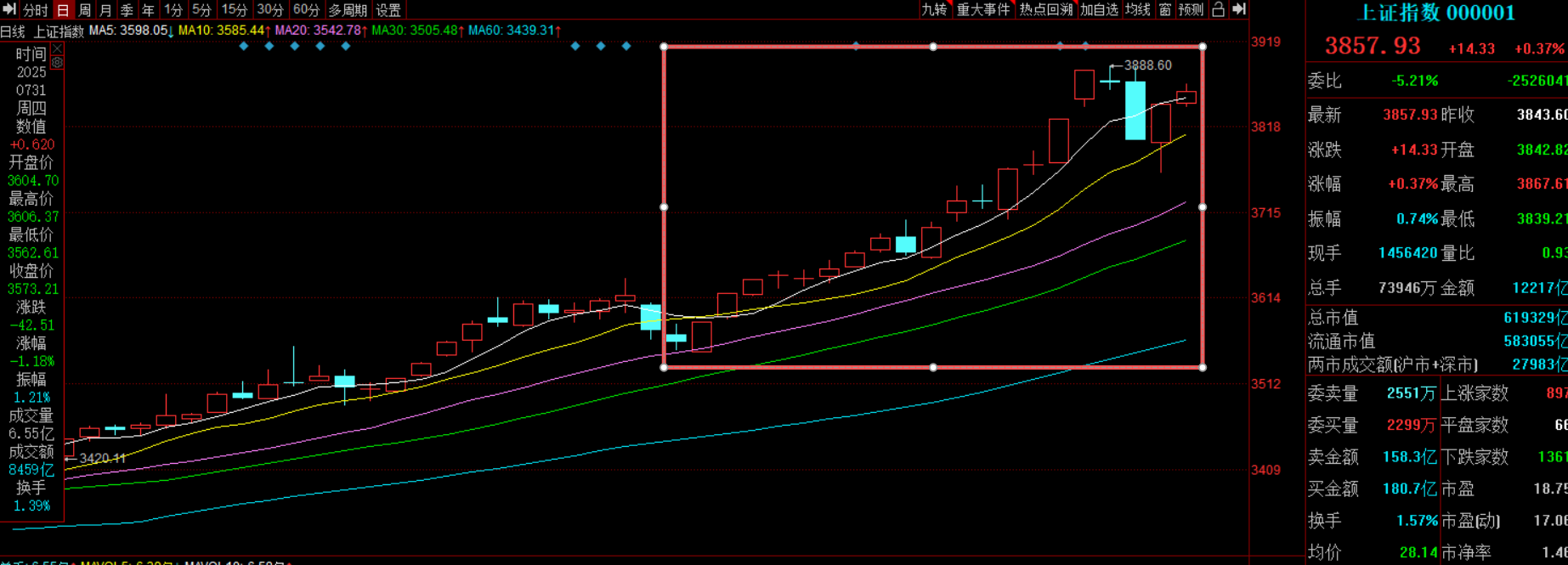
Core Viewpoint - The A-share market experienced a significant upward trend in August, with the Shanghai Composite Index surpassing 3800 points for the first time in 10 years, reflecting a cumulative increase of 7.97% for the month [1]. Group 1: Top Performing Stocks - The top-performing stock in August was Gobi Jia, with a remarkable cumulative increase of 155.37%, followed by Kaipu Cloud at 147.90%. All ten stocks in the top list saw gains exceeding 100%, with Cambrian Technologies achieving a 110.36% increase, surpassing Kweichow Moutai to become the new "king" of A-shares [2][3][4]. Group 2: Gobi Jia - Gobi Jia led the North Exchange 50 Index with a 155.37% increase, including a single trading day with a 30% limit up. The company specializes in the research, production, and sales of optical glass and high-end crystal craft glass. Despite the stock's volatility, Gobi Jia reported no significant changes in its operational environment or undisclosed major information. For the first half of the year, the company reported revenue of 251 million yuan, a decrease of 22.06%, and a net profit of 12.39 million yuan, down 74.13% year-on-year [5]. Group 3: Kaipu Cloud - Kaipu Cloud announced a major asset acquisition plan on August 24, intending to purchase 70% of Nanning Taike Semiconductor Co., Ltd. in cash and 30% through share issuance. This acquisition aims to enhance the company's capabilities in high-performance storage, completing its AI infrastructure offerings. Following the announcement, the stock hit a limit up on August 25 and recorded three limit-up days in total for the month [6]. Group 4: Sainuo Medical - Sainuo Medical's stock surged after two of its products received breakthrough designations from the FDA. The company achieved four limit-up days in August, with a total of 20% limit up on four trading days. For the first half of 2025, Sainuo Medical reported a revenue of 240 million yuan, a year-on-year increase of 12.53%, and a net profit of 13.84 million yuan, up 296.54% [7][8].
硅谷圈疯传的新“MBTI 测试”,到底是啥?
Hu Xiu· 2025-08-30 06:49
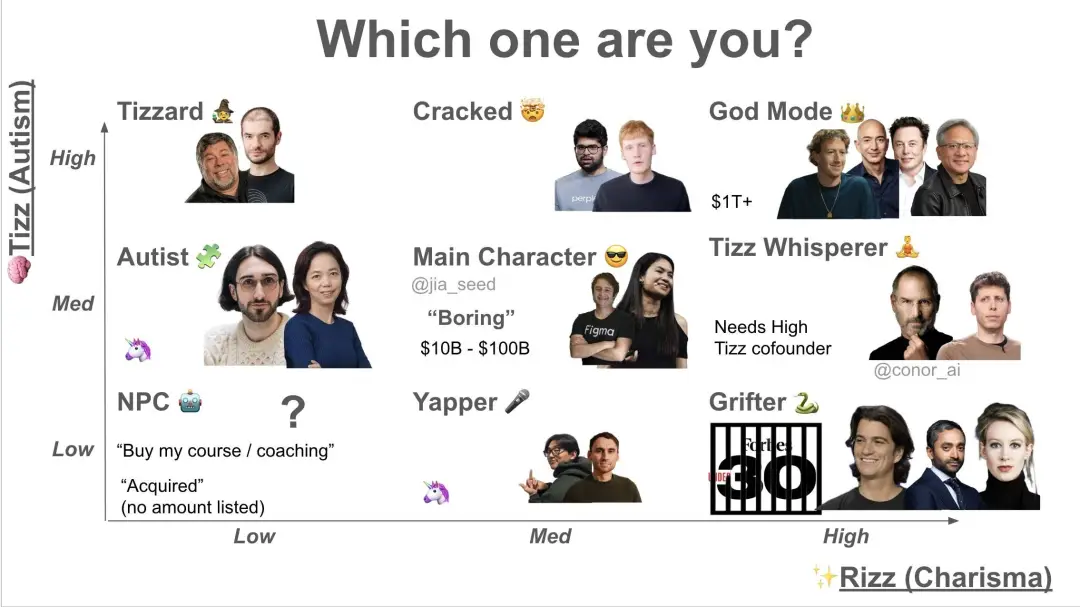
Core Insights - The article discusses the emergence of a new social concept called the "Tizz/Rizz matrix," which categorizes individuals based on their social charm (Rizz) and technical expertise (Tizz) [2][4][33] - It highlights notable figures in the tech industry, such as Steve Jobs, Elon Musk, and Jeff Bezos, positioning them within this matrix to illustrate their unique combinations of social and technical skills [27][30][36] Group 1: Tizz and Rizz Definitions - Rizz is defined as the "social prowess" index, indicating an individual's ability to charm and persuade others, with high Rizz individuals being able to secure significant funding with minimal effort [5][9] - Tizz represents the "tech-savvy" level, where a higher Tizz indicates a greater comfort with technology but potentially less social interaction [6][20] Group 2: Matrix Quadrants - The matrix consists of four quadrants: - Tizzard (top left) represents technical geniuses who may lack social skills [9][10] - Grifter (bottom right) includes individuals who are more deceptive and charismatic but lack substantial technical skills [12][13] - Cracked (bottom left) features those who can deliver products while being socially awkward [25] - God Mode (top right) includes the most successful individuals who excel in both technical and social domains [27][28] Group 3: Notable Figures - Key figures in the Tizzard quadrant include Steve Wozniak and Ilya Sutskever, who are recognized for their technical contributions without being prominent public speakers [10][11] - The God Mode quadrant features influential leaders like Musk, Bezos, Huang, and Zuckerberg, who possess both high Rizz and Tizz, allowing them to significantly impact their industries [27][30] Group 4: Implications for Success - The article suggests that achieving top-tier success in today's world requires a balance of technical skills and social charm, as exemplified by the figures in the God Mode quadrant [31][33] - It emphasizes the importance of both creating value (Tizz) and communicating that value effectively (Rizz) in the business landscape [33]


“干1个月赚了800万就跑路?”小扎「天价挖角」惨遭翻车!
猿大侠· 2025-08-30 04:11
Core Viewpoint - Despite offering exorbitant salaries, Meta is struggling to retain top talent in its newly formed AI team, Meta Superintelligence Labs (MSL), as evidenced by a wave of recent departures [1][16]. Recruitment and Compensation - Meta has aggressively recruited over 50 AI professionals, offering contracts exceeding $100 million, which has drawn criticism from competitors like OpenAI [5][4]. - The recruitment strategy included direct communication from CEO Mark Zuckerberg to potential candidates, even those who initially declined offers [4] Internal Challenges - The high salaries have led to internal friction, with long-time employees expressing dissatisfaction over the rapid promotions and pay of new hires, contributing to a wave of resignations [6][16]. - Departing employees include both seasoned veterans and new recruits, indicating significant issues with internal management and organizational stability [16][15]. Notable Departures - Key figures leaving Meta include: - Bert Maher, a 12-year veteran involved in developing PyTorch, who joined Anthropic [7]. - Tony Liu, who managed the PyTorch GPU systems, announced his departure [8]. - Chi-Hao Wu, an AI expert, left for Memories.ai due to instability from frequent reorganizations [9]. - New hires like Avi Verma and Ethan Knight returned to OpenAI shortly after joining Meta [13][14]. Competitive Landscape - The ongoing talent exodus signals challenges for Meta's "Superintelligence" initiative, as competitors like OpenAI, Anthropic, and Google continue to innovate and attract talent [18][16]. - The situation highlights the difficulties Meta faces in maintaining a cohesive and effective team despite substantial financial resources [18].

重投AI,阿里起飞
雷峰网· 2025-08-29 14:25
Core Viewpoint - Alibaba has significantly increased its investment in AI, with over 100 billion yuan spent in the past four quarters, demonstrating its commitment to the AI sector and dispelling market concerns about reduced investment [2][3]. Group 1: Financial Performance - In Q1 of FY2026, Alibaba's AI and cloud capital expenditure reached 38.6 billion yuan, a year-on-year increase of 220%, marking a new quarterly high [2]. - Alibaba Cloud's revenue growth accelerated to 26%, the highest in three years, driven by AI-related products, which have seen triple-digit year-on-year growth for eight consecutive quarters [2][3]. - AI revenue now accounts for over 20% of external commercialization revenue [2]. Group 2: AI Strategy - Alibaba's AI strategy focuses on a full-stack approach, integrating capabilities across various layers, including computing power, cloud, models, and applications, similar to Google's strategy [5][6]. - The company plans to invest 380 billion yuan in cloud and AI hardware infrastructure over the next three years, surpassing the total investment of the past decade [6]. Group 3: Global Infrastructure and Model Development - Alibaba Cloud has launched eight new AI and cloud data centers in various regions, with plans to expand to 30 regions and 95 availability zones by the end of the year [7]. - The company has developed a series of advanced AI models, achieving multiple global open-source championships and significant downloads, with over 300 models released and more than 400 million downloads [10]. Group 4: AI Applications - Alibaba is integrating AI across its various business units, with initiatives like DingTalk's new AI-driven office system and the launch of Gaode Map 2025, which features an AI assistant for personalized travel planning [14][16]. - The introduction of the RecGPT model on Taobao aims to enhance user experience and efficiency, resulting in over 5% increases in user engagement metrics [19]. Group 5: Long-term Vision - Alibaba's long-term commitment to AI is characterized by substantial investments in model development and open-source initiatives, positioning the company as a leader in the AI ecosystem [21][22].
港股AGI第一股“云知声”首战告捷:大模型贡献1亿收入,单客价直线提升116.2%,AI保险业务暴涨1386.8%
量子位· 2025-08-29 11:37
Core Viewpoint - The article highlights the impressive financial performance of Cloud Know Voice, marking its transformation into a leader in AGI (Artificial General Intelligence) within the Hong Kong stock market, as evidenced by its first financial report post-listing [1][43]. Financial Performance - In the first half of 2025, Cloud Know Voice reported total revenue of 405 million yuan, a 20.2% increase from 337 million yuan in the same period of 2024 [4]. - Revenue from large models surged by 457% to nearly 100 million yuan [5][9]. - The medical business generated 70 million yuan, reflecting a 22.3% year-on-year growth, accounting for 17.3% of total revenue [8][9]. Business Segmentation - Daily life revenue reached 335 million yuan, making up 82.7% of total revenue, with solutions contributing 283 million yuan (69.8% of total revenue) and products accounting for 53 million yuan (13% of total revenue) [7][8]. - The insurance claims review service saw a dramatic increase in revenue from 670,000 yuan in 2024 to 9.96 million yuan in 2025, a growth of 1386.8% [12]. Model and Technology Development - The "Shan Hai Medical Model" upgrade allowed the company to offer higher-end solutions at increased prices, driving revenue growth [11]. - R&D expenses for the first half of 2025 were 168 million yuan, representing 41.5% of total revenue, with the R&D team comprising 68.7% of total employees [14]. Strategic Alignment - Cloud Know Voice's business strategy aligns with the State Council's "Artificial Intelligence+" initiative, focusing on daily life and medical applications [19][22]. - The company has developed a comprehensive AGI capability architecture, integrating foundational chips, computing facilities, and large models [33][41]. Market Implications - The article indicates a growing trend in the commercialization of large models, with significant demand in sectors related to public welfare, particularly in healthcare and service industries [44]. - Cloud Know Voice's strong foundational capabilities position it favorably in the competitive landscape, suggesting long-term growth potential [45].

阿里发布Q1财报 “AI+云”板块超预期加速增长
Zheng Quan Ri Bao Zhi Sheng· 2025-08-29 10:39
Core Viewpoint - Alibaba Group has made significant investments in AI and cloud infrastructure, achieving a record high capital expenditure of 38.6 billion yuan in Q1 FY2026, reflecting its commitment to AI development and strategic growth opportunities [1] Group 1: Financial Performance - Alibaba's cloud revenue grew by 26%, marking a three-year high, with AI-related product revenue experiencing triple-digit year-on-year growth for eight consecutive quarters [1] - The company aims to focus on major consumer and AI + cloud strategies for long-term growth [1] Group 2: AI Model Development - Alibaba's AI model has achieved rapid updates, with the release of multiple new models, including the Qwen3-Coder and Wan2.2, which have gained global recognition in their respective fields [2] - The company has launched the Qwen-Image model, which quickly topped the Hugging Face model rankings [2] Group 3: Infrastructure Expansion - Alibaba has opened eight new AI and cloud data centers globally this year, as part of a broader plan to invest 380 billion yuan in cloud and AI hardware infrastructure over the next three years [3] - The global infrastructure layout of Alibaba Cloud will expand to 30 regions and 95 availability zones in the second half of the year [3] Group 4: AI Application Development - Various Alibaba platforms, including Gaode and DingTalk, are accelerating AI integration to enhance user and industry value [4] - Gaode has launched the world's first AI-native application based on maps, while DingTalk has introduced an AI-driven work information flow application [4] Group 5: E-commerce AI Tools - The "Full Site Promotion" AI tool has improved operational efficiency for merchants on Alibaba's platforms, with increasing penetration rates [5] - The launch of the RecGPT model has enhanced user engagement metrics, such as increased add-to-cart rates and longer session durations [5] - Alibaba is also expanding into hardware with the upcoming release of its self-developed AI glasses [5]