
资产配置

Search documents
打造“固收+”精品致力于提升持有人体验——访银华基金于蕾
Shang Hai Zheng Quan Bao· 2025-11-30 14:10
Core Viewpoint - The article emphasizes the importance of "fixed income plus" (固收+) investment strategies in providing stable long-term returns for investors, particularly in a declining interest rate environment [3][4][9]. Group 1: Investment Strategy - The core of the "fixed income plus" business is asset allocation, which is seen as a critical measure of a professional team's capabilities [3][7]. - The investment philosophy focuses on maximizing returns while controlling drawdowns, highlighting the significance of cost-effectiveness across different asset classes [3][7]. - The "fixed income plus" products have gained popularity as they address asset allocation challenges and offer a relatively stable approach to achieving long-term returns in volatile market conditions [4][9]. Group 2: Market Trends and Data - As of Q3 2025, the total market size of "fixed income plus" products reached 2.44 trillion yuan, an increase of over 500 billion yuan from Q2 2025, and a rise of 1.11 trillion yuan compared to Q3 2024 [4]. - The article notes that the real estate sector's drag on the economy is expected to diminish over the next two to three years, potentially leading to a recovery in consumer and business confidence, which could create overall investment opportunities in A-shares and Hong Kong stocks [9]. Group 3: Team and Technology - The company has invested significantly in resources to support the "fixed income plus" direction, with a multi-asset team of over 50 members, including specialists in equity and various investment strategies [5][6]. - AI technology is increasingly utilized to enhance investment decision-making, improve efficiency, and identify investment risks, thereby strengthening the team's capabilities [6][5]. Group 4: Future Outlook - The company plans to launch a new "fixed income plus" product, focusing on balancing aggressiveness and safety while aiming for excess returns [9]. - Future investment strategies will consider sectors showing signs of recovery, such as consumption-related industries and cyclical products linked to PPI recovery, while maintaining an open mindset to adapt to market changes [9].


广发基金王浩:“发车”顺势而为灵活把握结构性机会
Shang Hai Zheng Quan Bao· 2025-11-30 14:09
Group 1 - The core viewpoint emphasizes the importance of market timing as a tool for respecting market dynamics and making informed decisions based on current market conditions [1][2] - The investment strategy involves a combination of passive and active management, focusing on structural opportunities through a systematic approach to timing and asset selection [4][5] - The "Index 100" advisory strategy has achieved a cumulative return of 45.67% since its inception, demonstrating a favorable risk-return profile with a Calmar ratio of 1.38 [4] Group 2 - The timing strategy aims to enhance the risk-reward ratio of investment portfolios, particularly in volatile equity assets, which are more pronounced in emerging markets [2][3] - The investment team utilizes a comprehensive research framework that includes policy, fundamentals, technicals, sentiment, and valuation to guide decision-making [2] - The execution of the timing strategy is based on identifying trends and mispricing, with a focus on position management to mitigate risks associated with market misjudgments [3] Group 3 - Looking ahead, the company identifies three main investment themes: high-growth sectors such as AI and semiconductors, export-related industries, and gold and dividend-paying assets [6] - The outlook for risk assets remains positive due to ongoing monetary easing in the U.S. and potential global risk appetite recovery [6] - The investment strategy will adapt dynamically to core catalysts such as policy support and technological advancements in high-growth sectors [6]
与牛市共舞:一份给理性投资者的生存指南!
雪球· 2025-11-30 13:01
Core Viewpoint - The article emphasizes the importance of building a robust asset allocation strategy that can withstand market fluctuations, rather than merely chasing high returns during a bull market [4][5]. Group 1: Understanding Market Behavior - In a bull market, investors often feel anxious about whether to chase opportunities or hold back, leading to a binary mindset [7][8]. - The most dangerous behavior in a rising market is to remain completely inactive, as this can erode purchasing power over time [10]. - The distinction between a professional investor and an emotional trader lies in having a clear financial goal and understanding one's risk tolerance [11]. Group 2: Risk Management - True risk in investing often stems from asset misallocation rather than market downturns [12][13]. - Investors must align their investment horizon with the lifecycle of their funds to avoid mismatches that can lead to financial strain [15][17]. - A well-structured investment portfolio should clearly indicate the purpose and timeline for each allocation, serving as a protective measure against risks [17]. Group 3: Asset Allocation Strategy - Asset allocation should be viewed as an art of harvesting rather than merely a defensive strategy [24]. - A successful asset allocation consists of a stable foundation ("keel") and a dynamic growth component ("sail") [25][26]. - Regularly rebalancing the portfolio by taking profits from high-performing assets and reallocating them to safer investments is crucial for maintaining balance [29][31]. Group 4: Conclusion and Reflection - The journey of investing is continuous, reflecting not only market dynamics but also personal emotions and decision-making processes [35][36]. - The ultimate goal of asset allocation is to create a financial order that allows for a more fulfilling life, rather than just maximizing returns [35].

2026配置攻略!李蓓:先抓“寒冬小花”,再抓“满园春色”,再等全球资本涌入的大牛市
Xin Lang Zheng Quan· 2025-11-30 02:39
Core Viewpoint - The 2025 Analyst Conference highlighted a bullish outlook on China's manufacturing sector, emphasizing the significant mismatch between China's manufacturing global share and the low proportion of the Renminbi in trade settlements and international reserves, suggesting a potential correction in this disparity as the economy stabilizes and asset prices recover [1]. Group 1: Manufacturing Sector Insights - China's manufacturing sector currently holds a global share of 50%, establishing itself as a core pillar of the global supply chain [1]. - The Renminbi's share in international trade settlements and global foreign exchange reserves remains at a negligible level, indicating a substantial room for correction [1]. Group 2: Economic Recovery and Currency Positioning - The correction process is expected to align with China's economic recovery, where a stabilization in the economy and rising asset prices will enhance the Renminbi's relative advantages [1]. - As the Renminbi's international settlement and reserve proportions increase, they are likely to converge with the global standing of China's manufacturing sector, entering a sustained upward trajectory [1]. Group 3: Asset Allocation Strategy - For 2026, the focus should be on resilient leading enterprises that can thrive even in challenging conditions, representing a "small happiness" during the current phase [1]. - The ultimate market direction is anticipated to be a significant bull market driven by the alignment of industrial advantages and currency status, alongside a shift in global capital allocation logic [1].

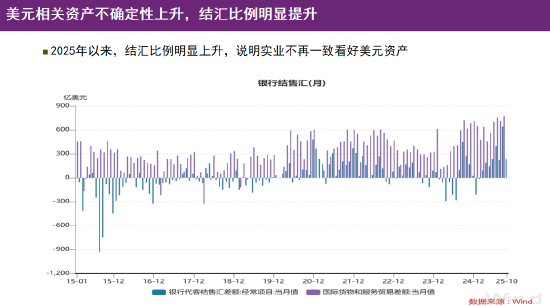
李蓓曝关键信号:美元相关资产不确定性上升,结汇比例明显提升,说明实业不再一致看好美元资产
Xin Lang Zheng Quan· 2025-11-30 01:50
Core Insights - The 2025 Analyst Conference highlighted a significant shift in asset allocation preferences among high-net-worth individuals and business owners in China, driven by increasing uncertainty in U.S. policies and concerns over the long-term credibility of the U.S. dollar [1] Group 1: Asset Allocation Trends - Since the Trump administration, there has been a noticeable decline in the preference for U.S. dollar assets among Chinese high-net-worth individuals and business owners, with a marked increase in the willingness to convert currency back to yuan [1] - Historical data indicates that over the past decade, particularly before 2024, China's monthly current account surplus (including trade and services) exceeded actual currency conversion amounts by approximately $20 billion, leading to an accumulation of over $2 trillion in unconverted funds [1] - In 2025, a significant change occurred where the willingness to convert currency has risen, although full conversion has not yet been achieved [1] Group 2: Driving Factors - The two main drivers behind this shift are the ongoing uncertainty in U.S. policies since Trump's presidency and growing concerns regarding the long-term credibility of the U.S. dollar [1] - This change in asset allocation preferences is interpreted as an important indicator of global capital flows, reflecting a diminishing attractiveness of U.S. dollar assets [1]
金价一涨再涨,投资者什么时候可以进场抄底,2026年黄金还会再涨吗?
Sou Hu Cai Jing· 2025-11-30 01:48
Core Viewpoint - The gold market is experiencing a significant bull run, with prices reaching historical highs due to geopolitical tensions, monetary policy changes, and central bank purchases, leading to widespread public interest in gold as a safe-haven asset [1][3][9]. Group 1: Price Trends and Historical Context - Gold prices have surged from approximately $2,600 per ounce at the beginning of the year to over $4,100 per ounce, marking a nearly 58% increase within a year [1]. - In 2024, international gold prices set 40 historical highs, indicating a rare and robust bull market not seen in many years [1][3]. - Predictions for 2026 suggest that gold prices may continue to rise, with estimates from major financial institutions indicating potential prices exceeding $5,000 per ounce [8][9]. Group 2: Factors Driving Gold Prices - Geopolitical instability, including issues in the Middle East and the Russia-Ukraine conflict, has led investors to view gold as a safe-haven asset, increasing demand and driving prices higher [3]. - The Federal Reserve's shift to a rate-cutting cycle has attracted funds to gold, as lower interest rates diminish the opportunity cost of holding non-yielding assets like gold [3][9]. - Central banks globally have significantly increased their gold purchases, with a reported net purchase of 220 tons in Q3 2025, a 28% increase from the previous quarter, indicating strong institutional support for gold [3][9]. Group 3: Investment Considerations - Current gold prices are at a high level, with fluctuations observed, such as a recent drop from $4,150 to $4,090 within two days, suggesting potential volatility for investors [4][5]. - Historical patterns indicate that after rapid price increases, a correction phase typically follows, which may present buying opportunities for investors [5][10]. - The domestic market shows a divergence in pricing, with brand gold jewelry often priced 20% to 25% higher than international market rates, suggesting that investors may benefit from considering investment-grade gold products like ETFs instead of high-premium jewelry [6][10]. Group 4: Consumer Behavior and Market Dynamics - Consumer demand for gold jewelry in China has decreased by 32.5% year-on-year in the first three quarters, indicating that high prices may be deterring purchases [8]. - Investors are advised to prepare for potential short-term volatility and to consider a phased investment approach to mitigate risks associated with market entry at high prices [8][11]. - The long-term appeal of gold as a hedge against inflation and economic uncertainty remains strong, despite potential challenges from high prices and fluctuating dollar strength [9][13].

李蓓:富人面临“财富无处安放、安全难有保障”的资产荒
Xin Lang Zheng Quan· 2025-11-30 01:45
Core Insights - The 2025 Analyst Conference highlighted the current challenges faced by high-net-worth individuals regarding asset allocation, emphasizing the phrase "wealth has nowhere to go, and safety is hard to guarantee" [1] Group 1: Market Conditions - The fixed income assets, particularly non-standard assets, which were once considered a "ballast" for wealthy individuals, are now facing dual pressures: declining interest rates compressing yield space and a gradual supply shortage of non-standard assets [1] - Traditional investment channels for high-net-worth individuals are continuously narrowing, leading to increased asset allocation anxiety [1] Group 2: Real Estate Market - The real estate market is viewed through a dual lens: as a consumption good, its residential attributes are beginning to reflect corresponding value; however, as an investment, the current rental yield levels lack sufficient attractiveness for high-net-worth individuals [1]
李蓓:房地产作为消费品已体现出价值,作为投资品租金回报依然没有足够的吸引力
Xin Lang Zheng Quan· 2025-11-30 01:45
炒股就看金麒麟分析师研报,权威,专业,及时,全面,助您挖掘潜力主题机会! 11月28日,2025分析师大会举行。半夏投资创始人李蓓出席本次大会并发表主题演讲。李蓓表示,当下 的富人正身处一个特殊的时期,核心痛点可概括为八个字——财富无处安放,安全难有保障。 专题:2025分析师大会:资本市场"奥斯卡"启幕 对于备受关注的房地产市场,李蓓给出了辩证判断:"若将房地产视为纯粹的消费品,其居住属性已开 始体现相应价值;但如果仍作为投资品来看,当前的租金回报水平依然缺乏足够吸引力,难以成为高净 值人群资产配置的优质选择。" 责任编辑:常福强 李蓓的论述直击高净值人群的资产配置焦虑。她进一步拆解道,从国内市场来看,曾经作为富人资产配 置"压舱石"的固定收益类资产,尤其是非标资产,正面临双重冲击:一方面利率持续下行再下台阶,收 益空间不断被压缩;另一方面非标资产供给逐渐断供,传统配置渠道持续收窄。 ...
从小确幸到大牛市
半夏投资· 2025-11-29 05:03
Core Viewpoint - The article discusses the increasing difficulty of asset allocation in a chaotic global environment, highlighting the challenges faced by high-net-worth individuals in securing their wealth and achieving satisfactory returns [2][3]. Domestic Asset Dilemma - Over the past decade, fixed-income assets, particularly non-standard assets, have been crucial for wealthy individuals in China. However, current comprehensive interest rates are at historical lows, and non-standard assets are gradually being phased out [4]. - Real estate, once a primary investment for affluent individuals, now shows an average rental return of 2.3% in the top 20 cities, making it less attractive due to liquidity issues and high transaction costs [4]. Increased Uncertainty Overseas - The trend of investing abroad has been beneficial for high-net-worth individuals in recent years, with investments in USD deposits, US stocks, and real estate in the US and Japan yielding good returns. However, potential returns are now significantly lower, and uncertainty has increased [5][6]. AI Investment Uncertainty - Current AI investments in the US resemble past infrastructure investments in China, appearing beneficial but ultimately unsustainable due to the mismatch between cash flow and debt burdens [7][8]. - Structural uncertainties in AI investments have risen, including questions about technology paths and which service providers will succeed [8]. Economic Outlook - The US economy is expected to slow significantly in the second half of next year, with AI investment being a major support for economic resilience over the past two years. However, signs of layoffs and declining housing prices in Silicon Valley indicate emerging challenges [10]. - The current high valuations and earnings in the US stock market suggest limited future returns, with a likelihood of long-term depreciation of the USD against the RMB [10]. Gold Investment Outlook - The best phase for gold investment appears to be over, with rising uncertainties and potential overvaluation based on historical pricing models [12][14]. - Recent sales of gold by central banks, particularly by Russia, signal a significant change in the market dynamics for gold [18]. Asset Allocation Challenges - The article emphasizes that asset allocation has become more complex, with increasing uncertainties regarding the safety of wealth, especially for Chinese individuals with assets abroad [20]. - The potential for major countries, including the US, to face fiscal issues could further complicate the investment landscape [20]. Investment Opportunities - Despite economic challenges, the A-share and Hong Kong stock markets currently offer some of the highest implied returns globally, with the Shanghai Composite Index trading at a PE ratio of around 13, implying a return of approximately 7% [21]. - The article suggests that even in a weak economic environment, the return on equity (ROE) for core indices may stabilize, providing a foundation for future growth [23][25]. Examples of Resilience - The article highlights examples of leading companies in struggling industries, such as construction materials and real estate, that have managed to maintain profitability and even grow amidst broader market challenges [26][33]. Future Market Outlook - The potential for a significant bull market is discussed, driven by the return of wealth from overseas and the reallocation of global capital towards Chinese assets as the domestic economy stabilizes [39][43]. - Historical patterns suggest that a low-interest environment combined with a lack of investment opportunities in other major markets could lead to a new bubble in Chinese assets [44][46].

红利底仓可以,全仓大可不必
雪球· 2025-11-29 04:09
Core Viewpoints - The article emphasizes that ETFs will become the ultimate destination for most retail investors, encouraging them to act as their own fund managers [2][4]. Group 1: Dividend and Low Volatility - Dividends are essentially akin to bond assets, providing a form of down protection through stable cash flows [4][5]. - The low volatility characteristic of dividend assets offers a safe haven during market turbulence, as evidenced by the difference in maximum drawdowns between total return indices and price indices [5][7]. - Full allocation to dividend stocks may lead to missed opportunities for upward gains, as these stocks often belong to mature companies with stable cash flows but limited growth potential [7][13]. Group 2: Asset Allocation Strategy - A balanced allocation strategy is recommended, with 30% in dividend stocks to provide stable cash flow and reduce overall portfolio volatility [8][11]. - An additional 20% should be allocated to growth technology stocks to capture upward potential, as demonstrated by significant market movements [9]. - The remaining allocation can include diverse assets such as 10% in gold, 10% in bonds, and 20% in indices like the Nasdaq [10]. Group 3: Market Response and Rebalancing - The strategy of "not predicting, only responding" is highlighted as the ultimate solution to market unpredictability [11]. - Rebalancing is essential to manage risk; during market downturns, dividend stocks provide stability, while profits from growth stocks can be reinvested into undervalued dividend assets [12]. - Full allocation to a single investment style is viewed as a gamble, and diversification across different styles and asset classes is encouraged for long-term health [13][15].
