长期主义

Search documents
东呈首发《穿越周期的力量》!中国品牌节论道“高性价比”
Nan Fang Du Shi Bao· 2025-08-11 12:51
Core Viewpoint - The launch of the book "The Power to Cross Cycles: My 18 Years of Entrepreneurship in China's Hotel Industry" by Cheng Xinhua, founder and CEO of Dongcheng Group, highlights the company's journey and insights into the hotel industry, emphasizing high cost-performance and long-termism as key strategies for navigating industry cycles [1][4][9]. Group 1: Book Launch and Event Highlights - The book was officially launched at the 19th China Brand Festival, attended by notable figures from cultural and business sectors, enhancing the event's significance [3]. - Cheng Xinhua's speech shared practical examples of Dongcheng's strategies for overcoming industry challenges, focusing on the company's evolution and strategic insights [4][7]. Group 2: Company Growth and Strategy - Dongcheng Group, founded in 2006, has achieved rapid growth, becoming one of the top five hotel groups in China and the top fourteen globally, recognized as a "dark horse" in the industry [4]. - The company has adopted a long-term perspective, emphasizing high cost-performance as a guiding principle for development, which resonates with current market trends [7][9]. Group 3: Industry Insights and Trends - The hotel industry is transitioning from rapid growth to stable growth, necessitating a shift in operational focus from expansion to efficiency and profitability [7]. - Cheng Xinhua's insights reflect a broader understanding of consumer trends, advocating for localized innovation and a commitment to balancing business growth with social responsibility [8]. Group 4: Brand Value and Recognition - Dongcheng Group has been recognized in the "Top Brand 2025 China Brand 500 Strong" list, achieving a brand value of 10.466 billion, indicating its strong market presence and potential for future growth [11].


互联网企业慢性死亡的招聘视角分析:从岗位割裂看战略短视
Sou Hu Cai Jing· 2025-08-11 06:44
Core Insights - The article highlights the chronic issues facing Chinese internet companies, particularly focusing on recruitment practices that reflect strategic shortsightedness, internal conflict culture, and a lack of core competitiveness [2][5][12] Recruitment Practices - The article discusses absurd recruitment practices where companies seek candidates with overly specific labels rather than assessing their underlying skills and experiences [4][11] - There is a significant trend of job role fragmentation in the internet industry, with a 37% increase in job specialization over the past five years, while the proportion of hybrid roles has decreased by 18% [6][10] - Companies often prioritize short-term KPIs in recruitment, leading to inefficiencies and neglect of long-term user value [7][10] Strategic Short-sightedness - The article points out that many internet companies are unable to see the interconnectedness of roles, such as advertising and user growth, which leads to a fragmented understanding of their business [5][9] - The focus on immediate results has caused companies to split roles unnecessarily, resulting in poor collaboration and a lack of strategic vision [8][14] Internal Conflict Culture - Internal power struggles and a lack of effective governance structures contribute to a culture of conflict, which distracts management from making sound strategic decisions [8][12] - The article cites examples of companies like Bitmain and Dangdang, where internal conflicts have led to operational chaos and hindered growth [8][9] Core Competitiveness - The article emphasizes that many internet companies have lost their ability to innovate and rely heavily on "buying traffic" rather than developing core products and technologies [9][10] - Research indicates a U-shaped relationship between R&D investment intensity and company survival, with many companies failing to invest adequately in R&D [9][10] Recommendations for Improvement - Companies are encouraged to shift from a short-term focus to a long-term strategy, integrating roles rather than fragmenting them, and fostering a collaborative culture [14][15] - Successful companies like Google and Microsoft prioritize foundational skills and learning potential over narrow specialization, which helps maintain innovation and adaptability [12][15]

富达基金总经理孙晨: 从华尔街到黄浦江外资公募探寻“本土化解法”
Zheng Quan Shi Bao· 2025-08-10 17:45
Core Viewpoint - The article discusses the challenges and strategies of foreign asset management firms, particularly Fidelity, in navigating the complexities of the Chinese market, emphasizing the need for a localized approach and long-term investment strategies [1][2][6]. Group 1: Market Challenges - Since the establishment of the first wholly foreign-owned public fund in China in 2020, foreign public funds have faced difficulties due to the highly localized market environment, which makes it challenging to apply international experiences directly [2][3]. - Foreign asset management firms are currently in a "positioning phase," where they are learning from the market and adjusting their organizational structures to meet unique local demands [2][3]. Group 2: Strategic Framework - Fidelity has proposed a strategic framework of "two markets and two systems," focusing on the local market through partnerships with banks, brokers, and e-commerce platforms, while also addressing international market needs for Chinese asset allocation [2][3]. - The "two systems" include a product system and a research system, ensuring that global research resources are effectively aligned with the specific needs of the Chinese market [3][4]. Group 3: Local Adaptation - Fidelity emphasizes understanding the true needs of the Chinese market, which is still evolving, providing opportunities for sustainable growth through active investment strategies and multi-asset approaches [4][5]. - The company aims to develop localized products based on the unique requirements of the Chinese market rather than simply replicating existing models from abroad [5][6]. Group 4: Long-term Commitment - In the context of the volatile A-share market, Fidelity stresses the importance of maintaining a long-term investment philosophy and a stable underlying structure to navigate short-term fluctuations [6][7]. - The firm has implemented a long-term evaluation system for fund managers, allowing them to adhere to their investment styles despite market changes, thereby fostering trust among investors [6][7].
如何穿越投资迷雾 ——读《大道至简:大师投资说》
Shang Hai Zheng Quan Bao· 2025-08-10 17:40
Core Insights - The book "大道至简:大师投资说" emphasizes a return to the essence of investing, focusing on value investment principles and localized strategies for navigating market volatility [3][4][10] Group 1: Value Investment Principles - The core of value investing is understanding that stocks represent a part of a business, and investors should analyze companies as they would their own businesses [4][10] - Long-termism is highlighted as a fundamental principle, requiring investors to maintain faith in the long-term growth potential of companies despite short-term market fluctuations [4][10] Group 2: Investment Framework - The author introduces a "three-dimensional perspective" for stock research, which includes industrial, financial, and risk perspectives [6] - The "86 system" focuses on qualitative analysis, emphasizing the selection of companies with clear business models, sustainable performance, and trustworthy management [6] - The "39 system" builds on the 86 system, advocating for contrarian investment strategies during market extremes [6] Group 3: Market Dynamics and A-Share Insights - The book addresses the high volatility of the A-share market, arguing that despite its challenges, value investing remains viable [9][10] - Historical data shows that high-quality companies like 贵州茅台 and 伊利股份 have provided substantial long-term returns, countering the notion of the A-share market being ineffective [9] Group 4: Overcoming Behavioral Challenges - The author identifies human nature as a significant barrier to successful value investing, with many investors losing direction due to short-term market movements [10][11] - Emphasizing the importance of independent thinking and emotional management, the book outlines key traits of successful value investors, including patience and decisiveness [11]






富达基金总经理孙晨: 从华尔街到黄浦江 外资公募探寻“本土化解法”
Zheng Quan Shi Bao· 2025-08-10 17:37
Core Viewpoint - The article discusses the challenges and strategies of foreign asset management firms, particularly Fidelity, in navigating the complexities of the Chinese market since the establishment of the first wholly foreign-owned public fund company in June 2021 [1][2]. Group 1: Market Challenges - Foreign public funds in China face difficulties due to the highly localized market environment, which makes it challenging to apply international experiences directly [2]. - The key challenges include unclear positioning and the need for strategic adjustments to meet the unique demands of the Chinese market [2]. - The market's relatively weak efficiency and high volatility present opportunities for sustainable growth for firms like Fidelity [4][5]. Group 2: Strategic Framework - Fidelity has proposed a "two markets, two systems" strategy, focusing on the local market through partnerships with banks, brokers, and e-commerce platforms, while also catering to international investors seeking exposure to Chinese assets [2][3]. - The "two systems" encompass a product system and a research system, ensuring that global research resources are effectively aligned with local market needs [3]. Group 3: Product Development - Fidelity emphasizes the importance of understanding the genuine needs of the Chinese market, particularly in the context of its evolving pension system [5]. - The firm aims to develop targeted products for different client segments, leveraging its global asset allocation strategies while also creating localized solutions [3][4]. Group 4: Long-term Investment Philosophy - Fidelity advocates for a long-term investment approach, avoiding short-term trends and focusing on maintaining a stable investment style amidst market volatility [6]. - The firm employs a structured investment framework and long-term assessments for fund managers to ensure consistency in investment strategies [6][7].
酒店业周期破局论坛在深圳举行 探索行业可持续发展之路
Zhong Guo Xin Wen Wang· 2025-08-10 15:03
中国旅游研究院国际交流部主任杨劲松表示,今年,全球旅游业呈现显著恢复态势,已超过2019年同期 水平。他提出,中国酒店业需通过"小而精、小而美、小而暖"实现差异化,关注在地文化连接、情绪价 值与非功能性服务,同时探索"酒店+"融合模式。 在高峰对话环节,跨界协同破局来自酒店集团、资管、科技企业、旅游平台的嘉宾围绕"周期破局"展开 对话,大家一致认为,面对消费者需求多元化、市场竞争加剧等挑战,酒店业须通过聚焦核心需求,强 化科技赋能,深化跨界协同,坚持长期主义,最终实现从"生存"到"破局"的跨越。(完) (文章来源:中国新闻网) 中新网深圳8月10日电 (记者郭军)由品牌联盟与东呈集团联合主办的酒店业周期破局论坛9日在深圳举 行。本次论坛以"穿越周期的力量"为主题,汇聚政府领导、行业协会专家、企业领袖、学者及媒体代 表,围绕酒店业在周期挑战下的破局路径展开深度探讨,为酒店业应对周期波动、实现可持续发展提供 思路与方向。 教育部旅游管理教指委副主任、中国旅游与酒店投资人联盟主席马勇指出,当前酒店业面临"碳基时代 向硅基时代"转型的挑战,人工智能、消费市场变化(如情绪消费、理性消费)及行业生态重构是关键变 量。 东 ...
国泰的功守道
2 1 Shi Ji Jing Ji Bao Dao· 2025-08-08 23:13
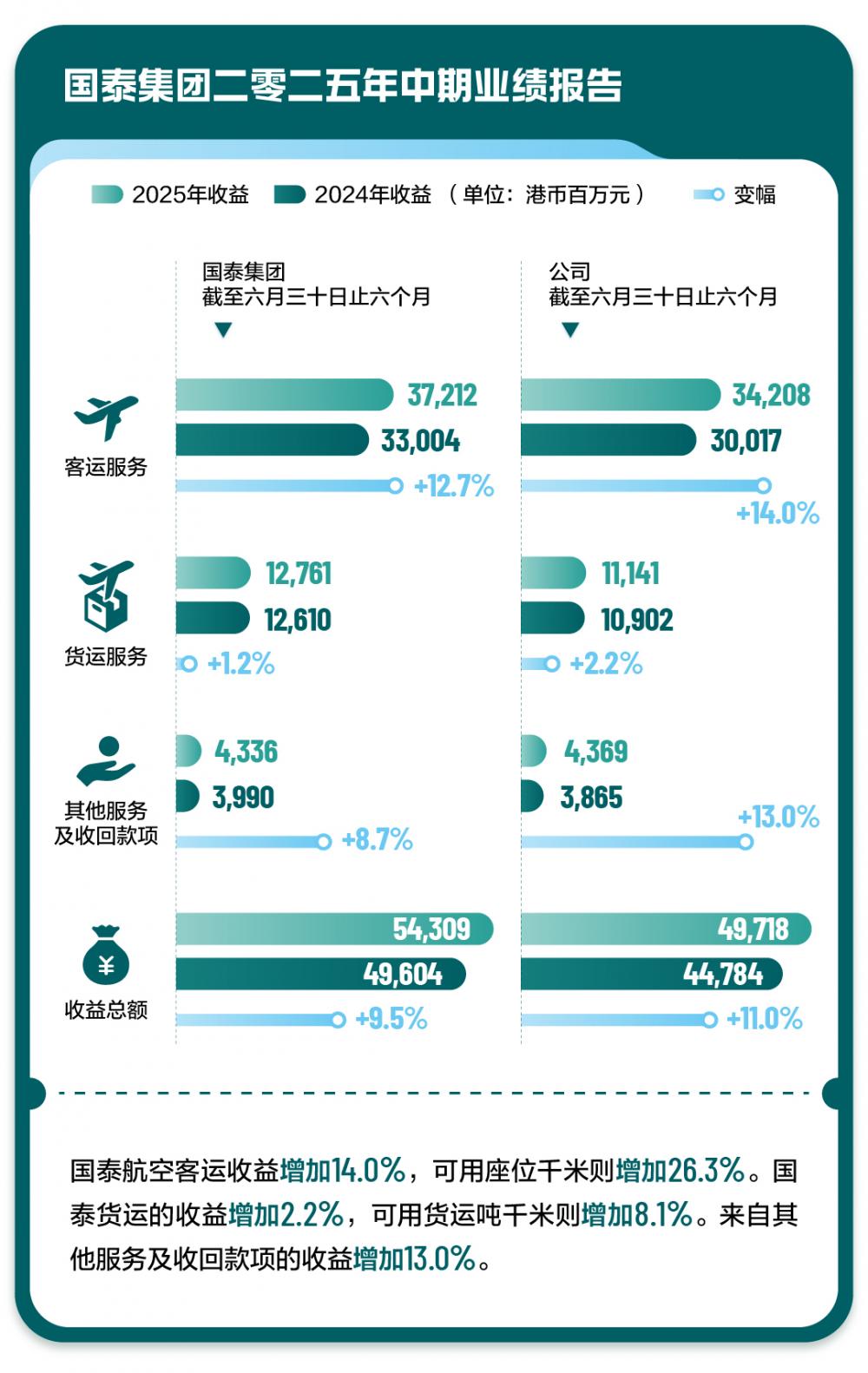
Core Viewpoint - Cathay Pacific Group has demonstrated a steady yet progressive performance in its financial results, achieving a revenue of HKD 54.309 billion for the first half of 2025, a year-on-year increase of 9.5%, and a net profit of HKD 3.7 billion, up 1.1% [2] Group 1: Investment in Future - The company announced an additional purchase of 14 Boeing 777-9 aircraft, increasing the total order to 35, which will bring the total number of new aircraft to over 100, including various types of planes [5] - Cathay Pacific and Hong Kong Express have added 19 new passenger routes, expanding their network to over 100 destinations globally, with 23 routes in mainland China and over 300 weekly flights [5] - The total investment by the group exceeds HKD 100 billion, aimed at enhancing customer experience and solidifying Hong Kong's position as an international aviation hub [5] Group 2: Steady Operations - Cathay Pacific Group reported a passenger revenue of HKD 37.212 billion, a 12.7% increase year-on-year, with a total passenger count of 13.6 million, averaging 75,300 passengers daily, a growth of 27.8% compared to the same period in 2024 [6] - Hong Kong Express recorded a passenger count of 3.8 million, with a daily average of 20,900 passengers, reflecting a 33.5% year-on-year increase [6] - Cargo revenue increased by 2.2% to HKD 11.141 billion, with overall cargo tonnage rising by 11.4%, showcasing the company's strategic stability amidst uncertainties [6] Group 3: Market Positioning and Strategy - The company is focused on long-term growth and stability, emphasizing the need for time to mature new routes and expressing confidence in Hong Kong Express's future [6] - Cathay Pacific's competitive edge lies in its ability to balance future ambitions with a strong cultural foundation, aiming to be the most international Chinese airline while remaining deeply rooted in its heritage [7] - The company is actively exploring cargo demand in Southeast Asia and India, adjusting its flight network accordingly and investing in diverse cargo services [7]
国泰的功守道:穿越周期的长期主义
21世纪经济报道· 2025-08-08 10:14
Core Viewpoint - The article emphasizes the dual strategy of "offensive and defensive" approaches in business operations, particularly in the context of Cathay Pacific's recent financial performance and strategic initiatives [1][3]. Financial Performance - In the first half of 2025, Cathay Pacific achieved a revenue of HKD 54.31 billion, representing a year-on-year growth of 9.5%, and a net profit of HKD 3.7 billion, up 1.1% [3]. - Passenger revenue reached HKD 37.21 billion, a year-on-year increase of 12.7%, with a total passenger volume of 13.6 million, reflecting a 27.8% growth compared to the same period in 2024 [14]. Strategic Initiatives - Cathay Pacific is expanding its route network, adding 19 new passenger routes, bringing its total to over 100 global destinations, with 23 in mainland China [6][11]. - The airline is focusing on three strategic directions for its route expansion: capturing regional economic vitality, leveraging the "Belt and Road" initiative, and enhancing intercontinental connectivity [4]. Investment in Assets - The company announced the purchase of 14 additional Boeing 777-9 aircraft, increasing its total order to 35, which signifies a strong commitment to future growth despite current challenges [9]. - Cathay Pacific's total investment in new aircraft, cabin products, airport lounges, and digital innovations exceeds HKD 100 billion, aimed at enhancing customer experience and solidifying its position as a global aviation hub [10]. Customer Experience Enhancements - Upgrades to ground services include the reopening of the "E-Lounge" in Hong Kong and the upcoming launch of a flagship lounge in Beijing, creating a comprehensive service experience for travelers [6]. - The airline's focus on customer experience is reflected in its recognition as one of the top three global airlines by Skytrax, along with awards for best economy class and in-flight entertainment [19]. Talent Development - Cathay Pacific is expanding its workforce by recruiting 1,000 new employees from mainland China, aiming to enhance its operational capabilities and support growth in the Greater Bay Area [18]. - The company has initiated a pilot training program for mainland candidates, successfully integrating new talent into its operations [18]. Market Outlook - The airline anticipates continued strong demand for passenger services in the second half of the year, despite geopolitical uncertainties and market competition [17]. - Cathay Pacific is actively exploring new cargo opportunities in regions like Southeast Asia and India to mitigate risks associated with trade tensions [17].

国泰的功守道:穿越周期的长期主义
2 1 Shi Ji Jing Ji Bao Dao· 2025-08-08 08:34
Core Viewpoint - Cathay Pacific Group has demonstrated a resilient performance in the first half of 2025, achieving a revenue of HKD 54.309 billion, a year-on-year increase of 9.5%, and a net profit of HKD 3.7 billion, up 1.1%, amidst a challenging global aviation environment [1][9]. Financial Performance - The group reported a passenger revenue of HKD 37.212 billion, a 12.7% increase year-on-year, with a total passenger volume of 13.6 million, reflecting a 27.8% growth [8][10]. - Cargo revenue reached HKD 11.141 billion, up 2.2%, with overall cargo tonnage increasing by 11.4% [8][10]. - The overall revenue from other services and recoveries rose by 13.0% [10]. Strategic Initiatives - Cathay Pacific is expanding its route network strategically, focusing on three main areas: capturing regional economic vitality, leveraging opportunities from the Belt and Road Initiative, and enhancing intercontinental connectivity [3][4]. - The airline has added 19 new passenger destinations, bringing its total to over 100 global destinations, with a significant presence in mainland China [4][8]. Investment in Future Growth - The group announced the purchase of 14 additional Boeing 777-9 aircraft, increasing its total order to 35, which signals a strong commitment to future growth despite current losses in its subsidiary, Hong Kong Express [6][7]. - Total investments exceeding HKD 100 billion are aimed at enhancing customer experience and solidifying Hong Kong's position as an international aviation hub [7][12]. Talent Development - Cathay Pacific is focusing on talent acquisition, planning to recruit 1,000 new employees from mainland China, which will enhance its operational capabilities [11][12]. - The company has initiated a pilot training program for mainland candidates, successfully integrating new talent into its workforce [11]. Brand Recognition - The airline has received accolades, ranking among the top three in Skytrax's "World's Best Airlines" and winning awards for "Best Economy Class" and "Best In-Flight Entertainment" [13].

做陪伴民营企业成长的长期主义者
Jin Rong Shi Bao· 2025-08-08 07:58
Core Insights - The article emphasizes the importance of long-termism and value co-existence in supporting private enterprises, particularly in the context of the financial sector's role in fostering growth and stability [1][9]. Group 1: Financial Support for Private Enterprises - The Suzhou Rural Commercial Bank has consistently prioritized support for private enterprises, embodying the principles of long-termism and value co-existence, and has been recognized as a leading enterprise in the production service industry for four consecutive years [1][2]. - As of the end of 2024, Suzhou Rural Commercial Bank's total assets reached 213.36 billion, with deposits at 170.25 billion and loans at 129.32 billion, with nearly 90% of loans supporting the real economy and over 60% directed towards private enterprises [2]. Group 2: Historical Context and Development - Since the 1990s, the Wujiang region has pioneered a new model for private economic development, with Suzhou Rural Commercial Bank being one of the first banks to support private enterprises by providing financial services and funding [3]. - The bank has played a crucial role in nurturing small and micro enterprises, particularly startups, by offering early-stage financing solutions since 2018 [4]. Group 3: Crisis Management and Support - During the textile industry's crisis from 2012 to 2014, Suzhou Rural Commercial Bank helped 664 enterprises overcome difficulties by maintaining stable credit policies and providing innovative loan services [6]. - The bank has also supported companies facing temporary liquidity issues by offering solutions such as non-repayment renewals of existing loans, ensuring their operational continuity [6]. Group 4: Strategic Partnerships and Growth - The partnership between Suzhou Rural Commercial Bank and Hengtong Group exemplifies mutual growth, with the bank facilitating Hengtong's financing needs and enhancing its business capabilities through strategic collaboration [7]. - The bank's involvement in the "Textile Industry Low Carbon Transition and Financial Innovation Guide" project highlights its commitment to supporting traditional industries in their transformation and green transition [9]. Group 5: Long-term Vision and Industry Development - The article advocates for a long-term perspective in financial operations, emphasizing the need to balance immediate actions with future goals to ensure sustainable growth [8][9]. - The bank's initiatives in green finance and industry transformation are positioned as essential strategies for adapting to changing economic landscapes and supporting the sustainable development of the textile industry [9].