
战略性新兴产业

Search documents
放宽注册,这支百亿省级科创母基金招GP
母基金研究中心· 2025-09-05 09:41
Core Viewpoint - The article discusses the recent developments in China's mother fund industry, highlighting the management scale of 39.6 billion yuan and the focus on early-stage technology innovation investments across various regions including Jiangsu, Zhejiang, Shaanxi, Sichuan, and Henan [1][2]. Group 1: Shaanxi Province Initiatives - Shaanxi Province is launching a 10 billion yuan science and technology innovation mother fund to attract social capital for early-stage technology investments, focusing on strategic emerging industries such as advanced manufacturing and artificial intelligence [4][6]. - The fund will generally invest up to 50% of a sub-fund's total scale, with a maximum of 60% for seed and angel funds, and will prioritize investments aligned with the province's strategic industry plans [6][7]. Group 2: Zhejiang Province Developments - In Zhejiang, the Jiaxing City Xiuzhou District Science and Technology Investment Fund is being established with an 80% government contribution, aiming to support high-end manufacturing and AI sectors [5][8]. - The fund will have a total scale of 1 billion yuan, with a 10-year lifespan, including a 4-year investment period [8]. Group 3: Jiangsu Province Activities - Jiangsu's Yancheng City is initiating the Huanghai Huichuang Jinshi Mergers and Acquisitions Industry Fund to enhance resource allocation and industrial upgrades, focusing on the "5+2" strategic emerging industries [9][10]. - The fund aims to select quality fund management institutions with rich M&A experience to establish project-based sub-funds [10][11]. Group 4: Other Regional Initiatives - Sichuan has established the Jiuzhou Yuanhe Mother Fund, which will focus on digitalization and intelligent-driven emerging industries, with a strong emphasis on collaboration with leading investment institutions [16][17]. - The first provincial low-altitude economy industry fund in Zhejiang has completed registration with a target scale of 3 billion yuan, focusing on technology-driven enterprises in the low-altitude economy sector [18]. Group 5: Henan Province Initiatives - Henan Province is launching a regular selection process for sub-fund management institutions under its angel investment guidance fund, aiming to attract social capital for seed and early-stage projects [25][30]. - The talent development fund in Henan will focus on supporting innovative projects and early-stage technology commercialization, with a total scale of 30 billion yuan [30][31].



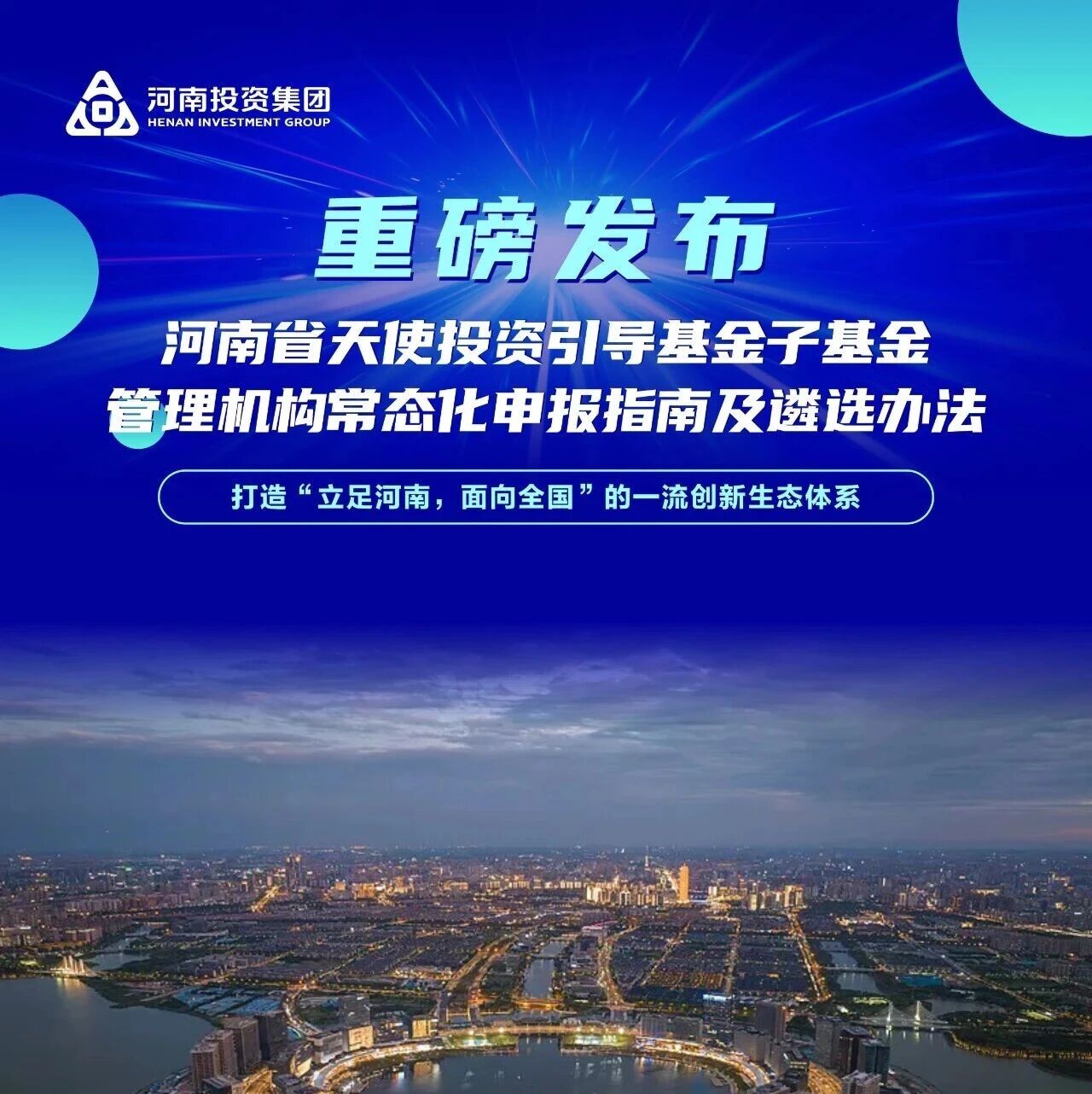
返投仅一倍,河南省这两支母基金常态化招GP
母基金研究中心· 2025-09-05 09:41
Group 1 - The core viewpoint of the article is the announcement of the regular selection of sub-fund management institutions by the Henan Investment Group to promote angel investment in seed and early-stage projects, aiming to foster strategic emerging industries and accelerate the development of new productive forces [1][6][33] - The Henan Angel Investment Guidance Fund has a total scale of 3 billion yuan, with an initial scale of 1 billion yuan, managed by Henan Jin Investment Management Co., Ltd. [6][10] - The selection process for sub-fund management institutions will be open-ended, encouraging diverse applicants including institutions with funding or industry experience [8][31] Group 2 - The application guidelines include relaxed registration area requirements, with sub-funds expected to be registered primarily in Henan Province [8][10] - The maximum contribution limit for sub-funds has been increased, allowing for a total contribution of up to 200 million yuan for a single sub-fund [10][12] - The investment period for sub-funds is generally not to exceed 10 years, aligning with the overall timeline of the angel mother fund [11][12] Group 3 - The article outlines a reward mechanism for sub-funds that meet the return investment requirements, allowing for a buyback of the angel mother fund's shares under certain conditions [20][21] - The investment focus for sub-funds includes key industries in Henan such as new materials, equipment, new energy vehicles, and modern light textiles [50][51] - Sub-funds are required to invest at least 60% of their total scale in early-stage projects [51]
A股三大指数回暖,创业板指领涨,高弹性创业板ETF华夏(159957)涨超3%
Mei Ri Jing Ji Xin Wen· 2025-09-05 04:45
Core Insights - The A-share market experienced a collective rebound on September 5, with the ChiNext Index leading the gains, rising over 3% at one point, driven by sectors such as power batteries, lithium batteries, solid-state batteries, and energy storage [1] - The ChiNext Index focuses on high-end manufacturing, photovoltaic, and new energy industries, exhibiting high elasticity and often leading broad market indices during A-share rebound phases, positioning it as a potential leader for investors looking to capitalize on the A-share bull market [1] - The Huaxia ChiNext ETF (159957) closely tracks the ChiNext Index, showcasing significant characteristics of high growth and elasticity, with a management fee of 0.15% and a custody fee of 0.05%, which are the lowest in its category, facilitating low-cost investment in the ChiNext market [1]





从“勤劳致富”到“创新致富” 新浙商如何“传承与蜕变”?
Zhong Guo Xin Wen Wang· 2025-09-04 15:36
Group 1 - The core viewpoint emphasizes the transformation of Zhejiang merchants from traditional manufacturing to innovation-driven enterprises, highlighting the shift from "hard work to innovation" and from "global selling to global creation" [1] - The new generation of Zhejiang merchants, referred to as "digital natives," possess an innate sensitivity to digital technology and are adept at utilizing digital tools for innovation and management [2] - The Zhejiang government aims to foster a favorable innovation ecosystem characterized by "encouraging innovation and tolerating failure," combining government guidance with market mechanisms to overcome traditional innovation challenges [3] Group 2 - The concept of the Zhejiang innovation ecosystem is summarized as "Success = Government (Sunshine) × Market (Soil) × Talent (Seeds) × Culture (Climate)," indicating the importance of these elements in driving innovation [3] - The new Zhejiang merchants are seen as a blend of "engineers and entrepreneurs," with many being technology-oriented entrepreneurs who are actively entering strategic emerging industries such as digital economy, high-end manufacturing, and new energy [3] - The expectation is for new Zhejiang merchants to possess the qualities of self-sufficiency and innovation, enabling them to lead the economic advancement of Zhejiang and China towards higher quality and sustainability [3]
创业板半年报业绩领跑A股,创业板ETF天弘(159977)、中证A500ETF天弘(159360)、科创综指ETF天弘(589860)交投活跃
2 1 Shi Ji Jing Ji Bao Dao· 2025-09-04 02:38
Group 1 - The A-share market experienced a collective decline on September 4, with major ETFs such as the ChiNext ETF Tianhong (159977) dropping by 1.4% and trading volume exceeding 210 million yuan [1] - The ChiNext index, which the ChiNext ETF closely tracks, consists of 100 representative companies listed on the ChiNext board, reflecting the operational status of the ChiNext market, characterized by a high proportion of emerging industries and high-tech enterprises [1] - The Science and Technology Innovation Board ETF Tianhong (589860) fell by 1.8%, with a trading volume of over 37 million yuan, and leading stocks included Hangke Technology and Daqo Energy [1] Group 2 - As of August 31, 2025, 1,384 companies listed on the ChiNext have reported their semi-annual results, showing significant improvement in operating performance, with total revenue reaching 2.05 trillion yuan and net profit of 150.54 billion yuan [2] - Key sectors such as advanced manufacturing, digital economy, and green low-carbon industries have shown outstanding performance, with leading companies playing a stabilizing role [2] - The ChiNext Composite Index, which reflects the overall performance of the ChiNext, has strong representation in new economic sectors, covering strategic emerging industries like new energy, pharmaceuticals, electronics, and communications [2]
深市公司上半年总营收超10万亿元战略性新兴产业增势强劲
Zheng Quan Shi Bao· 2025-09-03 18:19
Group 1 - The core viewpoint highlights that companies in the Shenzhen market have demonstrated significant revenue and profit growth in the first half of the year, showcasing the capital market's role in supporting the real economy and fostering new productive forces [1] - Shenzhen companies achieved a total operating revenue of 10.24 trillion yuan, a year-on-year increase of 3.64%, with the second quarter showing a substantial quarter-on-quarter growth of 9.78% [1] - The net profit attributable to shareholders reached 595.46 billion yuan, reflecting a year-on-year growth of 8.88%, with nearly 80% of companies reporting profits and over 50% experiencing profit growth [1] Group 2 - Strategic emerging industries in Shenzhen have shown remarkable performance in revenue growth, R&D investment, and international competitiveness, contributing to high-quality economic development [1] - In the first half of 2025, 842 strategic emerging industry companies reported a combined revenue of 1.49 trillion yuan, with an average revenue of 176.7 million yuan per company, marking a year-on-year increase of 14.73% [1] - The new generation information technology sector saw a revenue increase of 20.41%, while the new energy vehicle industry experienced a net profit growth of 34.37% [1] Group 3 - Companies in the strategic emerging industries achieved significant overseas revenue of 434.66 billion yuan, a year-on-year increase of 23.59%, with overseas business accounting for 29.22% of total revenue [2] - The electronics sector reported a combined revenue of 984.76 billion yuan, with a net profit of 45.46 billion yuan, reflecting a year-on-year profit growth of 24.59% [2] - The computer industry also showed strong performance with a total revenue of 501.25 billion yuan and a net profit growth of 26.00% [2] Group 4 - R&D investment among Shenzhen companies reached a total of 352.97 billion yuan in the first half of 2025, with several companies investing over 5 billion yuan [3] - A total of 386 companies announced mid-term dividend plans, with a total dividend amount of 88.61 billion yuan, marking a year-on-year increase of 49.51% [3] - Share buyback plans were disclosed by 230 companies, with a total planned buyback amount of 68.21 billion yuan, aimed at enhancing shareholder value and market confidence [3]
营收超10万亿元!深市公司上半年成绩单,公布了
Zhong Guo Ji Jin Bao· 2025-09-03 14:38
(原标题:营收超10万亿元!深市公司上半年成绩单,公布了) 【导读】上半年深市上市公司实现营收合计10.24万亿元,净利润达5954.56亿元 中国基金报记者 张燕北 深市公司2025年半年度成绩单出炉,整体向好。 上半年,深市公司实现营业收入合计超10万亿元,实现归属于母公司股东的净利润接近6000亿元,双双实现稳健增长。 整体而言,深市龙头公司表现亮眼,引领作用显著,研发投入持续加大,战略性新兴产业公司增势强劲,"新"的动能持续累积。 营收、净利润双双稳健增长 截至8月31日,共有2873家深市上市公司披露2025年半年度报告。 数据显示,深市公司2025年上半年实现营业收入合计10.24万亿元,同比增长3.64%。其中,第二季度实现营业收入合计5.36万亿元,环比增长 9.78%;实现净利润5954.56亿元,同比增长8.88%。 近八成公司上半年实现盈利,超过五成公司实现净利润同比增长,超过两成的公司盈利同比增长超50%。 主板公司创新蓝筹发挥"市场稳定器"作用。披露半年报的1489家深市主板公司合计实现营业收入8.19万亿元,平均54.99亿元,共计801家公司营业 收入同比增长,占比为53.76% ...
营收超10万亿元!深市公司上半年成绩单,公布了
中国基金报· 2025-09-03 14:11
【导读】上半年深市上市公司实现营收合计10.24万亿元,净利润达5954.56亿元 中国基金报记者 张燕北 深市公司2025年半年度成绩单出炉,整体向好。 上半年, 深市公司实现营业收入合计 超10 万亿元,实现归属于母公司股东的净利润 接近6000 亿元,双双实现稳健增长。 整体而言,深市 龙头公司表现亮眼, 引领 作用显著,研发投入持续加大, 战略性新兴产业 公司增势强劲,"新"的动能持续累积。 营收、净利润双双稳健增长 截至8月31日,共有2873家深市上市公司披露2025年半年度报告。 数据显示, 深市公司2025年上半年实现营业收入合计10.24万亿元,同比增长 3.64 % 。 其中,第二季度实现营业收入合计5.36万亿 元,环比增长9.78% ; 实现 净利润5954.56亿元,同比增长 8.88 % 。 近八成公司 上半年 实现盈利,超过五成公司实现净利润同比增长,超过两成的公司盈利同比增长超50%。 主板公司创新蓝筹 发挥 "市场稳定器"作用。 披露半年报的 1489家深市主板公司合计实现营业收入8.19万亿元,平均54.99亿元,共计 801家公司营业收入同比增长,占比 为 53.76% ...
2025上半年深市公司近八成实现盈利 业绩稳中向好态势明显
Zheng Quan Ri Bao· 2025-09-03 13:49
Core Insights - Shenzhen Stock Exchange companies reported a strong performance in the first half of 2025, with revenue and net profit both showing growth, indicating a stable and improving trend in performance [1][2] Overall Performance - In the first half of 2025, Shenzhen-listed companies achieved a total revenue of 10.24 trillion yuan, a year-on-year increase of 3.64%, with Q2 revenue reaching 5.36 trillion yuan, up 9.78% quarter-on-quarter [2] - The net profit attributable to shareholders was 595.46 billion yuan, a year-on-year increase of 8.88%, with nearly 80% of companies reporting profits and over 50% showing a year-on-year increase in net profit [2] Main Board Performance - Among the 1,489 main board companies, total revenue was 8.19 trillion yuan, with an average revenue of 5.499 billion yuan per company [2] - 53.76% of companies reported a year-on-year revenue increase, and 55.17% reported a net profit increase, with 571 companies achieving both revenue and net profit growth [2] Growth in ChiNext (Growth Enterprise Market) - The 1,384 ChiNext companies reported total revenue of 2.05 trillion yuan, a year-on-year increase of 9.03%, with over 60% of companies showing positive revenue growth [3] - Net profit reached 150.54 billion yuan, a significant year-on-year increase of 11.18%, leading the A-share market [3] Performance of Leading Companies - 55 companies with a market capitalization exceeding 100 billion yuan achieved total revenue of 2.81 trillion yuan, a year-on-year increase of 10.69%, and net profit of 306.09 billion yuan, up 18.28% [3] Key Industry Highlights - Key industries such as electronics, power equipment, computing, telecommunications, and automotive showed strong performance, demonstrating resilience and growth [4] - The electronics sector reported total revenue of 984.76 billion yuan, a year-on-year increase of 14.1%, and net profit of 45.46 billion yuan, up 24.59% [4][5] R&D Investment - Total R&D investment by Shenzhen-listed companies reached 352.97 billion yuan in the first half of 2025, with 409 companies having an R&D intensity exceeding 10% [8] - Strategic emerging industry companies reported total revenue of 1.49 trillion yuan, a year-on-year increase of 14.73%, with the new generation information technology sector growing at 20.41% [8][9] Dividend and Buyback Trends - 386 companies announced mid-term dividends totaling 88.61 billion yuan, a year-on-year increase of 49.51%, reflecting a growing awareness of shareholder returns [9] - Companies also increased share buyback plans, with 230 buyback announcements totaling 68.21 billion yuan [9]
8月地方债发行规模近万亿 多地专项债注资政府投资基金
2 1 Shi Ji Jing Ji Bao Dao· 2025-09-03 13:46
Core Viewpoint - The issuance of local government bonds in August reached 977.6 billion yuan, maintaining strong momentum despite a decline compared to June and July, with special bonds accounting for about half of the total issuance [1] Group 1: Bond Issuance and Utilization - From January to August, the cumulative issuance of new special bonds reached 3.26 trillion yuan, accounting for 74% of the annual quota of 4.4 trillion yuan, with a notable acceleration in issuance since May [2][3] - In August, 44% of the newly issued special bonds were allocated for debt repayment, totaling 212.9 billion yuan, while the cumulative amount for debt repayment from January to August was 968 billion yuan, representing 30% of the total new special bonds issued [2] - The funds from new special bonds are primarily directed towards project construction, including municipal infrastructure, transportation, and social projects, with significant allocations for municipal and industrial park infrastructure [2][5] Group 2: Land Reserve Bonds - The issuance of land reserve special bonds has increased, with a total of 3.24 trillion yuan issued by ten provinces from January to August, with Shanghai leading at 568 billion yuan [3] - Local governments are utilizing special bonds to recover idle land, which helps alleviate financial pressure on developers and promotes stability in the real estate market [3] Group 3: Acquisition of Existing Properties - Some provinces are initiating projects to acquire existing residential properties, with 32 projects identified across four provinces, primarily funded by special bonds [4][5] - The total funding for "stabilizing the housing market" through special bonds reached approximately 595 billion yuan from January to August, making it the second-largest category of funding after municipal infrastructure [5] Group 4: Support for Innovation and Emerging Industries - A significant trend in August was the issuance of special bonds to support government investment funds aimed at enhancing local technological innovation and strategic emerging industries [6][7] - Various provinces, including Beijing and Shanghai, have allocated special bonds to government investment funds, indicating a shift in investment focus from traditional infrastructure to new infrastructure and emerging sectors [7][8]