
AI泡沫

Search documents
金银新高,不是通胀来,是债务炸弹在滴答
Xin Lang Cai Jing· 2025-11-13 13:45
Group 1 - Gold has reached around $4,100 per ounce, while silver is approaching $50, indicating potential inflation concerns, but the CPI remains stable [3][4][14] - The recent surge in gold and silver prices reflects systemic concerns rather than traditional inflation fears, as the correlation between CPI and gold prices has diverged [16][40] - Central banks are significantly increasing gold purchases, with over 1,000 tons bought annually from 2022 to 2024, marking a historical high [30][93] Group 2 - Silver's industrial demand has surged, accounting for approximately 55% of global silver demand in 2023, driven by sectors like solar energy and electric vehicles [34][36] - The gold-silver ratio has decreased, indicating that silver is outperforming gold, with historical volatility reaching new highs since 2020 [21][26] - The current market dynamics suggest that gold serves as a "face" of central banks, while silver acts as a "lubricant" for the new energy era [38][39] Group 3 - The U.S. fiscal deficit is a growing concern, with interest payments nearing the federal tax revenue ceiling, leading to fears about the sustainability of the current monetary and debt systems [62][63] - The market is reassessing the "inflation risk premium," indicating that investors are more concerned about systemic risks than immediate inflation [66][67] - The Federal Reserve's monetary policy is tightening, with expectations of interest rate adjustments impacting gold prices [70][73] Group 4 - Emerging markets are experiencing capital inflows due to favorable conditions, including a weaker dollar and rising commodity prices, which improve export revenues [109][139] - The correlation between gold prices and emerging market debt suggests that as gold is viewed as a hedge against dollar risks, funds are flowing into high-yield emerging market bonds [118][130] - However, there are risks associated with this trend, as sudden shifts in the dollar or profit-taking in precious metals could lead to capital outflows from emerging markets [144][152] Group 5 - Investment strategies should focus on maintaining a balanced asset allocation, with gold and silver viewed as systemic insurance, while also considering dollar risk hedging and emerging market exposure [166][176][182] - Monitoring key economic indicators, such as U.S. core PCE and Chinese social financing, can provide insights into potential market adjustments and the timing of asset reallocation [191][198] - The evolving narrative around gold suggests it is now seen as a measure of national credit rather than merely an inflation indicator, reflecting broader concerns about the stability of fiat currencies and government debt [196][198]


百度拿到了赛点
远川研究所· 2025-11-13 13:29
Core Insights - The article discusses the ongoing AI arms race among tech giants, emphasizing the shift from using AI as a tool to integrating it as a core component of business operations and product development [2] - The concept of "AI native" is introduced, which refers to designing systems from the ground up with AI capabilities, rather than merely adding AI tools to existing processes [5][6] - Baidu's advancements in AI, particularly in autonomous driving and AI agents, are highlighted as examples of successful AI native applications [12][14] Group 1: AI Integration and Ecosystem - The real competition lies in building ecosystems that allow AI to emerge as a value creator within products and organizations, rather than just a supplementary tool [2] - Baidu's approach to internalizing AI capabilities is described as transforming AI from a cost into a productivity driver, enhancing decision-making and innovation cycles [2][5] - The integration of AI into daily operations is becoming a priority for more companies, indicating a clear shift towards AI being a fundamental aspect of business processes [2] Group 2: Market Potential and Risks - Morgan Stanley's report predicts that AI could save U.S. companies $920 billion annually and create up to $16 trillion in market value for S&P 500 companies, highlighting the immense potential of AI [5] - However, the report warns that not all companies will benefit equally, as the successful application of AI requires a comprehensive integration strategy that may take decades to achieve [5] - The lack of sufficient internalization of AI within some companies poses significant risks, limiting their ability to realize proportional returns on AI investments [5] Group 3: Baidu's AI Developments - Baidu's "LuoBo KuaPao" autonomous driving service has achieved over 1.4 billion kilometers of fully autonomous driving, with a safety record that outperforms competitors like Waymo [12][18] - The introduction of AI agents, such as "FaMou," represents a significant advancement in AI applications, enabling proactive problem-solving and continuous learning [14][16] - Baidu's comprehensive AI strategy includes the development of its Kunlun chips, which are essential for supporting its AI capabilities and have seen significant deployment across various industries [21][23][26] Group 4: Future Outlook - Baidu is positioned as a leader in the AI era, with a strong focus on creating AI native applications that drive value and efficiency [21][28] - The company is set to release new generations of its Kunlun chips and AI models, reinforcing its commitment to maintaining a competitive edge in the AI landscape [26] - The article concludes that the transformation towards AI native systems is a gradual process that requires a complete overhaul of existing structures, but the potential rewards are substantial [27][28]


悄悄关闭旗下基金,大空头Burry辟谣9亿美元做空英伟达和Palantir:一共才花了920万
Hua Er Jie Jian Wen· 2025-11-13 12:26
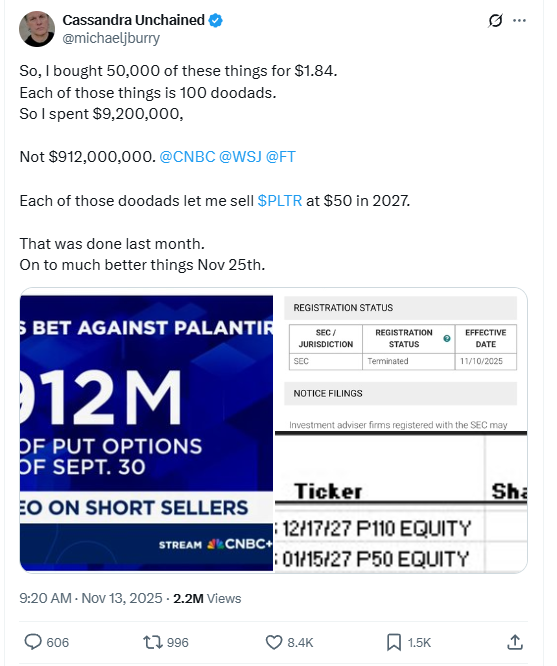
Core Viewpoint - Michael Burry, known for predicting the 2008 financial crisis, has sparked market discussions again after clarifying that his investment in shorting AI stocks is significantly lower than reported, amounting to only $9.2 million instead of $912 million as claimed by media outlets [1][2]. Group 1: Investment Actions - Burry purchased 50,000 put options for Palantir at $1.84 each, totaling an investment of $9.2 million, which corresponds to a notional value of $912 million based on the underlying stock's market value [2]. - The discrepancy in reported figures arises from the SEC's requirement for institutions to disclose options positions based on notional value rather than actual investment [2][3]. - Burry's put options allow him to sell Palantir shares at $50 each by 2027, while the current stock price is approximately $184, indicating a significant gap [2]. Group 2: Market Concerns - Burry has expressed concerns about an AI bubble, likening it to the 2000 internet bubble, and has criticized companies like Nvidia, Palantir, Meta, and Oracle for excessive capital expenditures and inflated valuations [3]. - Citron Research previously estimated Palantir's true value at $40, aligning with Burry's target price of $50 for his put options [3]. Group 3: Fund Status - Burry has officially terminated the SEC registration of his hedge fund, Scion Asset Management, and plans to liquidate the fund and return capital to investors due to disappointment with market valuations [4][10]. - The fund's registration status was terminated on November 10, and Burry hinted at a potential new direction for his investment activities, possibly outside traditional regulatory frameworks [10].

美国政府停摆结束提振风险情绪 欧元信用违约保护成本维持低位
Ge Long Hui A P P· 2025-11-13 11:22
格隆汇11月13日|在持续43天的美国政府停摆有望解决后,欧元信贷违约保护的成本稳定在较低水平。 分析师表示,这一消息提振了风险偏好,尽管投资者在大量美国经济数据发布前仍保持轻微谨慎。此 外,美国股市收盘时涨跌互现,纳斯达克指数收低,正如Interactive Investor的Victoria Scholar在一份报 告中所说,这是由于投资者担心AI泡沫破裂而将资金从科技股中撤出。跟踪欧元高收益信用违约互换 的iTraxx Europe Crossover指数稳定在259个基点,而跟踪欧元投资级信贷违约掉期(CDS)的iTraxx Europe Main指数保持不变,报54个基点。 ...
巴菲特真的“退休”了吗?段永平又说了什么?一场关于长期主义的思考直播,不要错过
首席商业评论· 2025-11-13 10:00
Group 1 - Warren Buffett, the legendary figure leading Berkshire Hathaway for over sixty years, announced his retirement as CEO at the end of 2025, raising questions about the end of the "Buffett era" [3] - Chinese investment figure Duan Yongping shared insights on market trends and long-term value investing, emphasizing that investment should focus on the essence of companies rather than short-term fluctuations [3][5] - The investment philosophies of Buffett and Duan are being compared, particularly their shared belief in long-term accumulation and understanding the intrinsic value of businesses [5][7] Group 2 - A special live event featuring Wang Zhaoming, an expert on Buffett's investment philosophy, will discuss the stories of individuals mentioned in Buffett's latest shareholder letter and their value to Berkshire [5][6] - The event aims to provide insights into rational thinking, time, and compounding, appealing to those seeking a path to understand corporate value through cycles [5] - Questions regarding the current state of AI and potential bubbles in the market will also be addressed during the live session [9]

红杉合伙人重磅发声:我们正身处AI泡沫,80%的钱投错了地方,毛利率会是AI应用穿越周期的生死线
Xi Niu Cai Jing· 2025-11-13 07:38
Core Insights - David Cahn, a partner at Sequoia Capital, acknowledges the existence of an AI bubble while emphasizing the importance of distinguishing between compute producers and consumers in the industry [1][2][3] - Cahn argues that the real winners in the AI space will be those who utilize compute effectively, rather than those who produce it, as the latter are likened to high-leverage commodity businesses [1][3] - He expresses concern over the current capital flow, stating that over 80% of funding is still directed towards compute producers, which he believes is a misallocation of resources [1][24] Group 1 - Cahn highlights the critical distinction between compute producers and consumers, suggesting that the latter will thrive in the long run [1][3] - He critiques the prevailing narrative of "King making" in venture capital, asserting that success is determined by the quality of the founding team and product-market fit rather than merely by capital investment [2][34] - Cahn warns against the misconception that companies can only succeed in an environment of unlimited financing, emphasizing the need for sustainable business models [2][3] Group 2 - Cahn predicts that AI could reshape 5% or more of global GDP, but warns that most excess profits will be diluted by competition and labor costs, rather than accruing to a few monopolistic giants [3][30] - He identifies defense as the next significant battleground for AI, predicting increased global conflicts as AI becomes more integrated into defense technologies [3][30] - Cahn believes that the current AI investment landscape is characterized by a "bubble" mentality, where capital is concentrated in a few major players, leading to potential systemic risks [25][30] Group 3 - Cahn discusses the physicality of AI infrastructure, noting that the construction of data centers and the acquisition of power resources are critical to the industry's future [6][7] - He emphasizes the importance of understanding the supply chain dynamics in AI, suggesting that the ability to build data centers will become a competitive advantage [9][10] - Cahn points out that the current focus on AI's physical requirements is essential for translating AI advancements into GDP growth [7][8] Group 4 - Cahn expresses skepticism about the sustainability of high salaries for AI talent, attributing it to an "ecosystem anxiety" where companies feel pressured to demonstrate progress [10][12] - He reflects on the unpredictability of AI advancements, suggesting that the timeline for achieving significant breakthroughs may be longer than currently anticipated [32][33] - Cahn warns that the current concentration of investment in a few tech giants could lead to significant market volatility if the AI narrative shifts [30][29]
李彦宏谈“AI泡沫”争议:产业结构正转向“倒金字塔”
Bei Jing Ri Bao Ke Hu Duan· 2025-11-13 06:06
Core Viewpoint - The AI industry structure is transitioning from an unhealthy "pyramid" model to a healthier "inverted pyramid" model, emphasizing the need for models and applications to generate significantly more value than the underlying chip technology [1]. Group 1: Industry Structure - The previous AI industry structure resembled a traditional pyramid where chip manufacturers captured most of the value, leading to skepticism about an AI bubble [1]. - The new "inverted pyramid" model suggests that chip manufacturers should earn less, while models should create ten times the value, and applications should generate one hundred times the value [1]. Group 2: Technological Advancements - Over the past year, advancements in AI have expanded beyond chatbots to include digital human technology, code intelligence, and self-evolving technologies that seek global optimal solutions [1]. - Baidu announced the release of its native multimodal model, Wenxin Model 5.0, which has 2.4 trillion parameters and supports various forms of input and output, marking a significant leap in AI capabilities [1]. Group 3: Company Achievements - During the Baidu World Conference, it was highlighted that the global travel service "Luo Bo Kuaipao" has surpassed 17 million service instances, ranking among the top globally [1]. - Baidu also introduced the next-generation Kunlun chip and the Tianchi supernode product, along with an upgrade to the GenFlow intelligent agent to version 3.0, making it the largest general-purpose intelligent agent globally [1].
巨头“变着法子”表外融资,这三笔“AI巨额融资”如此“创新”,整个华尔街都盯着
3 6 Ke· 2025-11-13 04:00
Core Insights - Tech giants are collaborating with Wall Street to fund the costly AI arms race through unprecedented off-balance-sheet financing arrangements [1][2] - Recent large-scale transactions reveal a trend of transferring astronomical debt and risk away from balance sheets to appease investor concerns about an AI bubble [1][2] Group 1: Financing Structures - Meta's financing for the Hyperion data center is described as a "Frankenstein" structure, combining elements of private equity, project financing, and investment-grade bonds [3] - Meta's debt has doubled after issuing $30 billion in bonds last year, prompting the need for a financing method that does not increase its own liabilities [3] - The financing involves Blue Owl Capital investing approximately $3 billion for 80% equity in a joint venture, while Meta retains 20% with a $1.3 billion investment [3][4] Group 2: OpenAI's Financing Challenge - OpenAI's Stargate data center project has a total cost of $38 billion, challenging Wall Street's underwriting capabilities due to its unprecedented scale [5] - The financing is structured through traditional project loans, with Oracle signing a 15-year lease to repay the loan, which is secured by the data center assets [5][7] - The loan's interest rate is approximately 6.4%, nearly two percentage points higher than Oracle's comparable bonds, reflecting the high-risk nature of the investment [7] Group 3: xAI's High-Leverage Financing - xAI, led by Elon Musk, has a financing plan to purchase chips for its Colossus 2 data center, requiring $18 billion for 300,000 NVIDIA chips [8][9] - The financing tool involves selling private equity and leveraging billions in debt, with Apollo Global Management assisting in arranging the debt [9] - The debt interest rate is as high as 10.5%, with potential additional returns based on chip performance, raising concerns about a market bubble [9] Group 4: Capital Demand in AI Industry - The emergence of these transactions highlights the immense capital demand within the AI industry, with JPMorgan strategists warning that $5 trillion will be needed for AI data center construction over the next five years [10][13] - There is an estimated $1.4 trillion funding gap even if all available credit markets are fully utilized, indicating a significant reliance on private credit and government funding [13][15]

李彦宏回应AI泡沫争议
新华网财经· 2025-11-13 03:34
Group 1 - The core viewpoint of the article is that the AI industry structure is transitioning from an unhealthy "pyramid" model to a healthier "inverted pyramid" model, as stated by Baidu Chairman Li Yanhong at the Baidu World Conference on November 13 [2] - In the traditional "pyramid" structure, the chip layer captures the majority of the value, while the economic benefits decrease for models and applications above it, leading to market skepticism about AI bubbles [2] - The "inverted pyramid" model suggests that regardless of the profits made by chip manufacturers, models must generate ten times the value, and applications developed from these models should create one hundred times the value, which is essential for a sustainable industry ecosystem [2]

速递|Anthropic豪掷500亿美元联手Fluidstack,自建AI计算基础设施新纪元开启
Z Potentials· 2025-11-13 02:54
Core Insights - Anthropic has announced a significant partnership with Fluidstack to invest $50 billion in building data centers across the U.S. to meet its growing computational demands [2][3] - The data centers will be located in Texas and New York, with plans to be operational by 2026, specifically designed to enhance workload efficiency for Anthropic [2] - The CEO of Anthropic emphasized the need for robust infrastructure to support advanced AI development, which is crucial for accelerating scientific discoveries [2] Financial Projections - Despite the large investment, it aligns with Anthropic's internal revenue forecasts, expecting to achieve $70 billion in revenue and $17 billion in positive cash flow by 2028 [3] - The $50 billion investment, while substantial, is comparatively smaller than competitors' projects, such as Meta's $600 billion commitment and SoftBank's collaboration with OpenAI and Oracle for a $500 billion infrastructure project [3] Industry Context - The investment raises concerns about an AI bubble due to potential demand fatigue and misallocation of funds [3] - Fluidstack, a relatively young cloud service provider, has emerged as a key player in the AI infrastructure space, having been designated as a major partner in a $11 billion AI project supported by the French government [3] - Fluidstack is also one of the first third-party suppliers to receive Google's custom TPU, indicating strong confidence in its capabilities [4]
