
内需战略

Search documents
ETF盘中资讯|白酒龙头重挫!吃喝板块全线回调,食品饮料ETF华宝(515710)跌超1%!机构:白酒基本面接近底部
Sou Hu Cai Jing· 2026-01-08 06:01
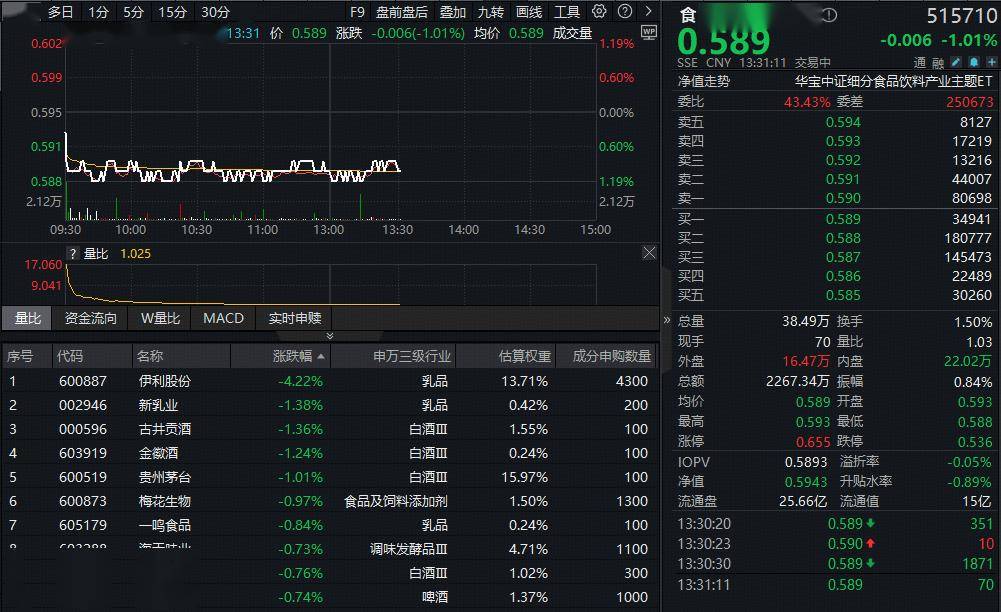
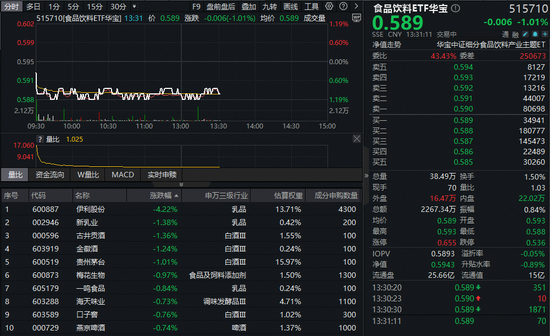
Group 1 - The food and beverage sector is experiencing a downturn, with the Huabao Food and Beverage ETF (515710) showing a decline of 1.01% as of the latest report [1] - Major stocks in the sector, particularly leading liquor and dairy companies, are facing significant drops, with Yili Co. falling over 4% and other companies like Kweichow Moutai and Gujing Gongjiu also declining [1] - The current consumption industry is entering a strategic opportunity period supported by policies, with a focus on domestic demand as a core economic task, which is expected to benefit the food and beverage sector [1][3] Group 2 - Pacific Securities notes that upcoming policies aimed at boosting domestic demand are anticipated to improve consumption, particularly in high-end luxury goods, which may positively impact the broader consumer market [3] - The food and beverage sector's valuation is at a historical low, with the Huabao ETF's underlying index PE ratio at 20.27 times, indicating a favorable entry point for long-term investments [3] - The liquor industry is nearing a bottom in its fundamentals, with major companies like Moutai and Wuliangye implementing market-driven adjustments, suggesting potential for recovery in sales during the 2026 Spring Festival [3][4] Group 3 - Citic Construction points out that some food and beverage stocks are expected to exceed performance expectations due to their differentiated advantages, despite a temporary slowdown in revenue growth [4] - The liquor sector is seeing major companies managing inventory and optimizing channel structures, which may lead to improved profitability despite short-term challenges [4] - The Huabao Food and Beverage ETF is heavily weighted towards leading high-end liquor stocks and also includes significant positions in dairy and beverage companies, making it a key asset for investors in the sector [4]





白酒龙头重挫!吃喝板块全线回调,食品饮料ETF华宝(515710)跌超1%!机构:白酒基本面接近底部
Xin Lang Cai Jing· 2026-01-08 05:48
Group 1 - The food and beverage sector is experiencing a pullback, with the Huabao Food and Beverage ETF (515710) showing a decline of 1.01% as of the latest report [1][8] - Major stocks in the sector, particularly leading liquor brands and dairy companies, are seeing significant drops, with Yili Co. down over 4% and Kweichow Moutai, Gujing Gongjiu, and others down over 1% [1][8] - The current consumption industry is entering a strategic opportunity period supported by policy, with a focus on domestic demand as a core economic task, which is expected to benefit the food and beverage sector [10] Group 2 - Pacific Securities indicates that upcoming policies aimed at boosting domestic demand are anticipated to improve consumption, particularly in high-end luxury goods, benefiting the broader consumer market [3][10] - The food and beverage sector's valuation is at a historical low, with the food index's price-to-earnings ratio at 20.27 times, placing it in the 7.05% percentile of the last decade, suggesting a favorable long-term investment opportunity [3][10] - The liquor industry is nearing a bottom in its fundamentals, with major companies like Moutai and Wuliangye implementing market-oriented adjustment plans, indicating potential for recovery in sales during the 2026 Spring Festival [11] Group 3 - The Huabao Food and Beverage ETF (515710) tracks the CSI segmented food and beverage industry index, with approximately 60% of its holdings in high-end and mid-range liquor stocks, and nearly 40% in beverage, dairy, seasoning, and beer sectors [12] - Investors can also access core assets in the food and beverage sector through the Huabao Food and Beverage ETF linked funds [12]
食品饮料行业周报:2025承压收官,2026反转可期-20260104
KAIYUAN SECURITIES· 2026-01-04 10:44
Investment Rating - The industry investment rating is "Positive" (maintained) [1] Core Viewpoints - The food and beverage index experienced a decline of 2.3% from December 29 to January 2, ranking 27th among primary sub-industries, underperforming the CSI 300 by approximately 1.7 percentage points. The sub-industries of soft drinks (+0.5%), other foods (+0.0%), and other alcoholic beverages (-0.2%) performed relatively better [3][11] - The report expresses a cautious optimism for 2026, despite the poor performance of the food and beverage sector in 2025, which was impacted by factors such as the alcohol ban, declining prices of Moutai, and a weak consumption environment. The recent market adjustments by leading liquor companies indicate that the industry is nearing a bottom [4][11] - The report suggests focusing on three stock selection strategies for consumer goods in 2026: identifying cyclical recovery opportunities, seeking growth stocks driven by channel innovation and product upgrades, and looking for companies in turnaround situations due to internal business cycles [4][12] Summary by Sections Weekly Viewpoints - The food and beverage sector is in a phase of adjustment, with a focus on the liquor market's recovery and the strategic layout of consumer goods [11] Market Performance - The food and beverage index underperformed the market, with a 9.7% decline in 2025, ranking last among all sectors. The report highlights the need for strategic adjustments in response to market conditions [11][13] Upstream Data - Some upstream raw material prices are declining, with the price of whole milk powder down 18.7% year-on-year as of December 16, 2025, and fresh milk prices down 2.6% year-on-year as of December 26, 2025 [17][19] Liquor Industry Data - The report notes that leading liquor companies are implementing market-oriented reforms to adapt to changing demand, with Moutai's recent sales strategy indicating a shift towards a more sustainable business model [4][41] Recommended Portfolio - The recommended stocks include Moutai, Shanxi Fenjiu, Ximai Food, Weilong, and Ganyuan Food, with each company showing potential for growth or stability in the upcoming year [5][12]
国内观察:2025年12月PMI:制造业PMI逆势走强下的亮点
Donghai Securities· 2025-12-31 11:21
Group 1: PMI Overview - In December, the manufacturing PMI rose to 50.1%, up from 49.2% in the previous month, while the non-manufacturing PMI increased to 50.2%, from 49.5%[2] - The December PMI's unexpected strength is attributed to multiple factors, including positive expectations from recent important meetings, easing trade frictions, and increased pre-holiday inventory demand[2] - The manufacturing PMI's month-on-month increase of 0.9 percentage points (pct) significantly exceeds the five-year average decline of 0.3 pct for the same period[2] Group 2: Supply and Demand Dynamics - The production index rose to 51.7% (+1.7 pct), returning above the threshold, while the new orders index increased to 50.8% (+1.6 pct), marking the first time since June that it is above the threshold[2] - The new export orders index also saw a notable increase, rising to 49.0% (+1.4 pct), matching the high point of March this year[2] - The price index showed divergence, with the main raw material purchase price index at 53.1% (-0.5 pct) and the factory price index at 48.9% (+0.7 pct), indicating faster downstream replenishment compared to upstream[2] Group 3: Sector Performance - High-tech manufacturing PMI rose to 52.5% (+2.4 pct), significantly above the overall level, driving the increase in the overall manufacturing PMI[2] - Consumer goods PMI reached 50.4% (+1.0 pct), slightly higher than the overall PMI increase, supported by strong performance in sectors like computer communication and textile manufacturing[2] - The construction PMI was notably strong at 52.8% (+3.2 pct), outperforming seasonal expectations due to favorable weather conditions and pre-holiday construction activity[3]
中央经济工作会议,多位券商首席经济学家火速解读!
券商中国· 2025-12-12 03:33
Core Viewpoint - The Central Economic Work Conference held on December 10-11, 2025, emphasized a shift in policy focus from quantity expansion to quality and efficiency, highlighting the integration of existing and new policies for better effectiveness [2][3]. Policy Framework - The macroeconomic policy maintains a positive tone but has undergone significant changes, with a shift from "promoting stability through growth" to "seeking progress while maintaining stability and improving quality and efficiency" [3][4]. - Fiscal policy will focus on maintaining necessary levels of deficit and debt, with a potential reduction in the deficit ratio to around 4% or slightly lower, emphasizing the optimization of expenditure structure [4][6]. - Monetary policy aims to promote stable economic growth and reasonable price recovery, with a more flexible approach to tools like interest rate cuts and reserve requirement ratio adjustments [5][4]. Domestic Demand Strategy - The strategy to build a strong domestic market is prioritized, addressing the "strong supply and weak demand" contradiction and laying a long-term foundation for economic growth [6]. - Key highlights include optimizing the implementation of "two new" policies (equipment updates and trade-ins), establishing a plan for urban and rural income growth, and addressing the decline in fixed asset investment [6][7]. Innovation and Competition Order - The conference underscored the importance of innovation and the cultivation of new growth drivers, with a focus on artificial intelligence and other advanced technologies [8]. - The "anti-involution" initiative has been elevated to a primary reform task, aiming to standardize competition and eliminate barriers to high-quality development [8][9]. Real Estate and Capital Market - The policy approach to the real estate market has shifted from "stabilizing prices" to a long-term model of "controlling growth, reducing inventory, and optimizing supply," indicating a lower priority for large-scale stimulus [9]. - The capital market is set for deeper reforms, with a focus on enhancing market mechanisms and supporting new quality productivity, laying the groundwork for a "technology growth" style in the A-share market for 2026 [9].

牢牢把握内需战略基点 建设强大国内市场
Sou Hu Cai Jing· 2025-12-11 13:14
Group 1 - The upcoming year 2026 marks the beginning of the "14th Five-Year Plan," making effective economic work crucial amid a changing global economic landscape and domestic supply-demand imbalances [1] - The central economic work conference prioritizes "domestic demand as the main driver" for economic stability and high-quality development, indicating a long-term strategic focus rather than a short-term stimulus [2][3] - From 2013 to 2024, China's economy is projected to maintain an average growth rate of 6.1%, with domestic demand contributing an average of 93.1% to this growth, although the current situation of insufficient domestic demand has not been fully reversed [3] Group 2 - The conference emphasizes the importance of consumption as a key component of domestic demand, proposing actions to boost consumption, increase residents' income, and optimize supply of quality goods and services [4] - The policy approach will focus on three pillars: increasing income through multiple channels, addressing supply-demand mismatches in the consumption market, and improving the consumption environment by removing barriers [4] - The government aims to stimulate investment by increasing central budget investments, optimizing project management, and enhancing the role of policy financial tools, with a focus on new infrastructure and technology [5] Group 3 - The 2026 domestic demand strategy represents a deep transformation aimed at reducing reliance on external uncertainties and strengthening the "endogenous" foundation of the Chinese economy [6] - The awakening of potential consumer demand and the innovation vitality of market entities are seen as essential for the resilience of the Chinese economy [6]
【广发宏观团队】面对逆全球化贸易环境:同与不同
郭磊宏观茶座· 2025-03-16 10:16
Core Viewpoint - The article discusses the impact of the current global trade environment on China's economy, highlighting differences from previous trade conflicts and emphasizing the importance of domestic demand and structural adjustments in response to external pressures [1][2]. Group 1: Global Trade Environment - The current trade environment is characterized by a more diversified trade structure for China, with the proportion of exports to the US decreasing from 19.2% in 2018 to 14.0% in early 2025, indicating improved expectations among enterprises [1][2]. - The article notes that the current round of de-globalization differs from the past, as it is not marked by unilateral trade conflicts but rather a systemic uncertainty affecting global supply chains [2]. Group 2: Domestic Market Performance - In the second week of March, over 90% of domestic industries recorded gains, with a shift towards domestic demand and dividend-driven sectors, as evidenced by a 1.49% increase in the Wande All A index [3][5]. - The consumer sector, particularly in beauty care, food and beverage, and coal, led the gains with weekly increases of 8.2%, 6.2%, and 4.8% respectively [5]. Group 3: Economic Indicators - The article reports that the actual and nominal GDP growth rates for the first quarter are projected to be 5.22% and 4.51% respectively, with expectations for industrial production growth to rise to 5.9% in March [8]. - The consumer price index (CPI) is expected to show a slight increase of 0.24% year-on-year, while the producer price index (PPI) is projected to decline by 2.17% year-on-year [8]. Group 4: Financial and Investment Climate - The liquidity situation remains stable, with narrow fluctuations in short-term interest rates, while the total social financing is expected to expand, indicating a supportive environment for investment [9][10]. - The issuance of local government bonds for debt replacement is progressing rapidly, with a completion rate of 60%, although project-based bonds still require improvement [10]. Group 5: Consumer Policy Impact - The introduction of childcare subsidies is anticipated to boost consumer spending by approximately 0.1-0.3 percentage points, with the government planning to issue substantial subsidies for families with children [11]. - The estimated annual subsidy funding could range from 200 to 1200 billion yuan, which would significantly impact related industries and long-term economic growth [11].
