出口许可证管理

Search documents
五矿期货黑色建材日报-20251224
Wu Kuang Qi Huo· 2025-12-24 01:14
Report Summary 1. Report Industry Investment Rating No information provided regarding the industry investment rating. 2. Report Core View - The overall sentiment in the commodity market was positive yesterday, but the finished steel prices continued to fluctuate. The terminal demand remains weak, and steel prices are expected to oscillate within the bottom range. The finished steel prices are under short - term pressure due to export license management but are expected to gradually digest the policy impact. The willingness for winter storage is low this year, and there may not be large - scale restocking. Attention should be paid to the possible marginal impact of the "dual - carbon" policy on the steel industry [2]. - For iron ore, the supply of overseas shipments has decreased, the demand for molten iron has declined, and the port inventory has increased while the steel mill inventory is at a low level. The price is expected to move within an oscillatory range [5]. - For manganese silicon and ferrosilicon, the overall macro sentiment has improved. The future market contradictions lie in the direction of the black sector, the cost - push from manganese ore for manganese silicon, and the supply contraction of ferrosilicon due to losses. Attention should be paid to possible disruptions from the "dual - carbon" policy [9][10]. - For industrial silicon, the price is expected to fluctuate following the market, and attention should be paid to new supply - side disturbances in the northwest [13]. - For polysilicon, the supply is expected to decline, the demand is weak, and the inventory pressure is high. The futures price is unstable, and attention should be paid to actual spot transactions and warehouse receipt registration [17]. - For glass, the demand recovery is weak, and the market is expected to continue narrow - range oscillations [20]. - For soda ash, the downstream demand is weak, the inventory is accumulating, and the price rebound is limited. Short positions can be considered [22]. 3. Summary by Catalog Steel - **Market Information** - The closing price of the rebar main contract was 3128 yuan/ton, up 2 yuan/ton (0.063%) from the previous trading day. The registered warehouse receipts were 60,684 tons, unchanged. The position of the main contract decreased by 11,933 lots to 1.580041 million lots. The Tianjin aggregated price was 3170 yuan/ton, unchanged, and the Shanghai aggregated price was 3320 yuan/ton, up 20 yuan/ton [1]. - The closing price of the hot - rolled coil main contract was 3281 yuan/ton, up 4 yuan/ton (0.122%) from the previous trading day. The registered warehouse receipts were 104,293 tons, unchanged. The position of the main contract increased by 9846 lots to 1.198397 million lots. The Lecong aggregated price was 3260 yuan/ton, unchanged, and the Shanghai aggregated price was 3270 yuan/ton, unchanged [1]. - **Strategy View** - Rebar's supply and demand both increased this week, and inventory continued to decline, showing off - season characteristics. Hot - rolled coil production dropped significantly, apparent demand decreased slightly, and inventory continued to fall. The export license policy aims to promote the high - quality development of the steel industry. Overall, the terminal demand is weak, the hot - rolled coil inventory pressure is prominent, and steel prices are expected to oscillate at the bottom. The finished steel prices are under short - term pressure due to the policy but are expected to gradually digest it. Winter storage has started in some areas, but the willingness is low [2]. Iron Ore - **Market Information** - The main contract (I2605) of iron ore closed at 778.50 yuan/ton, down 0.38% (- 3.00). The position increased by 2081 lots to 554,000 lots. The weighted position was 928,000 lots. The spot price of PB fines at Qingdao Port was 790 yuan/wet ton, with a basis of 60.70 yuan/ton and a basis rate of 7.23% [4]. - **Strategy View** - In terms of supply, the overseas iron ore shipments decreased. The shipments from Australia and Brazil declined, while those from non - mainstream countries increased slightly. The near - end arrivals decreased. In terms of demand, the daily molten iron output continued to decline, and the steel mill profitability remained stable. The port inventory increased, and the steel mill's imported ore inventory reached a five - year low. The price is expected to move within an oscillatory range [5]. Manganese Silicon and Ferrosilicon - **Market Information** - The main contract of manganese silicon (SM603) closed at 5822 yuan/ton, down 0.31%. The spot price in Tianjin was 5720 yuan/ton, with a basis of 88 yuan/ton. The main contract of ferrosilicon (SF603) closed at 5648 yuan/ton, up 0.07%. The spot price in Tianjin was 5700 yuan/ton, with a basis of 52 yuan/ton [8]. - **Strategy View** - The macro sentiment has improved. For manganese silicon, the supply - demand pattern is not ideal, but most factors are already priced in. For ferrosilicon, the supply - demand is basically balanced, and the supply has decreased due to production losses. The future market contradictions lie in the black sector's direction, the cost - push from manganese ore for manganese silicon, and the supply contraction of ferrosilicon due to losses. Attention should be paid to possible disruptions from the "dual - carbon" policy [9][10]. Industrial Silicon and Polysilicon - **Industrial Silicon** - **Market Information** - The main contract (SI2605) of industrial silicon closed at 8780 yuan/ton, up 2.15% (+ 185). The weighted position decreased by 15,701 lots to 401,013 lots. The spot price of 553 in East China was 9200 yuan/ton, unchanged, with a basis of 420 yuan/ton [12]. - **Strategy View** - The price is expected to fluctuate following the market. The weekly output decreased slightly, and the demand from polysilicon weakened. Attention should be paid to new supply - side disturbances in the northwest [13]. - **Polysilicon** - **Market Information** - The main contract (PS2605) of polysilicon closed at 59,225 yuan/ton, up 0.65% (+ 380). The weighted position decreased by 10,996 lots to 223,576 lots. The spot price of N - type granular silicon was 50 yuan/kg, unchanged; the N - type dense material was 51 yuan/kg, unchanged; the N - type re - feed material was 52.35 yuan/kg, down 0.05 yuan/kg, with a basis of - 6875 yuan/ton. The Guangzhou Futures Exchange restricted the daily opening positions from December 25 [14][16]. - **Strategy View** - The supply is expected to decline, but the decrease may be limited. The downstream demand is weak, and the inventory pressure is high before the Spring Festival. The futures price is unstable, and attention should be paid to actual spot transactions and warehouse receipt registration [17]. Glass and Soda Ash - **Glass** - **Market Information** - The main contract of glass closed at 1028 yuan/ton on Tuesday afternoon, down 0.29% (- 3). The North China large - plate price was 1020 yuan, down 10; the Central China price was 1080 yuan, unchanged. The weekly inventory of float glass sample enterprises was 58.558 million boxes, up 331,000 boxes (+ 0.57%). The top 20 long - position holders reduced 20,833 long positions, and the top 20 short - position holders reduced 21,478 short positions [19]. - **Strategy View** - The demand recovery is weak, and the market is expected to continue narrow - range oscillations due to insufficient terminal demand and increasing inventory pressure [20]. - **Soda Ash** - **Market Information** - The main contract of soda ash closed at 1175 yuan/ton on Tuesday afternoon, up 0.51% (+ 6). The Shahe heavy - soda price was 1137 yuan, up 18. The weekly inventory of soda ash sample enterprises was 1.4993 million tons, up 5000 tons (+ 0.57%), with the heavy - soda inventory down 18,800 tons and the light - soda inventory up 23,800 tons. The top 20 long - position holders reduced 9114 long positions, and the top 20 short - position holders reduced 10,651 short positions [21]. - **Strategy View** - The downstream demand is weak, the inventory is accumulating, and the price rebound is limited due to cost reduction and low profitability. Short positions can be considered [22].
商务部:中欧双方正在就电动汽车案开展磋商 已批准部分稀土出口通用许可申请
Jin Rong Jie· 2025-12-18 08:50
Group 1: Steel Export License Management - The Ministry of Commerce announced the implementation of export license management for certain steel products starting January 1, 2026, marking the first time in 16 years this measure has been enacted [1] - The management will cover approximately 300 customs codes related to steel products, aimed at enhancing monitoring, statistical analysis, and tracking of export product quality [1] - Companies must provide proof of product quality inspection when applying for export licenses, encouraging a focus on quality and innovation in the steel industry [1] Group 2: Electric Vehicle Negotiations - The Ministry of Commerce confirmed ongoing negotiations between China and the EU regarding electric vehicles, emphasizing a willingness to resolve differences through dialogue [2] - The Chinese side seeks to establish an overall industry solution and urges the EU to act in good faith to create a stable market environment for both parties [2] Group 3: Opposition to EU Investigations - The Ministry of Commerce expressed strong opposition to the European Commission's recent investigations into multiple Chinese companies under the Foreign Subsidies Regulation (FSR), highlighting the discriminatory nature of these actions [3] - The Chinese government calls for an immediate halt to what it perceives as unreasonable pressure on foreign investment enterprises, advocating for a fair and predictable business environment [3] Group 4: Rare Earth Export Licenses - The Ministry of Commerce reported progress in the export control of rare earth items, indicating that some Chinese exporters have met the basic requirements for applying for general export licenses [4] - A number of applications for general licenses have already been received and approved [4] Group 5: Review of Overseas Port Asset Sales - The Ministry of Commerce stated that the Chinese government will conduct legal reviews and regulatory oversight regarding the sale of overseas port assets by CK Hutchison Holdings [5] - The government aims to protect fair market competition and uphold national sovereignty, security, and development interests [5]
淡季需求压制,钢价弱势震荡
Zhong Yuan Qi Huo· 2025-12-16 02:58
Report Industry Investment Rating - Not provided in the content Core Viewpoints of the Report - The steel market is currently in a weak and volatile state due to suppressed demand during the off - season. The prices of steel products, raw materials, and related futures contracts have generally declined. However, the fundamentals of finished steel are not under significant pressure, and the downward space for prices is limited. For different varieties: - **Rebar and Hot - Rolled Coil**: They show production cuts and inventory reduction. The demand for rebar has declined significantly, while the demand for hot - rolled coil shows certain resilience. Rebar should continue to focus on the support around 3000 yuan/ton, and hot - rolled coil should focus on whether it can stabilize around 3200 yuan/ton [3]. - **Iron Ore**: The supply has increased, the demand has continued to decline, and port inventory has reached a new high. The price is under overall pressure, and the support below is temporarily around 730 - 750 yuan/ton [4]. - **Coking Coal and Coke**: The overall supply has increased slightly, and the downstream transactions have improved. The coking plant and port coking coal inventories have accumulated, suppressing prices. After the second round of coke price cuts, there is still an expectation of further cuts, but the downward space for the disk price is limited. Coking coal should focus on the support around 1000 yuan/ton [5]. Summary of Each Section According to the Table of Contents 01 Market Review - **Price Changes**: Raw material price drops have dragged down steel prices. Spot and futures prices of rebar and hot - rolled coil have generally declined, and the prices of imported iron ore and coke have also decreased. The basis of rebar has slightly increased [9]. - **Inventory Changes**: The five major steel products have continued to reduce inventory, with significant reduction in rebar social inventory and a slight decrease in factory inventory. The reduction in hot - rolled coil inventory has accelerated [9]. 02 Steel Supply and Demand Analysis - **Supply**: Rebar production has decreased significantly, with both blast furnace and electric furnace production cuts. The national hot - rolled coil production has also decreased, and the blast furnace operating rate has decreased month - on - month, while the electric furnace operating rate has remained stable. The profits of rebar and hot - rolled coil have decreased month - on - month [12][17][22]. - **Demand**: The demand for rebar and hot - rolled coil has both declined slightly, with a more obvious decline in rebar demand [31]. - **Inventory**: Rebar has continued to reduce inventory, with factory and social inventories both falling. Hot - rolled coil has slightly reduced inventory, with factory inventory increasing and social inventory decreasing [36][40]. - **Downstream Market**: In the real estate market, the transaction volume of commercial housing and the land market have both increased month - on - month. In the automotive market, the production and sales in November have continued to grow both month - on - month and year - on - year [45][48]. 03 Iron Ore Supply and Demand Analysis - **Supply**: The arrival volume of iron ore at ports has increased significantly month - on - month, while the shipments from Australia and Brazil have decreased slightly [53]. - **Demand**: The daily production of hot metal has continued to decline, and the port ore handling volume has remained stable [59]. - **Inventory**: The iron ore port inventory has reached a new high, while the steel enterprise iron ore inventory has decreased [64]. 04 Coking Coal and Coke Supply and Demand Analysis - **Supply**: The operating rate of domestic coking mines has decreased slightly month - on - month, and the Mongolian coal customs clearance has remained at a relatively high level [71]. - **Demand**: The coking coal auction transaction rate has increased, but the daily production of hot metal has continued to decline, and the steel mill replenishment power is limited [76]. - **Inventory**: The port coking coal inventory has continued to increase, and the coking plant inventory has rebounded. The coke port inventory has continued to decline, and the coking plant inventory has rebounded [84][90]. - **Spot Price**: The second round of coke price cuts has been implemented, and the game between steel and coke enterprises continues [96]. 05 Spread Analysis - The basis of rebar and hot - rolled coil has both widened, and the 1 - 5 spreads of rebar and hot - rolled coil have both slightly widened. The coil - to - rebar spread has fluctuated narrowly, and the 1 - 5 spread of coking coal has slightly widened [102][106].
黑色建材日报-20251215
Wu Kuang Qi Huo· 2025-12-15 02:14
Group 1: Report Industry Investment Rating - No relevant content provided Group 2: Core Viewpoints of the Report - The overall sentiment in the commodity market was weak last Friday, and the prices of finished steel products showed a weak and volatile trend. The terminal demand remains weak, and the inventory pressure of hot-rolled coils is prominent. Steel prices are expected to fluctuate in the bottom range. With the approaching of winter storage, attention should be paid to winter storage policies and price guidance [2]. - The supply of iron ore has slightly increased, while the demand has decreased, and the inventory has continued to rise. The price of iron ore is expected to fluctuate weakly, and attention should be paid to the support level of 750 yuan/ton for the weighted contract [5]. - The market is relatively optimistic about the black sector and domestic policies. It is recommended to pay attention to whether there are any unexpected situations, as well as the inflection points of sentiment and prices [9]. - The supply and demand pattern of manganese silicon is not ideal, while that of ferrosilicon remains basically balanced. The future market trends of these two products will be mainly influenced by the direction of the black sector and cost increases [10]. - The price of industrial silicon is expected to be weak in the short term, and it may rebound if the sentiment of "anti-involution" related commodities improves. Attention should be paid to new supply-side disturbances in the northwest [14]. - The price of polysilicon is expected to be affected by the "anti-involution" policy and the weak supply and demand situation. Attention should be paid to the pressure level of 60,000 yuan for the futures contract [16]. - The float glass market is in a state of weak supply-demand balance and is expected to continue to show a narrow-range fluctuation trend in the short term [19]. - The price of soda ash is expected to continue to decline under pressure in the short term. Attention should be paid to the impact of enterprise maintenance schedules and inventory changes on the market [21]. Group 3: Summary by Related Catalogs Steel Market Quotes - The closing price of the rebar main contract was 3,060 yuan/ton, a decrease of 9 yuan/ton (-0.29%) from the previous trading day. The registered warehouse receipts were 43,097 tons, a net increase of 2,418 tons. The position of the main contract was 1.607057 million lots, a net increase of 4,982 lots. The spot prices in Tianjin and Shanghai remained unchanged [1]. - The closing price of the hot-rolled coil main contract was 3,232 yuan/ton, a decrease of 6 yuan/ton (-0.18%) from the previous trading day. The registered warehouse receipts were 108,128 tons, a net decrease of 886 tons. The position of the main contract was 1.190487 million lots, a net increase of 42,139 lots. The spot price in Lecong decreased by 10 yuan/ton, while that in Shanghai remained unchanged [1]. Strategy Views - The production of rebar decreased significantly this week, and the inventory continued to decline, showing a neutral to stable overall performance. The production of hot-rolled coils continued to decline, the apparent demand decreased slightly, and it was more difficult to reduce inventory. The factory inventory also increased this week [2]. - The central economic work conference proposed to focus on stabilizing the real estate market, which will provide some support for steel demand, but the steel consumption related to real estate will remain weak [2]. Iron Ore Market Quotes - The closing price of the iron ore main contract (I2605) was 760.50 yuan/ton, an increase of 0.46% (+3.50). The position decreased by 2,568 lots to 465,500 lots. The weighted position was 882,300 lots. The spot price of PB powder at Qingdao Port was 782 yuan/wet ton, with a basis of 70.00 yuan/ton and a basis rate of 8.43% [4]. Strategy Views - The overseas iron ore shipments increased slightly in the latest period. The shipments from Australia increased, while those from Brazil decreased. The shipments from non-mainstream countries reached a new high for the year, and the near-term arrivals decreased [5]. - The daily average pig iron output decreased to below 2.3 million tons. The profitability of steel mills decreased slightly, and the port inventory continued to rise [5]. Manganese Silicon and Ferrosilicon Market Quotes - On December 12, the manganese silicon main contract (SM601) closed up 0.32% at 5,730 yuan/ton. The spot price in Tianjin was 5,700 yuan/ton, with a basis of 160 yuan/ton [8]. - The ferrosilicon main contract (SF603) closed up 0.96% at 5,470 yuan/ton. The spot price in Tianjin was 5,600 yuan/ton, with a basis of 130 yuan/ton [8]. Strategy Views - The supply and demand pattern of manganese silicon is not ideal, but most of these factors have been reflected in the price. The supply and demand structure of ferrosilicon remains basically balanced [10]. - The future market trends of these two products will be mainly influenced by the direction of the black sector and cost increases, especially the potential impact of sudden changes in the manganese ore market [10]. Industrial Silicon and Polysilicon Market Quotes - The closing price of the industrial silicon futures main contract (SI2605) was 8,390 yuan/ton, an increase of 1.94% (+160). The weighted contract position decreased by 35,281 lots to 459,941 lots. The spot price of 553 non-oxygenated silicon in East China remained unchanged at 9,200 yuan/ton, with a basis of 810 yuan/ton [12]. - The closing price of the polysilicon futures main contract (PS2605) was 57,190 yuan/ton, an increase of 2.56% (+1,425). The weighted contract position increased by 4,484 lots to 269,692 lots. The average spot prices of N-type granular silicon, dense material, and reclaimed material remained unchanged, with a basis of -4,890 yuan/ton [15]. Strategy Views - The production of industrial silicon has reached a bottleneck in decline, and the demand has weakened. The price is expected to be weak in the short term and may rebound if the sentiment of related commodities improves [14]. - The production of polysilicon is expected to continue to decline in December, but the decline may be limited. The downstream demand is weak, and the inventory pressure is difficult to relieve. Attention should be paid to the pressure level of 60,000 yuan for the futures contract [16]. Glass and Soda Ash Market Quotes - The glass main contract closed at 964 yuan/ton on Friday afternoon, a decrease of 2.03% (-20). The inventory of float glass sample enterprises decreased by 1.215 million boxes (-2.04%) week-on-week. The top 20 long and short positions decreased by 68,030 and 67,811 lots respectively [18]. - The soda ash main contract closed at 1,094 yuan/ton on Friday afternoon, a decrease of 2.76% (-31). The inventory of soda ash sample enterprises decreased by 443,000 tons (-2.04%) week-on-week. The top 20 long and short positions decreased by 54,680 and 61,494 lots respectively [20]. Strategy Views - The supply of glass decreased due to cold repairs, and the market sales were supported to some extent. However, due to high inventory and weak terminal demand, the upward space was limited. The market is expected to continue to fluctuate narrowly in the short term [19]. - The supply of soda ash increased due to the resumption of production of maintenance enterprises and new capacity releases. The downstream demand has not improved significantly, and the price is expected to continue to decline under pressure in the short term [21].
金属材料流通协会陈雷鸣:钢铁产品出口许可证管理有利于规范出口行为
Xin Lang Cai Jing· 2025-12-13 07:21
Core Viewpoint - The Ministry of Commerce and the General Administration of Customs announced the implementation of export license management for certain steel products starting January 1, 2026, marking a new phase in China's steel export management after a 16-year hiatus since 2009 [1][2]. Group 1: Current Challenges in the Steel Industry - China's steel export data shows a facade of prosperity, with 2025 H1 steel exports reaching 58.15 million tons, a 9.2% year-on-year increase, while the average export price fell to $699.3 per ton, a 10.3% decline, leading to a total export value of $40.66 billion, down 2.0% year-on-year [3]. - The surge in low-value primary product exports and the increase in trade friction cases indicate structural contradictions within the industry, which are exacerbated by a "volume compensates for price" export model that increases energy consumption and carbon emissions [3]. Group 2: Positive Implications of Export License Management - The export license management policy is expected to curb the chaotic export of low-value products, as it will raise compliance costs for such exports, compelling companies to adjust their product structures [2][3]. - This policy will help companies navigate international trade barriers by encouraging them to optimize their export market strategies and reduce reliance on traditional markets with high anti-dumping duties, while exploring emerging markets in Africa and Latin America [2][3]. - The management will also promote green transformation within the industry, coinciding with the steel sector's inclusion in the national carbon emissions trading market and the upcoming EU carbon border adjustment mechanism [2][3]. Group 3: Recommendations for Steel Companies - Companies are advised to familiarize themselves with the specific product catalog under management and prepare necessary export contracts and quality inspection certificates ahead of time [4]. - From December 15, 2025, companies can apply for export licenses for 2026, and early planning is encouraged [4]. - Increased investment in R&D for high-performance products such as bearing steel, gear steel, and high-temperature alloys is recommended, with some leading domestic companies already exporting "green steel" products that achieve a 50% reduction in carbon emissions per ton through full-process carbon verification [4].
商务部、海关总署决定对部分钢铁产品实施出口许可证管理
Guo Ji Jin Rong Bao· 2025-12-12 14:42
Core Viewpoint - The Ministry of Commerce and the General Administration of Customs announced the implementation of export license management for certain steel products starting January 1, 2026 [1] Group 1: Regulatory Changes - Certain steel products will be included in the export license management catalog [1] - Exporters of these products must apply for export licenses with contracts and quality inspection certificates from manufacturers [1] - Export licenses will be issued by provincial commerce departments or designated municipal departments based on the location of the exporter [1] Group 2: Implementation Details - The announcement will take effect on January 1, 2026 [1] - The management of export licenses will follow the guidelines set forth in previous announcements by the Ministry of Commerce and the General Administration of Customs [1]
商务部、海关总署:对部分钢铁产品实施出口许可证管理
Xin Lang Cai Jing· 2025-12-12 09:13
Core Viewpoint - The Ministry of Commerce and the General Administration of Customs of China announced the implementation of export license management for certain steel products starting January 1, 2026, as part of adjustments to the export license management catalog for 2025 [2][4]. Group 1: Export License Management - Certain steel products have been added to the export license management catalog, requiring exporters to obtain licenses [2][3]. - Exporters must present a contract for the goods and a quality inspection certificate issued by the manufacturer to apply for the export license [3][8]. - The Ministry of Commerce and designated provincial departments will issue export licenses based on their jurisdiction, with specific cities also having designated authorities for this purpose [3][8]. Group 2: Implementation Details - The announcement will take effect on January 1, 2026, indicating a timeline for compliance by exporters [4][8]. - The management of export licenses will follow the guidelines set forth in previous announcements, specifically referencing the 2024 announcement [3][8].


政策护航 我国新能源汽车出口加速
Zhong Guo Chan Ye Jing Ji Xin Xi Wang· 2025-11-20 00:40
Core Insights - China's automotive exports are experiencing rapid growth, with a significant increase in new energy vehicle (NEV) exports, which are projected to exceed 200,000 units by September 2025, supporting high-quality development in the automotive industry [1][2] Export Performance - In September 2025, China's total automotive exports reached 652,000 units, marking a month-on-month increase of 6.7% and a year-on-year increase of 21%. NEV exports accounted for 222,000 units, representing a 100% year-on-year growth [2] - From January to September 2025, total automotive exports were 4.95 million units, up 14.8% year-on-year, with NEV exports at 1.758 million units, reflecting an 89.4% increase [2] - The top ten countries for NEV exports from January to September 2025 included Belgium, the Philippines, the UK, Brazil, Mexico, Australia, Thailand, the UAE, Indonesia, and India [2] Market Dynamics - The shift from subsidy-driven to market-driven growth in China's NEV sector has significantly enhanced its competitiveness. Despite challenges from EU policies in 2024, NEV exports still reached 2.01 million units, a 16% increase [3] - The performance of NEV exports in 2025 has been strong, particularly in plug-in hybrid and hybrid models, with robust demand in Western Europe and Asia [2][3] Regulatory Developments - To promote healthy development in NEV trade, the Ministry of Commerce and other departments have implemented export license management for pure electric passenger vehicles as of September 2025 [4][5] - The new regulations require that only automotive manufacturers and their authorized dealers can apply for export licenses, aiming to cut off unauthorized exports and improve product quality [6] Quality Control Measures - The export license management aims to address issues of low-quality exports that have tarnished the reputation of "Made in China" products. The lack of targeted management has led to a proliferation of low-quality vehicles in international markets [5][6] - The new policy stipulates that companies must be listed in the Ministry of Industry and Information Technology's announcement of vehicle production enterprises and products, and their products must pass mandatory certification to ensure compliance with national safety standards [6] Strategic Recommendations - Industry experts suggest that companies should focus on technological innovation and differentiation to enhance brand competitiveness, investing in areas such as smart driving, solid-state batteries, and ultra-fast charging technologies [6][7] - There is a call for strengthening overseas compliance and risk management to ensure sustainable development, including adherence to local regulations and fostering partnerships with local enterprises [7]

纯电动乘用车纳入出口许可证管理 专家:新政助推汽车高质量出海
Zhong Guo Jing Ying Bao· 2025-09-27 08:52
Core Viewpoint - The Chinese government has announced the implementation of export license management for pure electric passenger vehicles starting January 1, 2026, to promote healthy development in the electric vehicle trade and enhance international competitiveness [1][2]. Group 1: Policy Implementation - The new policy specifies that all pure electric passenger vehicles must obtain export licenses from the Ministry of Commerce or its authorized agencies, with non-compliance leading to export bans [1]. - The policy aims to strengthen brand responsibility, improve service levels, and curb low-price competition, thereby creating a sustainable export ecosystem for Chinese electric vehicles [1][2]. Group 2: Market Dynamics - Europe remains a key market for Chinese electric vehicle exports, with Belgium, the UK, Spain, and Germany among the top five destinations in 2024 [2]. - Southeast Asia and Latin America are emerging as significant growth markets for Chinese electric vehicles, although demand in these regions can be volatile [2]. Group 3: Challenges and Adaptation - Some domestic electric vehicles have struggled to adapt to overseas conditions, facing challenges such as varying certification regulations and climate-related performance requirements [3]. - The lack of local service networks and charging infrastructure has hindered brand reputation and market competitiveness [3]. Group 4: Strategic Recommendations - Direct operation of exports by car manufacturers is recommended to ensure local adaptation and continuous service support, enhancing brand image and customer experience [3]. - A shift towards a user-centered value creation model is suggested, focusing on high-quality products and services to meet diverse international market demands [4][6]. Group 5: Industry Growth - China has established a leading position in the global electric vehicle industry, with production and sales consistently ranking first worldwide for the past decade, and exports reaching 5.859 million vehicles in 2024, with over 20% being electric vehicles [5]. - The export volume of electric vehicles surged by 87.3% year-on-year in the first eight months of 2025, indicating robust growth in this sector [5]. Group 6: Governance and Collaboration - The new export license management reflects an improvement in regulatory frameworks, allowing for better oversight and responsiveness to market changes [6]. - The collaboration between government and enterprises is emphasized as a means to enhance policy effectiveness and protect the overall interests of Chinese automotive exports [6].
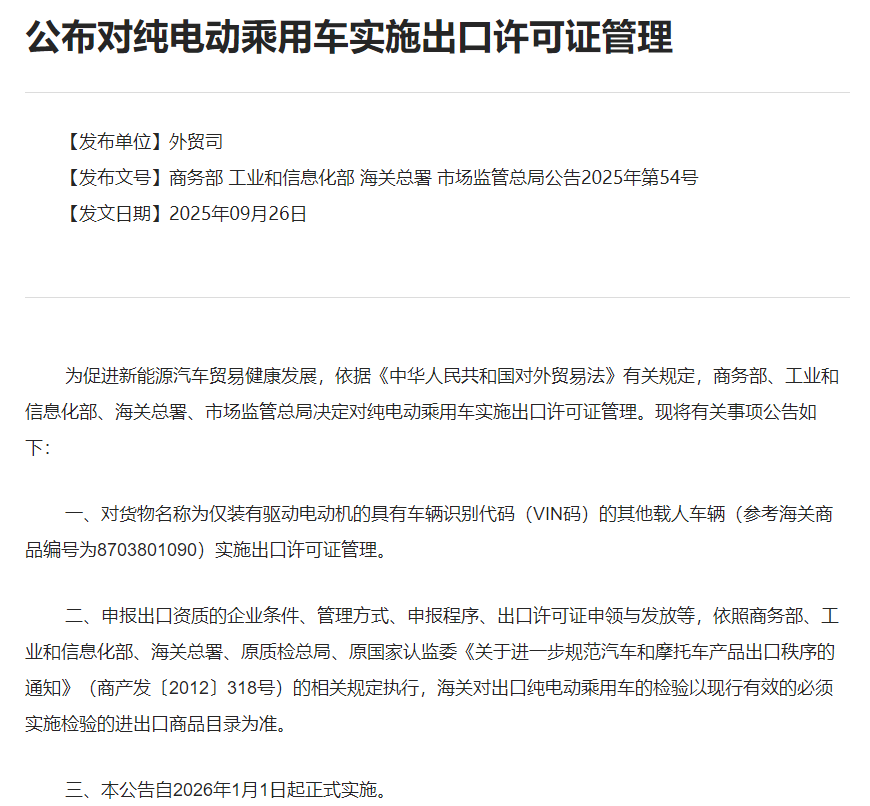
2026年1月1日正式实施!纯电动乘用车出口设“许可门槛” 专家:将重构出口秩序 助力出口提质升级
Mei Ri Jing Ji Xin Wen· 2025-09-26 15:36
Core Viewpoint - The announcement by the Ministry of Commerce and other regulatory bodies marks a shift in China's electric vehicle (EV) export strategy from a focus on scale to prioritizing quality, implementing an export licensing system for pure electric passenger vehicles starting January 1, 2026 [1][4][6]. Group 1: Export Licensing System - The new export licensing system requires all pure electric passenger vehicles to obtain export licenses from the Ministry of Commerce or its authorized agencies, with non-compliance leading to export bans [4][6]. - Only automotive manufacturers and their authorized entities can apply for export licenses, and they can only export vehicles under their own brand [4][6]. Group 2: Current Export Trends - In the first seven months of 2025, China's export of new energy passenger vehicles reached 1.199 million units, a year-on-year increase of 57.1% [6]. - Despite rapid growth, issues such as the export of "0-kilometer used cars" as new vehicles have emerged, damaging China's automotive reputation internationally [6]. Group 3: Historical Context and Lessons - The announcement is rooted in historical lessons from the motorcycle industry, which faced a decline due to low-quality exports and lack of standards, highlighting the importance of quality control in maintaining long-term competitiveness [6][8]. - The licensing system aims to prevent low-quality exports and ensure that only companies with robust overseas service capabilities can participate in the export market [7][8]. Group 4: Impact on Industry Dynamics - The implementation of the export licensing system is expected to enhance the market order, allowing well-established companies to thrive while potentially eliminating those lacking compliance and operational capabilities [8]. - The announcement is anticipated to strengthen brand responsibility, improve service levels, and curb price competition, fostering a healthier export ecosystem for China's electric vehicles [8].