
地缘政治缓和

Search documents
Amillex 安迈每日汇评|美元走弱助推金价登顶,降息预期点燃多头情绪
Sou Hu Cai Jing· 2026-01-23 04:34
Group 1: Gold Market - Spot gold continues its strong upward trend, surpassing the $4,900 mark and reaching a historical high of $4,960.43 per ounce [1] - The primary driver of this surge is the persistent weakness of the US dollar, which fell 0.5% to 98.28, marking a three-week low [1] - Market expectations indicate that the Federal Reserve is likely to initiate a rate cut cycle in the second half of 2026, with two cuts totaling 50 basis points, enhancing gold's appeal as a non-yielding asset [1] Group 2: Stock Market - The Dow Jones index is reported at 49,384.01 points, up 0.63%, buoyed by signals of easing geopolitical tensions from the Davos Forum [7] - The S&P 500 index stands at 6,913.35 points, up 0.55%, reflecting optimistic expectations ahead of the upcoming Federal Reserve meeting [7] - The Nasdaq index is at 25,436.02 points, up 0.91%, with active performance in tech stocks, particularly in the AI sector [7] Group 3: Currency Market - The US dollar index (DXY) is at 98.30, down 0.41%, as safe-haven buying recedes due to easing geopolitical tensions [8] - The euro to dollar exchange rate is reported at 1.1750, up 0.56%, benefiting from reduced trade friction risks between the US and Europe [8] - The dollar to yen exchange rate is around 158.40, with market risk appetite improving and demand for the yen weakening [8] Group 4: Commodity Market - WTI crude oil is priced at approximately $59.70 per barrel, down 2.14%, as geopolitical premiums significantly decline [5] - Spot silver is reported at about $95.82, up 3.44%, as the market rebounds above the $95 historical high amid easing geopolitical tensions [8] Group 5: Cryptocurrency Market - Bitcoin is trading at approximately $89,521, having slightly dropped from the psychological $90,000 mark, showing strong technical support around $88,000 [8] - Ethereum is fluctuating around the $3,000 mark, with recent on-chain activity debates affecting its price, oscillating between $2,980 and $3,050 [8]
黄金4580成短期关键防线,破位警惕调整走势(2026.1.16)
Sou Hu Cai Jing· 2026-01-16 00:55
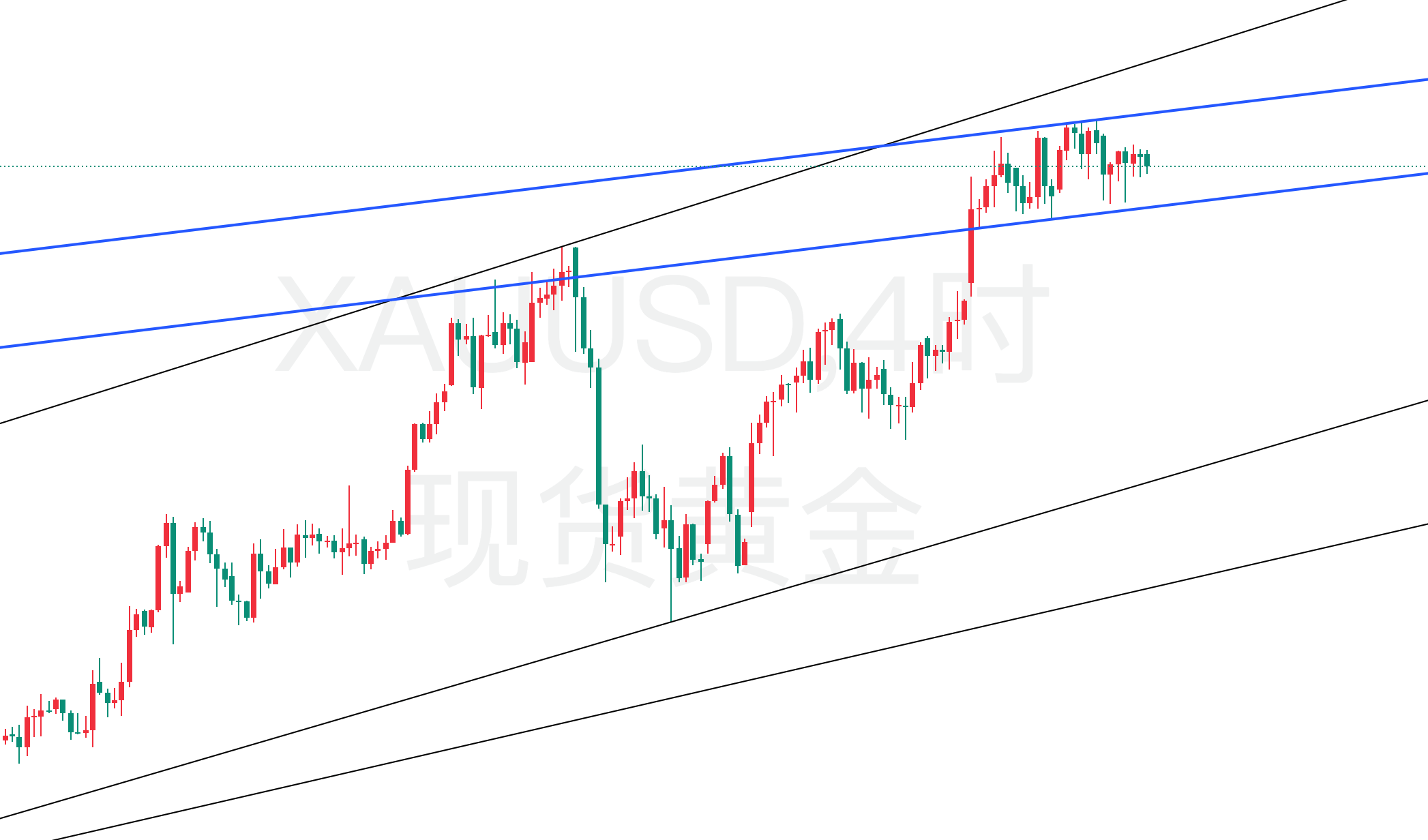
Group 1: Fundamental Analysis - Strong U.S. employment data led to a decrease in initial jobless claims by 9,000, resulting in a seasonally adjusted total of 198,000, significantly below the expected 215,000, which pushed the U.S. dollar index to a six-week high of 99.49, closing at 99.35 with a gain of 0.28% [2] - The strengthening dollar made gold more expensive for overseas buyers, suppressing demand and reinforcing expectations that the Federal Reserve will maintain interest rates in the short term, delaying the next rate cut to June, with the probability of a March cut dropping from 50% to 21.6%, reducing the appeal of non-yielding assets like gold [2] - Easing geopolitical tensions, particularly Trump's softened rhetoric regarding Iran, diminished expectations of escalating Middle Eastern conflicts, thereby weakening gold's safe-haven appeal [3] - Rising bond yields, driven by strong economic data, pushed the 10-year Treasury yield to 4.156% and the 2-year yield to 3.558%, increasing the opportunity cost of holding gold as inflation-protected securities (TIPS) reached new highs [4] - Trump's decision to retain Federal Reserve Chairman Powell alleviated market concerns about Fed leadership instability, boosting risk sentiment and further supporting the dollar's upward momentum [4] Group 2: Technical Analysis - The daily chart indicates that gold exhibited a volatile trading pattern, closing with a long lower shadow on a bearish candle, while remaining above the 5-day moving average, suggesting a continuation of a strong consolidation phase [5] - The current upward trend in gold, which began at 3886, is characterized by a five-wave structure, with the market currently in the fifth wave, necessitating caution regarding potential pullback risks [6] - Key support levels to monitor include the 4540/4535 area, corresponding to the 10-day moving average, while initial resistance is noted at the current high of 4642/4643 [7] - The four-hour chart analysis maintains focus on the five-wave structure since the 4274 point, with the market currently within a rising channel, requiring close monitoring of the channel's performance [9] - The lower support of the channel is near 4580, which aligns with previous low points, while the upper resistance is around 4650; breaking below the channel support would lead to further attention on 4560 and 4540/4535 support levels, while a breakout above resistance would shift focus to 4661 and 4690 [9]

港股收评:恒指涨0.69%,恒科指一度冲高至2.2%,科技金融普涨,军工股熄火
Sou Hu Cai Jing· 2025-11-25 08:34
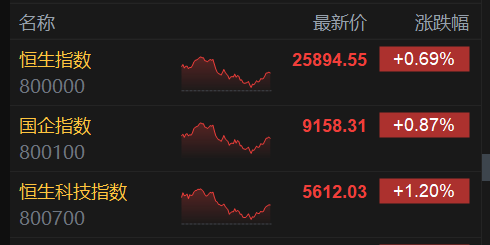
Core Viewpoint - The market sentiment has improved significantly due to easing geopolitical tensions and expectations of interest rate cuts by the Federal Reserve [1] Group 1: Market Performance - The Hong Kong stock market indices continued their rebound, with the Hang Seng Index rising by 0.69%, briefly surpassing 26,000 points [1] - The Hang Seng China Enterprises Index and the Hang Seng Tech Index increased by 0.87% and 1.2%, respectively, with the tech index peaking at a 2.2% gain during the session [1] Group 2: Sector Performance - Large technology stocks contributed to the market's strength, with Baidu and Xiaomi both rising over 4.3%, while Alibaba, JD.com, and Meituan also saw gains [1] - Major financial stocks, including China Life, China Pacific Insurance, Agricultural Bank of China, Bank of China, and CITIC Securities, experienced widespread increases [1] - The rising expectations for Federal Reserve interest rate cuts led to active trading in gold stocks and non-ferrous metal stocks such as copper and aluminum [1] - Other sectors showing collective activity included Apple-related stocks, entertainment, steel, building materials, and automotive industries [1] Group 3: Underperforming Sectors - The airline sector faced pressure, with a 56% increase in flight cancellations between China and Japan compared to the same month last year, leading to a nearly 6% drop in China Eastern Airlines, which fell below HKD 100 billion in market capitalization [1] - Defense stocks, which had surged the previous day, cooled off, while dairy, telecommunications, and home appliance stocks mostly remained sluggish [1]
建信期货钢材日评-20251023
Jian Xin Qi Huo· 2025-10-23 02:49
Report Summary 1. Report Industry Investment Rating No relevant content provided. 2. Core Viewpoints - Geopolitical tensions are easing, and there are expectations of improved terminal demand for steel, leading to a price rebound. However, caution is needed as steel mill profits are still declining. The path to profit recovery will determine the price rebound rhythm. If it's through raw material price cuts, the negative feedback will be greater and the price increase will be more tortuous. If it's due to significantly improved terminal demand, the price increase will be smoother. Without trade conflict disruptions, the latter is more likely [9]. 3. Summary by Directory 3.1 Market Review and Outlook - **Futures Market**: On October 22, the main contracts of rebar and hot-rolled coil futures 2601 fluctuated upwards, reaching the highest closing price in the past 7 trading days. The rebar RB2601 closed at 3068 yuan/ton, up 0.59%; the hot-rolled coil HC2601 closed at 3247 yuan/ton, up 0.81% [5]. - **Spot Market**: On October 22, the prices of individual rebar and hot-rolled coil spot markets rebounded. The rebar prices in Hefei, Zhengzhou, and Nanning rose by 10 - 30 yuan/ton; the hot-rolled coil prices in Hangzhou, Guangzhou, and Wuxi rose by 10 - 20 yuan/ton, while the price in Shijiazhuang fell by 30 yuan/ton [7]. - **Technical Analysis**: The daily KDJ indicators of the rebar 2601 and hot-rolled coil 2601 contracts showed a divergent upward trend after a golden cross on October 20 and 21 respectively. The daily MACD green bars of both contracts have been significantly narrowing for 3 consecutive trading days [7]. - **Outlook**: Geopolitical tensions are easing, and there are expectations of improved terminal demand for steel. However, steel mill profits are still declining. The path to profit recovery will determine the price rebound rhythm [9]. 3.2 Industry News - **Company News**: Anyang Iron and Steel announced that its subsidiary, Henan Angang Zhoukou Iron and Steel Co., Ltd., plans to increase its registered capital by no more than 1 billion yuan through equity financing, and Anyang Iron and Steel intends to waive its pre - emptive right [10]. - **Coal Market**: Domestic thermal coal prices have risen sharply. As of October 17, 2025, the price of Qinhuangdao Port Q5500 thermal coal was 748 yuan/ton, up 43 yuan/ton week - on - week. The price increase in production areas was even greater. The winter heating season may start early, and the thermal coal consumption is expected to support coal prices. The target price of thermal coal for the year has been raised to 750 - 800 yuan/ton [10]. - **International Trade**: The EU Commission has made a positive anti - dumping final ruling on steel track shoes originating from China, with an anti - dumping tax of 62.5% [10]. - **Company Performance**: Brazil's Vale's iron ore production in Q3 reached 94.4 million tons, a year - on - year increase of 3.8%. It is expected to achieve its 2025 production target. The sales volume of iron ore pellets increased by 5.1% year - on - year, and the price of iron ore powder rose by 4.2% [11]. - **Coal Trade**: In August 2025, Australia's coal export value was 5.425 billion Australian dollars, a month - on - month increase of 1.35% but a year - on - year decrease of 26.53%. From January to August, the cumulative export value was 41.379 billion Australian dollars, a year - on - year decrease of 29.20%. From April to August this year, India's coal imports were 118 million tons, a 2.57% decrease compared to the same period last year [11][12]. 3.3 Data Overview - The report provides multiple data charts, including the social inventory of rebar and hot - rolled coil in major cities, the weekly output of five major steel products, the steel mill inventory of five major steel products, the blast furnace and electric furnace operating rates and capacity utilization rates, the national daily average pig iron output, the apparent consumption of five major steel products, and the basis between Shanghai rebar and hot - rolled coil spot and January contracts [16][20][23][27][29].

深夜突发,金价崩了!网友懵圈:我才买啊
Sou Hu Cai Jing· 2025-10-22 04:43
Core Viewpoint - The gold and silver markets experienced significant declines on October 21, with gold prices dropping sharply due to profit-taking by investors after a recent surge driven by expectations of further interest rate cuts by the Federal Reserve and strong safe-haven demand [7][9][11]. Price Movements - As of October 21, gold prices fell by 6.3%, dropping below $4100 per ounce, with a decline of over $240 in just seven hours [2]. By 11 PM, gold was reported at $4112.37 per ounce, marking a 5.58% decrease, while COMEX futures were at $4145 per ounce, down 4.92% [2]. - Concurrently, silver also saw a significant drop, with London silver reported at $48.18 per ounce, down 8.02%, and COMEX silver futures declining by 7.69% to $47.44 per ounce [4][5]. Market Analysis - Analysts attribute the recent pullback in gold prices to profit-taking after a rapid increase in prices, which was fueled by geopolitical tensions and expectations of monetary easing [7][9]. - The market is currently experiencing a correction phase, with concerns about overbought conditions leading to increased caution among traders [9][11]. - The volatility in gold trading has reached high levels, indicating potential risks associated with overtrading [9]. Future Outlook - The future trajectory of gold prices remains uncertain, with some analysts suggesting that the likelihood of a decline is greater than further increases [10]. - The sustainability of high net-worth individual investors' demand for gold is a critical factor; if this demand diminishes, it may be challenging to maintain current price levels [10]. - HSBC forecasts that gold's upward momentum could continue until 2026, driven by strong central bank purchases and ongoing fiscal concerns in the U.S., with a target price of $5000 per ounce [11]. However, they caution that fewer interest rate cuts than expected could hinder gold's price trajectory [11].
方正中期期货有色金属日度策略-20250814
Fang Zheng Zhong Qi Qi Huo· 2025-08-14 03:08
Group 1: Report Industry Investment Rating No relevant content found. Group 2: Core Views of the Report - The non - ferrous metals sector continues to oscillate, with a slight upward trend. The weakening of the US dollar and the easing geopolitical situation have boosted market sentiment. Domestic industrial products are showing signs of anti - involution, benefiting non - ferrous metals and related products [12][13]. - The suspension of the 24% tariff for 90 days between China and the US provides more room for industry adjustment, which is beneficial to industrial products. China's favorable policies, such as real estate and personal consumption loan subsidy policies, also have a positive impact on the market [12]. - The market's expectation of a Fed rate cut in September has increased due to the lower - than - expected inflation data in the US in July, which is conducive to the rise of non - ferrous metals prices [12]. Group 3: Summary by Relevant Catalogs 3.1 First Part: Non - ferrous Metals Operating Logic and Investment Recommendations - **Macro Logic**: The non - ferrous metals sector oscillates. The suspension of tariffs, China's favorable policies, the easing geopolitical situation, and the increasing expectation of a Fed rate cut all have a positive impact on the non - ferrous metals market. The market should pay attention to relevant economic data this week [12][13]. - **Variety Analysis** - **Copper**: The exemption of US refined copper import tariffs will change the global copper trade flow. The supply - demand fundamentals of Shanghai copper are gradually becoming more balanced, and it is expected to rebound in the short term. The recommended strategy is to buy on dips [3][14]. - **Zinc**: The supply is increasing, the demand is weak, and the inventory is rising. It is recommended to take short - term long positions and short on rallies in the medium term [4][14]. - **Aluminum Industry Chain**: The aluminum market is in a state of shock. It is recommended to wait and see or take small short positions. The alumina market has regional supply - demand mismatches, and it is recommended to hold short positions cautiously [5][14][15]. - **Tin**: It is in a range - bound state, and the recommended strategy is to buy on dips and sell on rallies [6][14][15]. - **Lead**: The supply and demand are increasing, and it is recommended to take long positions on dips and use option double - selling strategies [7][8][14]. - **Nickel and Stainless Steel**: The supply of refined nickel is in excess, and the demand for stainless steel is weak. It is recommended to take short - term long positions on nickel and long positions on stainless steel in the short term, and short on rallies in the medium term [9][14][17]. 3.2 Second Part: Non - ferrous Metals Market Review - The closing prices and price changes of various non - ferrous metal futures are presented, including copper, zinc, aluminum, alumina, tin, lead, nickel, stainless steel, and casting aluminum alloy [18]. 3.3 Third Part: Non - ferrous Metals Position Analysis - The latest position analysis of the non - ferrous metals sector shows the net long - short strength comparison, net long - short position differences, changes in net long and short positions, and influencing factors of different varieties [20]. 3.4 Fourth Part: Non - ferrous Metals Spot Market - The spot prices and price changes of various non - ferrous metals are provided, such as copper, zinc, aluminum, alumina, nickel, stainless steel, tin, lead, and casting aluminum alloy [21][23]. 3.5 Fifth Part: Non - ferrous Metals Industry Chain - For each non - ferrous metal variety, relevant industry chain charts are presented, including inventory changes, processing fees, and price trends [25][29][31]. 3.6 Sixth Part: Non - ferrous Metals Arbitrage - For different non - ferrous metal varieties, charts related to arbitrage are presented, such as the ratio of domestic to foreign prices, basis, and spreads between different contracts [62][63][66]. 3.7 Seventh Part: Non - ferrous Metals Options - For various non - ferrous metal varieties, charts related to options are presented, including historical volatility, implied volatility, trading volume, and open interest [80][82][85].
市场快讯:铜价脱离震荡区间上涨
Ge Lin Qi Huo· 2025-06-27 12:45
Report Summary 1) Report Industry Investment Rating No relevant information provided. 2) Core Viewpoints of the Report - The price of Shanghai copper broke through the three - month oscillation range of 77,400 - 79,500 on the night session of June 26th and during the day on June 27th, and continued to rise strongly, breaking through the 80,000 mark. It is expected to rise further and reach the previous high of 83,000 [4][7]. 3) Summary According to Related Logics - **Macroeconomic Factor**: The slowdown of the US economic growth, with the season - adjusted Q1 GDP at 0.5%, weaker than expected, has led to a continued downward trend of the US dollar index and increased expectations of the Fed's interest rate cut, thus supporting the strengthening of copper prices [7]. - **Geopolitical Factor**: The cease - fire in the Israel - Iran war and the gradual easing of the Russia - Ukraine war, along with the lenient handling of US tariff policies, will bring a favorable external environment for copper demand [7]. - **Market Sentiment Factor**: According to the CFTC's weekly position report, long positions have been higher than short positions recently. Also, the long positions and trading volume on the Shanghai Futures Exchange have been on the rise [7]. - **Long - term Demand Factor**: In the long - run, under the framework of global energy transformation, with a loose domestic macro - economic environment and increased structural investment, domestic investment in power equipment and big data centers is expected to increase, ensuring a positive trend in copper demand and an upward - oscillating copper price [7].
美联储政策转向叠加中东停火 新兴市场资产开启反弹之旅
Zhi Tong Cai Jing· 2025-06-24 23:03
Group 1 - Emerging market assets experienced a broad rebound driven by improved market sentiment due to signals from the Federal Reserve and easing geopolitical tensions, with the MSCI Emerging Markets Currency Index rising over 0.6% in a single day [1] - The U.S. dollar index and 10-year Treasury yields weakened simultaneously, while emerging market stock indices recorded their largest single-day gain since April [1] - Fed Chairman Jerome Powell's congressional testimony hinted at a potential window for early rate cuts, aligning with dovish comments from other Fed officials, which reinforced market expectations for a third rate cut this year [1] Group 2 - Easing geopolitical risks, particularly a temporary ceasefire agreement between Israel and Iran facilitated by the U.S., contributed to rising asset prices in developing countries, with the Israeli shekel soaring 1.7% to a new high since January 2023 [2] - The Mexican peso strengthened due to a decline in inflation data, while the Brazilian real fell against the dollar as the central bank remained cautious about inflation [2] - Eastern European markets showed varied trends, with Hungary's central bank maintaining rates for the ninth consecutive month and Slovenia issuing its first sustainable development-linked bond [2] Group 3 - Investor sentiment towards emerging markets is improving, with a recent HSBC survey indicating that the proportion of fund managers bullish on emerging market assets reached a two-and-a-half-year high [3] - If the current risk appetite persists, emerging market stocks are expected to continue outperforming, driven by expectations of a shift in Fed policy and easing geopolitical tensions [3] - Analysts emphasize the need to monitor upcoming U.S. non-farm payroll data and developments in the Middle East closely [3]