
宏观预期改善

Search documents
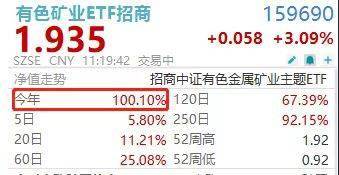
年内涨幅超100%!有色矿业ETF招商(159690)放量飙涨超3%,永兴材料涨停封板
Sou Hu Cai Jing· 2025-12-26 03:41
Group 1 - The core viewpoint of the articles highlights a significant rally in the non-ferrous metal sector, driven by improving macroeconomic expectations, supply disruptions, and structural growth in demand for energy metals [1][2] - The non-ferrous mining ETF, specifically the招商(159690), has seen a notable increase of 3.09%, with key stocks like 永兴材料 hitting the daily limit, and others such as 江西铜业 and 云南铜业 showing strong gains [1] - Recent analysis indicates that the non-ferrous metal sector is experiencing a robust performance due to three main factors: improved manufacturing sentiment globally, supply-side disruptions in major overseas mines, and sustained demand growth in new energy sectors [1][2] Group 2 - Certain metal inventories are at historically low levels, which, combined with the financial and commodity attributes, is further driving the valuation recovery of the sector [2] - The non-ferrous metals are recognized as strategic resources in the context of global energy transition and industrial chain restructuring, emphasizing their long-term investment value [2] - The招商(159690) ETF focuses on leading resource companies and offers a convenient channel for investors to participate in the sector's performance while mitigating individual stock volatility [2]


何看待铜价创历史新高?
Guoxin Securities· 2025-11-02 08:45
Group 1: Copper Price Dynamics - Copper prices reached a historical high due to a combination of inventory distortion, improved macro expectations, and tight supply-demand fundamentals[12] - LME copper inventory has decreased by over 40% since the beginning of the year, leading to increased price volatility and liquidity risks[12] - The recent suspension of operations at Indonesia's Grasberg copper mine resulted in a single-day price increase of over 3%[12] Group 2: Macroeconomic Factors - Progress in US-China trade negotiations has improved growth expectations, contributing to the rise in copper prices[13] - On October 28, a consensus on key issues in US-China economic discussions was reached, boosting market risk appetite[13] - The delay in the Grasberg mine's resumption until 2027 and the collapse of Chile's El Teniente mine continue to tighten copper supply, providing price support[13] Group 3: Market Performance Overview - From October 25 to November 1, the Shanghai Composite Index fell by 0.43%, while the S&P 500 rose by 0.72%[14] - The US dollar index increased by 0.8%, and LME copper prices rose by 0.88% during the same period[14] - The latest week saw crude oil inventories rise by 2.78 million tons, while copper inventories increased by 14,656 tons[23]
多资产周报:如何看待铜价创历史新高?-20251102
Guoxin Securities· 2025-11-02 08:42
Group 1: Copper Price Dynamics - The recent surge in copper prices is attributed to a distortion in inventory, with LME copper inventory down over 40% since the beginning of the year, leading to increased price volatility[12] - The low inventory environment allows for significant price fluctuations, as evidenced by a single-day increase of over 3% in LME copper prices following the shutdown of the Grasberg mine in Indonesia[12] - The imbalance in inventory distribution, particularly in Europe where inventory accounts for less than 15%, heightens the risk of supply disruptions[12] Group 2: Macroeconomic Factors - Recent easing of risk events, particularly progress in US-China trade negotiations, has improved macroeconomic expectations, fueling copper price increases[13] - On October 28, a consensus on key issues in US-China economic talks was reached, enhancing market risk appetite[13] - The outlook for copper prices suggests increased short-term volatility but a long-term upward trend, supported by ongoing supply constraints from delayed mine restarts[13] Group 3: Market Performance Overview - For the week of October 25 to November 1, the Shanghai Composite Index fell by 0.43%, while the S&P 500 rose by 0.72%[14] - In commodities, LME copper increased by 0.88%, while WTI crude oil decreased by 0.85% during the same period[14] - The latest inventory data shows a rise in copper stocks to 109,690 tons, up by 14,656 tons from the previous week[23]

焦煤一周涨逾10%!发生了什么?
Qi Huo Ri Bao· 2025-10-23 23:55
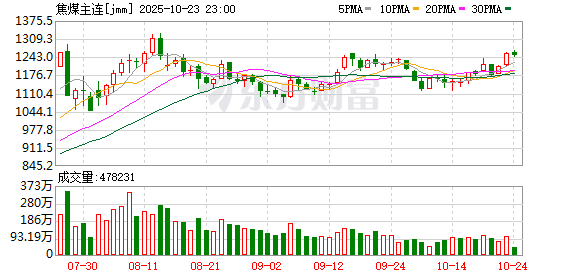
Core Viewpoint - Recent surge in coking coal futures prices, with the main contract rising over 10% since October 15, driven by supply concerns and reduced production from Mongolia [2] Group 1: Supply and Demand Dynamics - Significant reduction in Mongolian coal production and customs clearance has raised supply concerns, with domestic coal mine operating rates declining [2] - As of October 22, coal production capacity utilization in China was reported at 85.1%, down 2.3 percentage points week-on-week, with daily raw coal output at 191.0 million tons, a decrease of 5.1 million tons [3] - The supply-demand balance has shifted to tight equilibrium, with prices remaining strong despite recent increases in futures prices [2][3] Group 2: Market Reactions and Future Outlook - The market's trading logic is shifting from expectations of increased coal production and weak steel demand to improved macroeconomic expectations and policy support [4] - Anticipation of further price increases for coking coal and coke, with potential for a third round of price hikes from major coking enterprises [4] - Analysts expect continued upward trends in coking coal prices as downstream steel mills prepare for winter stockpiling [4][5]
热轧卷板底部或已现,但下半年仍有二次探底风险
Qi Huo Ri Bao· 2025-07-17 00:46
Group 1 - The core viewpoint of the article is that the recent rebound in steel prices, particularly hot-rolled coil prices, is driven by improved macroeconomic expectations, better-than-expected supply-demand dynamics, and strong performance in raw material prices [1][2][8] - As of July 11, the price of hot-rolled coil main contract reached 3273 yuan/ton, an increase of 221 yuan/ton or 7.24% from the low point in early June [1] - The rebound in steel prices is supported by a positive outlook on macroeconomic conditions, including easing trade tensions between China and the U.S. and expectations for policy support in urban renewal [2][3] Group 2 - The supply-demand dynamics for hot-rolled coils have improved, with significant growth in the automotive and machinery sectors, leading to a positive consumption trend for hot-rolled coils [2] - The prices of coking coal and iron ore have remained strong, providing cost support for steel prices [2] - The manufacturing and export sectors, which are key consumers of hot-rolled coils, may face marginal weakening risks in the second half of the year, potentially impacting demand [4][6] Group 3 - The article highlights that the macroeconomic outlook is expected to continue improving, with potential for synchronized monetary easing between China and the U.S. [3][8] - The manufacturing sector's investment resilience is supported by policies promoting equipment upgrades, although the effectiveness of these policies may diminish in the second half of the year [5][6] - The price gap between cold-rolled and hot-rolled coils has narrowed, indicating weakening downstream demand [6] Group 4 - The current rebound in steel prices is characterized by strong speculative expectations, with the hot-rolled coil main contract price aligning closely with spot prices, creating arbitrage opportunities for traders [7] - There is a risk of a second price dip in late August to September due to potential policy impacts and weaker-than-expected demand recovery [8]
黑色建材日报:宏观预期改善,黑色底部反弹-20250606
Hua Tai Qi Huo· 2025-06-06 03:04
1. Report Industry Investment Rating No information provided. 2. Core Views of the Report - The macro - expectation has improved, leading to a bottom - up rebound in the black commodity market. The steel market is in a situation where the off - season expectation and the real consumption resilience are in a game, and the price fluctuates at the bottom. Iron ore shows a relatively strong short - term price due to high demand and inventory reduction, but the long - term supply is expected to be loose. For coking coal and coke, the third round of price cuts for coke has started, and the overall supply - demand pressure of coking coal is large. The price increase of thermal coal is limited due to weak demand and high inventory, but the price decline slows down as the peak season approaches [1][3][5][6]. 3. Summary by Relevant Catalogs Steel Market Analysis - Futures and spot: Yesterday, rebar and hot - rolled coil futures rebounded from the bottom following the black commodity sector. In the spot market, national rebar production, consumption, and inventory all decreased; hot - rolled coil production increased, inventory rose month - on - month, and consumption declined. The production, sales, and inventory of the five major steel products all decreased month - on - month [1]. - Supply and demand and logic: Currently, the plate market maintains a pattern of strong supply and demand, while the production and sales of building materials are weakening. Steel inventory is continuously decreasing, and export resilience persists. The off - season expectation of steel and the real consumption resilience are in a game, and the price fluctuates at the bottom. Later, attention should be paid to the performance of finished product demand in the off - season, inventory accumulation, and cost support caused by macro - disturbances [1]. Strategy - Unilateral: Oscillation; Cross - period: None; Cross - variety: None; Futures - spot: None; Options: None [2]. Iron Ore Market Analysis - Futures and spot: Yesterday, the iron ore futures price oscillated. In the spot market, the prices of mainstream imported iron ore varieties fluctuated slightly. Traders' enthusiasm for quoting was average, and steel mills mainly replenished inventory on demand. There were no transactions in the market yesterday. The cumulative transaction volume of iron ore at major ports across the country was 962,000 tons, a month - on - month decrease of 9.76%; the cumulative transaction volume of forward - looking spot was 1.96 million tons, a month - on - month increase of 75.31%. According to Steel Union data, the average daily hot metal output of 247 steel mills this week was 2.418 million tons, a month - on - month decrease of 100,000 tons, and the profitability rate of steel mills remained unchanged [3]. - Supply and demand and logic: Iron ore demand remains at a high level, and inventory maintains a slight reduction without further accumulation in the short term, so the price is relatively strong. In the long run, the iron ore market still shows a pattern of relatively loose supply and demand, and steel mills have an expectation of further production cuts. However, when the reality turns to a loose situation depends on the weakening of future consumption. Later, attention should be paid to the impact of supply - side changes on the industrial chain [3]. Strategy - Unilateral: Oscillation; Cross - period: None; Cross - variety: None; Futures - spot: None; Options: None [4]. Coking Coal and Coke (Double - Coking) Market Analysis - Futures and spot: Yesterday, the double - coking futures continued to rise. In some areas, the third round of price cuts for coke started. The sentiment in the domestic market was dull. For imported Mongolian coal, the customs clearance of Mongolian coal has maintained around 700 vehicles recently, and the port transactions are cold. The current quotation of Mongolian No. 5 raw coal is about 715 - 740 yuan/ton. The double - coking inventory decreased month - on - month, and the inventory reduction of coking coal was considerable [5]. - Supply and demand and logic: For coke, the third round of price cuts in the spot market has started, the coking profit has shrunk, and the supply has decreased month - on - month due to production cuts. Based on the expectation of a decline in iron ore production, the short - term demand for coke is under pressure. For coking coal, as it enters the off - season of consumption, the market is worried about the later consumption intensity. The hot metal output continues to decline, and the market has a strong willingness to suppress raw material prices. The price rebounds after reaching the phased bottom. The full - caliber coking coal inventory continues to increase, some coal mines have top - bin pressure, the production reduction is less than expected, and the overall supply - demand pressure is still large. In June, the origin enters the safety month, and the supply disturbance in the origin increases [5][6]. Strategy - Coking coal: Oscillation; Coke: Oscillation; Cross - period: None; Cross - variety: None; Futures - spot: None; Options: None [6]. Thermal Coal Market Analysis - Futures and spot: In the origin, the coal prices in the main producing areas were slightly adjusted. June is the safety production month, and the safety inspection intensity in the origin is strict, resulting in a slight contraction in production. Downstream metallurgical and chemical industries replenished inventory in small quantities, and the number of coal - pulling trucks in operating coal mines increased, with an obvious willingness to support prices. At the port, as the shipping volume declined, the port inventory continued to decrease but was still at a high level in the same period. The daily consumption of power plants decreased compared with the previous period, the demand was weak, the purchase of market coal was small, and the driving force for price increase was insufficient [6]. - Supply and demand and logic: In the short term, the support for coal demand is limited, but as the peak season approaches, the price decline slows down. In the long - term, the pattern of loose supply remains unchanged. Attention should be paid to the consumption of non - power coal and the inventory replenishment for peak - summer power consumption [6]. Strategy No strategy information provided.