
宽基指数基金

Search documents
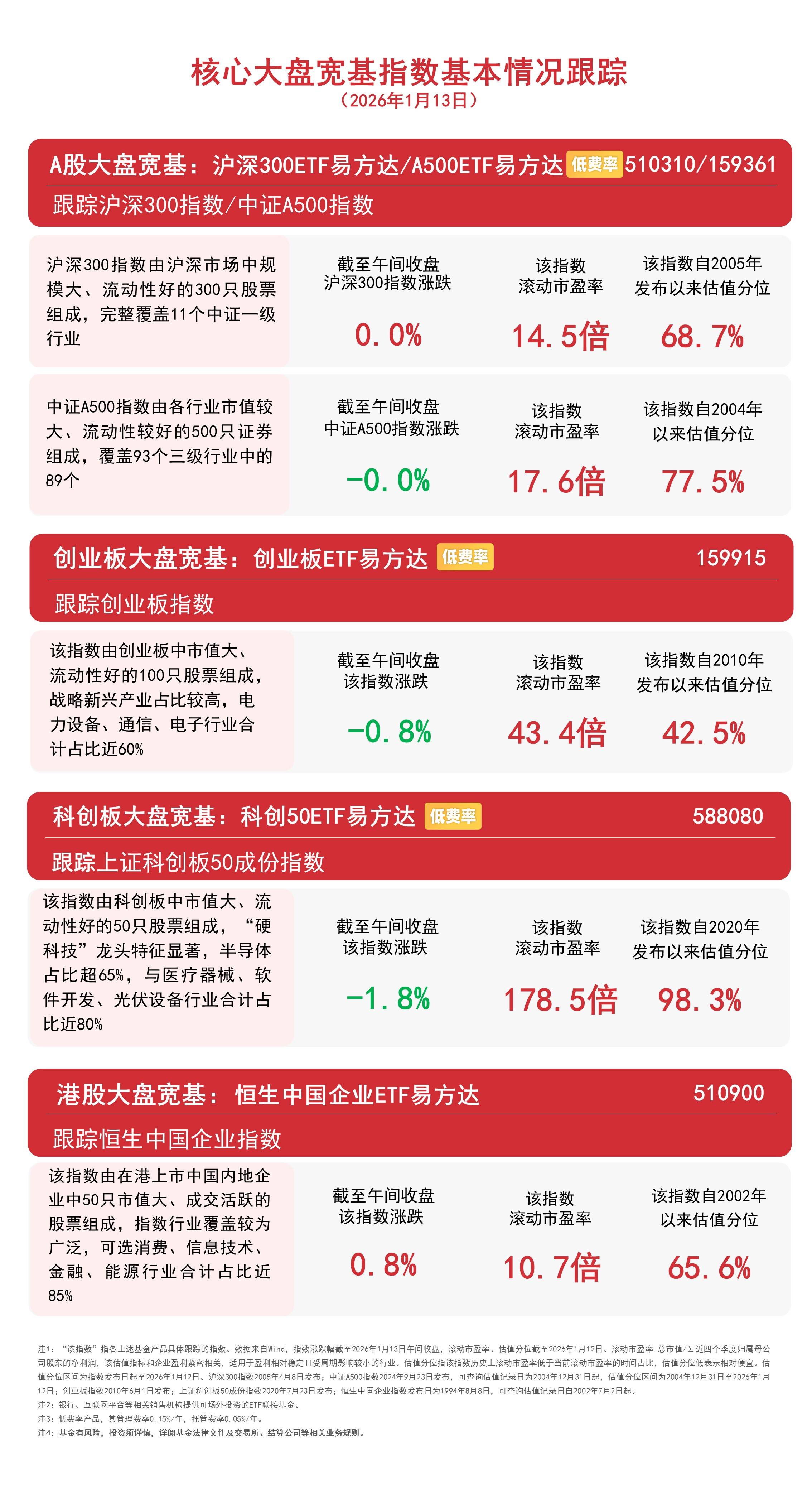
沪指早盘震荡微跌0.03%,关注沪深300ETF易方达(510310)、A500ETF易方达(159361)等产品投资机会
Sou Hu Cai Jing· 2026-01-13 05:11
Group 1 - The A-share market experienced a collective pullback on January 13, with the Shanghai Composite Index slightly declining by 0.03% and a total market turnover of approximately 2.47 trillion yuan, showing a slight increase compared to the previous day [1] - In terms of sector performance, the medical services, CRO, and lithium mining sectors saw the largest gains, while aerospace and military, semiconductor, and communication equipment sectors lagged behind [1] - The Hong Kong stock market showed an upward trend, with active performances in the pharmaceutical and technology sectors, while consumer stocks experienced a pullback [1] Group 2 - The CSI A500 Index fell by 0.03%, while the CSI 300 Index rose by 0.01%. The ChiNext Index decreased by 0.8%, and the STAR Market 50 Index dropped by 1.8%. In contrast, the Hang Seng China Enterprises Index increased by 0.8% [1]

基民征战2026: 多了一分冷静与笃定
Zhong Guo Zheng Quan Bao· 2026-01-04 22:00
Group 1 - The year 2025 was a transformative period for fund investors, marked by a journey of cognitive upgrades and emotional adjustments, leading to a more rational and determined mindset as they approach 2026 [1] - The capital market in 2025 demonstrated resilience amidst volatility, with investors like Zhao maintaining high positions in technology and metals, while others like Li faced challenges due to emotional decision-making [2][3] - Investors are shifting from chasing trends to focusing on asset allocation and rational decision-making, recognizing the importance of discipline and risk management in navigating market complexities [5] Group 2 - Investors are planning to optimize their portfolio structures in 2026, with strategies such as increasing investments in index funds and concentrating on high-performing funds to enhance returns [4] - The experiences of investors in 2025 have led to a more pragmatic approach, emphasizing the need for a balanced allocation and a focus on quality assets to navigate potential market fluctuations [4][5] - The overall sentiment among investors is moving towards a long-term perspective, with an understanding that investment is a continuous journey that requires patience and respect for market dynamics [5]
金融破段子 | 战胜“平庸”的难度
中泰证券资管· 2025-12-15 11:32
Core Viewpoint - The article highlights that despite the strong performance of the "Magnificent 7" (M7) stocks in the U.S. market, many of them have not outperformed the S&P 500 index this year, challenging the common perception of their dominance [2]. Group 1: Market Performance and Investment Strategies - The S&P 500 index is often viewed as a representation of "mediocrity," and beating the market is a challenging endeavor, even when focusing on high-performing stocks like the M7 [4][5]. - Many investors enter the stock market with the goal of outperforming it, but recognizing the difficulty of this task can lead to a more realistic investment strategy focused on not losing money [5]. - Index-enhanced products are suggested as a means to achieve the goal of "not losing," allowing investors to capture average market returns while potentially gaining excess returns through active management [5]. Group 2: Evaluating Enhanced Index Products - When assessing enhanced index products, three key factors should be considered: past performance, the sustainability of enhancement effects, and understanding the logic behind the enhancement strategies [6][7]. - The sustainability of enhancement is illustrated through examples of two products, where consistent performance over time is emphasized as a more favorable choice for investors [8]. - Understanding the enhancement logic is crucial, as different market conditions can lead to varying performance; investors should align with the investment logic of the products they choose [9]. Group 3: Specific Product Performance - The Zhongtai CSI 300 Enhanced Index Fund A has shown a net asset value growth rate of 69.29% from its inception on April 1, 2020, outperforming its benchmark by 44.18% as of September 30, 2025 [10]. - The fund has consistently outperformed its benchmark in every complete half-year since its establishment, indicating strong performance stability [10]. - Historical performance data for the Zhongtai CSI 300 Enhanced Index A/C shows varying annual growth rates, with significant outperformance against benchmarks in several years [11].

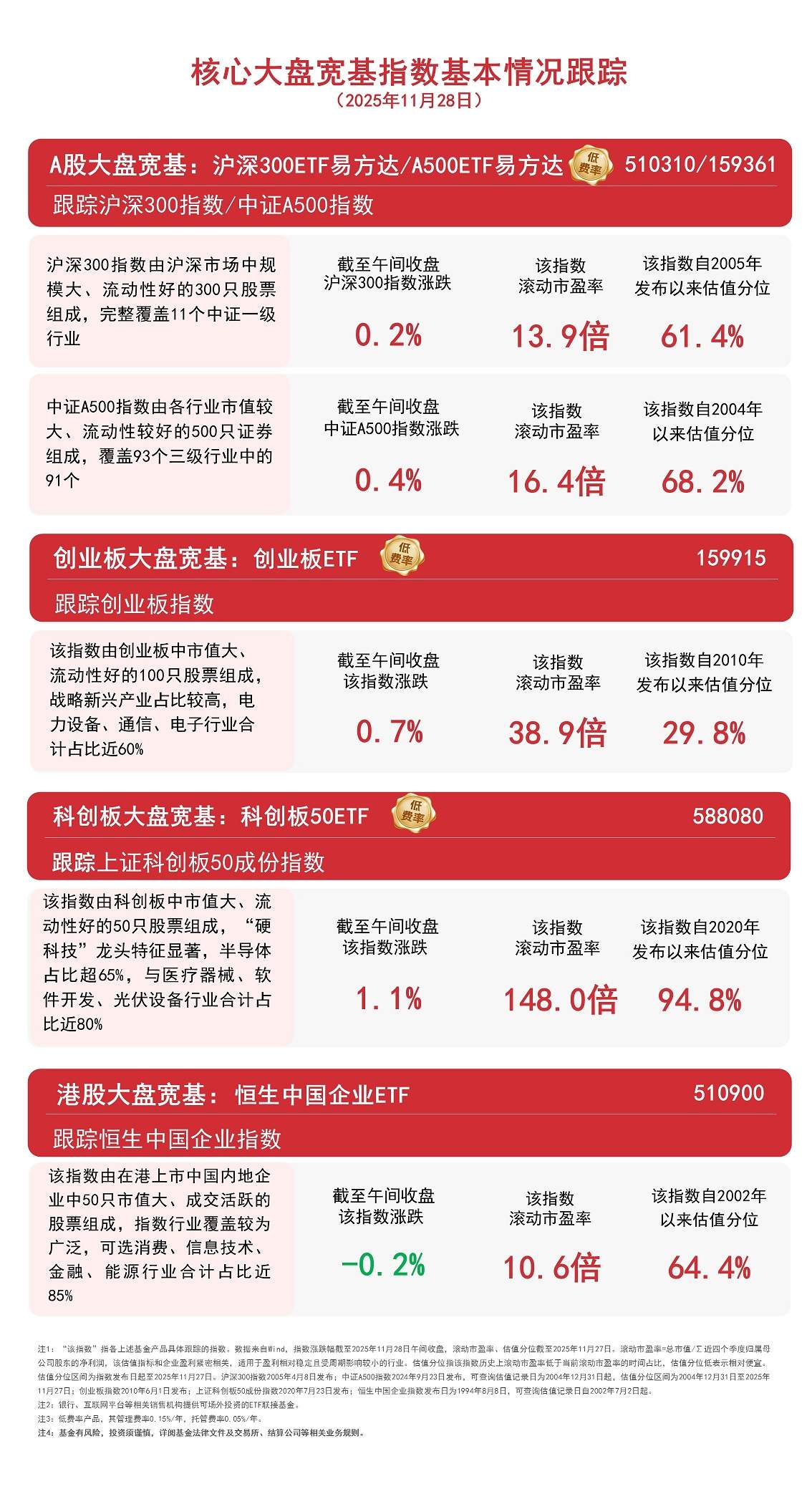
全市场超3500家个股飘红,持续关注A500ETF易方达(159361)、沪深300ETF易方达(510310)配置机会
Mei Ri Jing Ji Xin Wen· 2025-11-28 05:49
Market Overview - A-shares opened lower but rebounded, with over 3,500 stocks in the market showing gains. Key sectors that performed well included dairy, energy metals, and semiconductors, while pharmaceuticals, gaming, and banking sectors experienced adjustments [1] - As of the midday close, the CSI A500 index rose by 0.4%, the CSI 300 index increased by 0.2%, the ChiNext index gained 0.7%, and the STAR Market 50 index climbed by 1.1%. The Hang Seng China Enterprises Index fell by 0.2% [1] Index Performance - The CSI 300 index, which tracks 300 large and liquid stocks from the A-share market, had a rolling price-to-earnings (P/E) ratio of 13.9 times and a valuation percentile of 61.4% since its inception in 2005. It recorded a midday change of +0.2% [3] - The CSI A500 index, composed of 500 stocks with good liquidity across various industries, had a rolling P/E ratio of 16.4 times and a valuation percentile of 68.2% since its inception in 2004, with a midday change of +0.4% [3] - The ChiNext index, which includes 100 large and liquid stocks from the ChiNext board, had a rolling P/E ratio of 38.9 times and a valuation percentile of 29.8% since its inception in 2010, with a midday change of +0.7% [3] - The STAR Market 50 index, consisting of 50 large and liquid stocks from the STAR Market, had a rolling P/E ratio of 148.0 times and a valuation percentile of 94.8% since its inception in 2020, with a midday change of +1.1% [3] Hong Kong Market - The Hang Seng China Enterprises Index, which tracks 50 large and actively traded Chinese companies listed in Hong Kong, had a rolling P/E ratio of 10.6 times and a valuation percentile of 64.4% since its inception in 2002, with a midday change of -0.2% [4]
鹏华基金·科创股债ETF大厂|省心科技投资,双“创”组合动量轮动
Sou Hu Cai Jing· 2025-11-18 03:00
Core Insights - The technology sector has been the most prominent market theme this year, with rapid rotations among sub-sectors like AI computing, semiconductors, and new energy, making it challenging for ordinary investors to navigate [1] - Broad-based index funds are emerging as a better solution for ordinary investors to participate in the technology wave, offering industry-balanced allocation that diversifies individual stock risks while capturing industry trend dividends [1] Group 1: Index Characteristics - The ChiNext 50 and Sci-Tech 100 indices are highlighted as the "twin stars" of technology investment, with distinct compositions and risk profiles that complement each other [1][4] - The ChiNext 50 index represents "mature technology anchors," featuring leading companies in new energy, communications, and electronics, which have established strong competitive advantages and exhibit stable earnings [4] - In contrast, the Sci-Tech 100 index focuses on "hard technology pioneers," concentrating on sectors like semiconductors, pharmaceuticals, and high-end manufacturing, characterized by higher growth potential and volatility [4][6] Group 2: Momentum Rotation Strategy - A momentum rotation strategy is proposed, leveraging the strong performance of the ChiNext 50 and Sci-Tech 100 indices, which exhibit a "stronger gets stronger" effect typical in the technology sector [7] - Entry signals for the strategy are defined as a cumulative increase of 8% or more over the past 20 trading days for either index, with a preference for the index showing stronger momentum [7] - The strategy includes ongoing monitoring of the holding index's momentum, with a switch to the stronger index if the other surpasses it by 3 percentage points [7][8] Group 3: Strategy Performance - Historical backtesting from November 14, 2020, to November 14, 2025, shows that the momentum rotation strategy achieved a total return of 96.36%, significantly outperforming the ChiNext 50's 31.84% and the Sci-Tech 100's -0.78% [10] - The strategy also demonstrated effective risk control, with a maximum drawdown of -25.46%, compared to -63.72% for the Sci-Tech 100 index, resulting in a Sharpe ratio of 0.59, well above the benchmark's 0.21 [10] - The strategy successfully kept pace with market trends during bullish phases and avoided significant losses during market downturns by maintaining cash positions when both indices fell below the entry threshold [10]
科技双雄新投法 跟着鹏华“科创股债ETF大厂”玩转双“创”组合动量轮动
Cai Fu Zai Xian· 2025-11-17 09:30
Core Insights - The technology sector has been the most prominent market theme this year, with rapid rotations among sub-sectors like AI computing, semiconductors, and renewable energy, making it challenging for ordinary investors to navigate [1] - Broad-based index funds are emerging as a better solution for ordinary investors to participate in the technology wave, offering industry-balanced allocation that diversifies individual stock risks while capturing industry trend benefits [1] Group 1: Index Characteristics - The ChiNext 50 and Sci-Tech 100 indices are highlighted as the "twin stars" of technology investment, with distinct component stock structures, industry focuses, and risk characteristics that complement each other [1][3] - The ChiNext 50 index represents "mature technology anchors," primarily consisting of leading companies in renewable energy, communications, and electronics, which have established strong competitive advantages and exhibit stable profitability [3] - In contrast, the Sci-Tech 100 index focuses on "hard technology pioneers," concentrating on sectors like semiconductors, pharmaceuticals, and high-end manufacturing, characterized by higher growth potential and greater volatility [3][4] Group 2: Momentum Rotation Strategy - A momentum rotation strategy is proposed to capitalize on technology investment opportunities, leveraging the inherent differences between the two indices [5] - Entry signals are defined as when either index achieves a cumulative gain of 8% over the past 20 trading days, with a preference for the index showing stronger momentum [7] - The strategy emphasizes disciplined and adaptive management, avoiding emotional trading and market noise, with clear rules for entry, holding, and exit [7] Group 3: Performance Metrics - Historical backtesting from November 14, 2020, to November 14, 2025, shows that the momentum rotation strategy achieved a total return of 96.36%, significantly outperforming the ChiNext 50's 31.84% and the Sci-Tech 100's -0.78% [10] - The strategy also demonstrated superior risk control, with a maximum drawdown of -25.46%, compared to the Sci-Tech 100's maximum drawdown of -63.72%, resulting in a Sharpe ratio of 0.59, well above the benchmark's 0.21 [10] - The strategy effectively tracks market trends during bullish phases and successfully avoids significant losses during market downturns by maintaining cash positions when necessary [10]
4400亿!中证A500指数基金一周年:总规模增近50%,近80家基金公司下场
Zheng Quan Shi Bao Wang· 2025-09-21 10:57
Core Insights - The China Securities A500 Index Fund has seen significant growth in its first year, with nearly 80 fund companies launching a total of 140 funds, achieving a scale close to 440 billion yuan, marking a nearly 50% increase from the initial issuance scale of around 300 billion yuan [1][4]. Fund Company Layout - The launch of the first batch of 10 China Securities A500 ETFs from various fund companies has led to a broader trend of more companies entering the market, expanding from traditional ETFs to enhanced strategy ETFs and other diversified products [2]. - By the end of 2024, a new wave of larger fund companies is expected to lead the issuance of China Securities A500 index funds, with a focus on differentiated product offerings [3]. Fund Performance - Among the 140 funds, only 25 have seen growth in scale post-launch, with 19 of these being ETFs, indicating that the overall growth is driven by a small number of successful products [4][5]. - Conversely, 85 funds have experienced a decline in scale, with some funds seeing significant drops, such as the E Fund China Securities A500 ETF Link Fund, which fell by 27.1 million yuan [6]. Market Potential and Challenges - The China Securities A500 index fund has become a significant component of equity investment, with potential for further growth in market capacity, although it still lags behind the CSI 300 index fund in terms of scale [7][8]. - Fund companies are exploring ways to overcome the "long not growing" challenge, emphasizing the need for continuous innovation in strategies and the involvement of large institutional investors to achieve substantial scale [8].
盘点几只高收益、低回撤的宽基指数基金
Sou Hu Cai Jing· 2025-07-14 06:39
Core Insights - High-yield, low-drawdown broad-based index funds are favored by investors for their stability and consistent returns [6] Group 1: Index Fund Characteristics - The CSI 300 Index serves as a "barometer" for the A-share market, comprising 300 representative securities that reflect the overall trend of the market [1] - The CCTV Finance 50 Index is uniquely compiled to reflect the performance of well-governed, financially sound companies with growth potential and social responsibility, offering higher returns than the CSI 300 [2] - The Dividend Low Volatility Index focuses on high-dividend stocks from mature industries, providing stability and cash flow, although it has historically experienced significant drawdowns [3] - The Nasdaq 100 Index represents leading global tech companies, achieving a 110% return over five years and over 200% in seven years, but lacks industry diversification [4] - The S&P 500 Index includes 500 large U.S. companies, offering lower volatility and higher stability compared to the Nasdaq 100, with returns exceeding 90% over five years and 230% over ten years [5] Group 2: Investment Strategy - Investors are encouraged to select suitable funds based on their investment goals, risk tolerance, and time horizon, utilizing a mix of the highlighted index funds to create a tailored investment portfolio [6]
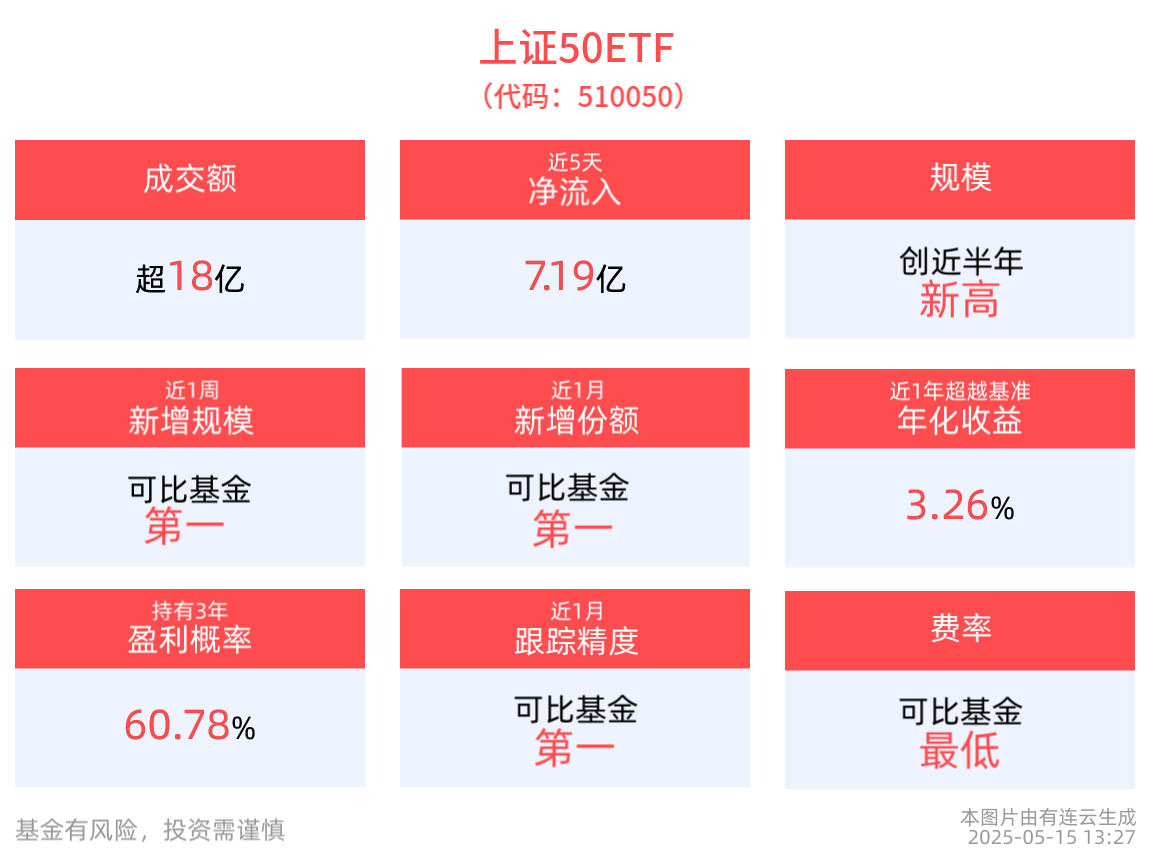
成交额超18亿元,宽基代表上证50ETF(510050)相对抗跌
Sou Hu Cai Jing· 2025-05-15 06:02
Core Viewpoint - The Shanghai Stock Exchange 50 ETF (上证50ETF) has shown significant growth in terms of scale and performance, despite a recent decline in major indices, indicating potential investment opportunities in the fund [3][4]. Performance Summary - As of May 15, 2025, the Shanghai Stock Exchange 50 ETF's scale reached 169.44 billion yuan, marking a six-month high and ranking it 1st among comparable funds [3]. - The ETF experienced a substantial increase in shares, with a growth of 2.023 billion shares over the past month [3]. - The highest monthly return since inception was 33.30%, with a maximum consecutive monthly gain of 335.29% over 15 months [3]. - The ETF outperformed its benchmark with a one-year annualized return exceeding the benchmark by 3.26% [3]. Risk and Recovery Metrics - The maximum drawdown for the ETF this year was 8.41%, with a relative benchmark drawdown of only 0.07%, indicating lower risk compared to peers [3]. - The recovery period after drawdown was 37 days, the fastest among comparable funds [3]. Fee Structure - The management fee for the Shanghai Stock Exchange 50 ETF is 0.15%, and the custody fee is 0.05%, both of which are the lowest in its category [4]. Tracking Accuracy - As of May 14, 2025, the ETF's tracking error over the past month was 0.015%, the highest tracking precision among comparable funds [5]. - The top ten weighted stocks in the index accounted for 49.87% of the total index weight, with notable companies including Kweichow Moutai and Ping An Insurance [5][7].





投资小知识:国家队大举买指数基金,有什么特点?
银行螺丝钉· 2025-04-12 12:45
文 | 银行螺丝钉 (转载请注明出处) 金,有什么特点呢? (1) 以宽基指数基金为主 毕竟宽基指数基金规模最大。 例如A股规模最大的是沪深300指数相关的 基金,总规模在2024年首次超过1万亿。 其次是中证500等指数基金。 (2) 逆势投资,长期持有 螺丝钉指数组合也是沪深300、中证500等 指数基金为主。 国家队往往是在市场大跌的时候会买入比 较多。 例如中央汇金,买入最多的时间点,出现 在2024年2月初和9月中旬,两次5.9星的 阶段。 买入了数千亿的沪深300、中证500等指数 川一) | ノヘレール リ | ▼点击阅读原 文,免费学习大额家庭资产配置课程 ...