
尿素供需格局

Search documents
尿素日报:能化品种分化,尿素表现不佳-20260303
Guan Tong Qi Huo· 2026-03-03 11:01
Report Industry Investment Rating - Not provided Core Viewpoints of the Report - The urea market shows a pattern of both supply and demand being strong. The domestic supply and demand fundamentally dominate the futures price, and it is expected to be in a weak and volatile state. After the energy and chemical sector rises, be vigilant about the potential for urea to make up for the increase [1] Summary by Relevant Catalogs Market Analysis - The urea futures opened low and moved lower, and the decline in futures prices dampened the enthusiasm for spot trading. The spot price remained generally stable. The ex - factory price of small - particle urea in Shandong, Henan, and Hebei was in the range of 1810 - 1840 yuan/ton. The daily production has reached around 220,000 tons, and there are no long - term shutdown and maintenance plans in the short term. Although the upstream factories accumulated a relatively large amount of inventory during the holiday, the current inventory level is much lower than that after the Spring Festival last year. March is the peak season for agricultural demand, and the demand for high - nitrogen compound fertilizers is expected to be strong, providing support for urea. However, the release of national reserves will still impact the price acceptance in the spot market [1] Futures and Spot Market Conditions Futures - The main urea 2605 contract opened at 1818 yuan/ton, closed at 1819 yuan/ton, with a decline of 0.38%. The trading volume formed a negative line, and the open interest was 266,075 lots (+3,294 lots). Among the top 20 main positions, the long positions decreased by 444 lots, and the short positions increased by 4,102 lots. For example, GF Futures had a net long position of - 704 lots, China Merchants Futures had a net long position of - 508 lots; Zhongtai Futures had a net short position of +1,318 lots, and Yide Futures had a net short position of +1,677 lots [2] Spot - The weakening of futures prices dampened the enthusiasm for spot trading, and the spot price remained generally stable. The ex - factory price of small - particle urea in Shandong, Henan, and Hebei was in the range of 1810 - 1840 yuan/ton [1][4] Warehouse Receipts - On March 3, 2026, the number of urea warehouse receipts was 0, which was the same as the previous trading day [3] Fundamental Tracking Basis - The mainstream spot price rose, while the futures closing price fell. Based on the Henan region, the basis weakened compared with the previous trading day, and the basis of the May contract was 41 yuan/ton (- 2 yuan/ton) [8] Supply Data - On March 3, 2026, the national daily urea production was 216,500 tons, which was the same as the previous day, and the operating rate was 86.77% [9]
长安期货张晨:供需宽松格局持续 尿素高位震荡
Xin Lang Cai Jing· 2026-02-10 03:24
Market Overview - Since January 2026, urea futures have shown a "wide fluctuation" trend, with prices initially rising and then stabilizing due to various factors including lower-than-expected resumption of gas-based production, pre-holiday stocking demand, and fluctuations in international energy prices [5][27] - As of February 6, 2026, the closing price for UR2605 was 1776 RMB/ton, with significant price increases across major domestic production areas [5][27] Supply Side - Domestic urea production capacity utilization reached 89.14%, an increase of 5.86 percentage points since early January, with daily production averaging 209,900 tons, up by 13,900 tons [7][31] - The coal-based urea production capacity utilization was 96.21%, with a daily output of 177,500 tons, while the gas-based urea utilization was 63.54%, producing 32,300 tons daily [7][31] Demand Side - Agricultural demand is gradually starting, particularly for winter wheat, with increased purchasing activity in major production areas like Hebei and Guangdong, although overall purchasing remains cautious due to high urea prices [11][33] - Industrial demand for urea is also increasing, with compound fertilizer production capacity utilization rising to 41.79%, up 4.62 percentage points since early January [12][34] Export Dynamics - In 2025, domestic urea exports totaled 4.895 million tons, a 17-fold increase year-on-year, with a shift from strict export restrictions to a quota and guidance price system [14][36] - A new procurement tender from India's RCF company for 1.5 million tons of urea may further boost international prices and domestic market confidence, although domestic export quotas may limit actual export volumes [14][36] Inventory Levels - As of February 6, 2026, total inventory at production facilities was 918,500 tons, down by 103,700 tons since early January, indicating a continued destocking trend [16][38] - Port inventories increased slightly to 165,000 tons, primarily due to insufficient new export orders and some incoming imports, but overall levels remain reasonable [16][39] Cost and Profitability - Production costs for different urea manufacturing processes have shown significant improvement in profitability since early January, with coal-based production costs at 1,507 RMB/ton and profits at 263 RMB/ton [19][41] - Gas-based production remains unprofitable, with costs at 1,978 RMB/ton, but losses have narrowed due to rising urea prices [21][41] Summary - The urea market is characterized by a continued supply-demand balance, with rising production capacity and stable agricultural demand expected to support prices [23][45] - The overall inventory situation is manageable, and as agricultural demand ramps up in March, further improvements in market conditions are anticipated [23][45]


尿素早评20251212:关注成本端能否企稳-20251212
Hong Yuan Qi Huo· 2025-12-12 02:12
Report Industry Investment Rating - Not provided in the report Core Viewpoints - The recent decline in urea prices is due to cooling sentiment and falling coal prices. It is necessary to focus on whether the cost - end of urea can stabilize. The low valuation of urea reflects the current pattern of strong supply and weak demand, but there are expectations of supply reduction in mid - to late December, and the export quota and winter reserve demand will relieve the supply - demand pressure and support the price. The trading strategy is to go long on far - month contracts at low prices [1] Summary by Relevant Catalogs Urea Futures and Spot Prices - Urea futures prices: UR01 closed at 1638 yuan/ton, down 7 yuan or 0.43% from the previous day; UR05 closed at 1703 yuan/ton, down 10 yuan or 0.58%; UR09 closed at 1716 yuan/ton, down 5 yuan or 0.29% [1] - Domestic spot prices (small - particle): Shandong was 1710 yuan/ton, up 10 yuan or 0.59%; Shanxi was 1540 yuan/ton, up 10 yuan or 0.65%; Henan remained unchanged at 1690 yuan/ton; Hebei was 1710 yuan/ton, down 10 yuan or 0.58%; Northeast remained unchanged at 1740 yuan/ton; Jiangsu was 1690 yuan/ton, up 10 yuan or 0.60% [1] Basis and Spread - The basis of Shandong spot - UR was 7 yuan/ton, up 20 yuan from the previous day. The spread of 01 - 05 was - 65 yuan/ton, up 3 yuan [1] Upstream and Downstream Prices - Upstream: The price of anthracite coal in Henan and Shanxi remained unchanged at 1030 yuan/ton and 930 yuan/ton respectively [1] - Downstream: The price of compound fertilizer (45%S) in Shandong was 3180 yuan/ton, up 20 yuan or 0.63%, and remained unchanged in Henan at 2670 yuan/ton. The price of melamine in Shandong and Jiangsu remained unchanged at 5233 yuan/ton and 5250 yuan/ton respectively [1] Important Information - The opening price of the main urea futures contract 2601 was 1651 yuan/ton, the highest was 1656 yuan/ton, the lowest was 1635 yuan/ton, the closing price was 1638 yuan/ton, the settlement price was 1645 yuan/ton, and the position was 127,530 lots [1] Trading Strategy - Go long on far - month contracts at low prices [1]
供大于求格局延续,尿素跌幅扩大
Yin He Qi Huo· 2025-12-11 05:09
Group 1: Report Investment Rating - Not provided Group 2: Core Views - Last week's view was that urea would oscillate downward as it returned to fundamentals; this week's view is that the supply - demand pattern has further deteriorated, leading to an enlarged decline in urea prices [3] - Currently, the domestic supply is abundant, with the daily output dropping below 190,000 tons due to some device overhauls. The overall demand is on a downward trend, and the inventory of urea production enterprises has increased to around 1.1327 million tons [3] - The new round of Indian tender results show a total tender volume of 2.03 million tons. Although the large price difference between domestic and foreign markets and relaxed export policies have a certain boosting effect on the domestic market sentiment, the domestic demand is still limited in the short term [3] - It is expected that the decline of urea will continue to widen in the short term. The trading strategy is to go short in the short - term for single - side trading, and to wait and see for arbitrage and over - the - counter trading [3] Group 3: Summary by Directory 1. Comprehensive Analysis and Trading Strategy - Analyzes the supply - demand situation of urea, including supply changes due to device overhauls, demand from different sectors such as agriculture and industry, and the impact of Indian tenders and export policies. Proposes trading strategies based on the analysis [3] 2. Fundamental Data - **Supply**: In the 36th week of 2025 (20250904 - 0910), the utilization rate of coal - based urea production capacity was 81.47%, a 1.61% increase from the previous week; the utilization rate of gas - based urea production capacity was 72.34%, unchanged from the previous week. In Shandong, the utilization rate of urea production capacity was 80.21%, a 3.62% decrease from the previous week [4] - **Demand**: In the 37th week of 2025 (20250905 - 0911), the average weekly utilization rate of China's melamine production capacity was 55.38%, a decrease of 3.6 percentage points from the previous week; the utilization rate of compound fertilizer production capacity was 37.82%, a 4.68 - percentage - point increase from the previous week. As of September 12, 2025, the urea demand of sample compound fertilizer production enterprises in Linyi, Shandong was 920 tons, a 5.75% increase from the previous week. As of September 10, 2025, the advance order days of Chinese urea enterprises were 6.88 days, a 7.33% increase from the previous period [4] - **Inventory**: On September 10, 2025, the total inventory of Chinese urea enterprises was 1.1327 million tons, a 3.44% increase from the previous week. As of September 11, 2025 (the 37th week), the sample inventory at ports was 549,400 tons, an 11.52% decrease from the previous week [4] - **Valuation**: The price of Jincheng anthracite lump coal was stable, and the price of Yulin pulverized coal fluctuated slightly. The urea spot price declined, with a loss of 30 yuan/ton for fixed - bed production, a profit of 100 yuan/ton for coal - water slurry production, and a profit of 300 yuan/ton for entrained - flow bed production. The futures price dropped, with a basis of - 60 yuan/ton and a 1 - 5 spread of - 55 yuan/ton [4]
尿素:新出口配额提振情绪
Wu Kuang Qi Huo· 2025-11-13 01:05
Report Industry Investment Rating - No relevant information provided Core Viewpoints - The release of a new urea export quota of 600,000 tons on November 6th boosted the domestic urea market sentiment, with the futures price gapping up and the spot price following suit. However, the domestic urea market has been facing high supply, weak demand, high inventory, and low production profits. The export has been the only way to digest the surplus production. The increase in the quota mainly affects the short - term market trend, and the price reversal requires an improvement in domestic supply - demand [1]. - Currently, the domestic urea supply is back to a high level, with a daily output of about 200,000 tons. The demand is generally weak, with industrial demand remaining sluggish and agricultural demand ending. The overall supply - demand is still weak, the inventory is at a high level year - on - year, and the price is expected to bottom - out and fluctuate [2]. Summary by Related Catalogs Supply - The daily output has recovered to around 200,000 tons, and high - level supply is one of the main reasons for the domestic surplus this year. Both coal - based and gas - based processes are in a loss state, and the rising coal price has further increased the cost of coal - based urea production. The cost support for the price will become more obvious at the current low price. Attention should be paid to enterprise production cuts and the scale of seasonal shutdown of gas - head devices in winter [6]. Demand - Industrial demand has been unable to bring incremental demand to urea due to the weak terminal market. The start - up of melamine is low, and the finished - product inventory of compound fertilizers is high. Although the start - up of compound fertilizers is gradually bottoming out and will increase seasonally, agricultural demand is in the off - season. The export policy is an important variable affecting the domestic urea market, as four batches of new export quotas this year have led to a significant year - on - year increase in exports [9].
尿素早评:情绪好转,反转存疑-20251107
Hong Yuan Qi Huo· 2025-11-07 02:47
Report Summary 1. Investment Rating No investment rating for the industry is provided in the report. 2. Core View The current sentiment for urea has improved, but a reversal may not be imminent based on supply - demand dynamics. The urea valuation is at a relatively low level, reflecting the strong supply and weak demand situation. The spot price in Shanxi has temporarily stabilized after reaching a near - five - year low. If prices continue to fall, upstream production willingness may decline further. In the short term, there is insufficient upward momentum due to high supply and inventory pressure, and downstream buyers are cautious. Future potential drivers include the renovation of old chemical plants on the supply side and new export quota issuance [1]. 3. Summary by Directory Urea Futures Prices - UR01 closed at 1644 yuan/ton on November 6, up 11 yuan or 0.67% from November 5 - UR05 closed at 1727 yuan/ton on November 6, up 12 yuan or 0.70% from November 5 - UR09 closed at 1750 yuan/ton on November 6, up 11 yuan or 0.63% from November 5 [1] Domestic Spot Prices - Spot prices in Shandong, Shanxi, Henan, Hebei, Northeast, and Jiangsu remained unchanged on November 6 compared to November 5 [1] Basis and Spreads - The basis of Shandong spot - UR decreased by 12 yuan to - 147 yuan/ton - The 01 - 05 spread decreased by 1 yuan to - 83 yuan/ton [1] Upstream Costs - Anthracite coal prices in Henan and Shanxi remained unchanged at 1030 yuan/ton and 930 yuan/ton respectively on November 6 compared to November 5 [1] Downstream Prices - The prices of compound fertilizer (45%S) in Shandong and Henan, as well as the prices of melamine in Shandong and Jiangsu, remained unchanged on November 6 compared to November 5 [1] Important Information - The opening price of the urea futures main contract 2601 was 1630 yuan/ton, the highest was 1653 yuan/ton, the lowest was 1628 yuan/ton, the closing price was 1644 yuan/ton, and the settlement price was 1640 yuan/ton. The持仓量 was 275142 hands [1] Trading Strategy - Consider gradually taking profit on the sold put options of the 12 - contract [1]
供应居高不下 尿素弱势运行
Zhong Guo Jin Rong Xin Xi Wang· 2025-09-25 23:46
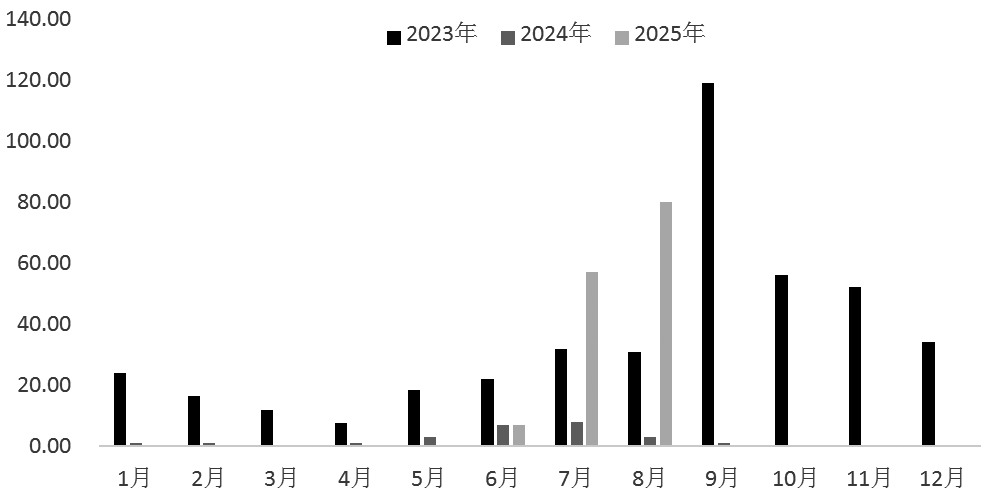
Core Viewpoint - The current urea market in China is characterized by an oversupply and high inventory levels, with no significant positive factors on the demand side. Although exports have seen some recovery, they are limited in both time and volume, leading to a continued weak price outlook for urea in the short term [1][11]. Supply Situation - Urea prices in China have been on a downward trend in the second half of the year, with production profits being squeezed. As of now, the average loss for fixed-bed process urea production is 220 CNY/ton, while gas-based process urea production incurs a loss of 185 CNY/ton. The more advanced gasification process yields a profit of 155 CNY/ton, indicating low overall industry profit levels [2]. - The operating rate of urea production enterprises in China is at 81.22% as of September 17, down 3.98 percentage points year-on-year and 8.61 percentage points from the high in late May. Despite this decrease, the supply pressure remains significant, with a weekly production of 1.3 to 1.35 million tons, which is notably higher than demand [2]. - As of September 18, total inventory for urea enterprises is 1.1653 million tons, with port sample inventory at 516,000 tons. Although port inventory has decreased due to export recovery, both enterprise and port inventories are significantly above levels from the same period last year, necessitating low prices to promote inventory reduction [2]. Demand Factors - Currently, there is a seasonal recovery in agricultural demand as the period for winter fertilizer reserves approaches. The order situation for compound fertilizers is decent, leading to an increase in operating rates and subsequently boosting urea demand. However, overall demand remains below expectations, with weekly demand around 1.15 million tons, failing to keep pace with supply [3][11]. Export Dynamics - China has transitioned from being a net importer to a net exporter of urea since 2000, with significant export volumes in 2014 and 2015. However, in 2024, to ensure urea demand and stabilize prices, exports have been suspended, with only 25,000 tons expected to be exported, a decrease of 3.9947 million tons or 94.11% from 2023 [10]. - The export policy has been gradually relaxed, allowing for a limited export window from May to September, with a total cap of 2 million tons. As of July and August, exports reached 1.37 million tons, a year-on-year increase of 740,000 tons or 117.46%. However, the impact on the overall supply-demand balance remains limited due to the capped export volume [10][11].
出口量同比大幅增长 尿素基本面维持宽松格局
Qi Huo Ri Bao· 2025-09-19 00:18
Core Viewpoint - Urea futures prices have shown a downward trend in early September, with a weak spot market and a bearish sentiment prevailing due to a lack of significant bullish drivers. It is expected that futures prices will maintain a weak oscillation trend in the short term [1]. Supply Summary - Despite some maintenance leading to a temporary drop in daily production to 190,000 tons, overall domestic urea supply remains relatively high. The production capacity utilization rate is at 79.34%, up 1.24 percentage points month-on-month. With fewer planned maintenance shutdowns, both production capacity utilization and daily output are expected to increase further [2]. - New production capacity is set to be released in Q4 2023, with daily production potentially exceeding 210,000 tons by 2026, which will exacerbate domestic supply pressure. Current inventories at urea enterprises are at a five-year high, totaling 1.1327 million tons, a 50% year-on-year increase [2]. - Production profits for urea have significantly declined year-on-year, with new gas flow bed production profits around 300 CNY/ton, traditional fixed bed production profits at about 50 CNY/ton, and natural gas process production profits at approximately 150 CNY/ton [2]. Demand Summary - Urea apparent demand from January to July 2023 was 41 million tons, an increase of 2.5 million tons or 8% year-on-year. However, agricultural demand is currently in a seasonal lull, and compound fertilizer companies are facing high finished product inventories and low operating rates, primarily purchasing urea as needed [3]. - Industrial demand, particularly from the real estate sector, remains weak, with a notable decline in plywood demand, leading to low operating rates in plywood factories [3]. - Although daily production of urea slightly decreased in early September, it is expected to rebound to over 190,000 tons by mid to late September due to the resumption of previously shut-down facilities and new capacity coming online. However, agricultural demand is unlikely to see significant improvement, and industrial demand is recovering slowly, providing insufficient support for prices [3].
尿素:宽松氛围延续 盘面回升空间仍需看下游支撑
Jin Tou Wang· 2025-07-25 02:17
Core Viewpoints - The current structure of the domestic urea market shows a contradiction: inventory is decreasing while agricultural demand is in a lull, and small package exports are restricted [3] - Despite some maintenance in production facilities, overall daily output remains high, indicating sufficient market supply [3] - Agricultural demand is weakening as the northern summer fertilization season comes to an end, and the production of compound fertilizers for autumn has not yet started on a large scale, leading to a supply-demand imbalance and downward pressure on futures prices [3] Supply Side Analysis - Domestic urea daily production is approximately 192,600 tons with an operating rate of 81.62%, which is an increase of 9,400 tons compared to the same day last year [1] - Several production facilities are undergoing maintenance, including a 15-day maintenance at Henan Zhongying and a 200-day upgrade at Shanxi Jinfeng [1][2] - Overall supply remains ample despite some production disruptions [1][3] Demand Side Analysis - Agricultural demand is expected to weaken as the summer fertilization season concludes, and the production of compound fertilizers has not yet ramped up significantly [2][3] - Downstream compound fertilizer manufacturers are primarily focused on selling existing inventory due to high stock levels, which limits support for urea demand [2][3] - The average pre-sale days for July is 3.43 days, unchanged month-on-month but down 12.60% year-on-year, indicating a short-term purchasing approach from downstream buyers [2] Inventory and Export Dynamics - As of July 23, 2025, total inventory of Chinese urea enterprises is 858,800 tons, a decrease of 36,700 tons or 4.10% from the previous week [2] - Although domestic urea demand is weak, some inventory is still being exported, leading to a slight reduction in overall factory stock [2] - India’s IPL has announced a new round of urea import tenders for 2 million tons, with a bid deadline of August 4 [2] Market Strategy - A short-term range trading strategy is recommended, with a price range of 1,740 to 1,820 [4] - If futures prices fall below 1,780 yuan/ton, a small long position may be considered due to the higher certainty of supply contraction compared to the persistence of weak demand [4] - If prices rebound above 1,830 yuan/ton, a short position may be advisable as spot prices are unlikely to support significant futures price increases [4]
尿素期货低位大力反弹,却难持续?
Qi Huo Ri Bao· 2025-06-17 00:58
Core Viewpoint - The rebound in urea futures prices is primarily driven by macroeconomic factors, particularly changes in international geopolitical situations affecting export expectations and rising international prices due to regional instability [1][2]. Group 1: Market Dynamics - Urea futures main contract 2509 closed at 1723 yuan/ton, up 3.48% [1]. - International urea prices surged, with Middle Eastern FOB prices reaching 390 USD/ton, influenced by geopolitical tensions and India's new round of urea tenders [1]. - India's NFL announced a tender for 1.5 million tons of urea, with the lowest bid from Oman at an average CFR price of 399 USD/ton, exceeding market expectations by 10 USD/ton [1]. Group 2: Supply and Demand Analysis - Current urea production remains high at over 200,000 tons per day, with a slight decrease from the previous week [2]. - Agricultural demand is primarily for replenishment, with limited support for urea prices due to seasonal declines in compound fertilizer production [2]. - Urea inventories have risen again, reaching 1.1771 million tons, indicating a return to historical highs [2]. Group 3: Market Sentiment and Future Outlook - The market sentiment is currently cautious, with many participants adopting a "short and quick" purchasing strategy due to a prevailing bearish outlook [3]. - Despite the current supply-demand imbalance, positive news has temporarily boosted market sentiment, potentially narrowing the supply-demand gap [3]. - The potential for further price rebounds is constrained by ongoing supply pressures and limited policy adjustments, with a need for significant production cuts or increased export volumes to trigger a sustained price increase [4].