
文化产业数字化

Search documents
广东文化产业连续22年居全国首位,大湾区加速成全球高地
Di Yi Cai Jing· 2026-01-23 03:51
Group 1 - The cultural industry in the Greater Bay Area is becoming a significant growth engine for the national cultural industry, with the value added of the cultural industry in the nine mainland cities exceeding 6% of GDP [1] - The Guangzhou International Cultural Center (GICC), with a total investment of approximately 4.56 billion yuan, aims to be a benchmark for cultural humanism in Guangzhou and a hub for international cultural ecology, promoting high-quality development of the cultural industry in the Greater Bay Area [1] - Guangdong's cultural industry revenue has ranked first in the country for 22 consecutive years, highlighting its leading position in the cultural sector [1] Group 2 - Over the past five years, the Guangdong Publishing Group has achieved significant milestones, with total assets, net assets, and operating income entering the "three hundred billion" category, and net profit surpassing 1 billion yuan for the first time [2] - The completion of the Lingnan Cultural and Creative Industry Park Phase I and the opening of the Guangdong Digital Cultural Valley and Xinhua Li in Panyu, Guangzhou, are part of the group's strategy to extend its industry reach [2] - The new Beijing center of Southern Publishing Media is set to open in June 2025, serving as a crucial point for expanding the national market and enhancing industry influence [2]

数字赋能优质文化产品和服务供给
Xin Hua Ri Bao· 2025-12-25 23:24
Core Insights - Digital technology is reshaping the cultural ecosystem, enhancing the quality and efficiency of cultural products and services, and driving the transformation of traditional cultural industries into new cultural formats [1][2]. Group 1: Digital Technology and Cultural Industry Upgrade - The rapid development of digital technology is significantly impacting the expression and presentation of traditional Chinese culture, leading to innovative developments in cultural products such as films and games [2]. - High-quality cultural products like "Ne Zha" and "Black Myth: Wukong" demonstrate the empowering role of digital technology in the creative transformation of traditional culture [2]. - Technologies such as 5G, big data, cloud computing, artificial intelligence, the Internet of Things, and blockchain are becoming strong engines for upgrading traditional cultural industries [2]. Group 2: New Cultural Consumption Dynamics - Digital technology has stimulated new dynamics in cultural consumption by breaking spatial and temporal barriers, allowing for a broader shared experience [3]. - New consumption forms like online reading, virtual theaters, and interactive experiences are redefining cultural consumption and providing new meanings to traditional culture [3]. - The integration of digital technology with cultural resources offers consumers immersive experiences, enhancing the supply level of cultural products in publishing, exhibitions, tourism, and entertainment [3]. Group 3: Emergence of New Cultural Formats - Digital technology has directly led to the creation of new cultural production tools and methods, transforming the pathways and presentation forms of cultural production [4]. - Tools like generative AI and VR/AR are enabling cultural creators to produce diverse, intelligent, and immersive digital cultural products [4]. - Projects utilizing 3D and VR/AR technologies are enhancing visitor engagement and extending their stay, revitalizing cultural production [4]. Group 4: Cultural Service Model Optimization - Digital technology is providing innovative spaces for optimizing cultural service models, significantly changing the traditional cultural service landscape [6]. - The shift from standardized delivery to personalized experiences is becoming a key feature of modern cultural services, enhancing precision and accessibility [6][7]. - Initiatives like AI-guided tours and digital resource platforms are improving the quality and accessibility of cultural services, promoting social equity [7]. Group 5: Growth of New Cultural Industries - The combination of cultural innovation and technological advancement has led to the emergence of numerous new cultural industries, with significant revenue growth reported [5]. - In 2024, 16 subcategories of cultural industries with distinct new characteristics saw a revenue increase of 9.8%, outpacing the overall growth of cultural enterprises [5].
一把紫砂壶的数字化逆袭——“宜兴模式”走向全国
Jiang Nan Shi Bao· 2025-12-24 16:21
Core Insights - The article discusses the transformation of traditional Yixing purple clay teapots into a modern cultural asset through technology, specifically blockchain, which provides a unique digital identity and copyright certification for each piece [2][3]. Group 1: Challenges in Traditional Cultural Heritage - The traditional non-heritage sector, particularly in the realm of Yixing teapots, faces challenges such as difficulty in verifying authenticity, unclear copyright ownership, and limited circulation channels [3]. - The value of a teapot often relies on reputation and collector expertise, which restricts many skilled artisans and limits cultural assets to niche markets [3]. Group 2: Technological Innovations - Zhuoyi Culture has pioneered a certification model combining physical fingerprints, digital identities, and blockchain storage, allowing each artwork to have a traceable life cycle [3]. - This technology transforms Yixing art from informal collection to standardized cultural assets with clear ownership and traceability, establishing trust as a foundation for industry circulation [3]. Group 3: Data Utilization and Ecosystem Development - Zhuoyi Culture aims to create a "trustworthy data space" for Yixing teapots, which has been recognized in Wuxi's first batch of trustworthy data spaces, building a digital archive covering millions of works [4]. - The platform utilizes AI algorithms to analyze extensive data, enabling artisans to better understand market trends, investors to assess asset values scientifically, and consumers to gain transparency about the artworks [4]. Group 4: National Expansion and Standardization - With reliable assets and flowing data, the trading model has evolved, and Zhuoyi Culture has actively participated in developing national standards for cultural digital asset valuation and trading [5][6]. - The "Zisha.Easy" platform integrates e-commerce, copyright, auction, and trading, facilitating a comprehensive transformation path for cultural digital assets [6]. - The successful "Yixing model" has been replicated in other provinces, providing a clear digital transformation template for various cultural industries, thus injecting new momentum into regional economic development [6].


广州首个游戏电竞产业专项扶持政策将于近期出台
Nan Fang Du Shi Bao· 2025-12-18 06:45
Group 1 - The core viewpoint of the article highlights Guangzhou's proactive approach in embracing digital transformation and its commitment to developing the digital entertainment industry, particularly through the introduction of supportive policies for the gaming and esports sectors [1][2] - The "Eighteen Measures to Support the Development of the Gaming and Esports Industry" have been approved by the Guangzhou municipal government and will soon be publicly announced, marking the city's first dedicated policy for this sector [1] - Guangzhou's cultural industry achieved a revenue of 477.6 billion yuan in the first three quarters of 2025, representing a year-on-year growth of 8.6%, with the digital culture sector generating 239.8 billion yuan, up 14.3% [1] Group 2 - The Guangzhou Game Industry Service Center has been established in Tianhe, designed around three core concepts: display, service, and experience, aimed at supporting the full lifecycle development needs of gaming companies [2] - The center will integrate policies, resources, and professional expertise to create a comprehensive, one-stop service platform to enhance innovation efficiency and expand market opportunities for enterprises [2]
到此一游VS深度入戏,别让数字文旅同质化“杀死”复购率
Guan Cha Zhe Wang· 2025-11-10 11:10
Core Insights - The article emphasizes the importance of digital transformation in the cultural and tourism industry, highlighting the integration of digital technology to enhance visitor experiences and operational efficiency [1][4][6] Group 1: Digital Transformation in Cultural and Tourism Industry - The Chinese government’s "14th Five-Year Plan" advocates for the deep integration of the digital economy with the real economy, particularly in cultural and tourism sectors [1] - Digital technologies such as online booking, virtual exhibitions, and AI are increasingly being adopted in the cultural tourism industry, improving visitor experiences and operational management [1][4] - The Beijing Dongcheng District is leading efforts in digital transformation by leveraging cultural roots and technology to create a robust digital IP ecosystem that supports economic development [2][4] Group 2: Trends and Opportunities - Cross-industry collaboration is a significant trend, with cultural tourism sites partnering with tech companies to enhance visitor engagement through AR and VR technologies [4][6] - The "Digital Cultural Tourism Industry Development Action Plan" aims to cultivate 100 benchmark digital cultural tourism projects by 2026, with a projected consumption scale exceeding 1.5 trillion yuan [5] - Digital cultural tourism is seen as a way to overcome the limitations of traditional tourism, allowing for a more interconnected and immersive visitor experience [6] Group 3: Challenges and Solutions - The cultural tourism market faces issues of homogenization, with over 60% of digital IPs focusing on similar themes, leading to low visitor satisfaction and repeat purchase intentions [7] - Many cultural tourism enterprises report that significant investments in digital technology do not yield expected results, with 30% indicating that VR/AR projects often fail due to poor user experience [9] - Strengthening copyright awareness and utilizing blockchain technology for IP protection are recommended to mitigate risks associated with digital IP infringement [9][10]

市委召开专题会议研究文化产业发展:繁荣发展文化产业,加快建设文化强市
Chang Jiang Ri Bao· 2025-07-17 13:59
Core Viewpoint - The meeting emphasized the importance of developing the cultural industry in Wuhan to enhance the quality of cultural supply and improve people's sense of cultural gain and happiness [1][2]. Group 1: Importance of Cultural Industry - The development of the cultural industry aligns with the public's aspiration for a better life and is crucial for stimulating cultural innovation, enhancing the city's cultural soft power, and promoting structural optimization, transformation, consumption expansion, and employment growth [2]. - Wuhan has a rich historical background and abundant cultural resources, with a continuous growth in the scale and upgrading of the cultural industry in recent years [2]. Group 2: Strategic Directions - The meeting called for a focus on industrial thinking and market awareness, advocating for the effective integration of social and economic benefits while utilizing market mechanisms to revitalize urban cultural resources [3]. - It was highlighted that the cultural industry should extend towards both ends of the industrial chain and ascend to the high end of the value chain, becoming a pillar for economic growth [3]. Group 3: Development Initiatives - The meeting proposed optimizing the industrial structure by consolidating and enhancing advantages in creative design, publishing, and animation, while also promoting emerging cultural industries such as online audio-visual, e-sports, and immersive cultural experiences [3]. - Emphasis was placed on leveraging technology, particularly artificial intelligence, to explore effective mechanisms for the integration of culture and technology, supporting cultural enterprises in key technology research and development [3]. Group 4: Organizational and Policy Support - Strengthening organizational leadership and improving work mechanisms were deemed essential, with a focus on forming a strong collaborative force to promote cultural industry development [4]. - The meeting stressed the need for policy support, integrating cultural industry development into the city's 14th Five-Year Plan, and ensuring timely and effective policy implementation [4].
以数字化赋能文化产业高质量发展(专题深思)
Ren Min Ri Bao· 2025-07-03 21:59
Group 1: Digital Transformation in Cultural Industry - The digitalization of the cultural industry represents a deep integration of culture and technology, serving as a crucial means to meet the spiritual and cultural needs of the public and as a growth point for high-quality development of the digital economy [1][2] - The implementation of a national cultural digitalization strategy is emphasized, aiming to innovate and promote cultural digitalization to enhance economic development and cultural vitality [1][2] - In the first quarter of this year, 16 sub-sectors characterized by new cultural business models achieved a revenue of 1,484.6 billion yuan, marking a 12.5% increase year-on-year, outpacing the overall growth of large-scale cultural enterprises by 6.3 percentage points [2] Group 2: Challenges and Solutions - The digitalization of the cultural industry faces challenges such as content homogenization and technology dependence, necessitating the establishment of a robust cultural industry database to enhance product quality and explore market dynamics [4] - The "information cocoon" effect, where consumers experience a narrow range of information, must be addressed by promoting healthy competition in the digital cultural market and improving public digital literacy [4] - Strengthening intellectual property protection is crucial as digital cultural products face significant risks of infringement; new technologies like digital watermarking and blockchain can aid in protecting copyrights [5] Group 3: Social and Economic Benefits - The integration of digital technology into the cultural industry not only enhances production efficiency but also fosters innovative cultural products and services, aligning with the core socialist values and promoting traditional Chinese culture [3][4] - The digitalization process is expected to stimulate cultural consumption, leading to more personalized experiences and the emergence of new business models [2][3]
一周产业基金|上海交大发起一只AI天使基金;百亿长三角数智文化产业基金来了
Mei Ri Jing Ji Xin Wen· 2025-04-28 14:42
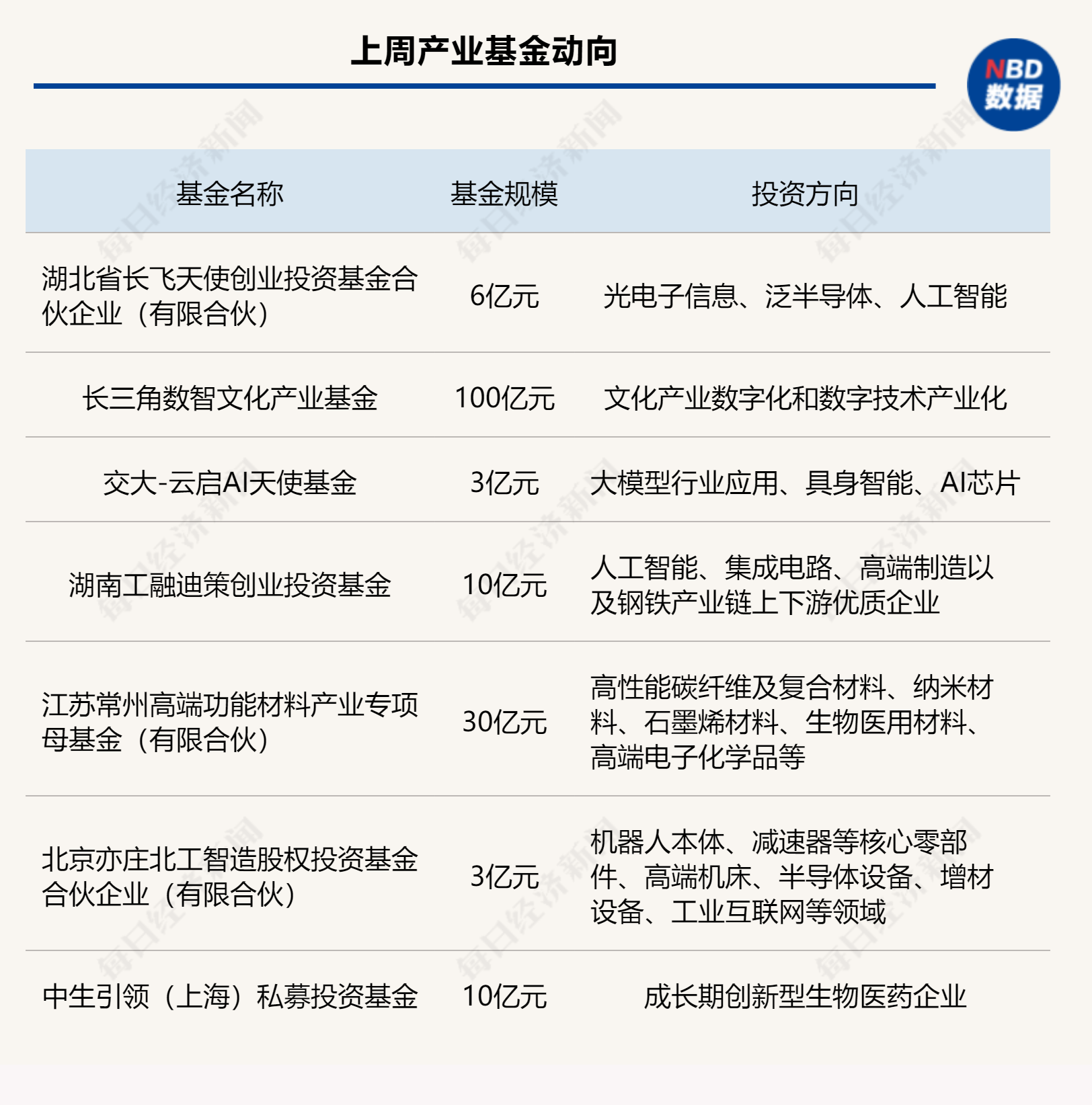
Group 1: AI Industry Funds - Multiple regions have initiated the establishment of AI industry funds, including the "Jiao Da-Yun Qi AI Angel Fund" aimed at early-stage AI tech companies [1] - The "Jiao Da-Yun Qi AI Angel Fund" has a total scale of 300 million yuan, focusing on applications in large models, embodied intelligence, and AI chips [2] - Beijing Yizhuang has set up a robot and intelligent manufacturing theme fund with an initial scale of 300 million yuan, targeting core components and systems in robotics and automation [6] Group 2: Cultural and Technological Innovation Funds - The Long Triangle Digital Cultural Industry Fund, with a total scale of 10 billion yuan, focuses on the digitalization of the cultural industry and the industrialization of digital technology [3] - The fund aims to enhance technological innovation and cross-regional collaboration in the cultural sector [3] Group 3: Emerging Industry Funds - The Shanghai Future Industry Fund plans to invest in six sub-funds covering brain science, synthetic biology, and hard technology, with a total fund size of 10 billion yuan [4] - The Hunan AIC Venture Capital Fund has a first-phase scale of 1 billion yuan, focusing on strategic emerging industries including AI and integrated circuits [5] - The Jiangsu Changzhou High-end Functional Materials Industry Fund has a total scale of 3 billion yuan, targeting high-performance materials and nanomaterials [9] Group 4: Biopharmaceutical and Low-altitude Economy Funds - The Zhongsheng Leading (Shanghai) Private Equity Fund focuses on innovative biopharmaceutical companies, with a target scale of 1 billion yuan [7] - The Sichuan Low-altitude Economy Fund has been established to invest in eVTOL manufacturing, marking the first fund of its kind in the region [8]
香港举办文化合作论坛推动亚洲文化和谐共生
Xin Hua Wang· 2025-04-23 01:50
Group 1 - The Asian Cultural Cooperation Forum +2025 aims to promote cultural exchange and cooperation among Asian countries, focusing on the development of the arts and creative industries, talent cultivation, and community participation [1][2] - The forum is hosted by the Hong Kong Special Administrative Region Government's Culture, Sports and Tourism Bureau, with participation from 17 cultural ministers or representatives from various Asian countries [1] - The event emphasizes the importance of intergovernmental cooperation and collaboration among cultural institutions to enhance cultural experiences for the people of different nations [1] Group 2 - Hong Kong is positioned as one of the world's top three art trading centers, attracting global art enthusiasts and facilitating cultural exchanges [2] - The "14th Five-Year Plan" supports Hong Kong's development as a center for cultural and artistic exchange between China and foreign countries, with new cultural facilities enhancing the region's cultural landscape [2] - The Asian Cultural Cooperation Forum was established in 2003 to provide a platform for cultural collaboration and to enhance Hong Kong's image as a cultural capital in Asia [2]
风语筑:2024年收入承压,2025Q1业绩表现亮眼-20250417
GOLDEN SUN SECURITIES· 2025-04-17 12:33
Investment Rating - The report maintains a "Buy" rating for the company [6] Core Views - The company is expected to face revenue pressure in 2024, with a projected revenue of 1.376 billion yuan, a year-on-year decline of 41.44%. However, the first quarter of 2025 shows promising performance with a revenue of 382 million yuan, a year-on-year increase of 29.81% [1] - The company is leveraging 3D and VR technologies to revitalize existing spaces and create new cultural tourism experiences, with a focus on urban renewal and digital reconstruction of existing spaces [2] - The company is integrating traditional cultural IP with immersive interaction technology to build a closed-loop system of "IP-Scene-Operation," focusing on high-quality projects in economically developed areas [3] - The company has strengthened its accounts receivable management, achieving a sales cash collection ratio of 131.72%, and is optimizing resource allocation to high-return projects [4] Financial Overview - In 2024, the company reported a revenue of 1.376 billion yuan, with a net profit attributable to the parent company of -135 million yuan. The projected revenues for 2025-2027 are 1.597 billion yuan, 1.836 billion yuan, and 2.038 billion yuan, respectively, with expected growth rates of 16.0%, 15.0%, and 11.0% [5] - The net profit attributable to the parent company is expected to recover significantly from -135 million yuan in 2024 to 157 million yuan in 2025, with a projected growth of 215.6% [5] - The company’s P/E ratios for 2025-2027 are projected to be 34, 23.1, and 21.6, respectively [5]
