水牛

Search documents
任泽平年度预测金句
泽平宏观· 2026-03-28 09:25
Core Insights - The article emphasizes that AI is not just a trend but a transformative force, described as a "tsunami" rather than a "windfall" [21] - It highlights the importance of embracing the Kondratiev wave cycle and the potential for a "confidence bull market" driven by policy, technology, and liquidity [5][18] - The article outlines seven major events expected to occur by 2026, including a global monetary easing and the rise of AI super applications [14] Group 1 - The annual prediction theme is "AI changes the world," indicating a significant historical cycle in which AI plays a central role [57] - The article mentions that the global economy is expected to experience explosive growth, driven by the number of robots and their productivity [34][35] - It states that AI will lead to breakthroughs in healthcare, potentially extending human lifespan to 120 years [39] Group 2 - The article discusses the global space race, with China and the U.S. as key players, impacting commercial space travel, AI, and national security [41][43] - It asserts that AI will help solve urban issues such as traffic congestion and pollution, positioning it as a critical solution for future challenges [38] - The article concludes with a call to action, encouraging individuals to recognize and seize opportunities presented by AI [13]


写给股民们的九条建议
泽平宏观· 2026-03-20 16:23
Core Viewpoint - The article discusses the current market conditions, emphasizing the "confidence bull" market driven by unprecedented macro policies and the AI revolution, while also addressing the potential for market fluctuations due to geopolitical tensions [2]. Market Analysis - The market has experienced significant highs since early 2026, with a strong consensus on the bull market, but recent geopolitical tensions have led to increased volatility [2]. - The article highlights the importance of understanding market trends and maintaining a balanced perspective, suggesting that the market's future direction may become more polarized and volatile [2]. Investment Strategies - Investors are advised to remain rational and not be swayed by emotions during market fluctuations, as short-term price movements do not reflect the intrinsic value of stocks [6][7]. - It is crucial to invest only with idle funds to avoid impacting short-term living standards and to maintain a calm and patient approach [8][9]. - The article warns against the common pitfalls of chasing trends and making frequent trades, which can lead to losses, especially in a market characterized by rapid shifts [11][12]. Risk Management - Investors should diversify their portfolios to mitigate risks, ensuring that they do not concentrate their investments in a single asset or sector [15]. - The importance of maintaining a long-term perspective is emphasized, advising against making decisions based on short-term market emotions [17]. Cognitive Awareness - The article stresses the need for investors to enhance their understanding of the market and avoid making decisions based on hearsay or superficial information [13][19]. - It encourages a comprehensive evaluation of market conditions, including macroeconomic factors, industry trends, and company performance, to form a well-rounded investment strategy [19].

这轮牛市能涨多久?我对终局的思考
Xin Lang Cai Jing· 2026-02-20 02:14
Core Viewpoint - The "Confidence Bull" market, ignited by unprecedented macro policies and the AI revolution since September 2024, is experiencing strong consensus and has led to a short squeeze, but is now facing market fluctuations due to regulatory tightening and mysterious capital outflows [2][12]. Group 1: Market Dynamics - The current bull market began during economic downturns, similar to previous major bull markets, driven by relaxed macro policies and the confidence boost from the AI technology revolution [3][14]. - The market is expected to see increased differentiation and volatility, with incorrect directional bets leading to losses [13]. Group 2: Future Market Outlook - For the bull market to continue, macro policies need to remain accommodative, including interest rate cuts, increased fiscal investment in new infrastructure, and stronger support for the real estate market to stabilize [4][15]. - Protection of the private economy and promotion of private investment recovery are crucial for achieving economic recovery and improving corporate performance, which can help absorb high valuations [4][15]. Group 3: Investment Strategy - Investors are advised to remain rational and cautious, as the current A-share market at 4100 points presents higher risks compared to the initial "Confidence Bull" prediction [5][16]. - The focus should be on identifying strong investment opportunities rather than speculative stocks, emphasizing the importance of long-term fundamental analysis over frequent trading [7][18].
这轮牛市能涨多久?我对终局的思考
泽平宏观· 2026-02-19 16:05
Core Viewpoint - The market is experiencing a "confidence bull" driven by unprecedented macro policies and the AI revolution, but there are signs of potential market fluctuations and risks ahead [2][3]. Group 1: Market Dynamics - The current bull market began in a period of economic downturn, similar to previous bull markets, and is primarily fueled by macro policy easing since September 2024 and the confidence boost from the AI technology revolution [5]. - The market is expected to face increased differentiation and volatility, with key signals indicating the potential end of the bull market, including high valuations, policy shifts, lack of new capital inflows, and economic recovery being disproven [4]. Group 2: Future Outlook - For the bull market to continue, macro policies need to remain accommodative, including interest rate cuts, increased fiscal investment in new infrastructure, and stronger support for the private economy to stimulate recovery [6]. - The current A-share market is viewed as riskier than when the "confidence bull" was predicted, with some stocks already having high valuations, necessitating a rational approach to market opportunities [6]. Group 3: Investment Strategy - Investors are advised to maintain a long-term perspective and avoid frequent trading, which often leads to losses during bull markets. Emphasis should be placed on fundamental analysis rather than speculative trading [9]. - The importance of monitoring the four key signals of a bull market's end is highlighted, urging investors to remain vigilant while enjoying the current market conditions [9].
任泽平:六大好消息,牛市反攻 !
Sou Hu Cai Jing· 2026-02-10 05:31
Group 1 - The US and Japanese stock markets have surged, with the Dow Jones reaching a historic high, and commodities rebounding while the US dollar index has depreciated for two consecutive days [2] - US Treasury Secretary Mnuchin indicated that the Federal Reserve may not quickly reduce its balance sheet, and White House economic advisor Hassett noted that job growth is below expectations, suggesting continued monetary easing which is favorable for the stock market and commodities [2] - The Chinese State Council emphasized the need to plan for major projects and engineering initiatives, indicating that monetary easing and fiscal stimulus are expected in China by 2026, along with relaxed housing market restrictions [2] Group 2 - The successful launch of the Long March 2F rocket carrying a reusable experimental spacecraft marks a milestone for China's commercial space and satellite communication sectors [2] - The A-share market is experiencing a significant rebound, driven by AI and commodities, with the "confidence bull" market since September 2024 being characterized by a combination of policy, technology, and monetary factors [2]
此轮牛市能走多远?涨多高?
泽平宏观· 2026-01-22 18:18
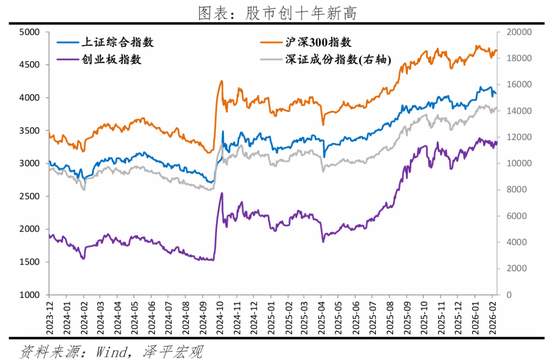
Core Viewpoint - A new bull market, termed "confidence bull," has emerged since September 2024, driven by significant policy easing, abundant liquidity, and a new wave of technological revolution, marking a historic opportunity for investors [3][10]. Group 1: Characteristics of the Current Bull Market - This bull market is described as a once-in-a-decade event, comparable to previous major bull markets in 2004-2007 and 2014-2015, with the current market driven by policy relaxation, liquidity, and technological advancements [4][5]. - The Shanghai Composite Index has risen by 56.2% and the ChiNext Index by 122.2% since their respective lows in 2024, indicating substantial market growth [6]. - Trading volume has surged from a few hundred billion to over 3 trillion, and market capitalization has increased from 70 trillion to 123 trillion, creating a wealth effect exceeding 50 trillion [9]. Group 2: Three Major Drivers of the Bull Market - The bull market is supported by three main drivers: continuous policy easing, a new technological revolution, and abundant liquidity, which together create a "confidence bull" [10]. - Policy easing since September 2024 has included interest rate cuts, relaxed housing market restrictions, and significant infrastructure investments, leading to increased risk appetite and lower risk-free rates [10][11]. - The technological revolution, characterized by advancements in AI, robotics, and semiconductor industries, has led to a surge in high-risk growth stocks, driving the current market [11]. Group 3: Historical Missions of the Bull Market - The current bull market is expected to fulfill three historical missions: supporting the development of new productive forces, aiding in major power competition, and repairing residents' balance sheets [13]. - The transition to high-quality economic development necessitates capital market support for new economy sectors, which are often unable to secure financing through traditional banking systems [13]. - The bull market's prosperity is crucial for addressing the challenges posed by the decline in real estate values, which have significantly impacted household wealth and consumption [14]. Group 4: Future Prospects and Outlook - The sustainability of the bull market will depend on continued macroeconomic policy easing, including further interest rate cuts and fiscal measures to stimulate demand [16]. - The market's volatility, characterized by rapid rises and falls, necessitates effective regulation of leverage to ensure healthy development [16][17]. - A long-lasting bull market could significantly enhance wealth effects, stimulate economic activity, and promote technological innovation, creating a positive feedback loop for the economy [17].
任泽平:解析牛市成因及后续市场震动分化趋势
Sou Hu Cai Jing· 2026-01-15 12:36
Core Viewpoint - The current bull market is characterized as a "confidence bull," driven by a combination of policy support, technological advancements, and ample liquidity, leading to a market that is experiencing a short squeeze [1] Group 1: Market Dynamics - The bull market is supported by macro policy easing, a new wave of technological revolution, asset scarcity, and abundant liquidity [1] - The market is expected to experience increased volatility, oscillation, and differentiation in performance among sectors [1] Group 2: Market Behavior - Historically, bull markets often "re-emerge in despair, rise amid controversy, and collapse in euphoria," suggesting that the end of the current bull market may exceed expectations [1] - The coexistence of structural recession in traditional industries and prosperity in new technologies indicates a stark contrast in sector performance, with some sectors thriving while others struggle [1]
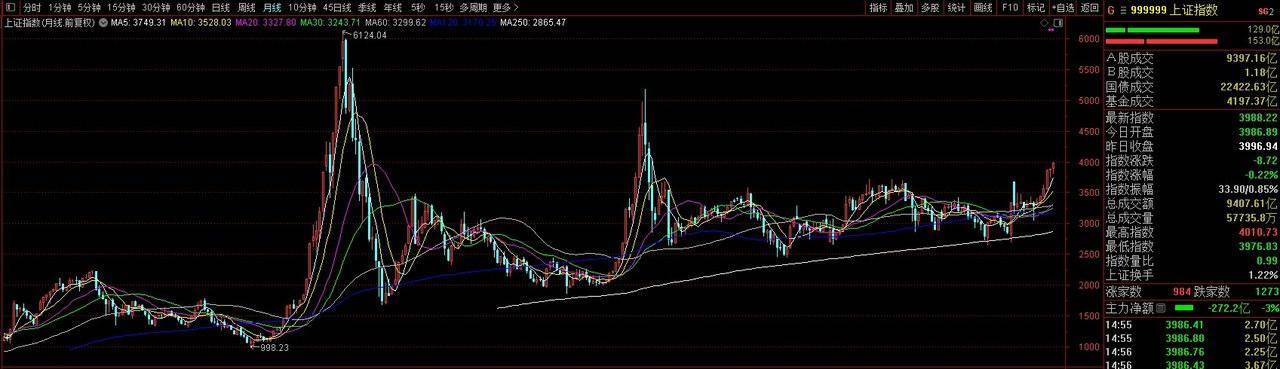
再见4000点,A股或已告别“水牛” “快牛”
Sou Hu Cai Jing· 2025-10-29 00:57
Core Viewpoint - The A-share market has seen significant changes over the past decade, with the Shanghai Composite Index (SSE) recently breaking the 4000-point mark for the first time since August 2015, raising questions about the sustainability of the current bull market and the potential for a "slow bull" market phase [1][3][5] Market Performance - The SSE reached 4000 points on October 28, 2023, marking a significant milestone after 3724 days since its last occurrence [1] - The total market capitalization of A-shares has increased from 52 trillion yuan to 107 trillion yuan over the past decade, with the number of listed stocks rising from 2662 to 5440 and the number of retail investors growing from over 93 million to more than 240 million [3] - Major indices have shown varied performance, with the STAR Market up 47% since its inception, the ChiNext Index up 21%, and the CSI 300 Index up 16%, while the SSE has seen no cumulative gain over the decade [3] Sector Performance - The food and beverage sector has seen the highest index increase of 135%, followed by electronics at 94%, and non-ferrous metals at 78% [4] - Notable individual stock performances include Zhongji Xuchuang with a 5887% increase, Shenghong Technology at 3724%, and Tianfu Communication at 2377% [4] Market Sentiment and Trends - Current market sentiment is characterized by cautious optimism, with investors exhibiting a more measured approach compared to previous bull markets, which were marked by rapid price increases and subsequent corrections [5][6] - The market is expected to transition into a "slow bull" phase, moving away from the historical patterns of "fast bull" or "water bull" markets, as the A-share market matures and institutional frameworks evolve [6][8] Future Outlook - The introduction of the "14th Five-Year Plan" is anticipated to serve as a significant milestone for the Chinese capital market, potentially catalyzing a new phase of growth from the 4000-point level [7][8] - Analysts suggest a balanced investment strategy between technology growth and dividend value, with a focus on sectors such as communication equipment, electronic components, semiconductors, and non-ferrous metals for short-term opportunities [9]
大摩邢自强闭门会分享:当前还没有看到“水牛”停歇的迹象,本轮海外资金参与有限
凤凰网财经· 2025-09-18 12:44
Core Viewpoint - The article discusses the current state of the Chinese market, characterized as a "water buffalo" bull market, with ongoing liquidity-driven dynamics and the potential for structural changes through policy reforms and economic recovery [2][11][43]. Group 1: Market Dynamics - Recent macro strategies emphasize the emergence of a "water buffalo" bull market in China, with no signs of slowing down [2][12]. - There are early signs of residents migrating their savings towards equity assets, with an estimated RMB 800 billion having shifted in the past two months [3][40]. - The participation of overseas investors in this bull market is limited, with European long-term funds remaining cautious while U.S. hedge funds show more interest [5][18]. Group 2: Economic Indicators - Recent economic data indicates weakness, with August CPI at -0.4% and PPI at -2.9%, suggesting ongoing deflationary pressures [6][34]. - GDP growth is expected to slow to around 4.5% in Q3 and Q4, prompting the need for additional policy support [6][15]. Group 3: Policy Outlook - A potential economic stimulus package of RMB 500 billion to 1 trillion is anticipated, including measures like local government debt swaps to stimulate economic activity [7][15]. - The upcoming "14th Five-Year Plan" is expected to address key issues such as high-level opening and social security reforms, which could solidify the transition from a liquidity-driven "water buffalo" market to a more structured "institutional bull" market [8][17]. Group 4: Investor Sentiment - European long-term investors are generally neutral towards increasing their positions in China, influenced by geopolitical concerns and a lack of enthusiasm for long-term allocations [20][31]. - In contrast, U.S. investors, particularly hedge funds, are more agile and interested in thematic trading opportunities within the Chinese market [26][32]. Group 5: Future Expectations - The effectiveness of upcoming policies and the "14th Five-Year Plan" in addressing structural reforms will be crucial for determining the sustainability of the current market dynamics [41][42]. - The transition from a liquidity-driven narrative to a more robust structural bull market hinges on the successful implementation of these reforms and the improvement of corporate earnings [43].

今天,突破3万亿!创历史第二高
Nan Fang Du Shi Bao· 2025-08-25 12:57
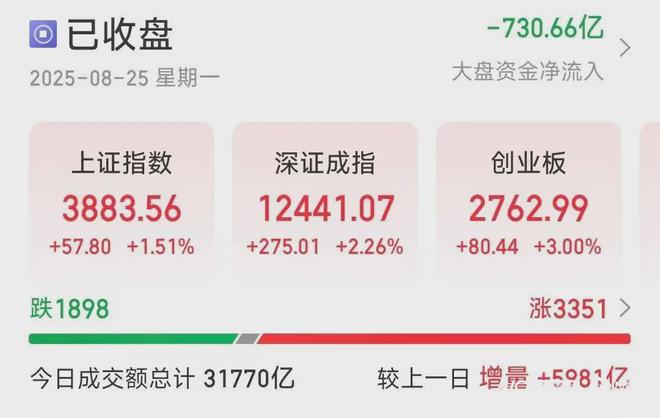
Market Performance - The three major indices continued to rise strongly, with the Shanghai Composite Index closing at 3883.56, up 1.51%, the Shenzhen Component Index at 12441.07, up 2.26%, and the ChiNext Index at 2762.99, up 3.00% on August 25 [1][3] - The total trading volume reached 31.77 trillion yuan, marking a significant increase of 5.981 trillion yuan from the previous trading day, the second highest in history [3] Sector Performance - The rare earth and liquor sectors led the gains, with notable stocks such as Nanchang Taida and Jinyi Rare Earth hitting the daily limit, while liquor stocks like Shede Liquor and Shui Jing Fang also saw substantial increases [3] - The real estate sector experienced a rebound, with stocks like Wantong Development and Vanke A showing significant gains [3] Market Trends and Analysis - According to research from China International Capital Corporation (CICC), the increase in market activity and new capital inflow is partly due to the initial signs of residents moving their deposits [4] - The current low interest rate environment, with the 10-year government bond yield below 1.8% and the one-year LPR at 3%, is encouraging this shift [4] - CICC estimates that the potential funds from resident deposits entering the market could range from 5 trillion to 7 trillion yuan, although actual inflow will depend on various macroeconomic factors [5] Bull Market Outlook - The current bull market is described as a rare occurrence, comparable to previous bull markets in 2007 and 2015, with the market showing strong upward momentum after breaking the 3800-point level [5][6] - The market's price-to-earnings ratio for the CSI 300 is approximately 14 times, below the historical average of 18 times, indicating potential for further growth [5] - The current bull market is characterized by high liquidity and investor enthusiasm, but it may also lead to significant volatility, with investors advised to adopt a long-term investment strategy [6]