
宽财政政策

Search documents
港股重磅调整!恒生指数指数成分股调整,宁德时代上市仅8个月时间被纳入,恒生指数成分股数量将增至90只
Jin Rong Jie· 2026-02-14 08:38
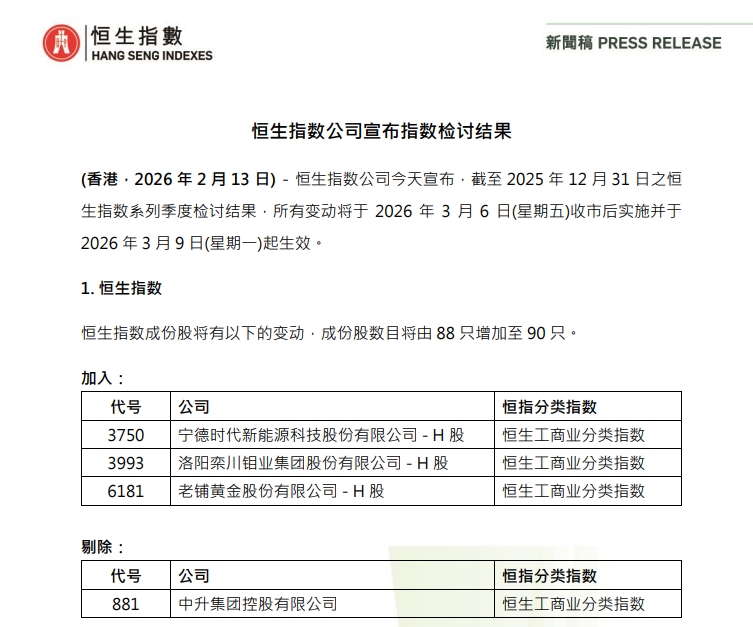
Group 1 - The core point of the article is the inclusion of CATL (宁德时代) in the Hang Seng Index, along with other companies like Luoyang Molybdenum and Laopu Gold, while Zhongsheng Group is removed, increasing the number of constituent stocks from 88 to 90, effective March 9 [1][4]. - CATL was listed on the Hong Kong Stock Exchange on May 20, 2025, and has seen a stock price increase of over 90% within the year, reaching a market capitalization of over HKD 2.7 trillion [3]. - As of February 13, 2025, CATL's H-shares closed at HKD 517.5, while Luoyang Molybdenum and Laopu Gold closed at HKD 21.72 and HKD 738.5 respectively, with respective declines of 6.94% and 3.97% [3]. Group 2 - The adjustment of index constituents is expected to trigger passive fund reallocation, potentially leading to increased trading volumes for the affected stocks as the effective date approaches [4]. - The Hang Seng Index series is gradually incorporating more new economy sectors such as renewable energy, new consumption, and biotechnology, while reducing the weight of traditional industries, enhancing the growth potential and investment attractiveness of the index [4]. - As of December 2025, the total assets under management for products tracking the Hang Seng Index series amounted to approximately USD 117.7 billion [4]. Group 3 - Since the beginning of 2026, there has been a structural divergence in the Hong Kong stock market, with the Hang Seng Index rising by 3.65% while the Hang Seng Tech Index has declined by 2.82% [5]. - In 2025, both the Hang Seng Index and the Hang Seng Tech Index experienced gains of 27.77% and 23.45% respectively [5]. - Analysts suggest that the consumer sector, currently at relatively low valuations, may continue to rise due to increased consumption activity leading up to the Spring Festival, while precious metals and energy sectors are expected to experience upward volatility amid geopolitical uncertainties [5].


2026宏观展望:周期的力量
Guang Fa Qi Huo· 2026-01-23 02:17
Report Industry Investment Rating No relevant content provided. Core Viewpoints of the Report - In 2026, the world will be in a macro - background of deepening "de - globalization" and the resonance of loose fiscal policies of major economies. Supply - chain vulnerability and demand expansion will lead to a tightening of resource supply - demand relations, and intensify strategic competition for key minerals and energy [1]. - China's economy will be based on the principle of "internal stability and external control" in 2026. Exports will remain a mainstay, investment will play a supporting role, and consumption will focus on equipment updates and service - scenario innovation. The de - dollarization trend and the weakening of the US dollar credit will bring opportunities for international capital inflows into RMB assets, and Sino - US competition will focus on technology and supply - chain security [1]. - In 2026, a macro - hedging portfolio should be constructed under the premise of seeking certainty. Commodity assets will have prominent allocation value, with the order of commodity > equity > bond. Attention should be paid to potential uncertainties such as recessions in Europe and the US, domestic inflation repair, geopolitics, and real - estate risks [2]. Summary by Directory I. Cycle Changes: Resonance of "De - globalization" and Loose Fiscal Policies (1) The Wave of De - globalization: From Great - Power Games to the G2 Pattern - International events such as the COVID - 19 pandemic, the Russia - Ukraine war, and the Trump administration's high - tariff policies have led to the wave of de - globalization, which is essentially the reshaping of the world order [6]. - Traditional capitalist powers like the US and the UK are withdrawing from international alliances, while emerging - market countries led by China are exploring new international cooperation models. A G2 competition pattern between China and the US is gradually taking shape in key technologies and resources [7]. - The wave of de - globalization has increased the vulnerability of the global supply chain, deteriorated the global trade environment, and accelerated the rotation and increased the volatility of global major assets. The credit systems of the US dollar and US Treasury bonds have been shaken [9]. (2) Loose Fiscal Resonance: Upward Global Manufacturing and Inventory Cycles - In 2026, the fiscal policies of major overseas economies such as the US, Europe, and Japan are expected to expand further. The US "big and beautiful" bill may increase the fiscal deficit by $4.1 trillion in the next decade, and EU countries will increase their defense spending to 5% of GDP by 2035. Japan will implement a trillion - level economic stimulus plan. This will lead to an increase in economic activity demand and drive up the global manufacturing and inventory cycles [15]. (3) Resource Shortage: Tightening Supply - Demand Balance - De - globalization has increased supply - chain vulnerability, and loose fiscal policies will stimulate demand, leading to a tightening of the global industrial supply - demand relationship. Countries will pay more attention to resource competition for national security. The US is seizing resources through trade control and military actions. Core resources such as minerals and energy will see price increases in 2026 [16]. II. The Game between Endogenous Momentum and External Changes (1) Endogenous Economic Transformation: Long - Term Policy Guidance of the 15th Five - Year Plan - In 2026, as the starting year of the 15th Five - Year Plan, China aims to achieve a reasonable GDP growth rate while gradually realizing structural transformation. New - quality productivity sectors such as AI, biomedicine, and new energy will become new pillar industries [17]. - Investment will be the supporting force for achieving economic growth goals, while consumption will be the main growth driver. Exports will remain a mainstay due to factors such as reduced Sino - US trade - dispute volatility, fiscal expansion in developed economies, and the rise of emerging markets. Investment in infrastructure, manufacturing, and new areas will support economic growth, and real - estate's negative impact on the economy is expected to turn neutral [18][19][23]. - In the consumption area, policies will focus on releasing existing demand through subsidies and exploring incremental demand by expanding service - consumption scenarios [27]. (2) External Changes and Game: Coexistence of Challenges and Opportunities - The weakening of the US dollar credit due to the expiration of the "petro - dollar" agreement and the establishment of a new cross - border settlement mechanism provides an opportunity for RMB assets. International capital will flow back to the Asia - Pacific market and drive up the prices of RMB - denominated assets. China can promote RMB internationalization [30]. - Sino - US relations will remain a key variable in 2026. The two countries have long - term competition and phased balance in technology and resource issues. The competition pattern will not change significantly, and extreme decoupling is unlikely [31]. III. Guidance on Major Asset Allocation: Constructing a Macro - Hedging Portfolio (1) Between "Change and Constancy": Unchanging Competition Relations and Changing Cycle Rotations - The long - term competition exists among all global economies due to limited resources and growing economic demand. China's economic recovery has three main lines: technological independence, price repair, and expansion of domestic demand. The US will try to avoid recession and stagflation, and continue to rely on the stock market and AI to support the economy [33]. (2) 2026: Seeking Certainty and Constructing a Major Asset Portfolio: Commodity > Equity > Bond - In 2026, asset allocation should pursue certainty and balance risks. Attention should be paid to risks such as recessions in Europe and the US, slow domestic inflation repair, intensified de - globalization, and a downward real - estate market [36]. (3) Grasping the Rhythm and Main Lines in the Short, Medium, and Long Terms - Based on economic - cycle theory, in the high - inflation and high - growth stage (2026 - 2027 expected), commodities will be dominant. Different commodity sectors will rotate in the order of risk pricing, expected trading, and real - situation regression [37]. - In 2026, the four quarters will be dominated by different factors: Q1 is dominated by short - term liquidity, driving up the prices of precious metals and non - ferrous metals; Q2 focuses on correcting the mid - term narrative; Q3 verifies the long - term logic; Q4 is for brewing cross - year expectations [39].
贵金属:贵金属日报-20251231
Wu Kuang Qi Huo· 2025-12-31 01:44
1. Report Industry Investment Rating No relevant content provided. 2. Core View of the Report - The precious metals are currently in an accelerated upward phase. From now until Powell officially steps down as the Fed Chairman in May next year, precious metals may face short - term significant corrections due to the Fed's "inaction". However, this does not signal the end of the current upward cycle for gold and silver. The Trump administration has the motivation to further loosen fiscal policies under the pressure of the mid - term elections, and the Fed will enter a new and more aggressive interest - rate cut cycle after Powell's departure. Currently, the prices of gold and silver have fully reflected the expectations of monetary and fiscal policies. It is recommended to remain on the sidelines in the context of significant price fluctuations and not to open new long or short positions. The reference operating range for the main contract of Shanghai gold is 940 - 1001 yuan/gram, and for the main contract of Shanghai silver is 16360 - 20000 yuan/kilogram [4]. 3. Summary by Related Catalogs 3.1 Market Quotes - Shanghai gold rose 0.04% to 986.34 yuan/gram, and Shanghai silver rose 5.36% to 18792.00 yuan/kilogram. COMEX gold was reported at 4346.40 dollars/ounce, and COMEX silver at 74.83 dollars/ounce. The yield of the 10 - year US Treasury bond was reported at 4.14%, and the US dollar index at 98.23 [2]. - Trump mentioned that he is considering suing Fed Chairman Powell and believes Powell should resign. The candidate for the new Fed Chairman will be announced in January [2]. 3.2 Policy Expectations - The selection of the new Fed Chairman has led the market to price in an aggressive easing policy by the Fed next year. The Fed under Powell cut interest rates and expanded the balance sheet in the December meeting, and the dot - plot shows that current Fed officials only expect one 25 - basis - point interest - rate cut next year. However, the market's expectations for the Fed's monetary policy are more focused on the selection of the new Fed Chairman. At the end of the year, the market expectations that Kevin Hassett and Kevin Warsh, two members of the Trump camp, will be nominated as the new Fed Chairman have gradually fermented, and both have stated that they will support the interest - rate cut policy desired by Trump. Trump himself has also stated that "those who oppose him will not get the position of Fed Chairman". The Fed is likely to conduct relatively aggressive interest - rate cuts in the second half of next year, which has pushed the international silver price to a new record high [3]. 3.3 Strategy Suggestions - Given the current situation, it is recommended to maintain a wait - and - see attitude in the face of significant price fluctuations of precious metals and avoid opening new long or short positions. The reference operating range for the main contract of Shanghai gold is 940 - 1001 yuan/gram, and for the main contract of Shanghai silver is 16360 - 20000 yuan/kilogram [4]. 3.4 Data Summary - A detailed summary of key gold and silver data from December 29 - 30, 2025, including closing prices, trading volumes, open interest, inventories, and precipitation funds of various gold and silver contracts in different markets such as COMEX, LBMA, SHFE, etc., as well as their daily changes, daily percentage changes, and historical quantiles over the past year [6].
分析人士:贵金属基本面仍偏强
Qi Huo Ri Bao· 2025-12-31 01:40
Core Viewpoint - The recent decline in precious metal prices is attributed to a technical correction following a strong prior rally, compounded by multiple macroeconomic and geopolitical negative factors, particularly during the low liquidity period of the Christmas holidays in Europe and the U.S. [1] Group 1: Price Movements - As of December 30, domestic precious metal futures prices collectively fell, with the main gold contract down 3.11% and the main silver contract down 3.96%, while platinum and palladium futures hit their daily limit down [1] - The sharp decline in precious metal prices is seen as a correction of previous over-expectations regarding U.S. fiscal and monetary policies [2] - Platinum prices surged over 30% in the previous week, leading to significant profit-taking and increased volatility in the short term [2] Group 2: Market Influences - The expectation of a new Federal Reserve chair aligning with President Trump's fiscal policies is influencing market sentiment, with potential for accelerated interest rate cuts [4] - Global central banks are reducing U.S. Treasury holdings while increasing gold reserves, which directly supports higher precious metal prices [4] - The industrial demand for silver remains strong due to its support from the photovoltaic industry, while platinum and palladium face declining demand from the automotive sector [4] Group 3: Future Outlook - Despite the recent price corrections, the long-term outlook for precious metals remains positive, driven by expectations of continued Federal Reserve rate cuts [4] - The upcoming announcement of the new Federal Reserve chair and the pace of interest rate cuts will be critical factors to monitor [4] - The introduction of new regulations in India regarding silver collateral may impact international silver supply dynamics in the first quarter of the following year [5]
突发,沙特空袭!美联储会议纪要公布,特朗普威胁!分析人士:贵金属基本面仍偏强
Qi Huo Ri Bao· 2025-12-30 23:43
Group 1: Yemen Situation - Saudi Arabia conducted airstrikes on Mukalla port in Yemen, leading to a nationwide state of emergency declared for 90 days by the Yemeni Presidential Leadership Council [1][2] - The airstrikes targeted weapons and military vehicles unloaded from two Emirati ships that entered Mukalla port without coalition permission [1] - The coalition's actions were described as necessary to protect civilians in the Hadhramaut and Mahra provinces due to the threat posed by the weapons [1] Group 2: Federal Reserve Meeting Minutes - The Federal Reserve's December meeting minutes indicated that most participants supported a rate cut in December, with a consensus on the economy expanding at a moderate pace [3] - Participants noted a rise in inflation since the beginning of the year and expressed uncertainty regarding GDP growth forecasts [3] - The market's expectations for rate cuts have not significantly changed, with traders leaning towards two rate cuts next year rather than three [4] Group 3: Precious Metals Market - Domestic precious metal futures prices experienced a collective decline, with gold and silver contracts dropping by 3.11% and 3.96% respectively [7] - Analysts attribute the recent price drop to a technical correction following previous strong gains and a lack of market liquidity during the holiday season [7] - The outlook for precious metals remains influenced by expectations of Federal Reserve rate cuts and rising demand for safe-haven assets [10][11]
——2025年11月进出口数据点评:11月的出口高增速可持续吗?
EBSCN· 2025-12-08 09:33
Group 1: Export Performance - In November 2025, China's exports reached $330.35 billion, with a year-on-year growth of 5.9%, significantly higher than the expected 3.0%[2] - The increase in export growth is attributed to the fading high base effect and strong overseas demand, particularly in integrated circuits and automobiles[3] - Exports to the EU, Africa, and Latin America showed notable increases, while exports to the US slightly declined by 28.6%[5] Group 2: Import Trends - November 2025 imports totaled $218.67 billion, reflecting a year-on-year increase of 1.9%, up from 1.0% in October[2] - The rise in imports is driven by robust export-related demand for intermediate goods and a low base effect from the previous year[18] - Key imports such as copper and iron ore saw significant growth, with copper imports increasing by 35.3% and iron ore by 15.9%[18] Group 3: Future Outlook - December's export growth may face challenges from high base effects, but optimism remains for overseas demand in 2026 due to global fiscal expansion and improved US-China trade relations[21] - The expected decrease in the fentanyl tariff rate from 20% to 10% is anticipated to narrow the year-on-year decline in exports to the US[21] - Continued strong demand for key mineral resources from Africa is expected to support capital goods exports from China[21]
2026年度展望:中国外贸&人民币汇率
2025-12-01 00:49
Summary of Key Points from Conference Call Records Industry Overview - The records primarily discuss the **Chinese export market** and the **RMB exchange rate** outlook for 2026, highlighting the resilience of Chinese exports despite US-China trade tensions and the strategic shift towards non-US markets [1][3][5]. Core Insights and Arguments - **Export Growth**: Chinese exports are expected to recover to approximately **5% growth** in 2026, aided by demand from Africa and Central Asia, compensating for the decline in exports to the US [1][2]. - **US Tariff Impact**: The likelihood of significant new tariffs from the US on Chinese goods is low, with existing tariffs having a diminished marginal impact due to the reduced share of exports to the US, now around **10%** [5][3]. - **Global Economic Policies**: The dual monetary and fiscal easing policies in major economies are expected to sustain overseas demand, with the US likely to continue a **rate cut cycle** into 2026, potentially lowering rates four times [1][7]. - **AI Investment Influence**: The expansion of AI investments in the US is driving demand for semiconductors and related products, positively impacting Chinese exports in these sectors [9][6]. - **Strengthening Trade Relations with Africa**: China has established zero-tariff treatment for all products with African nations, significantly increasing exports of construction machinery and related products, which are expected to grow further due to infrastructure demands [10][3]. Additional Important Insights - **RMB Exchange Rate Forecast**: The RMB is projected to appreciate against the USD, potentially reaching **6.7-6.8** by the end of 2026, driven by a surplus in the current account and increased net capital inflows [13][14]. - **Investment Trends**: Foreign investment in Chinese financial assets has been increasing, with a notable **62.29 billion CNY** net increase in A-shares, indicating a positive outlook for capital inflows [16]. - **Long-term RMB Outlook**: The RMB is expected to experience gradual appreciation with low volatility, potentially breaking below **7.0** against the USD by 2026, supported by favorable economic conditions and capital flows [17]. Risks and Opportunities - **Risks**: The main risks for Chinese exports in 2026 include potential fluctuations in US tariffs and global economic conditions, although these risks are expected to be mitigated by ongoing trade agreements and reduced reliance on the US market [5][6]. - **Opportunities**: The continued growth in non-US markets, particularly in Africa and ASEAN, presents significant opportunities for Chinese exports, enhancing resilience against market fluctuations [12][6]. This summary encapsulates the key points from the conference call records, focusing on the Chinese export landscape and the RMB exchange rate outlook, while highlighting both risks and opportunities in the current economic environment.
2026年度展望:海外政策&海外宏观
2025-11-26 14:15
Summary of Key Points from the Conference Call Industry and Company Overview - The discussion primarily revolves around the U.S. economy and the implications of the 2026 midterm elections under the Trump administration, focusing on fiscal and monetary policies, inflation, and investment opportunities in AI and gold. Core Insights and Arguments - **Economic Outlook**: The U.S. economy is expected to experience a rebound in the second half of 2026 after a short-term impact from government shutdowns, with fiscal and monetary policies driving expansion in Q3 and rising inflation pressures in Q4 [1][2] - **Fiscal Policy**: The Trump administration is likely to continue implementing expansionary fiscal policies, including a proposed $2,000 tax credit per person, to stimulate economic growth and garner voter support ahead of the midterm elections [1][8] - **Monetary Policy**: The new Federal Reserve chair is anticipated to focus more on economic downturn risks, potentially leading to more interest rate cuts than the market expects, with analysts predicting three rate cuts in 2026 [7] - **Inflation Trends**: Inflation is expected to remain sticky in the first three quarters of 2026, with a potential increase in inflationary pressures as the economy expands in Q4, raising concerns about a second wave of inflation risks [1][11] - **Investment Opportunities**: Gold and AI are identified as the best investment combinations, each representing half of the recommended portfolio, alongside stocks, commodities, and short-term U.S. Treasury bonds benefiting from loose fiscal and monetary policies [1][2][12] Additional Important Content - **Midterm Election Challenges**: The 2026 midterm elections pose significant challenges for Trump, with predictions indicating a 70% chance for Democrats to gain control of the House, which could lead to a divided government [3][4] - **Trade Policy**: Trump may leverage trade policies, including tariffs, to secure votes from key regions while also creating external conflicts to pressure the Federal Reserve into lowering interest rates [6] - **Market Sentiment**: While market sentiment may gradually improve, there are risks of sudden deterioration due to trade policy fluctuations and economic conditions [2] - **Asset Performance**: The macroeconomic environment is expected to favor lower dollar rates and a weaker dollar index, with gold prices likely to rise and stock and commodity markets benefiting from expansionary policies [13][14] This summary encapsulates the critical insights and projections regarding the U.S. economy, fiscal and monetary policies, and investment strategies as discussed in the conference call.
瑞达期货宏观市场周报-20251107
Rui Da Qi Huo· 2025-11-07 10:34
Report Industry Investment Rating There is no information provided in the content about the report industry investment rating. Core Views - A-share major indices generally rose this week, except for the Sci - Tech Innovation 50. The four stock index futures showed differentiation, with large - cap blue - chip stocks outperforming small and medium - cap stocks. The market was in a performance and policy vacuum period, showing a random walk state, and trading activity declined compared to last week. It is recommended to buy on dips [10]. - Treasury futures weakened collectively this week, and the central bank shifted to net withdrawal. Although the central bank's Treasury bond trading volume in October was prudent, bond - buying operations still released a loose signal. The market expects short - term interest rates to continue to decline, possibly driving long - term interest rates down, but there is a potential suppression of long - term interest rates due to the recovery of risk appetite. It is recommended to go long with a light position [10]. - The downgraded expectation of the Fed's December interest rate cut pushed up the US dollar index, and the decline of China's manufacturing PMI had a negative impact on commodity prices. However, crude oil and gold were stable recently, and the commodity index is expected to remain volatile. It is recommended to wait and see [10]. - The US federal government's continued shutdown led to the US dollar rising and then falling. The improvement in the eurozone's economic expectations narrowed the US - euro interest rate spread, providing medium - term support for the euro. The Japanese yen's trend is mainly volatile in the short term [10][14]. - China's foreign trade declined more than expected in October, with exports turning from an increase to a decrease. But the positive results of the Sino - US consultation in Kuala Lumpur are expected to relieve the foreign trade pressure [15]. Summary by Directory 1. This Week's Summary and Next Week's Allocation Suggestions Stocks - The CSI 300 rose 0.82%, and the CSI 300 stock index futures rose 0.49%. A - share major indices generally rose, except for the Sci - Tech Innovation 50. The four stock index futures showed differentiation, with large - cap blue - chip stocks stronger than small and medium - cap stocks. The market was in a performance and policy vacuum period, and trading activity declined. It is recommended to buy on dips [10]. Bonds - The 10 - year Treasury bond yield rose 0.06% (a weekly change of + 0.11BP), and the main 10 - year Treasury bond futures fell 0.19%. Treasury futures weakened this week, and the central bank shifted to net withdrawal. The central bank's bond - buying operations released a loose signal. Short - term interest rates are expected to decline, possibly driving long - term interest rates down, but there is a risk of long - term interest rate suppression due to the recovery of risk appetite. It is recommended to go long with a light position [10]. Commodities - The Wind Commodity Index fell 1.90%, and the CSI Commodity Futures Price Index fell 0.51%. The downgraded expectation of the Fed's December interest rate cut and the decline of China's manufacturing PMI had a negative impact on commodity prices, but crude oil and gold were stable, and the commodity index is expected to remain volatile. It is recommended to wait and see [10]. Foreign Exchange - The euro against the US dollar fell 0.02%, and the euro against the US dollar 2512 contract fell 0.06%. The US federal government's continued shutdown led to the US dollar rising and then falling. The improvement in the eurozone's economic expectations narrowed the US - euro interest rate spread, providing medium - term support for the euro [10]. 2. Important News and Events - China announced specific measures to implement the consensus of the Sino - US economic and trade consultation in Kuala Lumpur, including stopping some tariff - adding measures on US imports [18]. - The US federal government's shutdown set a new record, which may cause economic losses. The US Treasury Secretary threatened to impose tariffs on China, and the EU reached an agreement on the 2040 climate change target [19]. 3. This Week's Domestic and Foreign Economic Data - China's October exports in US dollars decreased by 1.1% year - on - year, and imports increased by 1% year - on - year [15]. - The US October ISM manufacturing PMI was 48.7, and the ADP employment number was 4.2 million [20]. - The eurozone's October manufacturing PMI was 50, and the September PPI monthly rate was - 0.1% [20]. 4. Next Week's Important Economic Indicators and Economic Events - Next week, important economic data such as Japan's September trade balance, UK's October unemployment rate, and China's October social consumer goods retail sales will be released [78].
五矿期货贵金属日报-20250704
Wu Kuang Qi Huo· 2025-07-04 02:56
Group 1: Market Performance - Shanghai gold (Au) dropped 0.40% to 775.68 yuan/gram, while Shanghai silver (Ag) rose 0.67% to 8926.00 yuan/kilogram. COMEX gold fell 0.09% to 3340.00 dollars/ounce, and COMEX silver dropped 0.19% to 37.02 dollars/ounce. The US 10-year Treasury yield was reported at 4.3%, and the US dollar index was at 97.02 [2]. - Au(T+D) closed at 775.81 yuan/gram, up 0.71% from the previous trading day; Ag(T+D) closed at 8929.00 yuan/kilogram, up 2.20%. London gold was at 3332.15 dollars/ounce, down 0.11%, and London silver was at 36.88 dollars/ounce, up 1.58%. SPDR Gold ETF holdings remained unchanged at 947.66 tons, and SLV Silver ETF holdings increased by 22.61 tons to 14868.74 tons [3]. - The US 10-year Treasury yield rose to 4.3500%, and TIPS increased to 2.0200%. The US dollar index rose 0.35% to 97.1185, and the offshore RMB fell 0.49% to 7.2545. Major stock indices, including the Dow Jones, S&P 500, and Nasdaq, all rose, while the VIX index fell 1.56% [3]. Group 2: Market Outlook and Policy Expectations - The "Big and Beautiful Bill" passed the House of Representatives, and the US's loose fiscal policy is about to be implemented, which requires a loose monetary policy from the Federal Reserve. Despite the better-than-expected non-farm payroll data, silver prices remained resilient [2]. - The US added 147,000 non-farm jobs in June, higher than the expected 110,000 and the revised previous value of 140,000. The non-farm government employment sub - item contributed 73,000 jobs, and the education and health services sector added 51,000 jobs. The market reduced its expectations for the Fed's subsequent interest rate cuts [2]. - The implementation of the US's loose fiscal policy will increase the pressure on US Treasury bond issuance, and the Federal Reserve is expected to maintain the interest rate unchanged at the July meeting with a more dovish stance and cut interest rates by 25 basis points at the September meeting [2]. Group 3: Investment Opportunities - Against the background of the expected loosening of the Federal Reserve's monetary policy, attention should be paid to the long - term opportunities for silver. The reference operating range for the main contract of Shanghai gold is 760 - 801 yuan/gram, and that for Shanghai silver is 8638 - 9300 yuan/kilogram [2]. Group 4: Data Summary - For gold on July 3, 2025, COMEX gold's closing price (active contract) was 3336.00 dollars/ounce, down 0.97%; trading volume increased by 16.99% to 151,500 lots; and open interest decreased by 1.42% to 435,000 lots. SHFE gold's closing price (active contract) was 781.28 yuan/gram, up 0.68%; trading volume decreased by 11.96% to 267,500 lots; and open interest increased by 0.82% to 413,800 lots [6]. - For silver on July 3, 2025, COMEX silver's closing price (active contract) was 37.04 dollars/ounce, up 0.68%; open interest decreased by 5.53% to 174,600 lots; and inventory decreased by 0.18% to 15,529 tons. SHFE silver's closing price (active contract) was 8944.00 yuan/kilogram, up 2.25%; trading volume increased by 47.09% to 923,300 lots; and open interest increased by 10.21% to 927,300 lots [6]. Group 5: Price Structure and Spread - COMEX gold and silver, London gold and silver, and Shanghai gold and silver all have corresponding near - far month price structures and spreads. For example, on July 3, 2025, the SHFE - COMEX spread for gold was 7.46 yuan/gram, and for silver was 446.74 yuan/kilogram [49].