港股投资策略

Search documents
开源量化评论(121):港股CCASS优选20组合的年度回顾及最新持仓
KAIYUAN SECURITIES· 2026-02-13 06:43
- The "Hong Kong CCASS Preferred 20 Portfolio" was constructed using a two-step screening method: "select brokers first, then select stocks"[3][4] - The first step involves selecting top-performing brokers by standardizing and equally weighting their excess Sharpe ratio and monthly win rate, then selecting the top 10 brokers[4][16] - The second step involves equally distributing funds to the 10 selected brokers, aggregating their latest holdings, and retaining the top 20 stocks by weight for equal allocation[5][17] - The portfolio has shown significant outperformance over the Hang Seng Index, with an annualized excess return rate of 19.3% and an excess Sharpe ratio of 2.45 over the period from 2020 to 2025[3][12][15] - The portfolio demonstrated defensive characteristics during market adjustments, achieving a positive return of 2.05% from October 8, 2025, to December 31, 2025, while the Hang Seng Index fell by 4.47% and the Hang Seng Technology Index dropped by 15.32%[3][12] - The latest holdings of the portfolio as of February 2026 include a low valuation and high dividend yield configuration, with the banking and non-bank financial sectors accounting for about 45%, the energy sector about 10%, and the technology and internet sectors about 20%[6][19][22] Portfolio Performance Metrics - Annualized return: 19.3%[15] - Annualized volatility: 7.9%[15] - Sharpe ratio: 2.45[15] - Maximum drawdown: -7.6%[15] - Monthly win rate: 75.3%[15]
中金:披沙剖璞,公募基金港股投资策略解构
中金点睛· 2025-12-18 23:58
Core Viewpoint - The Hong Kong stock market is increasingly favored by mainland public funds due to its deep value opportunities, potential for future growth, and global diversification, leading to a rise in public fund participation in Hong Kong stocks [2][10]. Market Overview - As of Q3 2025, the number of equity funds including Hong Kong stocks reached 2,689, with a total scale of 2.63 trillion yuan. Active management funds dominate in both quantity and proportion, indicating a strong willingness from public institutions to flexibly allocate to the Hong Kong market [2][22]. - Active products show a steady increase in Hong Kong thematic funds, while balanced allocation funds have expanded significantly, with thematic and balanced funds numbering 92 and 872 respectively by Q3 2025 [2][31]. - Passive products are led by thematic funds, which have seen rapid growth, reaching 108 funds by Q3 2025, driven by the accelerated return of Chinese concept stocks and structural market trends [2][32]. Institutional Landscape - The concentration of management scale among different types of Hong Kong equity funds is gradually dispersing. As of Q3 2025, the CR5 for thematic, balanced, and minor participation funds stands at 60.3%, 35.8%, and 30.2% respectively [3][33]. - Passive products exhibit higher concentration due to scale effects and first-mover advantages, with CR5 for thematic, balanced, and minor participation funds at 67.0%, 67.9%, and 81.0% respectively [3][33]. Performance Analysis - Active management products show significant internal differentiation, indicating varying levels of management capability. Thematic funds have better upward momentum, while the advantages of active management are not prominently displayed [3][37]. - The median returns for passive and active thematic funds this year are 28.2% and 25.5%, respectively, suggesting that thematic focus may yield better market performance [3][37]. Strategy Characteristics - Thematic funds maintain a high Hong Kong stock position of around 90%, focusing on long-term trends rather than short-term fluctuations. They prefer H-shares with a balanced sector distribution [4]. - Minor participation funds view the Hong Kong market as a tactical allocation, focusing on short-term trading and flexible adjustments, with a preference for new economy sectors like technology and consumption [5]. - Balanced allocation funds maintain a Hong Kong stock position of 30-40%, frequently adjusting their allocations to capture excess returns through active cross-market timing [6]. Investment Value - The Hong Kong stock market has reversed its previous weak performance, with the Hang Seng Index rising 28.9% this year and 51.7% over the past two years, leading global major market indices [10]. - The market's flexible trading mechanisms and diverse funding structures position it uniquely to attract both domestic and international capital, enhancing its long-term investment value [10][15]. - As of November 30, 2025, the Hang Seng Index's PE ratio is 11.9, indicating a valuation advantage compared to other global markets, alongside a dividend yield of 3.0%, making it an attractive investment option [16][17].


金融工程定期:港股量化:组合超额创新高,12月维持高股息配置
KAIYUAN SECURITIES· 2025-12-02 06:45
Quantitative Models and Construction Methods - **Model Name**: Hong Kong CCASS Preferred 20 Portfolio **Model Construction Idea**: The model leverages CCASS data from the Hong Kong Stock Exchange to track and replicate the monthly holdings of high-performing brokers. The goal is to identify brokers with superior performance and construct a portfolio based on their holdings[4][38][40] **Model Construction Process**: 1. At the end of each month, all brokers are ranked based on their standardized excess Sharpe ratio and monthly win rate. These two metrics are equally weighted to form a composite score 2. The top N brokers with the highest composite scores are selected to form a pool of high-performing brokers (N=10) 3. The holdings of these brokers are aggregated, and the top M stocks by weight are retained (M=20) 4. The selected stocks are equally weighted to construct the portfolio Formula: $ \text{Composite Score} = \text{Standardized Excess Sharpe Ratio} + \text{Monthly Win Rate} $ **Model Evaluation**: The model effectively identifies high-performing brokers and constructs a portfolio with consistent excess returns and risk-adjusted performance[40][41][42] Model Backtesting Results - **Hong Kong CCASS Preferred 20 Portfolio**: - November 2025 performance: Portfolio return 0.13%, Hang Seng Index return -0.18%, excess return 0.32%[42] - Full period (2020.1–2025.11): - Annualized excess return: 19.7% - Annualized volatility: 7.6% - Sharpe ratio: 2.59 - Maximum drawdown: -6.0% - Monthly win rate: 78.9%[42][43][45] - Annual performance breakdown: - 2020: Annualized excess return 37.4%, Sharpe ratio 3.85, maximum drawdown -5.4%, monthly win rate 91.7% - 2021: Annualized excess return 11.5%, Sharpe ratio 1.40, maximum drawdown -5.1%, monthly win rate 50.0% - 2022: Annualized excess return 12.2%, Sharpe ratio 1.48, maximum drawdown -4.5%, monthly win rate 75.0% - 2023: Annualized excess return 20.3%, Sharpe ratio 2.99, maximum drawdown -3.7%, monthly win rate 75.0% - 2024: Annualized excess return 22.5%, Sharpe ratio 3.38, maximum drawdown -3.7%, monthly win rate 91.7% - 2025: Annualized excess return 15.9%, Sharpe ratio 3.17, maximum drawdown -2.0%, monthly win rate 90.9%[43][44][45]
道合直播:总量分会场|启航新征程·国泰海通2026年度策略会
国泰海通证券研究· 2025-11-01 04:05
Group 1 - The article discusses the upcoming 2026 Annual Strategy Conference hosted by Guotai Junan Securities, featuring various presentations on macroeconomic outlook, equity investment strategies, and IPO market forecasts [4][6]. - Key speakers include the Chief Macro Research Analyst, Chief Strategy Research Analyst, Chief Overseas Strategy Research Analyst, Chief Financial Engineering Research Analyst, and Chief New Stock Research Analyst, each presenting on their respective topics [4][6]. - The conference is scheduled for November 4, 2025, and will cover a range of topics relevant to investment strategies in China and Hong Kong [4]. Group 2 - The conference will provide insights into the 2026 macroeconomic outlook, equity investment strategies, and the performance of the IPO market, which are crucial for investors [4]. - The event aims to equip attendees with knowledge and strategies to navigate the investment landscape in the upcoming year [4]. - The article emphasizes the importance of these discussions for clients of Guotai Junan Securities, highlighting the firm's commitment to delivering valuable research and insights [8].


开源量化评论(112):基于港交所CCASS数据的港股投资策略
KAIYUAN SECURITIES· 2025-09-14 08:44
Group 1 - The report highlights a significant recovery in the Hong Kong stock market, with the Hang Seng Index rising by 31.5% and the Hang Seng Tech Index increasing by 34.0% as of September 12, 2025, driven by capital inflows and improved market sentiment [13][14][17] - The average daily trading volume in the Hong Kong stock market reached HKD 249.4 billion in September 2025, reflecting a year-on-year increase of nearly 93% [13][14] - Cumulative net inflows from southbound funds have surpassed HKD 1 trillion since the establishment of the Stock Connect, marking a historical high [17][18] Group 2 - The report indicates that the top three brokerage firms account for 54.8% of the total market value held in the Hong Kong Stock Connect, demonstrating a concentration of assets among major players [22][24] - A negative correlation exists between the market value held by brokerage firms and their turnover rates, with larger firms generally exhibiting lower turnover rates compared to smaller firms [22][24] - The report identifies several outstanding brokerage firms, including辉立证券 (Futu Securities) and沪市港股通 (Shanghai-Hong Kong Stock Connect), which have achieved high excess Sharpe ratios, indicating superior performance [29][33] Group 3 - The report presents a quantitative model that optimizes the selection of top-performing brokers and stocks, achieving an annualized excess return of 16.5% and a maximum drawdown of -15.2% [5][28] - The performance of the selected brokers and stocks is notably higher during bull markets, suggesting that the model is effective in capturing market upswings [5][28] - The report emphasizes the importance of utilizing detailed data from the Hong Kong Stock Exchange's CCASS system to gain insights into market dynamics and investor behavior [20][22]

华泰证券:港股方面重结构轻指数,把握交易型机会
Mei Ri Jing Ji Xin Wen· 2025-08-04 00:31
Group 1 - The recent pullback in Hong Kong stocks is primarily due to adjustments in internal and external expectations, but the logic of mid-term liquidity easing remains unchanged [1] - The company suggests looking for sectors with improving sentiment and low valuations, particularly emphasizing the technology sector [1] - Short-term trading should focus on mid-year performance reports, with recommendations to pay attention to: 1) gaming and internet e-commerce leaders with attractive valuations and improving sentiment; 2) innovative pharmaceuticals and non-bank financials with slightly higher forward 12-month valuation percentiles but high earnings realization [1]

港股投资策略有哪些?
Jin Rong Jie· 2025-07-31 03:58
Group 1: Investment Strategies - Fundamental analysis is essential for evaluating a company's intrinsic value through financial statements, considering revenue, profit, and balance sheet indicators [1] - Industry trends play a crucial role; companies in growing industries typically have greater growth potential, while those in declining industries face more challenges [1] - Valuation strategies, including Price-to-Earnings (PE) and Price-to-Book (PB) ratios, are important for assessing whether a stock is undervalued [1] Group 2: Macroeconomic Influences - The Hong Kong stock market is significantly influenced by global macroeconomic conditions and policy changes, including GDP growth, inflation rates, and interest levels [2] - Loose monetary policies can increase liquidity and support stock market growth, while tight policies may pressure stock prices [2] - Changes in international political situations and trade policies can have substantial impacts on the Hong Kong market [2] Group 3: Risk Management - Diversification is an effective strategy to reduce risk by spreading investments across different industries and company sizes [2] - Including bonds and funds in the investment portfolio can further optimize risk-return characteristics [2] - Short selling can be employed by experienced investors expecting stock price declines, but it carries high risks due to the potential for unlimited losses [2]
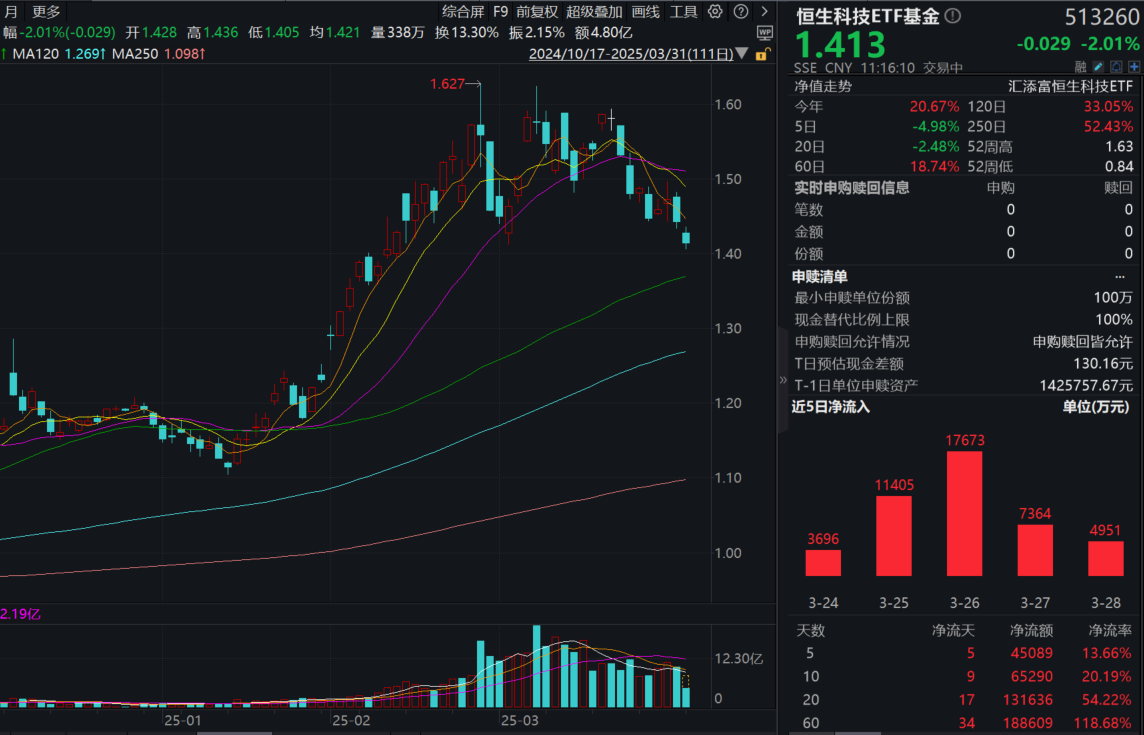
恒科连续回调!小米、阿里、中芯国际均跌超3%,恒生科技ETF基金(513260)跌超2%,融资余额逆势新高!什么信号?中金点评
Xin Lang Cai Jing· 2025-03-31 03:51
Core Viewpoint - The Hong Kong stock market is experiencing a pullback, particularly in technology stocks, despite a recent influx of capital into the Hang Seng Technology ETF, indicating ongoing investor optimism [1][3]. Group 1: Market Performance - The Hang Seng Technology ETF (513260) saw a decline of 2.01% with a trading volume exceeding 500 million HKD, reflecting a premium rate of 0.34% [1]. - Over the past five days, the net inflow into the Hang Seng Technology ETF has surpassed 450 million HKD [1]. - Margin financing for the Hang Seng Technology ETF has reached a new high of over 120 million HKD [3]. Group 2: Sector Performance - Most component stocks of the Hang Seng Technology ETF have experienced a pullback, with notable declines in Xiaomi, Alibaba, Tencent, and Meituan, while Midea Group and Haier Smart Home saw gains post-earnings announcements [5]. - Midea Group reported a net profit of 38.539 billion HKD for 2024, a year-on-year increase of 14.3%, with revenue of 409.1 billion HKD, up 9.5% [5]. - Haier Smart Home achieved a revenue of 285.981 billion HKD for the fiscal year 2024, a 4.29% increase, with a net profit of 18.74 billion HKD, up 12.92% [5]. Group 3: Capital Flows - Southbound capital has continued to flow into the market, with a net purchase exceeding 2.2 billion HKD on the day, and a cumulative net inflow of over 435.7 billion HKD year-to-date, six times that of the same period last year [5]. - The focus of southbound capital is primarily on technology assets, with Xiaomi, Meituan, Alibaba, and Li Auto being the top targets in the past week [7]. Group 4: Earnings and Valuation - The recent earnings season has led to upward revisions in index earnings, particularly for the Hang Seng Technology index, which is viewed positively for the market [9]. - Major companies like Tencent, Xiaomi, and Meituan are expected to contribute significantly to the earnings growth of the Hang Seng Technology index, accounting for 60% of the earnings increment [9]. - The valuation of Chinese technology stocks is considered reasonable compared to U.S. tech stocks and other emerging markets, with a focus on changes in risk premiums driven by capital flows [11]. Group 5: Future Outlook - The market is expected to maintain upward momentum, with the Hang Seng Index potentially reaching 26,000 if risk premiums for technology stocks decrease to early 2021 levels [13]. - The market has shown signs of stabilization and a clear focus on technology as the main investment theme, contrasting with the lack of direction seen from 2021 to 2023 [13].