
稳预期政策

Search documents
保利中海华润位居前三!1月百强房企销售额超1905亿元
Nan Fang Du Shi Bao· 2026-02-03 08:01
Group 1 - The core viewpoint of the articles indicates that the real estate market in January 2026 experienced a stable start, with the top 100 real estate companies achieving a total sales amount of 190.52 billion yuan, reflecting a year-on-year decline of 18.9%, consistent with the decline observed throughout the previous year [1][2] - The sales performance of the top 100 real estate companies in January 2026 aligns with market expectations, continuing the trend from the fourth quarter of the previous year, influenced by the recovery of market expectations and buyer confidence following the new policies introduced in September 2024 [2] - The top three companies in sales for January 2026 were Poly Developments, China Overseas Land & Investment, and China Resources Land, with sales amounts of 15.6 billion yuan, 14.47 billion yuan, and 11.65 billion yuan respectively, indicating stable performance among leading firms [3] Group 2 - In terms of land acquisition, the total amount spent by the top 100 companies in January 2026 was 57.99 billion yuan, representing a significant year-on-year decline of 52.1%, attributed to a high base from the previous year and reduced enthusiasm for land acquisition at the start of the year [4] - The top 10 companies accounted for 25.7% of the new land value, with China Resources Land leading with a new land value of 10.6 billion yuan, followed by Shijiazhuang Chengfa Investment Group with 6.2 billion yuan [4] - The central government has been sending signals to stabilize market expectations, emphasizing the importance of managing expectations to stabilize the real estate market, while local governments have also implemented measures such as lowering down payment ratios for commercial property loans [5]

房地产行业周报:“三道红线”目前约束意义已不大
Orient Securities· 2026-02-03 05:24
Investment Rating - The report maintains a "Positive" investment rating for the real estate industry, indicating an expectation of returns exceeding the market benchmark by more than 5% [5]. Core Viewpoints - The significance of the "three red lines" policy has diminished, suggesting that its policy objectives have largely been achieved, and the industry is transitioning from a "high-risk" model to high-quality development. Regulatory focus has shifted from preventing debt crises to stabilizing market expectations [3][7]. - Recent market data shows that the real estate sector index underperformed compared to the CSI 300 index, with a weekly decline of 2.2% and a relative return of -2.3% [3][8]. - New home sales in 30 cities increased by 23% compared to the previous week, totaling 141 million square meters, although year-to-date sales are down 24% [3][8]. Summary by Sections Market Performance - The real estate sector index has shown a weekly decline of 2.2%, underperforming the CSI 300 index by 2.3% [3][8]. - New home sales in 30 cities reached 141 million square meters, a 23% increase from the previous week, but a 24% decrease year-on-year [3][8]. Sales Data - New home sales increased in the fifth week compared to the fourth week, while second-hand home sales slightly decreased. The new home sales in 30 cities showed a 23% week-on-week increase, but a 24% year-to-date decline [3][8]. - Second-hand home sales in 18 cities totaled 17,000 units, a 2% decrease from the previous week, but a 14% year-to-date increase [3][8]. Investment Recommendations - The report suggests focusing on three categories of investment opportunities: 1. Quality developers with low historical burdens and strong sales growth expectations [4]. 2. Commercial real estate operations, particularly shopping centers that can maintain growth in a slowing economy [4]. 3. Real estate brokerage platforms that benefit from scale and brand advantages, which can enhance performance during market recovery [4].
单周录得量突破1600套 深圳二手房成交量延续回暖势头
Zheng Quan Shi Bao Wang· 2026-01-26 11:49
Group 1 - The Shenzhen second-hand housing market is showing signs of recovery, with a recorded transaction volume of 1,680 units last week, reflecting a 1.6% week-on-week increase, marking three consecutive weeks of growth [1] - The demand side is also improving, with a slight increase in new demand (委买合同), indicating a positive trend in both supply and demand, suggesting that transaction volumes may continue to rise steadily [1] - According to Beike Research Institute, from January 1 to January 25, the second-hand housing contract volume in Shenzhen increased by 26% compared to the same period last month, indicating a robust market performance [1] Group 2 - Real estate agents noted that the market typically experiences a "calm" period before the Spring Festival, but this year has seen a significant increase in transaction volumes, primarily driven by first-time homebuyers [2] - The second-hand housing market is increasingly viewed as a "barometer" for the overall market, with the proportion of second-hand transactions rising to approximately 65% in major cities, up about 4 percentage points from 2024 [2] - The timing of the Spring Festival in 2026 is later than usual, which may shift the traditional sales lull, making the performance from January to early February a critical indicator for the market's outlook for the first quarter and the entire year [2]
中指研究院:2025年房地产销售8.4万亿收官 市场有望在“十五五”中后期逐步完成筑底
智通财经网· 2026-01-19 07:28
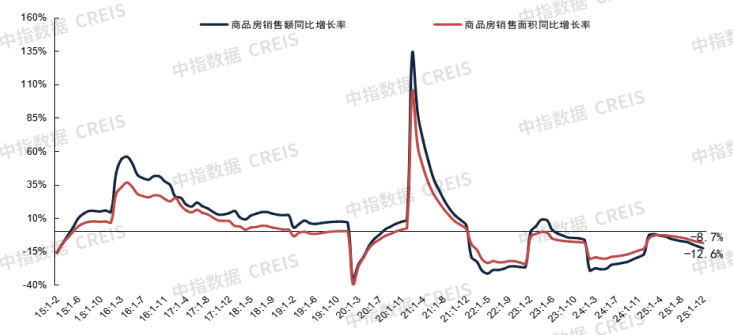
Core Insights - The overall real estate market in China is expected to continue its adjustment trend into 2025, with new residential property sales area projected at 880 million square meters, a year-on-year decline of 8.7%, and sales revenue at 8.4 trillion yuan, down 12.6% [1][3] - Investment, new construction, and completion areas are expected to decrease by 17.2%, 20.4%, and 18.1% respectively, indicating a cautious approach by companies during this market adjustment phase [1][8][10] - The policy environment is signaling a "stabilization of expectations" for 2026, with measures aimed at boosting market confidence through demand and financing support [1][25] Demand - In 2025, the total sales area of new residential properties is expected to be 880 million square meters, down 8.7% year-on-year, with residential sales area at 733 million square meters, a decline of 9.2% [3][30] - The sales revenue for new residential properties is projected at 8.39 trillion yuan, reflecting a 12.6% decrease, with residential sales revenue at 7.33 trillion yuan, down 13.0% [3][30] Supply - Real estate development investment is anticipated to be 8.28 trillion yuan in 2025, a decrease of 17.2%, with residential development investment at 6.35 trillion yuan, down 16.3% [8][30] - The total construction area is expected to be 6.599 billion square meters, a decline of 10.0%, with residential construction area at 4.601 billion square meters, down 10.3% [10][30] Market Dynamics - The market is transitioning into a "stock era," with the proportion of second-hand housing transactions increasing, particularly in major cities where first-time buyers are increasingly opting for second-hand homes [7] - In 2025, the transaction volume of second-hand homes in 30 cities is expected to remain stable, with their market share rising to approximately 65%, an increase of about 4 percentage points from 2024 [7] Financial Aspects - The total funds available to real estate developers are projected to be 9.31 trillion yuan in 2025, down 13.4% year-on-year [16] - Domestic loans are expected to be 1.41 trillion yuan, a decrease of 7.3%, while self-raised funds are projected at 3.31 trillion yuan, down 12.2% [17][19] Future Outlook - For 2026, the real estate market is expected to show a continued decline in sales, with new construction remaining low and investment pressures persisting [26] - The market is anticipated to gradually stabilize as inventory is absorbed, policies are implemented, and social expectations improve, leading to a shift towards high-quality development [1][25][30]

市场主流观点汇总-20251112
Guo Tou Qi Huo· 2025-11-11 23:30
Report Overview - The report objectively reflects the research views of futures and securities companies on various commodity varieties, tracks hot varieties, analyzes market investment sentiment, and summarizes investment driving logic [1] Market Data Commodities - From November 3 to November 7, 2025, PTA rose 1.70% to 4664.00, aluminum rose 1.41% to 21625.00, and other commodities also had different changes. Gold fell 0.07% to 921.26, and some commodities like palm oil, copper, etc., declined [2] A - shares - From November 3 to November 7, 2025, the Shanghai - Shenzhen 300 rose 0.82% to 4678.79, while the CSI 500 fell 0.04% to 7327.91 [2] Overseas Stocks - From November 3 to November 7, 2025, the Hang Seng Index rose 1.29% to 26241.83, while the Nasdaq Index fell 3.04% to 23004.54 [2] Bonds - From November 3 to November 7, 2025, the yield of China's 2 - year treasury bond changed from 2.84 to 1.43, and the 10 - year treasury bond yield decreased by 0.7 bp to 1.81 [2] Foreign Exchange - From November 3 to November 7, 2025, the euro - US dollar exchange rate rose 0.25% to 1.16, and the US dollar index fell 0.18% to 99.55 [2] Commodity Views Macro - financial Sector Stock Index Futures - Strategy views: Among 9 institutions, 3 are bullish, 1 is bearish, and 5 expect a sideways trend. Bullish logic includes long - term domestic policy support, the start of the global AI cycle, improved global capital market sentiment, and the likely easing of Sino - US trade relations. Bearish logic includes better - than - expected US employment and manufacturing, decline in China's PMI, high A - share valuation, and increased risk - aversion sentiment [4] Treasury Bond Futures - Strategy views: Among 7 institutions, 2 are bullish, 0 are bearish, and 5 expect a sideways trend. Bullish logic includes weak fundamentals supporting the bond market, the stock - bond seesaw effect, and central bank net investment. Bearish logic includes inflation repair, increased government bond issuance, and potential market sentiment disturbance [4] Energy Sector Crude Oil - Strategy views: Among 8 institutions, 1 is bullish, 3 are bearish, and 4 expect a sideways trend. Bullish logic includes OPEC's suspension of production increase, short - term interruption of Russian oil, expected end - year risk - asset trading, and cost - price support. Bearish logic includes unexpected US inventory build - up, tight dollar liquidity, expected global inventory build - up, and rising production from new oil fields [5] Agricultural Products Sector Rapeseed Oil - Strategy views: Among 8 institutions, 3 are bullish, 1 is bearish, and 4 expect a sideways trend. Bullish logic includes unexpected decline in rapeseed oil inventory, low inventory and low operating rate of domestic oil mills, and un - resumed domestic rapeseed crushing. Bearish logic includes lack of Chinese demand for Canadian rapeseed, weakening aquaculture demand, expected increase in imports, and potential impact of improved Sino - Canadian relations [5] Non - ferrous Metals Sector Copper - Strategy views: Among 7 institutions, 2 are bullish, 2 are bearish, and 3 expect a sideways trend. Bullish logic includes the expected end of the US government shutdown, slow recovery of overseas copper mines, consumption boost from the "15th Five - Year Plan", and long - term demand from emerging sectors. Bearish logic includes shrinking US manufacturing PMI, rising US dollar index, increasing domestic inventory, and high copper prices suppressing traditional consumption [6] Chemical Sector Glass - Strategy views: Among 7 institutions, 0 are bullish, 4 are bearish, and 3 expect a sideways trend. Bullish logic includes decreased inventory of key enterprises, low - price valuation support, stable and slightly rising spot prices, and long - term policy support. Bearish logic includes weak terminal demand, sufficient industry capacity, high - inventory dragging down prices, and consumption - season pressure [6] Precious Metals Sector Gold - Strategy views: Among 7 institutions, 2 are bullish, 1 is bearish, and 4 expect a sideways trend. Bullish logic includes concerns about the Fed's independence and US fiscal situation, geopolitical uncertainty, increased risk - aversion due to the US government shutdown, and high probability of December interest - rate cut. Bearish logic includes eased Sino - US trade relations, hawkish Fed remarks, strong US service data, and lack of clear bullish factors [7] Black Metals Sector Iron Ore - Strategy views: Among 8 institutions, 0 are bullish, 4 are bearish, and 4 expect a sideways trend. Bullish logic includes decreased global shipments, rising basis during price decline, and increased blast - furnace operating rate. Bearish logic includes continuous over - seasonal inventory build - up at ports, significant increase in arrivals, difficult de - stocking of downstream products, decreased molten iron production, and increased negative - feedback pressure on steel mills [7]
固收、宏观周报:股市或受益于风险偏好有望提升-20250513
Shanghai Securities· 2025-05-13 07:31
1. Report Industry Investment Rating No relevant content provided. 2. Core View of the Report - The stock market may benefit from the expected increase in risk appetite, and the bond market yield will fluctuate at a low level. A - shares may benefit from the increase in risk appetite due to potential policy support and positive progress in Sino - US economic and trade talks. The bond market price has fully factored in the central bank's reserve requirement ratio cut and interest rate cut expectations, and the bond yield may continue to fluctuate at a low level. Gold still has a long - term positive outlook, but short - term volatility may increase [11]. 3. Summary by Relevant Catalogs Stock Market - In the past week (20250505 - 20250511), US stocks declined, with the Nasdaq, S&P 500, and Dow Jones Industrial Average changing by - 0.27%, - 0.47%, and - 0.16% respectively, and the Nasdaq China Technology Index changing by - 2.46%. Meanwhile, the Hang Seng Index rose 1.61%, and the FTSE China A50 Index rose 2.63% [2]. - A - shares generally rose. The wind All - A Index rose 2.32%. Among them, the CSI A100, CSI 300, CSI 500, CSI 1000, CSI 2000, and wind micro - cap stocks changed by 2.13%, 2.00%, 1.60%, 2.22%, 3.58%, and 5.65% respectively. Growth and blue - chip stocks in the Shanghai and Shenzhen stock markets both rose [3]. - All 30 CITIC industries rose. Industries with relatively large increases included national defense and military industry, communication, banking, machinery, new energy, and comprehensive, with weekly increases of more than 3.5% [4]. Bond Market - In the past week (20250505 - 20250511), the yield of treasury bonds with a maturity of less than 10 years decreased, and the yield of those with a maturity of 10 years and above increased, making the yield curve steeper. The 10 - year treasury bond futures rose 0.06% compared to April 30, 2025 [5]. - The capital price decreased, and the bond market leverage level increased. As of May 9, 2025, R007 was 1.5805%, down 25.91 BP from April 30, 2025, and DR007 was 1.5409%, down 25.77 BP. The central bank had a net withdrawal of 781.7 billion yuan in the past week. The 5 - day average of inter - bank pledged repurchase volume increased from 4.97 trillion yuan on April 30, 2025, to 6.32 trillion yuan on May 9, 2025 [6]. - In the past week (20250505 - 20250511), the price of US treasury bonds fell, and the yield curve shifted upward as a whole. As of May 9, 2025, the yield of the 10 - year US treasury bond rose 4 BP to 4.37% compared to May 2, 2025 [7]. Foreign Exchange Market - In the past week (20250505 - 20250511), the US dollar appreciated. The US dollar index rose 0.38%, the US dollar against the offshore RMB exchange rate rose 0.40% to 7.2402, and the US dollar against the on - shore RMB exchange rate fell 0.24% to 7.2461 [8]. Commodity Market - In the past week (20250505 - 20250511), the spot price of London gold rose 2.30% to $3324.55 per ounce, and the COMEX gold futures price rose 3.14% to $3326.30 per ounce [9]. Foreign Trade - From January to April, China's cumulative export increased by 6.4% year - on - year, 0.6% higher than that in the first three months. Although the cumulative year - on - year growth rate of exports to the US decreased from 4.5% in January - March to - 2.5% in January - April, the cumulative year - on - year growth rates of exports to other countries and regions such as ASEAN, the EU, Hong Kong, Japan, and South Korea increased. The cumulative year - on - year import decreased by 5.2%, 1.8% higher than that in the first three months. The trade surplus in January - April was $368.76 billion, an increase of $113.808 billion year - on - year [10].