
管理变革

Search documents
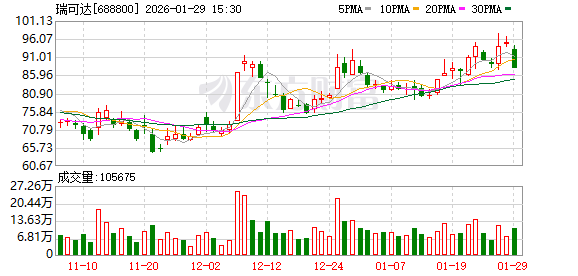
瑞可达:预计2025年净利同比增长64.2%-81.43%
Zhong Guo Zheng Quan Bao· 2026-01-29 09:41
Core Viewpoint - The company Ruikeda (688800) has announced its earnings forecast for 2025, projecting a net profit attributable to shareholders of between 288 million to 318 million yuan, representing a year-on-year growth of 64.2% to 81.43% [4]. Financial Performance - The expected net profit for 2025 is between 288 million to 318 million yuan, with a non-recurring net profit forecasted to be between 274 million to 303 million yuan, indicating a year-on-year increase of 67.85% to 85.54% [4]. - As of January 29, the company's price-to-earnings ratio (TTM) is approximately 56.92 to 62.89 times, with a price-to-book ratio (LF) of about 7.89 times and a price-to-sales ratio (TTM) of around 5.75 times [4]. Business Growth Factors - The company's performance improvement is attributed to steady growth across various business segments, leading to an increase in order volume [13]. - Continuous advancements in technology, process innovation, and production automation have enhanced product competitiveness and reduced costs [13]. - Management reforms have begun to yield results, with increased labor efficiency and optimized operational efficiency metrics [13]. - There has been a notable increase in orders from overseas factories compared to the previous year, along with improved operational capabilities [13]. - Initial success has been observed in the expansion of new business areas [13].


ERP系统深度测评:它如何重塑企业运营的“数字骨架”?
Sou Hu Cai Jing· 2026-01-14 10:22
Core Insights - The article emphasizes that ERP systems are not just software but a comprehensive management philosophy that integrates logistics, finance, and information flows within a company [1][2] - Successful ERP implementation relies more on management practices than on technology, indicating that it is a transformative process affecting business workflows and corporate culture [3] ERP Deployment Models - Companies face a choice between cloud-based SaaS and on-premise deployment, which involves considerations of IT strategy, cost structure, and data governance [4] - Cloud ERP is favored by growing companies for its ease of use and lower maintenance, while on-premise solutions offer greater control and customization but require significant upfront investment [4][5] Evaluation Framework - A scientific evaluation framework for ERP systems should include functionality, technology, ecosystem, and economic viability, with weights assigned based on the company's current situation [6] - Functionality must be assessed not just on breadth but also on industry-specific adaptability, as different sectors have unique requirements [7] Technical Architecture - The technical foundation of an ERP system is crucial for its longevity and future costs, with microservices architecture allowing for easier upgrades and integration with existing systems [8] Vendor Ecosystem - Evaluating the ERP vendor is essential, considering their financial health, local market investment, implementation partner capabilities, and the activity level of the user community [9] Common Misconceptions - Many ERP projects fail due to management misconceptions rather than technical issues, such as the belief that purchasing advanced software alone will resolve management problems [10] - Over-customization and scope creep during implementation can lead to budget overruns and future upgrade challenges [10] Professional Evaluation Platforms - Utilizing neutral, professional third-party platforms for ERP selection can enhance decision-making efficiency by providing structured decision support and verified user feedback [11][12] Frequently Asked Questions - The necessity of ERP systems is determined by business complexity and management pain points rather than company size, making lightweight or industry-specific ERP solutions valuable for smaller firms [14] - The implementation timeline varies based on company size and process complexity, with risk control strategies including strong project leadership and phased rollouts [14] - Long-term cost comparisons between cloud and on-premise ERP depend on various factors, including cash flow preferences and IT capabilities [14]
生于忧患:从任正非到黄仁勋,一流企业家的“心法”都是一致的!
Sou Hu Cai Jing· 2026-01-06 02:21
Core Insights - The article emphasizes the importance of maintaining a sense of crisis and awareness of potential failure, as success is often temporary and can lead to complacency [1][7] - It highlights that true success is not merely about achieving milestones but about enduring challenges and continuing to grow, as exemplified by companies like Huawei and Nvidia [3][5] Group 1: Crisis Awareness - The concept of "生于忧患死于安乐" (born in worry, die in comfort) is central to the mindset of successful entrepreneurs, fostering a culture of continuous improvement and vigilance [4][7] - Entrepreneurs who maintain a fear of being overtaken by competitors are less likely to become complacent and more likely to address their weaknesses [6][8] Group 2: Resilience and Adaptation - The article discusses how enduring hardships is essential for personal and organizational growth, with examples from leaders like Ren Zhengfei and Jensen Huang, who view adversity as a catalyst for development [5][11] - The narrative suggests that the ability to adapt to changing environments is more critical than the initial success, as demonstrated by the evolution of companies in the tech sector [3][10] Group 3: Continuous Striving - Entrepreneurship is portrayed as a relentless journey where one must keep moving forward despite challenges, with the notion that there is no such thing as a smooth path in life [9][10] - The article concludes that enduring struggles is a necessary part of achieving long-term success, reinforcing the idea that overcoming difficulties leads to maturity and resilience [11]


大连重工(002204) - 002204大连重工投资者关系管理信息20251204
2025-12-04 11:08
Group 1: Company Transformation and Management Changes - The company has implemented six major management transformations since the restructuring in 2022, focusing on quality management, lean management, integrated supply chain management, integrated product development, organizational transformation, and digital transformation [2][3][4]. - The continuous improvement in net profit margin is attributed to effective management changes and a solid foundation for growth, with a focus on scale effects and cost control measures [4][5]. Group 2: Cost Reduction and Efficiency Improvement - The company has set comprehensive cost reduction targets that include procurement, production processes, design optimization, and expense control, with a focus on enhancing operational quality and efficiency [6][7]. - Fixed costs are strictly controlled through dynamic monitoring, while hidden costs are reduced via lean management practices and digital transformation initiatives [7][8]. Group 3: Order and Revenue Insights - As of November 2025, the company has an order backlog of 37.9 billion CNY, with material handling equipment accounting for 36.9% of this total [8][9]. - The order distribution by sector includes mining (9%), metallurgy (23%), energy (24%), ports (17%), and shipbuilding (4%) [9]. Group 4: Product Performance and Market Position - The gross margin for material handling equipment has improved significantly, rising from 15-16% in 2021-2022 to 24-25% currently, driven by strong competitive advantages and market demand [10][11]. - The company has established strategic partnerships with major global players, enhancing its international market presence and product competitiveness [10][11]. Group 5: Future Growth and Strategic Goals - Future growth drivers are expected to focus on bulk material handling and wind power products, with plans to strengthen overseas market expansion and increase market share [12][13]. - The company aims to achieve steady growth in net profit margins through ongoing management reforms and alignment with national policies supporting heavy equipment development [13][14]. Group 6: Shareholder Engagement and Capital Expenditure - The company is implementing a stock incentive plan to enhance governance and attract talent, aligning the interests of shareholders and the core team [14]. - Future capital expenditures will focus on strategic areas such as smart manufacturing and internationalization, with a commitment to balancing development investments and shareholder returns [14].

如何让员工像华为人那样奋斗?一个老板感叹:我确实做不到任正非那样
Sou Hu Cai Jing· 2025-12-03 02:22
Group 1 - The core idea is that merely adopting management methods from successful companies like Huawei does not guarantee employee motivation; true motivation comes from fair profit distribution and recognizing employee contributions [1][4] - Companies must provide opportunities for employee growth, which relies on the leadership's insight and ability to create value [3] - Profit distribution is a critical aspect of a company's competitive edge, and fair internal distribution mechanisms are essential for effective management [4] Group 2 - Even with the ability to identify opportunities and distribute profits fairly, it may not be sufficient to inspire employees to work as hard as those at Huawei [5] - The culture of hard work is exemplified by leaders like Ren Zhengfei, who practices what he preaches, thereby setting a standard for employees [6][7] - Laziness and complacency are seen as detrimental to a company's success, and continuous improvement in management is necessary to avoid stagnation [7] Group 3 - The emphasis on a culture of striving is not unique to Huawei; companies like Amazon also promote a similar ethos, encouraging a mindset of continuous growth and vigilance [8] - Both Ren Zhengfei and Jeff Bezos highlight that success is an illusion, and ongoing effort is required to avoid being left behind in a competitive market [9]

万华化学(600309):管理变革成效凸显,自研技术加速转化
Bank of China Securities· 2025-09-01 07:25
Investment Rating - The investment rating for the company is "Buy" [4][6] Core Views - The company has shown significant improvements in management reforms, enhancing resource allocation efficiency while driving innovation for industrial upgrades. The acceleration of self-developed technology conversion is expected to strengthen the company's competitiveness in the polyurethane sector and its technological innovation capabilities in new materials [4][6] Financial Performance Summary - For the first half of 2025, the company achieved operating revenue of RMB 90.901 billion, a year-on-year decrease of 6.35%. The net profit attributable to the parent company was RMB 6.123 billion, down 25.10% year-on-year. In Q2 2025, revenue was RMB 47.834 billion, a decline of 6.04%, with a net profit of RMB 3.041 billion, down 24.30% year-on-year [4][10][11] - The company's revenue from the polyurethane, petrochemical, and fine chemicals segments for the first half of 2025 was RMB 36.888 billion, RMB 34.934 billion, and RMB 15.628 billion, reflecting year-on-year changes of +4.04%, -11.73%, and +20.41% respectively [9] Valuation Metrics - The estimated EPS for 2025-2027 is projected to be RMB 4.29, RMB 5.61, and RMB 5.61 respectively. The current stock price corresponds to a PE ratio of 15.9x for 2025, 12.2x for 2026, and 12.2x for 2027, indicating a favorable valuation outlook [6][8] Shareholder Information - The major shareholder is Yantai Guofeng Investment Holding Group Co., Ltd., holding 21.59% of the shares [2]

大港油田:"干"字当头培植产业增长点
Zhong Guo Chan Ye Jing Ji Xin Xi Wang· 2025-08-06 22:07
Group 1 - The core viewpoint of the articles highlights the proactive measures taken by Dagang Oilfield to innovate and develop unconventional energy resources, including shale oil and geothermal projects, while maintaining stable production in traditional areas [1][2] - Dagang Oilfield is focusing on accelerating the development of new production capabilities that are characteristic of the company, aiming for high-quality development through a second entrepreneurial effort [1] - The company is committed to technological innovation and management transformation to control costs and enhance production efficiency in both conventional and unconventional oil and gas sectors [1] Group 2 - Dagang Oilfield is leveraging its rich geothermal resources and strategic location in the Bohai region to promote the rapid development of new energy and gas storage businesses, contributing to a multi-energy complementary and low-carbon energy system [1] - The company is advancing its digital transformation by implementing smart oilfield initiatives, including the rollout of smart oilfield 1.0 and the development of smart oilfield 2.0 [2] - As a pilot unit for the Beidou project, Dagang Oilfield is integrating Beidou technology with oil and gas production to enhance safety and operational efficiency [2]
又被前员工“攀咬”,被指控“欺诈发债”?华熙生物:谣言!
Nan Fang Du Shi Bao· 2025-07-27 01:53
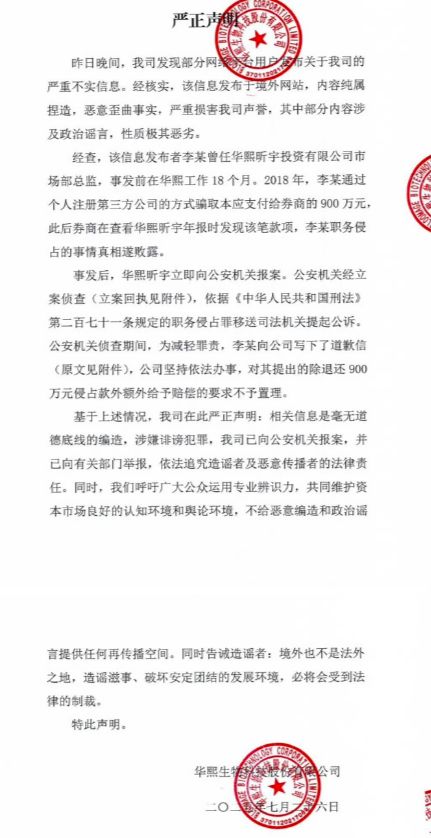
Core Viewpoint - The article discusses the controversy surrounding Hyaluronic Acid giant Huaxi Bio (688363.SH), following accusations of financial fraud and bond issuance fraud made by a former employee, Li, who previously served as the marketing director of a subsidiary [1][2]. Group 1: Allegations and Company Response - Li, the former marketing director, accused Huaxi Bio of "financial fraud" and "fraudulent bond issuance" [1]. - In response, Huaxi Bio issued a strong statement denying the allegations, labeling them as "morally bankrupt fabrications" and asserting that they severely damage the company's reputation [1][7]. - The company reported that it has filed a police complaint against Li and intends to pursue legal action against those spreading the allegations [1][7]. Group 2: Historical Context and Internal Issues - Huaxi Bio revealed that in 2018, Li had embezzled 9 million yuan (approximately 1.3 million USD) through a third-party company he registered, which was meant for a brokerage firm [3][4]. - Following the discovery of this embezzlement, Huaxi Bio reported the incident to the police [3]. - Li had previously written an apology letter, promising to return the embezzled funds and offering an additional compensation of 1.5 million yuan (approximately 220,000 USD) [4]. Group 3: Management Changes and Company Performance - Recently, Huaxi Bio has undergone significant management changes, with the CEO emphasizing a strict governance approach to address internal issues and corruption [7][9]. - The company announced the resignation of three senior executives as part of its restructuring efforts [9]. - Huaxi Bio's financial performance has declined, reporting a revenue of 5.371 billion yuan (approximately 800 million USD) in 2024, a decrease of 11.6% year-on-year, and a net profit of 164 million yuan (approximately 24 million USD), down 72.27% year-on-year [10].

山东钢铁:“扭亏增盈”逐步兑现,业绩改善未来可期-20250430
Xinda Securities· 2025-04-30 10:23
Investment Rating - The investment rating for Shandong Steel is "Buy" [1][8] Core Views - The report highlights that Shandong Steel is gradually turning losses into profits, with future performance improvements expected [1][4] - The company reported a total revenue of 82.094 billion yuan in 2024, a year-on-year decrease of 9.26%, and a net profit attributable to shareholders of -2.258 billion yuan, indicating an expanded loss compared to the previous year [1][2] - The first quarter of 2025 showed signs of recovery with a significant increase in steel production and a slight rise in steel prices, suggesting a potential turnaround in performance [4][8] Financial Performance Summary - In 2024, the company achieved a total revenue of 82.094 billion yuan, down 9.26% year-on-year, and a net profit of -2.258 billion yuan, which is a 465% increase in loss compared to 2023 [1][7] - The first quarter of 2025 saw a revenue of 19.255 billion yuan, a 15.66% decrease year-on-year, but a significant reduction in losses with a net profit of -0.14 billion yuan [2][4] - The company’s steel production in 2024 was 14.83 million tons, a slight decrease from the previous year, but a notable recovery in the first quarter of 2025 with production reaching 4.04 million tons, a year-on-year increase of 22,000 tons [4][8] Strategic Developments - The introduction of China Baowu Steel Group has led to significant improvements in operational efficiency, with a focus on management reforms and cost reductions [4][5] - The company aims to achieve profitability through strategic goals such as "turning losses into profits" and enhancing operational quality [4][8] - Shandong Steel has actively engaged in share buybacks and stock purchases by major shareholders to bolster market confidence [8]

山东钢铁(600022):“扭亏增盈”逐步兑现,业绩改善未来可期
Xinda Securities· 2025-04-30 09:44
Investment Rating - The investment rating for Shandong Steel is "Buy" [1][8] Core Views - The report highlights that Shandong Steel is gradually turning losses into profits, with future performance improvements expected [1][4] - The company reported a total revenue of 82.094 billion yuan in 2024, a year-on-year decrease of 9.26%, and a net profit attributable to shareholders of -2.258 billion yuan, indicating an expanded loss compared to the previous year [1][4] - The first quarter of 2025 showed signs of recovery with a significant increase in steel production and a reduction in losses [2][4] Financial Performance Summary - In 2024, the company’s steel production was 14.83 million tons, a slight decrease of 0.012 million tons year-on-year [4] - The average selling price of steel in 2024 was 3,643 yuan per ton, down 7% from 2023 [4] - The first quarter of 2025 saw a rebound in production to 4.04 million tons, a year-on-year increase of 0.22 million tons [4] - The report projects net profits for 2025-2027 to be -0.33 billion yuan, 0.723 billion yuan, and 1.009 billion yuan respectively, with EPS expected to be 0.00, 0.07, and 0.09 yuan per share [8] Strategic Developments - The introduction of China Baowu Steel Group has led to significant improvements in operational efficiency and management practices [4][5] - The company is focusing on management reforms and cost reductions, aiming for a turnaround with clear goals set for profitability [4][5] - Shandong Steel has actively engaged in share buybacks and has received support from its controlling shareholder to boost market confidence [8]