
资产负债表正常化

Search documents
巴克莱:美联储缩表将耗时多年 或需降息对冲 五年市场需额外吸收1.7万亿美元10年期等价债务推高成本40——50基点
Sou Hu Cai Jing· 2026-02-10 23:36
Group 1 - The core viewpoint is that the transition to a smaller Federal Reserve balance sheet requires close coordination between the central bank and the Treasury to avoid excessive market volatility [1] - The normalization of the balance sheet is expected to be a multi-year process, with potential risk premiums demanded by investors during the transition [1][3] - The Federal Reserve's balance sheet peaked at approximately $8.9 trillion in June 2022, significantly expanded from $800 billion two decades ago, and is projected to decrease to $6.6 trillion by November 2025 [1] Group 2 - Barclays notes that the Federal Reserve could reduce its balance sheet by stopping the Reserve Management Purchases (RMP), but this may lead to renewed funding pressures [2] - To achieve meaningful balance sheet reduction, the demand for reserves by banks must be lowered, with current bank reserves at $2.94 trillion and a suggested reduction in the reserve ratio from 12% to 8-9% [2] - An alternative approach involves reinvesting maturing long-term government bonds and mortgage-backed securities into short-term government debt, which requires close coordination with the Treasury to avoid increasing long-term bond issuance costs [2] Group 3 - Both proposed outcomes are not ideal for the Treasury, and the Federal Reserve may ultimately need to lower policy rates to counteract the tightening market environment [3] - Significant balance sheet reduction is feasible, provided that the Federal Reserve and the Treasury have clear and aligned objectives to stabilize market expectations [3]

【巴克莱:美联储缩表将耗时多年,或需降息来抵消金融环境收紧】巴克莱策略师表示,美联储向更小规模的资产负债表过渡,将需要央行与财政部之间进行密切协调,以防止市场波动过大。他们写道,这一过程将导致金融环境收紧,而曾呼吁大幅削减规模达6.6万亿美元资产组合的美联储主席提名人凯文·沃什,可能不得...
Sou Hu Cai Jing· 2026-02-10 21:47
Core Viewpoint - Barclays strategists indicate that the Federal Reserve's transition to a smaller balance sheet will take years and may require interest rate cuts to offset tightening financial conditions [1] Group 1 - The process of normalizing the balance sheet will necessitate close coordination between the Federal Reserve and the Treasury to prevent excessive market volatility [1] - The transition is expected to lead to tighter financial conditions, prompting potential adjustments in policy rates by the Fed [1] - Kevin Warsh, the nominee for Fed Chair, has called for a significant reduction of $6.6 trillion in the asset portfolio, which may conflict with the Treasury's objectives [1] Group 2 - Barclays strategists, Anshul Pradhan, Samuel Earl, and Demi Hu, emphasize that the normalization process will be prolonged and span multiple years [1] - Investors are likely to demand risk premiums during this transition due to the misalignment of goals between the Fed and the Treasury [1]
沃什的政策可能落地一半
Xinda Securities· 2026-02-06 13:31
Group 1: Policy Stance of Warsh - Warsh's hawkish stance should not be interpreted as aggressive; he opposes large-scale asset purchases and aims for a moderate approach to balance sheet normalization[6] - Warsh's approach to balance sheet reduction is not a quick process; he advocates for a steady and gradual reduction rather than an abrupt change[7] - Warsh's dual identity as a supporter of the first round of QE and an opponent of the second round indicates a nuanced view on monetary policy[7] Group 2: Federal Reserve's Policy Direction - The Federal Reserve's policy this year is likely to be dominated by interest rate cuts rather than balance sheet reduction, as the latter faces significant constraints[12] - The current environment suggests that achieving interest rate cuts is easier than implementing balance sheet reduction, especially given the political context of the upcoming midterm elections[16] - The Federal Reserve's balance sheet is expected to remain stable or slightly increase, with long-term bond yields likely to experience moderate declines[18] Group 3: Market Implications - Short-term hawkish expectations may lead to a temporary strengthening of the dollar before Warsh's official appointment, after which a shift towards interest rate cuts could weaken the dollar[18] - The 10Y-2Y yield spread is expected to widen as short-term yields decline more significantly due to the anticipated interest rate cuts[18] - The U.S. federal debt-to-GDP ratio has surged to over 120%, complicating the Fed's balance sheet management and monetary policy decisions[19]
日本央行审议委员小枝淳子:金融状况仍具宽松性,将继续刺激消费和投资
Sou Hu Cai Jing· 2025-11-20 02:02
Core Insights - The Bank of Japan's policy must consider both short-term and long-term impacts on economic activity, prices, financial markets, and the financial system [1] - The current financial conditions remain accommodative, which will continue to stimulate consumption and investment [1] - Inflation expectations have been steadily rising over the past few years, influenced by soaring food prices [1] Group 1 - The actual interest rates in Japan are still at low levels [1] - The Bank of Japan should make policy judgments based on available data and information at each point in time [1] - There is a need to discuss the optimal size and structure of the balance sheet from both asset and liability perspectives [1] Group 2 - As of October, the latest forecasts indicate that the risks to economic activity for the fiscal year 2025 are balanced, while the risks for fiscal year 2026 are skewed to the downside [1] - The Bank of Japan will consider corporate wage and pricing behavior, as well as exchange rates and import price trends, when assessing price risks [1]


美联储或考虑扩大持有规模,接近“流动性补给”的新阶段
Huan Qiu Wang· 2025-11-09 01:09
Core Viewpoint - The Federal Reserve may soon consider expanding its securities holdings to maintain sufficient reserves in the banking system, indicating a shift towards a new phase of liquidity support after two years of balance sheet reduction [1][3]. Group 1: Federal Reserve Actions - John Williams, President of the New York Federal Reserve, stated that the potential bond purchases would be a natural step in executing a strategy for sufficient reserves, not a change in policy stance [3]. - Since the initiation of balance sheet reduction in June 2022, the Federal Reserve's balance sheet has decreased by $2.2 trillion, reducing its GDP ratio from a peak of 35% to approximately 21%, making the timing for halting the reduction more appropriate [1]. Group 2: Market Implications - Financial institutions have increasingly utilized repurchase agreement facilities to address short-term funding pressures since October [1]. - The Markit iBoxx index for Chinese dollar bonds showed a 0.1% decline in returns as of October 31, with investment-grade bond returns also down by 0.1%, while high-yield bond returns remained unchanged [1].
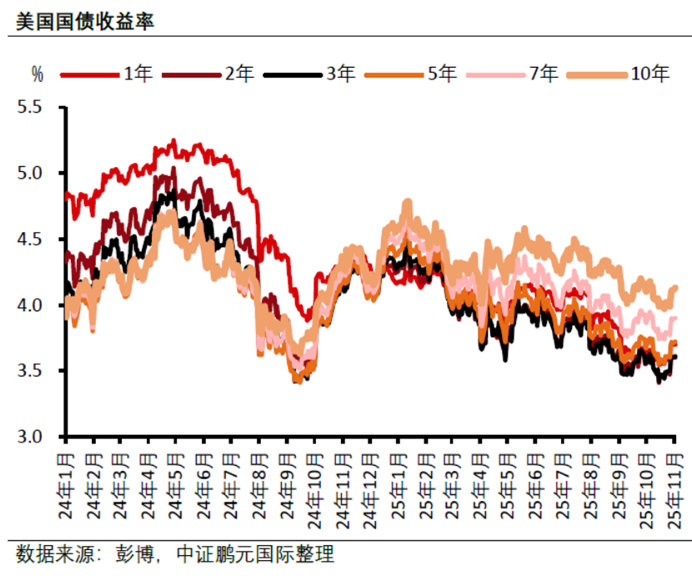
交银国际:美联储预防式降息延续 短期政策路径不确定性预计将有所上升
智通财经网· 2025-10-31 05:56
Core Viewpoint - The Federal Reserve is transitioning from a "preventive rate cut" approach to a "wait-and-see" stance, leading to increased uncertainty in short-term policy paths [1] Group 1: Federal Reserve's Rate Decisions - The Federal Reserve cut rates by 25 basis points to a range of 3.75%-4.00% during the October meeting, amidst a complex backdrop due to the U.S. government shutdown affecting key employment data [2] - The decision reflects a proactive approach to mitigate potential job market downturns, despite stable private sector employment indicators [2][3] - Internal divisions within the Federal Reserve are growing, with some members advocating for more aggressive cuts while others suggest pausing [3] Group 2: Economic Indicators and Market Reactions - The market's expectation for a December rate cut has decreased from 82.4% to 63.8% following the October meeting, indicating a shift in sentiment [1] - The upcoming December decision will heavily depend on employment and inflation data post-government shutdown, with a focus on whether job market indicators show significant improvement [1][3] - Recent easing of U.S.-China trade tensions may alleviate inflationary pressures from tariffs, presenting a potential positive factor for the economy [3] Group 3: Monetary Policy and Market Conditions - The Federal Reserve announced it will stop balance sheet reduction starting December 1, as liquidity tightening signals have emerged in the U.S. money market [4] - Since the initiation of balance sheet reduction in June 2022, the Fed's balance sheet has contracted by $2.2 trillion, reducing its GDP ratio from 35% to approximately 21% [4] - The dollar index has shown signs of a rebound, and with the Fed's hawkish signals, market volatility risks are expected to increase, potentially impacting metal prices and emerging market assets [5]
日本央行放风?酝酿启动ETF抛售,出售方案渐趋明朗,时机成最大悬念
Hua Er Jie Jian Wen· 2025-09-11 06:51
Core Viewpoint - The Bank of Japan is accelerating plans to reduce its substantial ETF holdings, with a gradual market sale of these risk assets being the primary strategy. The timing of this policy initiation remains uncertain [1][2]. Group 1: ETF Reduction Strategy - The internal strategy of the Bank of Japan will focus on "phased, small-batch, gradual sales" rather than alternative methods like transferring to state-owned entities [2]. - The Bank of Japan's experience from 2002 to 2010, where it sold bank stocks, will inform its approach to selling ETFs, aiming to avoid market turmoil through long-term, small-scale transactions [2]. - Since 2010, the Bank of Japan has accumulated ETF holdings amounting to 35 trillion yen (approximately 251 billion USD), which now faces pressure for market-driven "digestion" [2]. Group 2: Necessity of ETF Sales - Selling ETFs is viewed as a crucial step for the current governor, Ueda Kazuo, to conclude the large-scale monetary stimulus initiated by his predecessor [3]. - Unlike government bonds that automatically drop off the balance sheet upon maturity, ETFs do not have a maturity date, necessitating active sales for balance sheet normalization [3]. - The Bank of Japan has maintained a cautious stance regarding the timing and method of ETF sales, emphasizing the need for a "proper" price to avoid losses or significant market disruption [3]. Group 3: Timing and Political Factors - The timing of the ETF sale remains a significant issue, with no consensus reached within the Bank of Japan on when to proceed [4]. - Analysts suggest that the Bank of Japan is unlikely to make a decision on ETF sales in the upcoming policy meeting, although comments may be made afterward [4]. - Political uncertainty following the resignation of Prime Minister Kishida Fumio has created a challenging environment for the Bank of Japan to act, as the new government's policy direction is still unclear [5].
日本央行审议委员田村直树:日本央行必须稳步推进资产负债表的正常化,尽管这可能需要一些时间。
news flash· 2025-06-25 01:14
Core Viewpoint - The Bank of Japan must steadily advance the normalization of its balance sheet, although this process may take some time [1] Group 1 - The statement emphasizes the importance of a gradual approach to balance sheet normalization by the Bank of Japan [1]