长期持有

Search documents
别再只看收益率了,这四个指标,帮你的基金账户做次体检!
雪球· 2026-03-01 04:10
Core Viewpoint - The article emphasizes the importance of using four "CT indicators" to assess investment health and improve investment strategies, focusing on long-term investment and risk management [3]. Group 1: Investment Operation Level - The first indicator is Time-Weighted Return (TWR), which reflects the fund manager's ability to operate the fund, while the Money-Weighted Return (MWR) indicates the investor's timing ability [6][7]. - A standard check shows that if TWR is less than MWR, the investor's operation is better than the fund itself, indicating a good level of skill [9]. - An example is provided where an ordinary investor achieved a 0.82% higher MWR than TWR over 25 years through long-term investment and counter-cyclical buying [13][14]. Group 2: Earning Difficulty Level - The second indicator is the Sharpe Ratio, calculated as return divided by volatility, measuring the return per unit of risk taken [20][21]. - A Sharpe Ratio below 1 indicates excessive risk, while a higher ratio suggests better risk-adjusted returns [22][24]. - The example investor has a Sharpe Ratio of 1.99, outperforming the CSI 300 at 1.5 and the NASDAQ 100 at less than 1, indicating easier profit generation [25][26]. Group 3: Account Recovery Ability - The third indicator assesses the account's ability to recover from drawdowns, with a shorter recovery time than the benchmark indicating better self-healing capability [30][34]. - The example investor experienced a maximum drawdown recovery in 23 trading days, compared to 61 days for the benchmark and 65 days for the CSI 300 [39]. Group 4: Investment Experience - The fourth indicator focuses on the probability of profit versus loss over time, with a higher probability of profit leading to a better investment experience [45]. - The example investor has a 99.6% probability of profit after holding a fund for six months due to diversified investments across different fund types [46][47]. - The article concludes that diversified investment and long-term holding are key to achieving better investment outcomes [50].


一文吃透投资基础暗语,新手“养基”告别懵懂
Xin Lang Cai Jing· 2026-02-25 09:42
Core Insights - The article aims to demystify common investment jargon and concepts for new investors, enhancing their understanding and experience in finance [1] Group 1: Investment Concepts - "仓位" (position) refers to the total amount of funds allocated for buying stocks or funds, typically divided into ten parts, with a 10% position indicating 10% of available funds used for investment [1] - "空仓" (empty position) means having no investments, with all funds in cash, indicating a wait-and-see approach [2] - "轻仓" (light position) indicates investing less than 30% of available funds, while "半仓" (half position) means investing around 50%, balancing risk and opportunity [3] - "重仓" (heavy position) refers to investing over 70% of available funds, and "全仓" (full position) means investing all available funds [3] - Dynamic adjustment of positions is essential, with terms like "加仓" (adding position) for increasing investments and "减仓" (reducing position) for selling part of the holdings [4] Group 2: Trading Strategies - "止盈" (take profit) involves selling part of the investment after making a profit, while "止损" (stop loss) means selling to prevent further losses when reaching a predetermined loss threshold [4] - "梭哈" (all-in) refers to investing all funds at once, while "做多" (going long) indicates a bullish outlook, often involving leverage [5] - "做空" (short selling) is the opposite, betting on a decline in stock prices [5] Group 3: Market Behavior - Terms like "追涨" (chasing gains) and "杀跌" (panic selling) describe common emotional reactions to market movements, often leading to poor investment decisions [5] - "踏空" (missing out) refers to the frustration of not investing during a market rise, while "卖飞" (selling too early) describes selling an investment before it significantly appreciates [5] Group 4: Investment Duration and Strategies - Short-term holding is defined as holding investments for less than a year, while long-term holding refers to maintaining investments for over a year, which is generally more suitable for new investors [6] - "定投" (regular investment) involves investing a fixed amount regularly to mitigate price volatility, though it is not considered the best investment strategy [6] - The article emphasizes that understanding these basic terms and concepts is crucial for building a foundational investment logic before delving into more complex knowledge [6]
雪球基金获第二十届中国私募基金风云榜年度优秀独立三方销售机构
雪球· 2026-02-10 09:08
Core Viewpoint - The article highlights the recognition of Beijing Xueqiu Fund Sales Co., Ltd. as the "Annual Excellent Independent Third-Party Fund Sales Institution" at the 2025 China Private Equity Fund Awards, emphasizing its commitment to "asset allocation and long-term holding" and its established position in the independent third-party sales sector [1][4]. Group 1: Award Significance - The China Private Equity Fund Awards, held for the 20th time, adhere to principles of fairness, justice, and openness, with this year's evaluation focusing on strategy innovation, long-term value, and responsibility [4]. - The award for "Annual Excellent Independent Third-Party Fund Sales Institution" assesses institutions based on comprehensive service capabilities, innovation capabilities, and sustainable development capabilities [4]. Group 2: Company Achievements - Xueqiu Fund's award is attributed to its unique "community + wealth management" ecosystem and its continuous professional capabilities [4]. - The company offers a compliant fund distribution business under its fund sales license, selecting over 200 quality managers and 600 premium private equity products to provide high-net-worth clients with one-stop asset allocation solutions [4][5]. Group 3: Future Commitment - Xueqiu Fund aims to uphold its core philosophy of "long-term investment and asset allocation," continuously upgrading its product selection system and enhancing its "community + wealth management" ecosystem [5][6]. - The company is committed to promoting investor education and contributing to the high-quality development of the private equity fund industry [6]. Group 4: Company Background - Established in 2010, Xueqiu operates as a comprehensive online wealth management platform, focusing on long-term investment and asset allocation, with over 78 million users interested in investment [7].

金价暴跌9%!同一天有人赚30万,有人17万归零:黄金世界的两种命运
Sou Hu Cai Jing· 2026-02-02 11:10
Group 1 - The article discusses the contrasting behaviors of older and younger investors in the gold market, highlighting that older individuals view gold as a stable asset for long-term holding, while younger investors engage in speculative trading [4][6]. - Older investors prefer physical gold for its tangible value and are less affected by price fluctuations, often holding onto their investments regardless of market volatility [4][8]. - In contrast, younger investors are more inclined to use leverage and react emotionally to market changes, leading to higher risks and potential losses [6][10]. Group 2 - The article differentiates between physical gold and leveraged gold, stating that physical gold is a stable investment with no risk of liquidation, suitable for long-term holding [8][10]. - Leveraged gold trading is characterized by rapid price fluctuations, which can lead to quick profits but also significant losses, making it more suitable for experienced traders [10][12]. - The long-term trend for gold prices from 2023 to 2026 is expected to show an overall upward movement, with potential short-term volatility, indicating that long-term holding can yield positive returns despite market dips [12][14]. Group 3 - Financial experts suggest that long-term holding of gold is ideal for risk-averse individuals and those seeking stability in their asset allocation, particularly retirees and older investors [18][19]. - Short-term trading is recommended for experienced investors who can handle high volatility and have strict risk management practices in place [21]. - The article concludes that while gold itself is a reliable asset, the approach to investing in it can significantly impact outcomes, emphasizing the importance of strategy over emotional decision-making [23].

投资大咖说 | 从“长期持有”到“灵活交易”的迭代——访太平基金林开盛
Sou Hu Cai Jing· 2026-02-02 00:34
Core Viewpoint - The investment philosophy of Lin Kaisheng emphasizes understanding major trends and adapting strategies accordingly, moving from a long-term holding approach to a more flexible trading strategy that includes low-position layouts and timely profit-taking [5][6][10]. Investment Strategy Evolution - Lin Kaisheng's investment career is divided into two phases: the first phase (2017-2022) focused on long-term value investing, while the second phase (2023 onwards) emphasizes a flexible trading strategy that includes low-position layouts and high-low switching [6][7]. - The transition in strategy was prompted by the recognition that traditional predictive methods were becoming less effective, leading to a new mantra of "walking while watching" [6][9]. Research and Analysis Approach - Lin prefers concentrated communication at brokerage strategy meetings, one-on-one dialogues with listed companies, and participation in large industry-related exhibitions to gain a comprehensive understanding of the entire industry chain [4][8]. - The investment approach is based on historical accumulation and experience to derive deeper insights from publicly available information [4][8]. Risk Management Techniques - Key risk management strategies include diversifying into low-correlated industries, adhering to a "buy low" principle to reduce stock volatility, and maintaining strict profit-taking discipline when valuations are high [9][10]. Sector Focus and Future Outlook - Lin Kaisheng's 2026 strategy suggests gradually realizing profits in the AI sector while focusing on the chemical industry, which is expected to experience a "profit + valuation double hit" trend [10][11]. - The chemical sector is anticipated to benefit from a reduction in high-cost production capacity and steady growth in traditional and emerging demand [10][11]. Investment Philosophy - Lin aims to avoid being a single-sector fund manager, instead aspiring to create stable excess returns by navigating across various sectors such as technology and cyclical industries [11][12].

从“长期持有”到“灵活交易”的迭代——访太平基金林开盛
Shang Hai Zheng Quan Bao· 2026-02-01 18:22
Core Insights - The investment philosophy emphasizes understanding major trends and leveraging historical insights to identify investment opportunities [1][4] - A shift in investment strategy occurred in 2023, moving from a long-term buy-and-hold approach to a more flexible trading strategy that includes low-position entry, timely profit-taking, and sector rotation [2][3] Investment Strategy - The first phase of the investment career (2017-2022) focused on long-term value investing, with some stocks held for over a year, but faced challenges in timing profit-taking [2] - The second phase introduced a "low-position layout + trend-based profit-taking + high-low switching" strategy, allowing for dynamic adjustments based on market conditions [2][3] - The approach includes diversifying investments across low-correlated sectors to mitigate risks and adhering to strict profit-taking disciplines [5][7] Sector Focus - The chemical sector is highlighted as a key area for investment, with expectations of a "profit + valuation double boost" trend from 2022 to 2025, driven by supply-side adjustments and stable demand growth [6] - Specific segments within the chemical industry, such as spandex and organic silicon, are noted for their potential due to improving supply dynamics and strong pricing power among leading companies [6] Research Methodology - The research approach includes attending industry conferences and engaging in one-on-one dialogues with companies to gain comprehensive insights into the entire supply chain [1][4] - The ability to identify investment opportunities is enhanced by recognizing market discrepancies and leveraging historical patterns [4] Performance and Goals - The investment products have shown strong performance over the past three years, reflecting the effectiveness of the new trading strategy [3] - The goal is to maintain a balanced approach between sharp performance and low volatility, avoiding the pitfalls of being a single-sector focused fund manager [7]
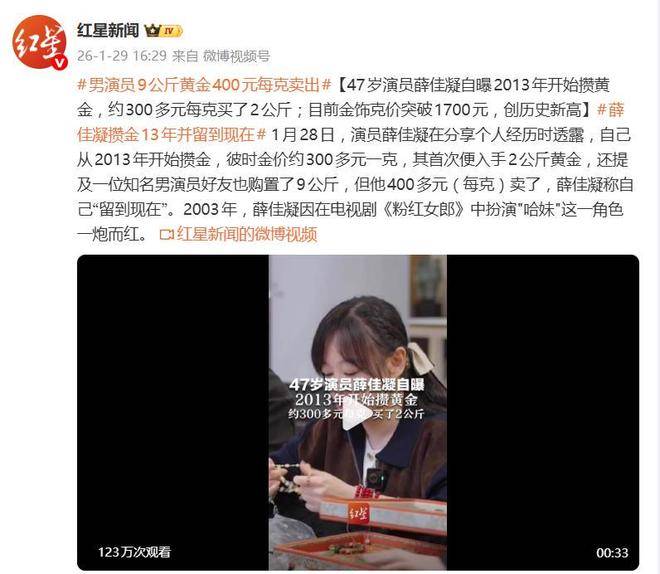
薛佳凝爆料知名男演员曾买入9公斤黄金,400元每克卖出
Sou Hu Cai Jing· 2026-02-01 06:01
Core Viewpoint - The story of actress Xue Jiaying's investment in gold highlights the stark contrast between long-term holding and short-term trading strategies, illustrating the potential missed opportunities in asset management [11] Group 1: Investment Experience - Xue Jiaying began investing in gold in 2013 when prices were around 300 RMB per gram, purchasing 2 kilograms [1] - A male actor friend followed her lead and bought 9 kilograms of gold [1][9] Group 2: Selling Decision - The male actor sold all his gold when prices reached approximately 400 RMB per gram, resulting in a profit of about 600,000 RMB [4] - This decision, made during a price increase, is now viewed as a significant missed opportunity given the current gold prices [4] Group 3: Current Gold Prices - As of January 2026, gold prices have surpassed 1700 RMB per gram, with some brands quoting as high as 1722 RMB per gram [7] - The current value of the 9 kilograms of gold is estimated to exceed 10 million RMB, indicating a potential loss of several million RMB for the actor [7] Group 4: Broader Implications - The incident serves as a lesson in investment strategy, emphasizing the challenges of timing the market and the benefits of long-term holding [11] - It raises questions about investment decisions even among those with substantial resources, such as celebrities [11]
做好投顾不需要十年十倍
远川投资评论· 2026-01-22 07:29
Core Viewpoint - The article discusses the journey of a prominent figure in the Chinese investment advisory space, known as "Banking Screw," who initially set a ten-year investment return expectation of ten times but ultimately fell short of this goal, highlighting the challenges and evolution of the fund advisory industry in China [2][5][11]. Group 1: Performance and Expectations - The initial expectation of achieving a tenfold return over ten years was proven unrealistic, with the best-performing public fund achieving less than six times return in the same period [2]. - The actual cumulative return of Banking Screw's index portfolio was approximately 22.1%, translating to an annualized return of only 2.14% [2]. - The article emphasizes that achieving a 25% annualized return over ten years is a nearly impossible target for most investors [2]. Group 2: Evolution of Fund Advisory - Banking Screw transitioned from a successful self-media figure to a fund advisor, focusing on a demographic of office workers who prefer low-risk investments [6][7]. - The introduction of the "fund combination" feature in 2016 marked a significant innovation in the industry, allowing for a dynamic investment approach and establishing a revenue source through sales commissions [8][9]. - The lack of regulatory backing for this model led to challenges, culminating in a pause of the "Big V" combinations in November 2021 due to new regulations [11][10]. Group 3: Institutional Challenges - The institutional fund advisory business has struggled to keep pace with the growth of individual advisors, primarily due to a lack of trust mechanisms and a focus on short-term sales metrics [12][13]. - The article notes that the fund industry has been slow to adapt to the evolving landscape, with a significant reliance on transaction-based income rather than sustainable advisory services [13][17]. - Recent regulatory changes emphasize the importance of fund advisory services, pushing institutions to transition towards a model that prioritizes investor profitability over sales volume [15][17]. Group 4: Future Outlook - The article suggests that the year 2026 could mark a turning point for the fund advisory industry in China, moving towards a more professional, institutional, and inclusive model [17][19]. - It highlights the need for a significant increase in the number of qualified fund advisors to meet the growing demand for personalized investment services [18][19]. - The shift from a sales-driven to a service-oriented approach in the fund industry is seen as essential for long-term success and sustainability [19].

ETF交投创7500亿天量,中国股市进入“配置型投资”新阶段
Jin Rong Jie· 2026-01-16 09:08
Core Insights - The ETF market in China is experiencing unprecedented growth, with daily trading volumes exceeding 750 billion yuan, marking a record high for three consecutive trading days [1] - The total management scale of China's ETF market has surpassed 6.2 trillion yuan, with a significant increase of over 200 billion yuan in just the first few weeks of the new year [2] Group 1: Market Phenomenon - The explosive growth of the ETF market is characterized by a rapid expansion in overall market size, with stock ETFs being the primary contributors to this growth [2] - Major fund companies like Huaxia Fund have reached a management scale of over 1 trillion yuan, indicating a new phase in the industry [2] - The concentration of funds is increasingly directed towards institutions with brand, product, and operational advantages, reshaping the capital market ecosystem [2] Group 2: Driving Forces - The influx of funds into ETFs is driven by several factors, including the shift of individual investors towards more rational asset allocation through low-cost ETFs [3] - Institutional investors, such as insurance and pension funds, are strategically allocating to ETFs, supported by regulatory policies that encourage equity investments [3] - Foreign capital is increasingly flowing into China's stock market through cross-border ETFs, with the scale of foreign investment in 2025 significantly surpassing previous years [3] - A consensus on market trends is leading investors to use ETFs as efficient tools for expressing market views, particularly in sectors like technology and new energy [3] Group 3: Cross-Border ETFs and Structural Differentiation - Cross-border ETFs have reached a historic scale of over 1 trillion yuan, becoming a preferred tool for global asset allocation among residents [4] - There is a noticeable structural differentiation in the market, with significant net inflows into technology and high-end manufacturing ETFs, while traditional industry and bond ETFs face net outflows [4] Group 4: Market Impact - The massive trading volume of ETFs is enhancing market efficiency by improving liquidity and reducing overall market volatility [6] - The popularity of ETFs is promoting investment concepts such as index investing and long-term holding, contributing to a healthier investor culture [6] - There is an increasing liquidity premium for leading companies as funds favor index constituents, leading to a "Matthew effect" where smaller companies receive less attention [6] Group 5: Future Outlook - The growth of the ETF market is expected to continue, driven by the ongoing shift of household assets from real estate to financial assets and the demand for long-term capital due to pension system reforms [7] - China's capital market is transitioning from a trading-oriented market to one focused on asset allocation, with ETFs playing a crucial role in this evolution [7] - The focus of the market is shifting from mere valuation recovery to improvements in corporate fundamentals and the realization of industry trends [7]
黄金价格震荡上行:普通人该“锁仓十年”还是“快进快出”?
Sou Hu Cai Jing· 2026-01-11 07:13
Core Insights - The domestic gold market is experiencing a new wave of price fluctuations, with major brands like Chow Tai Fook and Chow Sang Sang exceeding 1400 RMB per gram, while China Gold maintains a lower price advantage at 1011.5 RMB per gram [2] - There is a significant price differentiation among gold brands, reflecting a dual nature of gold as both a consumer "hard currency" and an investment "safe-haven asset" [2] - Historical data shows that gold has a strong long-term appreciation attribute, making it an essential stabilizer in household asset allocation [3] Price Trends - Major gold brands are priced between 1406-1410 RMB per gram, up over 8% since the beginning of the year, while price-sensitive brands like China Gold are priced between 1011.5-1209 RMB per gram [2] - The average price of gold is projected to remain between 2100-2300 USD per ounce in 2026, supported by ongoing central bank purchases and geopolitical risks [7] Investment Behavior - There is a noticeable increase in inquiries about gold bar investments, particularly among younger consumers who prefer smaller denominations [2] - Analysts recommend allocating 10%-15% of assets to gold, especially for risk-averse investors, as it can effectively hedge against stock and real estate market fluctuations [3] Trading Strategies - Short-term traders are capitalizing on T+0 trading mechanisms and daily fluctuations, with some achieving over 5% profits through intraday operations [4] - However, short-term trading carries significant risks, with 85% of retail investors ultimately losing money [4] Investment Guidance - Experts suggest prioritizing asset allocation by using gold as a safety net, recommending methods like gold ETFs and systematic investment plans to mitigate price volatility [5] - For consumers with gifting needs, participating in "old-for-new" programs can satisfy both consumption and asset preservation [5] - Short-term traders should set strict stop-loss limits and monitor key economic indicators that influence gold prices [5] Cautionary Notes - Investors should verify whether lower-priced brands are members of the Shanghai Gold Exchange to avoid purchasing non-investment products [6]