
高股息行情

Search documents
年末市场迎中期分红潮,四大行集中派发1761亿元“红包”!中证红利ETF(515080)或迎四季度分红评估
Sou Hu Cai Jing· 2025-12-12 01:57
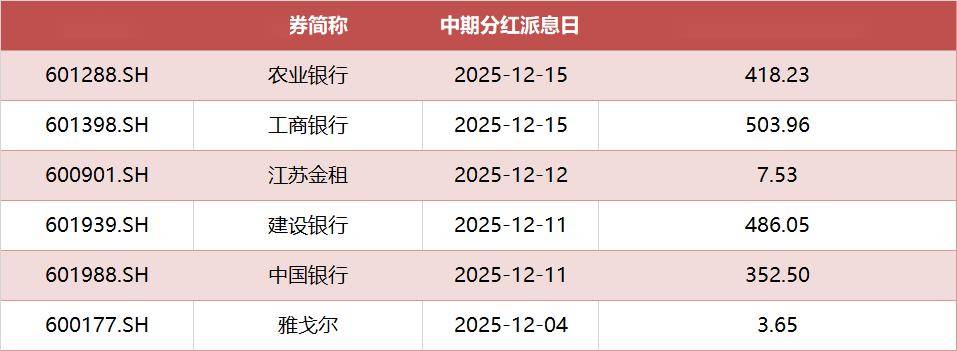
Core Viewpoint - Several major state-owned banks in China are implementing substantial interim dividends, reflecting their commitment to returning value to investors, with dividend amounts remaining stable compared to the previous year [1][2]. Group 1: Interim Dividends - Six companies in the CSI Dividend Index have announced or are about to announce dividend distributions since December, with notable amounts from major banks [1][2]. - The interim dividend amounts for major banks are as follows: China Construction Bank (486 billion), Bank of China (352.5 billion), Agricultural Bank of China (418 billion), and Industrial and Commercial Bank of China (504 billion) [1][2]. - The dividend payout ratio for these banks has remained stable at around 30%, indicating a consistent approach to shareholder returns [1]. Group 2: Dividend Distribution Data - As of December 11, a total of 43 companies in the CSI Dividend Index have announced interim dividend plans, with a total cash dividend amounting to 3,644 billion [2]. - The CSI Dividend ETF (515080) has distributed dividends 14 times since its inception, with a cumulative distribution of 3.65 yuan per ten shares [2]. Group 3: Market Trends and Fund Flows - The CSI Dividend ETF has adopted a quarterly dividend assessment rhythm, with dividend ratios for the first three quarters of this year being 1.01%, 0.99%, and 0.95% respectively [3][4]. - Recent market adjustments have led to a renewed interest in dividend assets, as indicated by significant net inflows into the CSI Dividend ETF, totaling 1.02 billion in a single day and 2.8 billion over the past five trading days [5]. - Analysts suggest that the upcoming spring market may trigger renewed attention on dividend stocks, particularly as insurance companies are expected to increase their allocations to A-shares [6][7].

重磅会议部署!A股,新机会来了!
Sou Hu Cai Jing· 2025-12-08 21:35
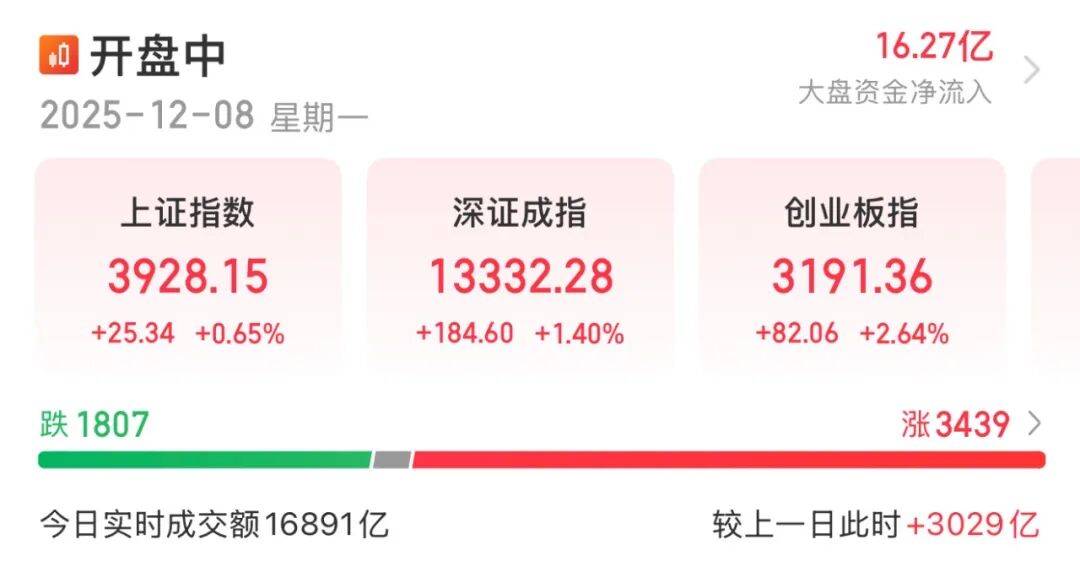
Group 1: Market Performance - On December 8, A-share brokerage stocks surged, with Xinyi Securities hitting the daily limit and Northeast Securities rising over 7% [1] - The Shanghai Composite Index rose by 0.65%, the Shenzhen Component Index increased by 1.40%, and the ChiNext Index climbed by 2.64% [2] Group 2: Policy and Economic Outlook - The upcoming economic work will focus on stability and progress, implementing more proactive fiscal policies and moderately loose monetary policies, enhancing macroeconomic governance [5] - A series of favorable policies and market conditions are expected to support market sentiment and long-term development, with expectations for a rebound in A-shares this week [6] Group 3: New Listings and Corporate Actions - Two new stocks, Nabai Chuan and Youxun Co., initiated their public offerings, with Nabai Chuan priced at 22.63 yuan per share and Youxun Co. raising approximately 809 million yuan for optical communication chip research [7] - Annie Co. announced a share transfer involving 9.229 million shares, which will result in a change of control to a new major shareholder [8] Group 4: Regulatory Changes and Market Impact - The implementation of the Securities Settlement Risk Fund Management Measures aims to enhance market infrastructure and operational efficiency [11] - Adjustments to risk factors for insurance companies' stock investments are expected to release significant liquidity into the market, potentially exceeding 100 billion yuan [14]
【申万宏源策略 | 一周回顾展望】保险开门红,春季行情的线索
申万宏源研究· 2025-12-08 01:39
Core Viewpoint - The article emphasizes the adjustment of risk factors for insurance companies, encouraging long-term investments in specific equity indices and stocks, while highlighting the potential for a significant increase in equity allocation space due to these adjustments [2][3]. Group 1: Risk Factor Adjustments - The risk factors for holding stocks in the CSI 300 and the CSI Dividend Low Volatility 100 indices for over three years, as well as for the Sci-Tech Innovation Board for over two years, have been reduced to 90% [3]. - This adjustment is seen as a policy to encourage long-term capital entry into the market, particularly benefiting state-owned insurance companies that have already allocated a high proportion of new premiums to the market [3]. - The reduction in risk factors is expected to release an equity allocation space in the range of hundreds of billions, which is crucial for increasing the equity investment ratio of insurance funds [3]. Group 2: Spring Market Outlook - The spring market is anticipated to be a small-scale rally, potentially characterized by high-level fluctuations, with a focus on the technology sector and cyclical assets [4]. - The market is expected to react to policy layouts starting from mid-December, which may trigger the spring rally, alongside the "insurance opening red" phenomenon [4]. - The overall market sentiment is cautious, with expectations of a rebound in the technology sector as it transitions from a correction phase to a consolidation phase [4]. Group 3: 2026 Market Style and Rhythm - The first half of 2026 is predicted to be a consolidation phase for the "Bull Market 1.0," favoring cyclical and value styles, while the second half is expected to transition into a comprehensive bull market led by technology and advanced manufacturing [5]. - The anticipated improvement in PPI year-on-year in 2026, along with cyclical price increases, positions cyclical assets as foundational for the spring market [5]. - There is a focus on high-dividend opportunities and the potential for a broad rebound in technology stocks, particularly in AI, storage, energy storage, and robotics [5].
风险因子下调释放“千亿级别”权益加仓空间!申万宏源:保险开门红升温,高股息行情正在提前抢跑
Hua Er Jie Jian Wen· 2025-12-08 00:19
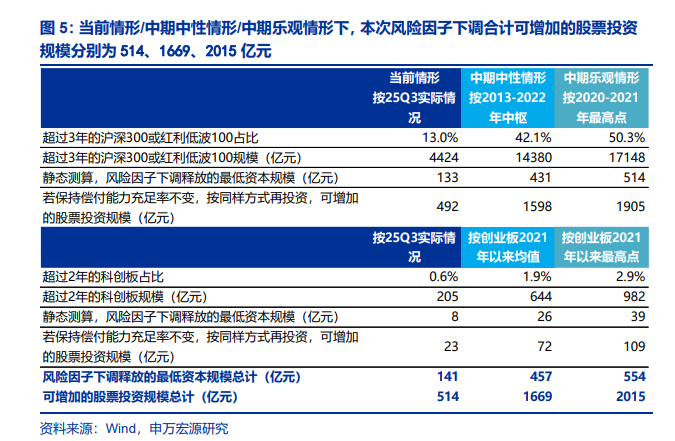
Core Viewpoint - A new regulatory policy aimed at insurance funds is expected to inject significant capital into the A-share market, potentially releasing hundreds of billions in incremental funds and stimulating market activity [1][9]. Group 1: Regulatory Changes - The National Financial Regulatory Administration announced a reduction in risk factors for insurance companies holding certain equity assets long-term, effective December 5, 2025 [1][10]. - The risk factor for stocks held over three years in the CSI 300 and the China Securities Low Volatility 100 Index has been lowered from 0.3 to 0.27, while for stocks held over two years in the Sci-Tech Innovation Board, it has been reduced from 0.4 to 0.36 [10]. Group 2: Capital Release Estimates - The policy is projected to release a minimum capital scale of approximately 457 billion yuan under a neutral scenario, with potential stock investment increases of about 1,669 billion yuan if the solvency ratio remains unchanged [2][3]. - In an optimistic scenario, the potential increase in stock investment could reach 2,015 billion yuan [2][3]. Group 3: Long-term Implications - The true potential for insurance funds entering the market lies in the systemic increase of their overall equity allocation ratio, which could represent a trillion-level space [5][7]. - As of Q3 2025, insurance companies' investment in stocks and funds exceeds 15%, indicating significant room for growth towards the regulatory cap of 30% [5][6]. Group 4: Market Impact - The timing of this policy is crucial, as it may catalyze the "spring market" amid a lack of clear industrial catalysts, with supply-demand dynamics becoming a primary market concern [9]. - The policy is expected to enhance the appeal of high-dividend assets, which may become a key focus for insurance capital as their investment appetite increases [9].

申万宏源策略一周回顾展望:保险开门红,春季行情的线索
Shenwan Hongyuan Securities· 2025-12-06 12:02
Group 1 - The report indicates that insurance companies have lowered risk factors for long-term holdings in the CSI 300, the China Securities Low Volatility 100, and the STAR Market, with state-owned insurance companies increasing their positions first, followed by the risk factor adjustments. This adjustment provides an additional incentive for other insurance companies to increase equity allocations, with a potential increase in equity investment space amounting to hundreds of billions under unchanged solvency ratios [4][5]. - The report highlights that the spring market's economic and industrial catalysts are not yet clear, and the supply-demand logic of funds may become the main contradiction. Expectations for the insurance "opening red" trading are rising, and high-dividend market trends may begin to emerge before early 2026 [4][5]. - The report suggests that the risk factor adjustments may encourage long-term capital to enter the market, particularly benefiting state-owned insurance companies that have already allocated a high proportion of new premiums to the market. The equity investment risk factor reduction is seen as a delayed policy optimization [5]. Group 2 - The report maintains that the spring market may be a small-scale market, with expectations of a rebound within a high-level oscillation for the overall market. For the oversold technology sector, it may transition into a phase of oscillation after sufficient adjustment [6]. - The mid-term judgment indicates a "two-stage bull market," with the technology structural bull market in 2025 at a high level, and subsequent adjustments may occur. A comprehensive bull market is expected in the second half of 2026 [6]. - The report anticipates that the first half of 2026 will see a "Bull Market 1.0" characterized by oscillation and a focus on cyclical and value styles, while the second half will transition to a "Bull Market 2.0" where technology and advanced manufacturing will dominate [8]. Group 3 - The report identifies potential triggers for the spring market, including the policy layout period starting in mid-December and the "two sessions" in 2026, which may activate policy and industrial themes [6]. - The report emphasizes that the spring market may serve as a foundation for cyclical assets, with a focus on basic chemicals and industrial technology as potential alpha sources. The insurance "opening red" may also highlight high-dividend opportunities [8]. - The report notes that the overall adjustment in technology may lead to a widespread rebound, with particular attention on sectors like innovative pharmaceuticals and national defense, as well as opportunities in AI computing, storage, energy storage, and robotics [8].
FICC日报:盘面再现高股息行情-20250516
Hua Tai Qi Huo· 2025-05-16 01:44
Report Summary 1. Report Industry Investment Rating No information provided. 2. Core Viewpoints of the Report - The short - term correction of stock indices indicates that the market has basically digested the previous policy benefits, and capital sentiment has turned cautious [3]. - The divergence of tariff policy expectations in the short - and long - term dimensions has led to increased fluctuations in small and medium - cap stocks [3]. - Supported by the continuous manifestation of the policy support effect and the trend of capital re - allocation, the large - cap stock index still has continuous upward momentum [3]. 3. Summary by Relevant Catalogs Market Analysis - **Domestic Policy**: The State Council held a work promotion meeting to strengthen the domestic large - cycle. The Premier emphasized focusing on strengthening the domestic large - cycle to achieve high - quality development [1]. - **Overseas Situation**: In April, the US PPI unexpectedly fell 0.5% month - on - month, with service prices dropping 0.7%, the largest single - month decline since 2009. The number of initial jobless claims last week was flat at 229,000, in line with market expectations [1]. - **Stock Index Performance**: A - share major indices closed down. The Shanghai Composite Index fell 0.68% to 3380.82 points, and the ChiNext Index fell 1.92%. Most sector indices declined, with only beauty care, coal, public utilities, and agriculture, forestry, animal husbandry, and fishery sectors rising. Computer, communication, electronics, and media sectors led the decline. The trading volume in the Shanghai and Shenzhen stock markets dropped to 1.15 billion yuan [2]. - **Overseas Market**: Powell said the Fed is considering adjusting the core of the monetary policy guidance framework. The US may enter a period of more frequent supply shocks and more unstable inflation, and long - term interest rates may rise. The three major US stock indices closed mixed, with the Dow rising 0.65% to 42322.75 points [2]. - **Futures Market**: Today is the delivery day of the current - month futures contracts of stock index futures, and the basis has basically converged. Both trading volume and open - interest in stock index futures decreased [2]. Strategy The short - term correction of stock indices shows that the market has digested previous policy benefits, and capital sentiment is cautious. The divergence of tariff policy expectations causes increased fluctuations in small and medium - cap stocks. Large - cap stock indices still have upward momentum due to policy support and capital re - allocation [3]. Chart Summaries - **Macro - economic Charts**: Include relationships between the US dollar index and A - share trends, US Treasury yields and A - share trends, RMB exchange rates and A - share trends, and US Treasury yields and A - share style trends [6][11][10]. - **Spot Market Tracking Charts**: Provide daily performance of major domestic stock indices. For example, on May 15, 2025, the Shanghai Composite Index closed at 3380.82, down 0.68%; the Shenzhen Component Index was at 10186.45, down 1.62%; and the ChiNext Index was at 2043.25, down 1.91% [13]. - **Stock Index Futures Tracking Charts**: - **Trading Volume and Open - interest**: The trading volume and open - interest of IF, IH, and IC contracts decreased. For example, the trading volume of IF was 99,618, a decrease of 39,806, and the open - interest was 250,422, a decrease of 23,251 [15]. - **Basis**: The basis data of IF, IH, IC, and IM contracts for different contract periods are provided, showing changes in basis values [35]. - **Inter - period Spreads**: The inter - period spreads between different contract periods (such as next - month - current - month, next - season - current - month, etc.) of IF, IH, IC, and IM contracts are presented, along with their changes [40].