
工艺美术及礼仪用品

Search documents
2026年1月物价数据点评:“反内卷”与新质生产力发展并进
BOHAI SECURITIES· 2026-02-12 10:11
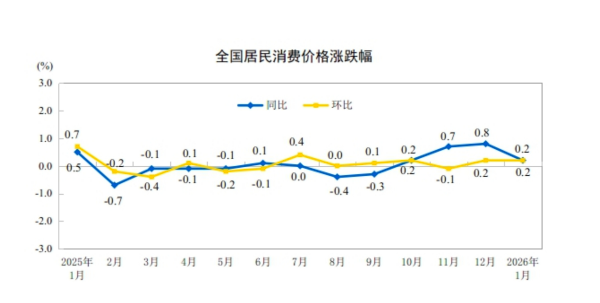
Group 1: CPI Analysis - In January 2026, the CPI increased by 0.2% year-on-year, a decrease from the previous value of 0.8%[11] - Core CPI's month-on-month growth reached its highest level in six months, driven by increased travel demand and rising international gold prices[4] - Food prices remained stable month-on-month, with fresh vegetable prices decreasing by 4.8%[14] Group 2: PPI Analysis - In January 2026, the PPI's year-on-year decline narrowed, while the month-on-month increase expanded[5] - Prices in the upstream raw materials sector turned from decline to increase due to the "anti-involution" effect, with basic chemical raw materials rising by 0.7%[25] - The month-on-month increase in production materials prices expanded, while living materials prices shifted from stable to rising[25] Group 3: Future Outlook - The CPI is expected to increase in February 2026, influenced by sufficient pig supply and potential price rises in fresh vegetables before the Spring Festival[16] - The PPI is projected to maintain a similar month-on-month increase in February, with a further narrowing of the year-on-year decline to around -1.0%[5] - Input inflation may rise in February, driven by ongoing "anti-involution" and the rapid development of new productive forces[26]
1月份CPI同比上涨0.2% 物价低位温和回升
Jin Rong Shi Bao· 2026-02-12 02:05
Group 1 - In January, the Consumer Price Index (CPI) increased by 0.2% month-on-month and year-on-year, while the core CPI, excluding food and energy, rose by 0.8% year-on-year, indicating a continued recovery in consumer demand [1][2] - The Producer Price Index (PPI) rose by 0.4% month-on-month but decreased by 1.4% year-on-year, reflecting a gradual stabilization in prices after four consecutive months of month-on-month increases [1][2] - The decline in year-on-year CPI growth was attributed to the high base effect from the previous year's Spring Festival and a significant drop in energy prices, which fell by 5.0% in January [2] Group 2 - The increase in core CPI, which rose by 0.3% month-on-month, is the highest in the past six months, suggesting that consumer demand is recovering despite the overall CPI decline [2] - The PPI's month-on-month increase was driven by the ongoing construction of a unified national market and rising demand in certain sectors, such as artificial intelligence and digital technology, which boosted prices for electronic semiconductor materials and storage devices [2] - The CPI base period rotation is set for 2025, with adjustments to the fixed basket of goods to better reflect current consumer spending patterns, enhancing the accuracy of the price index [3]
1月核心CPI温和上涨 节前重要民生商品量足价稳
Bei Jing Shang Bao· 2026-02-11 11:01
Group 1 - In January, the national consumer price index (CPI) increased by 0.2% year-on-year, with core CPI (excluding food and energy) rising by 0.8% [1][3] - The CPI increase was influenced by the Spring Festival timing and a significant drop in energy prices due to international oil price fluctuations [1][3] - The new base year for CPI and producer price index (PPI) is set to 2025, with the impact of this base year change on CPI and PPI monthly year-on-year indices averaging approximately 0.06 and 0.08 percentage points, respectively [1][8] Group 2 - Food prices decreased by 0.7%, contributing to a 0.11 percentage point decline in the year-on-year CPI, while non-food prices increased by 0.4% [4][5] - Core CPI showed a moderate increase, with a 0.3% month-on-month rise, marking the highest level in six months, driven by rising prices in travel and household services [5] - The PPI decreased by 1.4% year-on-year but increased by 0.4% month-on-month, marking four consecutive months of month-on-month increases [6][7] Group 3 - The new base year CPI classification includes adjustments to better reflect changes in consumer spending, with new categories added such as home security devices and internet medical services [8][9] - The overall weight changes in the CPI categories are minimal compared to the 2020 base year, with an increase in service weights and a decrease in consumer goods weights [9]


国家统计局:2026年1月份CPI同比上涨,PPI同比降幅收窄
Jin Rong Jie· 2026-02-11 07:43
Group 1 - In January, consumer demand continued to recover, with the Consumer Price Index (CPI) rising 0.2% month-on-month and 0.2% year-on-year, while the core CPI, excluding food and energy, increased by 0.8% year-on-year [1] - The year-on-year increase in CPI was affected by the timing of the Spring Festival, leading to a high base comparison from the previous year, particularly in food and service prices [1] - Food prices decreased by 0.7%, contributing to a 0.11 percentage point decline in CPI year-on-year, while energy prices fell by 5.0%, impacting CPI by approximately 0.34 percentage points [1] Group 2 - The core CPI continued to rise, with a month-on-month increase of 0.3%, marking the highest level in six months, driven by higher prices in air tickets and travel services [2] - The Producer Price Index (PPI) rose 0.4% month-on-month, marking the fourth consecutive month of increase, with significant contributions from sectors like cement manufacturing and lithium-ion battery production [2] - Year-on-year, PPI decreased by 1.4%, but the decline was narrower by 0.5 percentage points compared to the previous month, with notable price increases in non-ferrous metal mining and manufacturing sectors [3]
春节错月致1月CPI同比涨幅回落,反内卷带动相关领域价格改善
Di Yi Cai Jing· 2026-02-11 04:17
Group 1: Consumer Price Index (CPI) - In January, the CPI increased by 0.2% month-on-month and year-on-year, reflecting a decrease of 0.6 percentage points compared to December [1] - The decline in CPI is attributed to the Spring Festival timing and a significant drop in energy prices, which decreased by 5.0%, impacting CPI by approximately 0.34 percentage points [3] - Core CPI, excluding food and energy, rose by 0.8% year-on-year and 0.3% month-on-month, marking the highest increase in six months, indicating a steady recovery in consumer demand [3] Group 2: Producer Price Index (PPI) - The PPI rose by 0.4% month-on-month in January, marking the fourth consecutive month of increase, with an expansion of 0.2 percentage points from the previous month [5] - Factors contributing to the PPI increase include the ongoing construction of a unified national market and rising demand in certain industries [5] - Prices in sectors such as photovoltaic, battery, cement, and steel have shown positive improvements due to the "anti-involution" policies implemented last year [5] Group 3: Industry-Specific Price Changes - In January, prices for cement manufacturing and lithium-ion battery manufacturing increased by 0.1%, continuing a four-month upward trend [5] - The price of photovoltaic equipment and components shifted from a 0.2% decrease to a 1.9% increase, while basic chemical raw materials saw a 0.7% increase [5] - The prices of non-ferrous metal mining and smelting industries rose significantly, with silver smelting prices increasing by 38.2% and copper smelting by 8.4% [6] Group 4: Future Price Trends - The National Bureau of Statistics indicates that favorable factors for moderate price recovery are accumulating, supported by policies aimed at boosting consumption and stabilizing market expectations [6] - The implementation of coordinated fiscal and financial policies is expected to gradually expand consumer demand, providing a foundation for stable price operations [6] - Emphasis on industry self-regulation and capacity management is anticipated to further enhance price recovery in key sectors [6]
CPI同比涨幅继续扩大 PPI同比降幅收窄
Xin Lang Cai Jing· 2026-01-09 17:39
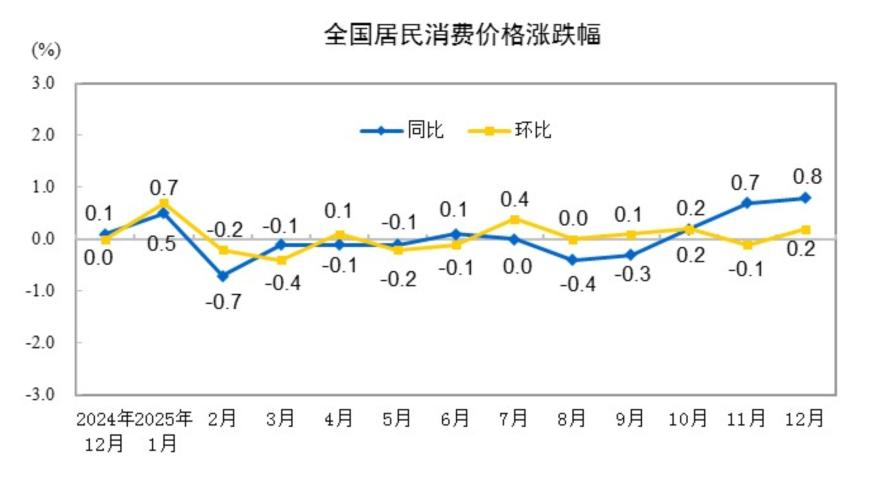
Group 1 - In December 2025, the Consumer Price Index (CPI) increased by 0.2% month-on-month and 0.8% year-on-year, while the Producer Price Index (PPI) rose by 0.2% month-on-month but decreased by 1.9% year-on-year [1][2] - The CPI's year-on-year growth rate expanded by 0.1 percentage points compared to the previous month, reaching the highest level since March 2023, primarily driven by an increase in food prices, which rose by 1.1% [1][3] - Key food items such as fresh vegetables and fruits saw price increases of 18.2% and 4.4%, respectively, contributing approximately 0.16 percentage points to the CPI's year-on-year increase [1][2] Group 2 - The month-on-month CPI increase was influenced by rising prices of industrial consumer goods, excluding energy, which rose by 0.6%, contributing about 0.16 percentage points to the CPI [2] - The PPI's year-on-year decline of 1.9% showed a narrowing of the decline by 0.3 percentage points from the previous month, with significant price reductions in coal mining and lithium-ion battery manufacturing [3] - Prices in sectors such as external storage devices and biomass liquid fuels increased by 15.3% and 9.0%, respectively, indicating a growth in new productive forces [3]
国家统计局:12月份CPI上涨0.8%,PPI环比上涨0.2%涨幅比上月扩大0.1个百分点
Jin Rong Jie· 2026-01-09 02:30
Core Insights - In December 2025, the national consumer price index (CPI) increased by 0.8% year-on-year, with urban areas rising by 0.9% and rural areas by 0.6% [3][20] - The producer price index (PPI) for industrial producers decreased by 1.9% year-on-year, with a narrowing decline compared to the previous month [12][25] CPI Analysis - The CPI rose by 0.2% month-on-month in December, driven by increased consumer demand ahead of the New Year [20][21] - Food prices increased by 1.1% year-on-year, significantly impacting the CPI, with fresh vegetable prices soaring by 18.2% [6][23] - Core CPI, excluding food and energy, rose by 1.2%, maintaining a growth rate above 1% for four consecutive months [20][23] PPI Analysis - The PPI saw a month-on-month increase of 0.2%, marking the third consecutive month of growth [24][25] - The decline in PPI year-on-year was less severe than in previous months, indicating a potential stabilization in industrial pricing [12][25] - Key industries such as coal mining and lithium-ion battery manufacturing experienced price increases, reflecting improved supply-demand dynamics [24][25] Price Movement by Category - In December, food and beverage prices rose by 0.8% year-on-year, contributing approximately 0.24 percentage points to the CPI [6][11] - The prices of production materials decreased by 2.1% year-on-year, with significant declines in mining and raw materials sectors [14][19] - The prices of durable consumer goods fell by 3.5%, while general daily necessities saw a price increase of 1.4% [14][19]
PPI环比“两连涨”,统计局:支持价格合理回升的积极因素继续累积
Xin Lang Cai Jing· 2025-12-15 04:54
Core Viewpoint - The Producer Price Index (PPI) in November continued to rise month-on-month for the second consecutive month, with the year-on-year decline stabilizing compared to the previous month, indicating a trend of narrowing year-on-year declines since August [1][3]. Group 1: Factors Influencing PPI - Consumption upgrade is driving price increases, with notable price rises in sports and cultural goods. In November, the price of arts and crafts and ceremonial goods manufacturing rose by 20.6% year-on-year, an increase of 2.2 percentage points from the previous month. The price of sports balls manufacturing increased by 4.3%, up by 1 percentage point from the previous month [1][3]. - The development of emerging industries is positive, with accelerated industrial transformation towards intelligence and sustainability. In November, the price of non-ferrous metal smelting and rolling increased by 7.8% year-on-year, up by 1 percentage point from the previous month. Prices for graphite and carbon products rose by 3.8%, and integrated circuit manufacturing prices increased by 1.7% [1][3]. Group 2: Market Competition and Policy Implications - The effects of regulating market competition are becoming evident, with the year-on-year price declines for photovoltaic equipment and components, lithium-ion batteries, and new energy vehicles narrowing by 2.0, 0.7, and 0.6 percentage points, respectively [2][4]. - The current PPI is still declining year-on-year, and further efforts are needed to solidify the foundation for a reasonable price recovery. Future strategies include expanding domestic demand, strengthening the domestic circulation, and improving supply-demand relationships to promote reasonable price recovery and enhance business operations [5].
扩内需政策措施继续显效
Jing Ji Wang· 2025-12-11 06:56
Group 1: Consumer Price Index (CPI) Insights - In November, the CPI increased by 0.7% year-on-year, marking the highest growth since March 2024, with a month-on-month decrease of 0.1% [2][3] - The rise in CPI was primarily driven by a shift in food prices from decline to increase, with fresh vegetable prices rising by 14.5% after nine consecutive months of decline [2][3] - Core CPI, excluding food and energy, rose by 1.2% year-on-year, maintaining above 1% for three consecutive months, indicating stable inflationary pressures [2][3] Group 2: Producer Price Index (PPI) Insights - The PPI increased by 0.1% month-on-month in November, marking the second consecutive month of growth, influenced by seasonal demand increases in certain industries [4] - Year-on-year, the PPI decreased by 2.2%, with the decline slightly widening compared to the previous month, primarily due to high comparison bases from the previous year [4] - The increase in PPI was supported by rising prices in coal and gas sectors, while international oil price fluctuations led to a decrease in domestic oil and gas extraction prices [4] Group 3: Market Trends and Future Outlook - The ongoing "anti-involution" measures are showing results, with price declines in key industries narrowing, indicating improved market competition [5] - Emerging industries are rapidly developing, contributing to price increases in related sectors, such as a 13.9% rise in external storage devices and components [6] - Future inflation is expected to remain low, with a gradual recovery in prices anticipated due to stable domestic demand and effective competition governance [7][8]
CPI同比涨幅扩大 核心CPI继续上涨
Xin Hua She· 2025-12-11 00:31
Group 1: Consumer Price Index (CPI) Trends - In November, the national Consumer Price Index (CPI) slightly decreased by 0.1% month-on-month but increased by 0.7% year-on-year, marking the highest growth since March 2024, with a 0.5 percentage point increase from the previous month [1] - The rise in CPI year-on-year was primarily driven by a shift in food prices from a decline to an increase, with food prices changing from a decrease of 2.9% to an increase of 0.2%, impacting CPI by approximately 0.04 percentage points [1] - Fresh vegetable prices saw a significant turnaround, increasing by 14.5% after a 9-month decline, contributing an additional 0.49 percentage points to the CPI [1] Group 2: Core CPI and Industrial Prices - The core CPI, excluding food and energy, rose by 1.2% year-on-year, maintaining a growth rate above 1% for three consecutive months [2] - Service prices and industrial consumer goods prices, excluding energy, increased by 0.7% and 2.1%, respectively, contributing approximately 0.29 and 0.53 percentage points to the CPI [2] - The Producer Price Index (PPI) increased by 0.1% month-on-month but decreased by 2.2% year-on-year, with the decline attributed to a high comparison base from the previous year [2] Group 3: Industry-Specific Price Changes - The "involution" competition in key industries has shown improvement, with price declines in coal mining, photovoltaic equipment manufacturing, and lithium-ion battery manufacturing narrowing over several months [3] - Emerging industries such as new materials and intelligent technology are driving price increases, with external storage devices and components rising by 13.9% year-on-year [4] - Consumer demand has been effectively released, leading to price increases in related industries, such as a 20.6% rise in the manufacturing of arts and crafts and ceremonial goods [5]