
农副食品

Search documents
2026年1月物价数据点评:“反内卷”与新质生产力发展并进
BOHAI SECURITIES· 2026-02-12 10:11
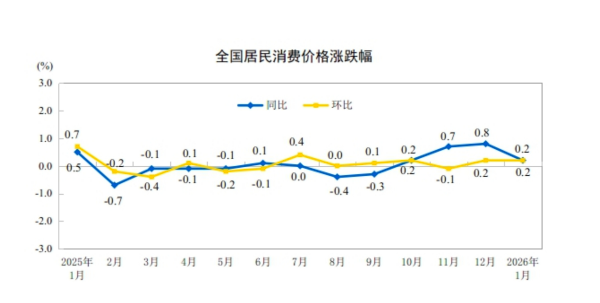
Group 1: CPI Analysis - In January 2026, the CPI increased by 0.2% year-on-year, a decrease from the previous value of 0.8%[11] - Core CPI's month-on-month growth reached its highest level in six months, driven by increased travel demand and rising international gold prices[4] - Food prices remained stable month-on-month, with fresh vegetable prices decreasing by 4.8%[14] Group 2: PPI Analysis - In January 2026, the PPI's year-on-year decline narrowed, while the month-on-month increase expanded[5] - Prices in the upstream raw materials sector turned from decline to increase due to the "anti-involution" effect, with basic chemical raw materials rising by 0.7%[25] - The month-on-month increase in production materials prices expanded, while living materials prices shifted from stable to rising[25] Group 3: Future Outlook - The CPI is expected to increase in February 2026, influenced by sufficient pig supply and potential price rises in fresh vegetables before the Spring Festival[16] - The PPI is projected to maintain a similar month-on-month increase in February, with a further narrowing of the year-on-year decline to around -1.0%[5] - Input inflation may rise in February, driven by ongoing "anti-involution" and the rapid development of new productive forces[26]
PPI同比转正时点或提前:1月通胀数据点评
Huachuang Securities· 2026-02-12 08:11
Inflation Data Summary - January CPI decreased from 0.8% to 0.2% due to the Spring Festival effect, while core CPI fell from 1.2% to 0.8%[2] - PPI year-on-year decline narrowed from -1.9% to -1.4%, indicating an overall improvement in price trends[2] - Estimated GDP deflator for January is approximately -0.4%, compared to -0.6% in the previous quarter[2] PPI Insights - PPI increased by 0.4% month-on-month, marking the fourth consecutive month of growth[3] - The likelihood of PPI turning positive year-on-year is expected in Q3 2026, driven by improved midstream supply-demand dynamics[4] - Yearly PPI projections for 2026 are estimated at -1.2%, -0.2%, 0.4%, and 0.2% for Q1 to Q4 respectively, with an adjusted central tendency around -0.2%[5] Price Movement Factors - Key price increases in January were observed in sectors such as AI chips, automobiles, and gold jewelry, while food prices, particularly vegetables, saw declines[2][25] - Input factors, including international monetary easing and rising prices in the non-ferrous metal sector, contributed to domestic price changes[4][10] - The proportion of industries experiencing price increases in PPI rose from 9 to 13 out of 30, indicating a recovery in pricing power[33]
1月份CPI同比上涨0.2% 物价低位温和回升
Jin Rong Shi Bao· 2026-02-12 02:05
Group 1 - In January, the Consumer Price Index (CPI) increased by 0.2% month-on-month and year-on-year, while the core CPI, excluding food and energy, rose by 0.8% year-on-year, indicating a continued recovery in consumer demand [1][2] - The Producer Price Index (PPI) rose by 0.4% month-on-month but decreased by 1.4% year-on-year, reflecting a gradual stabilization in prices after four consecutive months of month-on-month increases [1][2] - The decline in year-on-year CPI growth was attributed to the high base effect from the previous year's Spring Festival and a significant drop in energy prices, which fell by 5.0% in January [2] Group 2 - The increase in core CPI, which rose by 0.3% month-on-month, is the highest in the past six months, suggesting that consumer demand is recovering despite the overall CPI decline [2] - The PPI's month-on-month increase was driven by the ongoing construction of a unified national market and rising demand in certain sectors, such as artificial intelligence and digital technology, which boosted prices for electronic semiconductor materials and storage devices [2] - The CPI base period rotation is set for 2025, with adjustments to the fixed basket of goods to better reflect current consumer spending patterns, enhancing the accuracy of the price index [3]
1月核心CPI温和上涨 节前重要民生商品量足价稳
Bei Jing Shang Bao· 2026-02-11 11:01
Group 1 - In January, the national consumer price index (CPI) increased by 0.2% year-on-year, with core CPI (excluding food and energy) rising by 0.8% [1][3] - The CPI increase was influenced by the Spring Festival timing and a significant drop in energy prices due to international oil price fluctuations [1][3] - The new base year for CPI and producer price index (PPI) is set to 2025, with the impact of this base year change on CPI and PPI monthly year-on-year indices averaging approximately 0.06 and 0.08 percentage points, respectively [1][8] Group 2 - Food prices decreased by 0.7%, contributing to a 0.11 percentage point decline in the year-on-year CPI, while non-food prices increased by 0.4% [4][5] - Core CPI showed a moderate increase, with a 0.3% month-on-month rise, marking the highest level in six months, driven by rising prices in travel and household services [5] - The PPI decreased by 1.4% year-on-year but increased by 0.4% month-on-month, marking four consecutive months of month-on-month increases [6][7] Group 3 - The new base year CPI classification includes adjustments to better reflect changes in consumer spending, with new categories added such as home security devices and internet medical services [8][9] - The overall weight changes in the CPI categories are minimal compared to the 2020 base year, with an increase in service weights and a decrease in consumer goods weights [9]


国家统计局:2026年1月份CPI同比上涨,PPI同比降幅收窄
Jin Rong Jie· 2026-02-11 07:43
Group 1 - In January, consumer demand continued to recover, with the Consumer Price Index (CPI) rising 0.2% month-on-month and 0.2% year-on-year, while the core CPI, excluding food and energy, increased by 0.8% year-on-year [1] - The year-on-year increase in CPI was affected by the timing of the Spring Festival, leading to a high base comparison from the previous year, particularly in food and service prices [1] - Food prices decreased by 0.7%, contributing to a 0.11 percentage point decline in CPI year-on-year, while energy prices fell by 5.0%, impacting CPI by approximately 0.34 percentage points [1] Group 2 - The core CPI continued to rise, with a month-on-month increase of 0.3%, marking the highest level in six months, driven by higher prices in air tickets and travel services [2] - The Producer Price Index (PPI) rose 0.4% month-on-month, marking the fourth consecutive month of increase, with significant contributions from sectors like cement manufacturing and lithium-ion battery production [2] - Year-on-year, PPI decreased by 1.4%, but the decline was narrower by 0.5 percentage points compared to the previous month, with notable price increases in non-ferrous metal mining and manufacturing sectors [3]
春节错月致1月CPI同比涨幅回落,反内卷带动相关领域价格改善
Di Yi Cai Jing· 2026-02-11 04:17
Group 1: Consumer Price Index (CPI) - In January, the CPI increased by 0.2% month-on-month and year-on-year, reflecting a decrease of 0.6 percentage points compared to December [1] - The decline in CPI is attributed to the Spring Festival timing and a significant drop in energy prices, which decreased by 5.0%, impacting CPI by approximately 0.34 percentage points [3] - Core CPI, excluding food and energy, rose by 0.8% year-on-year and 0.3% month-on-month, marking the highest increase in six months, indicating a steady recovery in consumer demand [3] Group 2: Producer Price Index (PPI) - The PPI rose by 0.4% month-on-month in January, marking the fourth consecutive month of increase, with an expansion of 0.2 percentage points from the previous month [5] - Factors contributing to the PPI increase include the ongoing construction of a unified national market and rising demand in certain industries [5] - Prices in sectors such as photovoltaic, battery, cement, and steel have shown positive improvements due to the "anti-involution" policies implemented last year [5] Group 3: Industry-Specific Price Changes - In January, prices for cement manufacturing and lithium-ion battery manufacturing increased by 0.1%, continuing a four-month upward trend [5] - The price of photovoltaic equipment and components shifted from a 0.2% decrease to a 1.9% increase, while basic chemical raw materials saw a 0.7% increase [5] - The prices of non-ferrous metal mining and smelting industries rose significantly, with silver smelting prices increasing by 38.2% and copper smelting by 8.4% [6] Group 4: Future Price Trends - The National Bureau of Statistics indicates that favorable factors for moderate price recovery are accumulating, supported by policies aimed at boosting consumption and stabilizing market expectations [6] - The implementation of coordinated fiscal and financial policies is expected to gradually expand consumer demand, providing a foundation for stable price operations [6] - Emphasis on industry self-regulation and capacity management is anticipated to further enhance price recovery in key sectors [6]
加拿大总理8年来首次访华,有何看点?
第一财经· 2026-01-14 08:38
Group 1 - The visit of Canadian Prime Minister Carney to China from January 14 to 17 marks his first official visit to China since taking office and is the first visit by a Canadian Prime Minister to China in eight years, highlighting the importance of strengthening dialogue and cooperation between the two countries [4][6] - Carney's visit comes at a critical time for Canada, as it seeks to diversify its trade relationships and reduce economic dependence on the United States, especially in light of recent economic challenges and the impact of U.S. tariffs [6][8] - Canada aims to double its exports to non-U.S. markets over the next decade, with China being a key partner, as bilateral trade has grown significantly from $150 million in 1970 to an estimated $93 billion in 2024 [6][7] Group 2 - The focus of Carney's visit will include trade, energy, agriculture, and international security, with particular attention on potential breakthroughs in electric vehicle tariffs and agricultural trade, which have been significant barriers to expanding trade relations [11][12] - Recent polling indicates that 54% of Canadians support reaching a trade agreement with China, reflecting a shift in public sentiment towards enhancing economic ties [12] - The energy sector is a critical area of cooperation, with Canada exporting nearly 100 million barrels of crude oil and over 200,000 tons of liquefied natural gas to China in the first 11 months of 2025, as Canada seeks to reduce its reliance on the U.S. market [8][9]

韩国2025年出口同比增3.8%刷新纪录
Xin Lang Cai Jing· 2026-01-01 10:33
Core Insights - South Korea's total exports reached a record high of $709.7 billion in 2024, marking a year-on-year increase of 3.8% [1] Export Performance - Semiconductor exports surged by 22.2% year-on-year, totaling $173.4 billion, setting a new historical peak for the second consecutive year [1] - Automotive exports increased by 1.7%, reaching $72 billion, also achieving a record high [1] - Biopharmaceutical exports rose by 7.9% to $16.3 billion, maintaining growth for two consecutive years [1] - Other sectors such as shipbuilding, computers, wireless communication devices, agricultural products, cosmetics, and electrical equipment also experienced growth [1] Decline in Specific Sectors - Exports of petroleum products decreased by 9.6% to $45.5 billion [1] - Petrochemical product exports fell by 11.4% to $42.5 billion [1] - Steel exports dropped by 9% to $30.3 billion [1]
热点思考 | 7月出口会再超预期吗?(申万宏观·赵伟团队)
申万宏源宏观· 2025-07-23 11:56
Group 1 - The core viewpoint of the article suggests that July's export indicators show signs of improvement, particularly in exports to emerging countries, with a marginal increase of 8% in foreign trade port cargo volume since July [2][8][112] - The foreign trade port container throughput in July 2025 increased by 8.9% year-on-year, indicating a potential short-term improvement in actual export volume [2][8][112] - The container cargo volume from China to Vietnam rose significantly, reaching over 60% year-on-year, while the volume to the United States declined [2][13][112] Group 2 - Container shipping rates have been declining since July, with the CCFI composite index dropping 4.8% over three weeks, reflecting various factors including export demand and shipping capacity [3][21][113] - The relative price changes in shipping routes indicate better export performance to emerging countries compared to the U.S., with the price ratio of Southeast Asia and East-West Africa routes increasing [3][32][113] Group 3 - Production indicators suggest a rebound in export-related production, particularly in the consumption and metallurgy chains, with a 0.5% increase in export production indicators in July [4][5][114] - The external sales of crude steel and polyester filament maintained positive growth, indicating resilience in related industries [4][5][114] Group 4 - Processing trade imports, which lead exports by about one month, increased by 3.3% in June, suggesting a potential rise in exports in July to around 8% [6][92][100] - The Yiwu small commodity export price index remains high, supporting higher growth rates in cross-border exports to Europe and the UK [6][95][100] Group 5 - Overall, the July export production index increased by 0.5 percentage points, indicating a continuation of export improvement [5][85][115] - The weighted year-on-year growth of production indicators related to foreign trade aligns well with actual export performance, suggesting a positive outlook for July exports [5][85][115]
培育新动能 共享新机遇
Shan Xi Ri Bao· 2025-05-24 00:12
Group 1: Silk Road International Cooperation Conference - The "Smart Link, Enjoy the Future" 2025 Silk Road International Industry-Academia-Research Cooperation Conference was launched in Xi'an, attended by over 300 experts, entrepreneurs, and representatives from universities from countries including China, Russia, and Italy [1] - Several universities signed cooperation agreements in fields such as sports, music, and traditional Chinese medicine during the event [1] - The conference aimed to enhance cooperation in talent cultivation, technological innovation, and cultural exchange, contributing to the Belt and Road Initiative by fostering interdisciplinary talent and facilitating cross-border knowledge and technology transfer [1] Group 2: Specialized and Innovative Exhibition - The Specialized and Innovative Exhibition showcased advanced manufacturing innovations, covering an area of 500 square meters with the theme "Specialization Strengthens Chains, New Quality Powers New Journeys" [2] - The exhibition featured specialized and innovative enterprises, including Xi'an Daji Group Co., Ltd. and Xi'an ZhenTai Intelligent Technology Co., Ltd., highlighting new changes, breakthroughs, technologies, and products in the advanced manufacturing sector [2] - There are currently 4,476 innovative small and medium-sized enterprises in the province, with 1,627 provincial-level specialized and innovative SMEs and 206 national-level "little giant" enterprises, playing a crucial role in stabilizing the industrial supply chain [2] Group 3: "Foreign Trade Quality Products China Tour" Activity - The "Foreign Trade Quality Products China Tour" event was held from May 21 to 25, aiming to help enterprises expand domestic markets and promote integrated development of domestic and foreign trade [3] - The event featured over 50 key enterprises showcasing more than 100 quality products across six categories, including machinery, electronics, and agricultural products [3] - Activities during the event included Hanfu performances, enterprise promotions, and policy matchmaking, with participation from e-commerce platforms like JD.com and Vipshop to support foreign trade enterprises in expanding their sales networks [3]