CVC模式

Search documents
田轩:科技竞争新格局下的中国资本市场战略转型|资本市场
清华金融评论· 2025-12-28 09:17
Core Viewpoint - The capital market in China needs a profound "ideological innovation" to break free from traditional evaluation systems and support the country's technological future through a comprehensive capital support ecosystem that includes "basic research - results transformation - industry incubation" [3]. Group 1: Capital Market Transformation - The capital market must shift from passive adaptation to active leadership, especially in the context of global technological competition and supply chain security challenges, to become a core engine for driving technological breakthroughs and industrial iterations [5]. - By optimizing the issuance and listing system, the market can better identify and support technology companies with strategic significance and core technologies [5]. - Mergers and acquisitions can facilitate resource integration and technological collaboration among tech companies, fostering internationally competitive tech leaders and industrial clusters [5]. Group 2: Supporting Technological Independence - The capital market can provide strong financial support, effective incentive mechanisms, and optimized resource allocation platforms to enhance the level of technological independence [6]. - Long-term capital can support tech companies in exploring innovative "uncharted territories," while equity incentives and market value management can stimulate innovation and retain top talent [6]. - A virtuous cycle of "innovation input - results transformation - value realization - reinvestment" can be established to boost technological independence [6]. Group 3: New Evaluation Logic - The capital market should adjust its service logic from focusing on company size and profitability to emphasizing technological barriers, R&D sustainability, and strategic value [7]. - A new evaluation system should be established that highlights technological attributes and long-term growth potential, moving away from traditional metrics [7]. - Financing support mechanisms should cover the entire innovation cycle, allowing for the listing of companies that may not yet be profitable but have advanced technology and significant R&D achievements [7]. Group 4: Private Equity and Long-term Investment - Improving the exit mechanisms for private equity investments can guide more social capital towards early-stage tech projects [8]. - A multi-tiered capital market system should be constructed to enhance the efficiency of capital allocation and risk adaptation [8]. - Long-term capital, such as insurance and pension funds, should increase their allocation to equity assets, particularly in basic research and common technology development platforms [8]. Group 5: Addressing Short-term Focus - The capital market needs to shift from an excessive focus on short-term performance to encouraging long-term value creation [11]. - Analysts should be guided to focus on long-term value factors such as R&D paths and core competitiveness rather than just financial metrics [11]. - A differentiated information disclosure system should be established to allow tech companies in R&D phases to have more flexible reporting requirements [11]. Group 6: Corporate Venture Capital (CVC) Advantages - CVC can provide comprehensive support to startups by integrating capital, technology, and market resources, enhancing the financing bargaining power of Chinese companies [13]. - Policies should be strengthened to promote CVC, including tax incentives and support for cross-border capital flows [13]. - CVC should be positioned as a systemic support for national technological competitiveness, enabling Chinese tech companies to form multi-dimensional advantages in global competition [14]. Group 7: Policy Stability for Innovation - Policy uncertainty is a major barrier to innovation, as it disrupts the cost-benefit models of innovation activities [16]. - A stable policy environment is essential for long-term R&D investments, particularly in foundational research and disruptive technology development [16]. - Policies should be institutionalized to provide clear guidelines and a buffer period for adjustments, ensuring a conducive environment for innovation [16]. Group 8: Systematic Reform of Capital Markets - A comprehensive capital support system should be established, focusing on basic research and technology commercialization [19]. - The financial support ecosystem for tech companies should cover their entire lifecycle, with an emphasis on "hard tech" [19]. - Long-term capital should be encouraged to participate in early-stage tech financing through innovative financial instruments [19].


上市公司一级市场参与意愿尚待抬升 CVC逆势受捧
Zheng Quan Shi Bao Wang· 2025-12-27 05:06
Group 1 - The global IPO market is showing signs of warming in 2025, but this enthusiasm has not yet translated to the primary market for A-share listed companies, with the number of events involving the establishment of industrial funds remaining at last year's low levels [1][2] - A-share listed companies are increasingly favoring Corporate Venture Capital (CVC) as a preferred General Partner (GP) choice, attributed to CVC's strong industrial empowerment capabilities and its higher lower limit and better liquidity in the current fundraising environment [1][4] - The number of events involving A-share listed companies establishing industrial funds is reported to be 341 this year, which is consistent with last year's figures, while the investment focus of newly established industrial funds is primarily on sectors closely related to the listed companies, particularly in biotechnology and semiconductors [2][3] Group 2 - The active mergers and acquisitions market has positively influenced sentiment in the primary market, with investors seeking a balance between liquidity and potential returns [3] - CVCs are gaining popularity among Limited Partners (LPs), with approximately 7.53% of A-share listed companies having established CVCs, mainly concentrated among industry leaders [4][5] - CVCs have a higher lower limit for investment returns, with 33.07% of unicorn companies having received investments from Chinese CVCs, indicating a strong potential for investment returns [5][6]
上市公司产投新风向: 锚定硬科技,主业强协同
Sou Hu Cai Jing· 2025-12-26 23:35
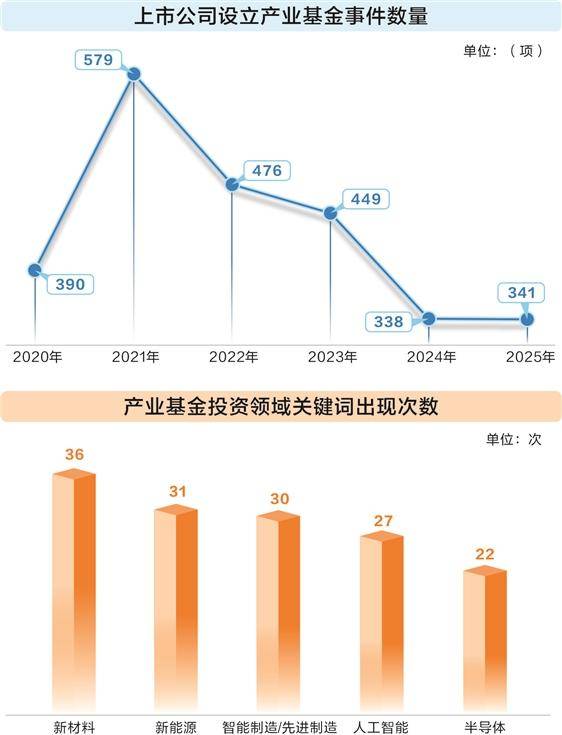
Core Viewpoint - The emergence of high-tech "unicorn" companies like Moore Threads and Muxi Co., Ltd. has created wealth effects for primary market investors, with listed companies increasingly participating in industry investment funds through corporate venture capital (CVC) models, focusing on hard technology sectors closely related to their main businesses [2][4]. Group 1: Industry Investment Trends - In 2023, 341 events of listed companies participating in the establishment of industry funds occurred, remaining stable compared to the previous year [4]. - Key sectors attracting investment include "new materials," "new energy," "artificial intelligence," "semiconductors," and "intelligent manufacturing," with these terms appearing nearly 150 times in the context of industry fund investments [4]. - The IPO count in advanced manufacturing reached 43, leading the market, followed by electronic information and healthcare sectors [5]. Group 2: Corporate Venture Capital (CVC) Insights - CVCs are increasingly favored by limited partners (LPs) due to their strategic depth and ability to integrate investments with corporate strategies, contrasting with traditional financial investments [6]. - CVCs accounted for 11.24% of total investment events in the primary market this year, with 33.07% of "unicorn" companies receiving CVC investments, indicating a high success rate [6][8]. - Approximately 410 A-share listed companies have established CVC institutions, representing about 7.5% of the total number of listed companies, a figure comparable to the U.S. market [9]. Group 3: Impact on Market Dynamics - The increasing maturity of CVC capabilities among listed companies is expected to deepen their influence in the primary market [10]. - Companies like Huagong Technology are establishing funds to strengthen their competitive edge in key sectors and to foster innovation in emerging industries [10][11]. - The shift in fundraising dynamics is evident, with a trend towards local state-owned assets becoming dominant LPs, reflecting a broader strategy of aligning with local industrial goals [11].


上市公司产投新风向:锚定硬科技,主业强协同
Zheng Quan Shi Bao· 2025-12-26 18:37
Core Insights - The emergence of high-tech "unicorn" companies like Moore Threads and Muxi Co. has created wealth effects for primary market investors, with listed companies increasingly participating in industrial investment funds as a significant investment force [1] - The trend shows a shift from unrelated "follow-the-trend" investments to a focus on hard technology sectors closely related to the companies' main businesses, with Corporate Venture Capital (CVC) models gaining popularity [1][4] Group 1: Investment Trends - In 2023, 341 events of listed companies participating in setting up industrial funds were recorded, remaining stable compared to the previous year, with a notable focus on hard technology fields such as "new materials," "new energy," "artificial intelligence," "semiconductors," and "intelligent manufacturing" [2] - The IPO numbers in advanced manufacturing, electronic information, and healthcare sectors have been significant, with 43, 34, and 33 companies listed respectively from January to November 2025 [3] Group 2: Corporate Venture Capital (CVC) Dynamics - Approximately 410 A-share listed companies have established CVC institutions, accounting for about 7.5% of the total, which is comparable to the less than 10% in the U.S. [7] - CVCs are favored by limited partners (LPs) due to their strategic depth and ability to integrate investments with corporate business logic, enhancing the likelihood of successful investments [5][6] Group 3: Market Impact and Future Directions - The establishment of CVCs is reshaping the primary market, with companies like Huagong Technology leveraging CVCs to drive dual engines of product and capital management, focusing on strengthening and supplementing industrial chains [8][9] - The evolving fundraising environment is pushing CVCs to adapt, with a shift towards partnerships with state-owned assets, reflecting a trend where CVCs are becoming preferred partners for local strategic goals [9]
对话上海交大高金严弘:绿色产业投资要因地制宜,“慧眼”在于读懂产业转型与技术路径
Xin Lang Cai Jing· 2025-12-23 02:12
Core Viewpoint - The Chinese financial system is at a historical juncture, emphasizing the construction of a financial powerhouse and the development of high-quality, resilient financial systems to support the real economy during the upcoming "14th Five-Year Plan" period [1][17]. Group 1: Green Technology Investment - Current green technology investment is heavily concentrated in the primary market and relies significantly on government-guided funds, leading to insufficient market-driven, long-term capital participation [1][13][30]. - The investment landscape requires financial institutions to enhance their professional judgment capabilities and focus on real application scenarios for long-term planning [1][18]. - The CVC (Corporate Venture Capital) model, led by industry players, is more aligned with the needs of green technology development, as it allows for long-term investment strategies that are closely tied to industry demands [1][18][33]. Group 2: Role of Technology in Green Finance - Technologies like artificial intelligence and blockchain can improve the credibility of green finance by enhancing data accuracy and reducing "greenwashing" [6][23]. - AI can provide reliable measurements of carbon footprints and emissions, while blockchain can ensure data integrity through its immutable nature, facilitating trust and verification in green certifications [6][23]. Group 3: Challenges and Opportunities in Green Technology - Despite advancements in certain areas like photovoltaic and wind energy, China's green technology development should not be limited to a few sectors but must address broader industrial challenges, especially in high-emission industries like steel and aluminum [8][25]. - The photovoltaic industry serves as a case study, demonstrating how significant government investment and policy support can reshape market dynamics and drive down costs, making green energy more competitive [9][26]. Group 4: Future Directions for Green Technology Investment - Long-term green technology investment should adopt a multi-modal approach, integrating large enterprises' resources with the needs of smaller firms that rely on external capital [31][30]. - Collaborative efforts among industry, academia, and research institutions are essential for advancing green technology, as seen in initiatives like Shanghai Jiao Tong University's "Big Zero Bay" project [31][30].

睿智医药:设立投资基金布局前沿项目,力争完成年度业绩目标
2 1 Shi Ji Jing Ji Bao Dao· 2025-11-14 09:25
Core Insights - The company is collaborating with professional investment institutions to establish an investment fund through a CVC model, focusing on innovative drug projects [1] - The company aims to achieve a revenue growth rate of no less than 15% by 2025 and to turn net profit positive (excluding equity incentive expenses) [1] Group 1 - The company’s wholly-owned subsidiary is involved in the investment fund initiative [1] - The investment strategy is designed to empower industrial collaboration and expand future orders [1] - The company is advancing its operational efforts around equity incentive goals [1]

睿智医药(300149) - 睿智医药2025年11月13日投资者关系活动记录表
2025-11-14 09:00
Group 1: Equity Incentive Plan - The company announced a restricted stock incentive plan on April 2025, with the first grant date set for July 11, 2025, at a price of 3.05 yuan per share, granting 44.56 million shares to 123 recipients including management and key personnel [2][3] - The equity incentive expenses for the first three quarters of 2025 amounted to 3,563.69 million yuan; excluding these expenses, the net profit attributable to shareholders was 42.72 million yuan, a year-on-year increase of 169.29% [3] Group 2: Employee Retention and Stability - The company's recent employee turnover rate is at a healthy level, indicating good team stability [3] Group 3: Collaboration with Investment Funds - The company has established investment funds in collaboration with professional investment institutions to enhance the innovative drug industry, leveraging their investment capabilities and risk control [3] Group 4: Performance Outlook - The company aims for a revenue growth rate of no less than 15% in 2025, with net profit (excluding equity incentive payment expenses) expected to be positive [3]
睿智医药(300149) - 睿智医药2025年9月2日投资者关系活动记录表
2025-09-03 10:02
Group 1: Company Performance - In the first half of 2025, the company achieved a revenue of 5.34 billion yuan, representing a year-on-year growth of 14.75% [3] - The net profit attributable to shareholders reached 25.38 million yuan, with a significant year-on-year increase of 140.35% [3] - The company's gross margin has improved significantly, indicating a fundamental enhancement in its financial health [3] Group 2: Strategic Planning - The company is focusing on a "one-stop service platform" for drug development, promoting a full-package service model to reduce communication costs and enhance efficiency [3] - The integration of AI technology into drug research and development is a key strategy, with successful applications in multiple core business areas [3] - The company aims to leverage its technological service capabilities to fill critical gaps in the industry chain and foster collaborative ecosystems [3] Group 3: Market Expansion - Over 80% of the company's revenue comes from overseas clients, with approximately 20% from the Asia-Pacific region [4] - The company is actively expanding its presence in the Asia-Pacific market and enhancing its service capabilities in Europe and the US [4] - New modality drug business has seen a significant increase, with orders from XDC and peptides rising from 8% to 17% year-on-year [5] Group 4: Customer Strategy - The company aims to secure long-term contracts with multinational corporations (MNCs) while also empowering more biotech firms as long-tail customers [5] - The customer structure is primarily composed of small to medium biotech firms, with a trend of MNC clients returning [5] - The company is focusing on enhancing collaboration with MNCs to stabilize its customer base and performance [5] Group 5: Financial Goals and Milestones - The long-term strategic goal is to capture 1% of the global CXO market, which is valued at 1 trillion USD [7] - The company targets a revenue increase to 2.5 billion yuan and a net profit of no less than 200 million yuan by 2027 [7] - Key milestones for the upcoming year include enhancing full-package services, establishing laboratories in Boston and the UK, and improving overall service capabilities [8]
杭州“六小龙”背后是“耐心政府”
Jing Ji Wang· 2025-06-16 09:19
Core Insights - The rise of the "Six Little Dragons" in Hangzhou signifies a new phase in China's technological innovation, moving beyond reliance on major cities and large enterprises to a broader engagement with smaller, innovative companies [1][3] - Hangzhou's government has adopted a supportive approach towards small and medium enterprises (SMEs), fostering an environment conducive to innovation and growth [3][4] - The concept of "patience" is emphasized as crucial for both government and policy in nurturing technological innovation [4] Government Support and Investment - Hangzhou's government is willing to invest in early-stage projects that other cities may avoid, helping companies navigate the challenges of initial growth phases [6][7] - The government has established various funds that support small enterprises, demonstrating a commitment to investing in their development rather than solely focusing on larger, established companies [6][8] - Examples include the investment in gaming company Game Science, which received support from local government funds even before achieving significant market validation [7] Innovation and Market Engagement - The city has created opportunities for SMEs to participate in significant events, such as the 2023 Asian Games, allowing them to gain visibility and showcase their innovations [5][6] - Hangzhou's approach includes opening up various sectors for experimentation by smaller companies, thus providing a fertile ground for innovation to take root [5][8] Comparative Analysis of Investment Models - Hangzhou's investment strategy contrasts with other cities like Shenzhen and Hefei, focusing more on future potential and smaller enterprises rather than just established players [8] - The article suggests that local governments should innovate in their approaches to support businesses, moving away from short-term metrics like immediate tax revenue [8]