A股反弹

Search documents
喜娜AI速递:今日财经热点要闻回顾|2026年1月22日
Xin Lang Cai Jing· 2026-01-22 12:03
Group 1 - US President Trump announced the suspension of tariffs on eight European countries, leading to a significant rebound in US stock markets, with all three major indices rising over 1% [2][7] - Goldman Sachs forecasts China's GDP growth to reach 4.8% by 2026, with strong export growth supported by global demand recovery and cost advantages [2][7] - The investment in copper bars has surged due to rising gold and silver prices, but experts warn that the investment's profitability is questionable due to significant price differences [2][7] Group 2 - A-shares rebounded with the Shanghai Composite Index up 0.14%, driven by strong performances in the computing power and commercial aerospace sectors [3][8] - National household deposits reached 167 trillion yuan, with per capita deposits nearing 120,000 yuan, indicating a shift in consumer confidence and increased corporate loan growth [3][8] - South Korea's semiconductor exports surged to $10.73 billion in the first 20 days of the year, reflecting strong global demand and boosting chip stocks [3][8] Group 3 - Yuanji Cloud Dumplings, a major Chinese fast-food chain, has submitted a listing application in Hong Kong, reporting significant revenue growth and plans for further expansion [3][9] - Dongtong Tui has been delisted but attracted attention from investors during its delisting period, indicating potential interest in its asset quality [4][9] - Volvo's global recall of the EX30 due to battery issues has sparked controversy in China, where some affected models were not recalled, raising concerns about sales pressure [4][9] Group 4 - The US has officially withdrawn from the World Health Organization, with an outstanding debt of approximately $260 million for the 2024-2025 period, which may impact global public health [5][9]
FICC日报:A股飘红迎反弹,贸易变量扰动市场情绪-20251022
Hua Tai Qi Huo· 2025-10-22 02:58
1. Report Industry Investment Rating - The overall rating for commodities and stock index futures is neutral [5] 2. Core Viewpoints - Domestic economic expectations are strong but the reality is weak. In August, China's economic data showed signs of weakness, and in September, exports were resilient. The M2 - M1 gap reached a new low for the year. To address external pressure, China has proposed policies to stabilize growth, with new policy - based financial instruments totaling 500 billion yuan. The GDP in Q3 increased by 4.8% year - on - year, and the growth rate of total retail sales of consumer goods in September slowed to 3% compared to August, while the added value of industrial enterprises above the designated size increased by 6.5% year - on - year. The housing prices in 70 large and medium - sized cities declined month - on - month in September [1] - Sino - US tariff frictions have intensified. As the extension of Sino - US tariffs is about to expire on November 10, the US has taken multiple measures such as adding Chinese companies to the entity list and imposing tariffs on various imported products. China has responded with measures like export controls on rare earth technology and imposing special port fees on US ships. The two sides agreed to hold a new round of economic and trade consultations as soon as possible [2] - The US government shutdown has affected the release of economic data. The US 9 - month Markit manufacturing and service PMI decreased slightly. The market has underestimated the severity of the shutdown, and attention should be paid to its development [3] - For commodities, it is advisable to wait and see in the near term. The black sector is affected by downstream demand expectations, the non - ferrous sector is constrained by long - term supply, the energy sector has a relatively loose supply in the medium term, the "anti - involution" space in the chemical sector is worthy of attention, agricultural products are driven by tariffs and inflation expectations, and short - term risks in precious metals should be guarded against [4] 3. Summary by Related Catalogs Market Analysis - Domestic economic situation: In August, China's economic data weakened, with characteristics of "slow industry, weak investment, and light consumption". In September, exports were resilient, and the M2 - M1 gap reached a new low for the year. The GDP in Q3 increased by 4.8% year - on - year, the growth rate of total retail sales of consumer goods in September slowed to 3% compared to August, and the added value of industrial enterprises above the designated size increased by 6.5% year - on - year. Housing prices in 70 large and medium - sized cities declined month - on - month in September. The government has proposed policies to stabilize growth, with new policy - based financial instruments totaling 500 billion yuan. On October 21, the A - share market strengthened, with the Shanghai Composite Index returning above 3900 points and the ChiNext Index rising more than 3%. The AI computing hardware sector soared, while sectors such as coal, gas, and precious metals declined [1] - Sino - US tariff frictions: As the extension of Sino - US tariffs is about to expire on November 10, the US has taken multiple measures such as adding Chinese companies to the entity list and imposing tariffs on various imported products. China has responded with measures like export controls on rare earth technology and imposing special port fees on US ships. The two sides agreed to hold a new round of economic and trade consultations as soon as possible [2] - US government shutdown: On October 15, the US Republican Party's temporary appropriation bill failed to advance in the Senate. The release of multiple economic data has been delayed. The US 9 - month Markit manufacturing and service PMI decreased slightly. The market has underestimated the severity of the shutdown, and attention should be paid to its development [3] Commodity Market - Overall strategy: It is advisable to wait and see in the near term. The volatility of previously bullish sectors is high, and the risk of price fluctuations is large [4] - Black sector: Still affected by downstream demand expectations, attention should be paid to the "anti - involution" situation [4] - Non - ferrous sector: Long - term supply constraints remain unrelieved, and it has been boosted by global easing expectations recently [4] - Energy sector: The medium - term supply is considered relatively loose. OPEC + announced that eight oil - producing countries will increase production by 137,000 barrels per day in November [4] - Chemical sector: The "anti - involution" space of products such as methanol, caustic soda, and urea is worthy of attention [4] - Agricultural products: Driven by tariffs and inflation expectations in the short term, but need to wait for fundamental signals and pay attention to the impact of Sino - US negotiations [4] - Precious metals: The market has overreacted in the short term, and the lease rates of gold and silver are relatively high. Short - term price fluctuations should be guarded against, and opportunities to buy on dips can be grasped in the long term [4] Strategy - The overall rating for commodities and stock index futures is neutral [5] Important News - Stock market: On October 21, the market strengthened throughout the day, with the Shanghai Composite Index returning above 3900 points and the ChiNext Index rising more than 3%. More stocks rose than fell, with over 4,600 stocks in the Shanghai, Shenzhen, and Beijing stock markets rising, and the trading volume reached 1.89 trillion yuan. The Shanghai Composite Index rose 1.36%, the Shenzhen Component Index rose 2.06%, and the ChiNext Index rose 3.02% [6] - International news: On October 21, the Japanese cabinet led by Ishiba Shigeru resigned, and Takamachi Sanae was elected as the new prime minister. European leaders signed a joint statement supporting an immediate cease - fire and peace talks, while the Russian foreign minister said the "immediate cease - fire" plan violated previous agreements [3][6] - Commodity news: On October 21, spot gold fell below $4,200 per ounce, with an intraday decline of 3.8%, the largest decline in four years [4]
陆家嘴财经早餐2025年10月21日星期二
Wind万得· 2025-10-20 22:41
Group 1: Economic Data and Trends - China's GDP grew by 5.2% year-on-year in the first three quarters, with quarterly growth rates of 5.4%, 5.2%, and 4.8% respectively [3] - In September, the industrial added value of large-scale enterprises increased by 6.5% year-on-year, while retail sales of consumer goods grew by 3% [3] - Fixed asset investment decreased by 0.5% year-on-year in the first three quarters, but grew by 3% when excluding real estate development investment [3] Group 2: Real Estate Market - In September, housing prices in 70 cities showed a month-on-month decline, with all second-hand housing prices falling [2] - The average premium rate for residential land in 300 cities dropped to 5.8%, with transaction area and land transfer fees decreasing by 13% and 10% year-on-year respectively [8] Group 3: Corporate Earnings - CATL reported a net profit of 18.549 billion yuan for the third quarter, a year-on-year increase of 41.21% [7] - China Mobile's net profit for the first three quarters was 115.4 billion yuan, up 4% year-on-year [7] - iFlytek's third-quarter net profit increased by 202.4% year-on-year [7] Group 4: Financial Policies and Instruments - The People's Bank of China maintained the 1-year and 5-year Loan Prime Rates (LPR) at 3% and 3.5% respectively for five consecutive months [3] - New policy financial instruments have been accelerated, with the China Development Bank having issued 189.35 billion yuan to support major economic provinces [3] Group 5: Stock Market Performance - A-shares experienced a slight increase, with the Shanghai Composite Index rising by 0.63% to close at 3863.89 points [4] - The Hang Seng Index closed up 2.42% at 25858.83 points, driven by a rebound in tech stocks [4] Group 6: International Developments - The U.S. and Australia signed an agreement to streamline the approval process for mining and processing facilities for rare earths and critical minerals [13] - Japan's three major banks announced a strategic partnership to issue a yen stablecoin, aiming to reduce payment and settlement costs [10]



今天,“牛市旗手”发力,A股成交额连续3日突破2万亿
Zhong Zheng Wang· 2025-08-15 07:31
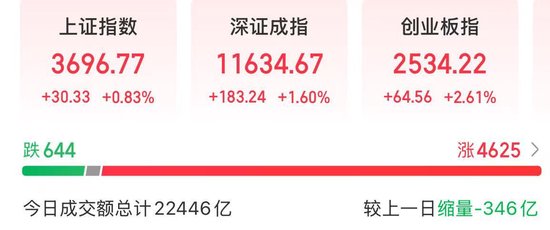
Market Overview - A-shares experienced a broad rally, with the Shanghai Composite Index rising 0.83% to 3696.77 points, the Shenzhen Component Index increasing by 1.6%, and the ChiNext Index up by 2.61% [1][2] - Over 4600 stocks rose, with a market turnover of 22,446 billion yuan, marking the third consecutive day above 20,000 billion yuan [2] Sector Performance - The securities and internet finance sectors saw significant gains, with stocks like Zhina Compass, Tonghuashun, and Dongfang Caifu experiencing substantial increases [2] - The computing power industry chain rebounded, with electric power equipment and liquid-cooled servers also showing strong performance [2] Financial Data Insights - CICC reported that new deposits from non-bank financial institutions reached 2.14 trillion yuan in July, a year-on-year increase of 1.39 trillion yuan, indicating heightened financial investment activity in the private sector [3] - The increase in non-bank financial institution deposits may suggest a shift of funds towards the stock market due to declining deposit rates and weaker relative attractiveness of fixed-income assets [3] Financing Trends - From August 11 to 14, A-share financing balances remained above 20 trillion yuan for four consecutive trading days, driven by improved policy expectations and a recovery in market risk appetite [4] - Financing funds have primarily flowed into information technology, industrial, and materials sectors, reflecting confidence in structural optimization and high-quality economic development [4] - Current margin financing levels are at historical midpoints, significantly lower than the peak levels seen in 2015, suggesting a stable liquidity environment [4]
十大券商一周策略:A股仍处于牛市中继,避免参与似是而非的资金接力
Zheng Quan Shi Bao· 2025-08-10 23:59
Group 1 - The current market for small and micro-cap stocks needs to slow down, as high valuations and negative TTM profits make it difficult to justify further upward movement [2] - The five strong industry trends (non-ferrous metals, telecommunications, innovative pharmaceuticals, gaming, and military industry) have more reasonable valuations compared to the small and micro-cap stocks [2] - The main drivers of small and micro-cap stocks are liquidity and retail investor contributions, but their overall profit growth is not as strong as in 2015 [2] Group 2 - A rebound in A-shares was observed, driven by trading funds, with a focus on themes like dividends and small micro-cap stocks [3] - The two financing balance reached a nearly 10-year high, indicating that liquidity-driven market conditions may still have incremental support [3] - The PPI has shown signs of bottoming out, and the "anti-involution" policy is beginning to show effects, suggesting a stable economic outlook [3] Group 3 - July exports exceeded expectations, particularly in competitive manufacturing sectors like machinery, automobiles, and integrated circuits [4] - The PPI decline has stabilized, benefiting from price rebounds in sectors like black metals, non-ferrous metals, coal, and photovoltaics [4] - The basic economic fundamentals are showing a trend of steady improvement, with recommendations to focus on sectors with high growth or improvement in earnings [4] Group 4 - The two financing balance has risen above 2 trillion yuan, but remains at historical mid-levels compared to the peak in 2015 [5] - The market is expected to maintain a high volatility range, with a focus on sectors with strong earnings performance during the concentrated reporting period [5] - The "anti-involution" concept is anticipated to be a recurring theme in the market, alongside opportunities in growth sectors driven by AI and emerging industries [5] Group 5 - The current bull market atmosphere is not expected to dissipate easily, with potential mainline directions including domestic technological breakthroughs and competitive manufacturing sectors [6] - The market is likely to maintain its characteristics of sector rotation and high micro-level activity, with small-cap growth stocks continuing to outperform [6] - There are new opportunities for participation, particularly in event-driven individual stocks [6] Group 6 - Short-term upward movement in A-shares may face resistance, but the market remains in a bull market continuation phase [7] - The focus is on new low-level niche products in emerging sectors, with significant potential in areas like brain-computer interfaces and liquid cooling technologies [7] - The military sector is expected to have a short-term rally, with attention on new combat capabilities and military trade-related stocks [7] Group 7 - The current market rally is supported by various sources of incremental capital, with a notable increase in M1-M2 growth rates indicating enhanced liquidity [8] - The two financing balance reaching a 10-year high reflects a rising risk appetite among individual investors [8] - The focus on new technologies and growth directions, such as domestic computing power and robotics, is expected to drive future market trends [8] Group 8 - There is a divergence in judgment regarding the liquidity-driven bull market, with the potential for significant resident capital inflow into the stock market [9] - Historical patterns suggest that the initial phases of a bull market often see improvements in specific channels before broader participation [9] - The current market's rise is still modest compared to previous bull markets, indicating that concerns about a major downturn may be premature [9] Group 9 - The current market adjustment is seen as a structural shift rather than a peak in the broader cycle, with manageable index fluctuations [11] - The market is transitioning from traditional cyclical sectors to technology sectors, driven by policies similar to previous economic stimulus measures [11] - Continued focus on technology sectors, including AI and robotics, is recommended for future investment strategies [11]