
政策性金融

Search documents
构建农业科创金融新生态
Jing Ji Ri Bao· 2026-02-10 22:13
Core Insights - The article emphasizes the increasing role of finance in supporting agricultural technology innovation as part of China's agricultural modernization efforts [1][2][3] Group 1: Financial Support Mechanisms - Policy and commercial finance are working together to create a multi-layered support system for agricultural technology innovation, with policy banks providing low-cost, long-term funding for key projects [1][2] - Capital markets are becoming more involved, with initiatives like the "specialized, refined, distinctive, and innovative" green channel at the Beijing Stock Exchange facilitating financing for hard-tech companies in agriculture [2] - Financial technology is enhancing resource allocation efficiency through tools like big data and AI, enabling precise credit assessments for agricultural tech enterprises [2][3] Group 2: Challenges and Recommendations - Current challenges include low conversion rates of agricultural technology achievements, financing difficulties for small enterprises, and insufficient "patient capital" [2][4] - Recommendations include establishing a national agricultural innovation guiding fund to direct investments into critical areas, and expanding pilot programs for funding models that alleviate financial pressure on research institutions and startups [3][4] - Strengthening financial technology infrastructure is crucial, including creating a unified database for agricultural tech enterprises to improve risk identification and support [3][4] Group 3: Risk Management and International Cooperation - There is a need for innovative risk-sharing and incentive mechanisms, such as expanding agricultural technology innovation insurance and developing specialized insurance products for various risks [4] - Enhancing international financial cooperation and aligning with global agricultural technology governance is essential, including supporting the issuance of green bonds by qualified agricultural tech companies [4]
联聚德视角:政策性金融新工具下的融合战略实践
Jin Tou Wang· 2025-12-22 03:07
Core Insights - The National Development and Reform Commission announced the release of 500 billion yuan in new policy financial instruments, which not only injects funds into the market but also creates strategic opportunities for market participants [1] - The new policy financial instruments exhibit three key characteristics: closer coordination between fiscal and monetary policies, clear structural arrangements for fund allocation, and an emphasis on capital attributes in financing models [1] - The "fusion" strategic approach proposed by the company emphasizes the organic combination of different elements rather than simple addition [1] Group 1: Fusion Strategy - The first aspect of the fusion strategy is the integration of financing and intelligence, where obtaining policy funding is just the first step; professional project operation and fund management capabilities are essential for effective utilization [2] - The second aspect is the integration of cycles and structures, focusing on industries like digital economy and green low-carbon sectors that align with long-term development trends [2] - The third aspect is the integration of capital and responsibility, incorporating environmental, social, and governance factors into project evaluation and implementation to ensure sustainable development and long-term returns [2] Group 2: Focus Areas - The company is particularly focused on three areas: technological innovation, emphasizing industrial internet and artificial intelligence with strong spillover effects [3] - In the green low-carbon sector, the team aims to promote a model that fosters the interaction between green asset construction and carbon financial innovation [3] - In consumption and urban renewal, the focus is on the integrated development of hardware and software to cultivate assets that generate sustainable and high-quality cash flows [3] Group 3: Future Outlook - The introduction of the 500 billion yuan policy financial instruments marks an important starting point and signifies the beginning of a new round of policy support [3] - The true value of the policy will depend on the ability of market participants to transform it into sustainable business models and actual development outcomes [3] - The company will continue to act as a bridge between policy and market, striving to seize policy opportunities while contributing to value creation in the process of China's high-quality economic development [3]
预计拉动项目总投资超7万亿元!
第一财经· 2025-10-30 09:21
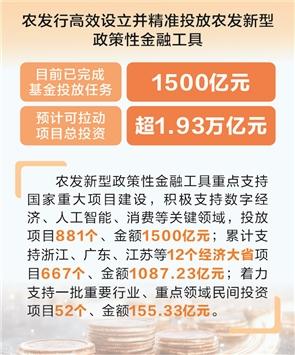
Core Viewpoint - The newly established policy financial tools amounting to 500 billion yuan have been fully deployed, significantly supporting key projects and expected to drive total project investment exceeding 7 trillion yuan [1]. Group 1: Deployment and Impact - The rapid and efficient establishment and deployment of these financial tools are highlighted as key characteristics [4]. - The National Development and Reform Commission announced the completion of the deployment of 500 billion yuan in new policy financial tools, with specific allocations of 250 billion yuan, 100 billion yuan, and 150 billion yuan from different banks [4]. - The focus areas for these tools include technological innovation, expanding consumption, and stabilizing foreign trade [4]. Group 2: Regional Focus - The tools have strengthened support for major economic provinces, with significant project investments in 12 key provinces [4]. - The new policy financial tools have supported 690 projects with an investment of 194.95 billion yuan in major economic provinces, accounting for 78% of the total [4]. - The agricultural development financial tool has supported 667 projects in major economic provinces, amounting to 108.723 billion yuan [4]. Group 3: Private Investment - The tools have increased support for private investment projects, with 128 projects receiving 68.59 billion yuan from the national development financial tool, representing 27.4% of the total [5]. - The agricultural development financial tool has supported 52 private investment projects with an amount of 15.533 billion yuan [5]. - The new policy financial tools have facilitated over 100 private investment projects, with more than 30% of the loan amounts allocated to these initiatives [5]. Group 4: Capital Supplementation - The 500 billion yuan in new policy financial tools is entirely allocated to supplement project capital, addressing the capital shortage issues faced by major projects [5]. - The national development, export-import, and agricultural development financial tools are expected to drive total project investments of 3.85 trillion yuan, over 1.3 trillion yuan, and over 1.93 trillion yuan, respectively [5]. Group 5: Future Expectations - Experts anticipate that the projects supported by the new policy financial tools will be rapidly implemented from October to December, converting previously reserved projects into actual construction [6]. - This transition is expected to enhance effective investment and promote stable economic development [6].


农发新型政策性金融工具1500亿元投放完成 时报数说
Zheng Quan Shi Bao· 2025-10-27 21:27
Core Viewpoint - The article discusses recent developments in the financial market, highlighting significant trends and potential impacts on investment opportunities [2] Group 1 - The financial market is experiencing notable fluctuations, which may present both opportunities and challenges for investors [2] - Key economic indicators are showing mixed signals, suggesting a complex environment for investment decisions [2] - Analysts are closely monitoring these trends to identify sectors that may benefit from the current market conditions [2]
【广发宏观郭磊】BCI数据继续印证广义财政影响
郭磊宏观茶座· 2025-10-27 12:37
Core Viewpoint - The article highlights a significant rebound in economic indicators for October, driven by the implementation of new policy financial tools, suggesting a recovery in the economy after a challenging period in July and August [1][4][15]. Economic Indicators - The October EPMI (Emerging Purchasing Managers Index) rose sharply by 7.3 points to 59.7, indicating strong seasonal characteristics typical of autumn [4][22]. - The BCI (Business Confidence Index) increased by 0.9 points to 52.0, confirming a positive trend in economic performance from September to October [1][4]. Sales and Profit Expectations - Sales and profit indices showed a slight pullback in October but remained at the second-highest level since May, indicating sustained autumn demand [6][8]. - The sales forecast index for October was 59.7, down from 60.9, while the profit forecast index was 47.4, down from 48.3, reflecting a weaker outlook compared to previous months [6][8]. Investment and Employment Outlook - Investment and employment forward-looking indices reached their highest levels of the year, attributed to the positive impact of policy financial tools on corporate expectations [2][8]. - As of October 17, new policy financial tools had injected 189.35 billion yuan, expected to stimulate a total project investment of 2.8 trillion yuan [2][8]. Financing Environment - The corporate financing environment index saw a significant increase, indicating improved credit conditions due to policy financial tools being used to supplement project capital [11]. - The October financing environment index was 52.4, surpassing the previous value of 47.6, with only three months in the year exceeding 50 [11]. Price Expectations - Price indices for intermediate and consumer goods showed varying degrees of decline, influenced by commodity price fluctuations [12]. - The consumer price forecast index for October was 44.7, down from 47.9, while the intermediate goods price forecast index was 33.4, down from 38.0, indicating uncertainty in future price trends [12]. Policy Implications - The rebound in EPMI and BCI data suggests that the economy is sensitive to investment, with the primary challenge for macroeconomic policy being the expansion of demand rather than merely lowering interest rates [15]. - If construction projects are prioritized in 2026, there is a high probability of a gradual recovery in nominal growth throughout the year, potentially leading to a second phase of a profit-driven bull market [15].

新型政策性金融工具 推动重要项目加快开工建设
Jin Rong Shi Bao· 2025-10-22 04:31
Core Insights - The establishment of new policy financial tools is a clear directive from the central government aimed at supporting technological innovation, expanding consumption, and stabilizing foreign trade [1][2] - The new policy financial tools are designed to address funding shortages for infrastructure projects, thereby facilitating targeted support for major national projects and guiding investments towards technology innovation, consumption upgrades, and green low-carbon initiatives [1][3] Group 1: Implementation and Impact - A total of 500 billion yuan in new policy financial tools has been initiated, with three main entities responsible for the deployment [2] - As of October 17, 2023, the National Development Bank has disbursed 1,893.5 billion yuan, primarily supporting major economic provinces and increasing support for private investment and new productive forces, which is expected to stimulate a total project investment of 2.8 trillion yuan [2][3] - The Agricultural Development Bank has completed 1,001.11 billion yuan in fund disbursement, supporting 562 projects and anticipating a total project investment exceeding 1.26 trillion yuan [2][3] Group 2: Focus Areas - The new policy financial tools prioritize investments in 12 major economic provinces, with significant allocations made to these regions [3] - There is a strong emphasis on private investment, with the National Development Bank having allocated 545.2 billion yuan to private sector projects, representing 28.8% of its total disbursement [3][4] - The inclusion of private enterprises, particularly in technology and consumption upgrade sectors, is expected to ensure that policy benefits reach eligible major enterprises and private projects [3]
新型政策性金融工具推动重要项目加快开工建设
Jin Rong Shi Bao· 2025-10-22 01:37
Core Insights - The establishment of new policy financial tools is a clear directive from the central government aimed at supporting technological innovation, expanding consumption, and stabilizing foreign trade [1][2] - The rapid deployment of the 500 billion yuan new policy financial tools is designed to address funding shortages for infrastructure projects and support major national projects [2][3] Group 1: Policy Financial Tools - The new policy financial tools are characterized by long terms, low costs, and strong leverage effects, playing a crucial role in supporting national infrastructure and specific industry development [1][4] - As of October 17, 2023, the National Development Bank has disbursed 1,893.5 billion yuan, with a focus on major economic provinces and increased support for private investment [2][3] Group 2: Investment Impact - The 500 billion yuan policy financial tools are expected to drive approximately 4.17 trillion yuan in social investment, with commercial bank loans being a significant component of the leveraged social capital [4] - The tools prioritize support for private enterprises, particularly in technology and consumption upgrade sectors, facilitating direct access to policy benefits for eligible major enterprises and private projects [3][4]
5000亿元新型政策性金融工具加速落地
Jing Ji Wang· 2025-10-21 04:11
Core Points - The National Development and Reform Commission (NDRC) announced the establishment of a new type of policy financial tool with a total scale of 500 billion yuan, aimed at supporting technology innovation, expanding consumption, and stabilizing foreign trade to promote stable economic development [1][2][6] - The new policy financial tools will be used exclusively to supplement project capital, addressing funding bottlenecks caused by tight local finances [2][6] - Various regions have begun to implement these financial tools, with initial funding already allocated to projects in infrastructure, digital economy, and artificial intelligence [4][5] Summary by Sections Policy Framework - The new policy financial tools were proposed during a Central Political Bureau meeting on April 25, emphasizing support for major national strategic projects [2] - These tools are characterized as "quasi-fiscal" instruments, typically funded through financial bonds issued by policy banks, with project selection led by the NDRC and interest subsidies from the Ministry of Finance [2] Funding Allocation - The total scale of the new policy financial tools is set at 500 billion yuan, all designated for project capital supplementation [2][8] - Recent data indicates that the establishment of new policy financial tool companies has occurred, with registered capital amounts of 20 billion yuan, 10 billion yuan, and 5 billion yuan respectively [2] Regional Implementation - Various regions, including Jiangsu, Guangdong, and Zhejiang, have actively launched projects funded by the new policy financial tools, with specific allocations such as 3.199 billion yuan for a rail transit project in Jiangsu [4][5] - The funding is directed towards both traditional infrastructure and emerging sectors like digital economy and artificial intelligence [4] Economic Impact - The new policy financial tools are expected to leverage additional investments, with estimates suggesting that the 500 billion yuan could mobilize between 1.5 trillion to 2 trillion yuan in fixed asset investments [8] - The tools are designed to support long-term projects, particularly in sectors like digital economy and green technology, aligning with the goals of the 14th Five-Year Plan [7][8]
多地积极布局 新型政策性金融工具加速落地
Sou Hu Cai Jing· 2025-10-16 06:02
Core Viewpoint - The National Development and Reform Commission (NDRC) of China announced the establishment of a new type of policy financial tool with a total scale of 500 billion yuan, aimed at supporting capital for projects in technology innovation, consumption expansion, and stabilizing foreign trade to promote stable and healthy economic development [1][2] Group 1: Policy Financial Tools - The new policy financial tools are designed to support major national strategic projects and are characterized by their "quasi-fiscal" nature, involving policy banks issuing financial bonds to raise funds [2] - The tools will focus on injecting capital into projects, addressing funding bottlenecks caused by tight local finances, and facilitating the implementation of significant projects [2][9] Group 2: Investment and Economic Impact - The new financial tools are expected to leverage significant investment, with estimates suggesting that the 500 billion yuan could mobilize approximately 2.75 trillion yuan in new social financing and potentially drive 1.5 trillion to 2 trillion yuan in fixed asset investment [11] - The tools are projected to have a multiplier effect on infrastructure investment, with previous similar tools showing a multiplier of about 3.5 times [11] Group 3: Regional Implementation - Various regions, including Jiangsu, Guangdong, and Zhejiang, have already begun deploying the new policy financial tools, with specific projects receiving funding such as the Wuxi-Yixing intercity rail project and urban renewal initiatives [6][7][8] - The funding will support both traditional infrastructure and emerging sectors like digital economy and artificial intelligence, reflecting a balanced approach to economic growth and structural adjustment [4][9] Group 4: Broader Economic Context - The establishment of these tools aligns with the broader policy goals set forth in the 14th Five-Year Plan, emphasizing the importance of expanding domestic demand and fostering technological innovation [10] - The NDRC has previously allocated significant funds for construction projects, with 800 billion yuan for "two heavy" construction projects and 735 billion yuan in central budget investments already distributed this year [3]
图说金融:新型政策性金融工具资金开始投放
Zhong Xin Qi Huo· 2025-10-09 11:34
Report Summary 1. Report Industry Investment Rating - No information provided 2. Core View of the Report - On September 29, 2025, three new policy-based financial instrument companies were registered, and funds started to be disbursed on the same day. The funds have been disbursed in provinces and cities such as Jiangsu, Zhejiang, Guangdong, Hainan, Guangxi, Fujian, Anhui, Shandong, Sichuan, Chongqing, and Inner Mongolia [2]. 3. Summary by Relevant Catalog Features of the Instruments - Long - term: Some project financing terms are 20 years or 15 - 20 years [2]. - Low - interest rate: The capital interest rate of a project is lower than the current LPR, setting a new record for the lowest financing cost among all financing channels since the group's establishment [2]. Investment Fields - The disclosed project fields include infrastructure areas such as transportation and logistics, green - low - carbon transformation, municipal and industrial parks, as well as scientific and technological innovation fields such as artificial intelligence [3]. Proportion in Total Investment - In some projects, the amount obtained accounts for less than or equal to 10% of the total project investment (less than or equal to 50% of the project capital) [4]. Project Approval Rate - The project approval rate in some areas may be low. For example, in a certain place in Zhejiang, the approval rate from the city to the province is 40%, and from the province to the state is 13% [5]. Disbursement Situation as of October 8 - Multiple projects in various provinces and cities have received new policy - based financial instrument funds, with specific amounts and project details as shown in the table. For example, the Wuxi - Yixing Intercity Rail Transit Project in Wuxi, Jiangsu received 31.99 billion yuan; the Taicang Water Supply Co., Ltd. Expansion and Booster Station Project in Taicang, Jiangsu received 0.2076 billion yuan, accounting for 10% of the total project investment of 2.0766 billion yuan [6].