
新能源和智能网联汽车

Search documents
焦点访谈|从地方两会看开局之年 各地确保实现“开好头、起好步”
Yang Shi Wang· 2026-02-05 13:40
Group 1: Economic Development Focus - The core focus of local governments during the "14th Five-Year Plan" is on expanding domestic demand, enhancing technological innovation, and building a modern industrial system [1][22] - The central economic work conference emphasized the importance of domestic demand as a priority for economic work in 2026, with local governments proposing specific policies to promote consumption upgrades and new growth points [1][22] Group 2: Consumption and Service Sector Initiatives - Beijing plans to enhance support for service consumption in education, health, and tourism, aiming to integrate cultural and commercial activities and introduce more international events [3] - Henan aims to boost consumption by optimizing policies for replacing old goods and enhancing retail innovation, focusing on the integration of culture and tourism [5] - Guizhou's tourism sector has attracted over 27.5 million visitors, generating 31.2 billion yuan in revenue, with plans to upgrade the service industry [7] Group 3: Technological Innovation - Technological innovation is a key theme, with local governments focusing on strengthening support for research and development [9] - Beijing is set to launch initiatives for foundational research and key technology breakthroughs, including the establishment of new research platforms [10] - Guangdong aims to create a globally influential industrial technology innovation center, emphasizing the importance of artificial intelligence applications [14] Group 4: Modern Industrial System Development - The construction of a modern industrial system is a strategic task for the "14th Five-Year Plan," with various provinces outlining their development goals [16][20] - Fujian is focusing on advancing its manufacturing sector, aiming for a 10% increase in R&D investment and promoting new industrial clusters [18] - Jiangxi plans to accelerate the modernization of emerging industries, particularly in electronics and renewable energy [20] Group 5: Collaborative Innovation - Hubei is working on optimizing collaborative innovation systems and establishing centers for industry-academia-research cooperation [14] - The integration of technological and industrial innovation is emphasized in Hebei, particularly in the robotics sector [12]

奋进的河北·数读新变化|2025年河北GDP增速何以跑进全国前三(二):创新动能加速释放 新质生产力不断催生
Xin Lang Cai Jing· 2026-01-31 23:42
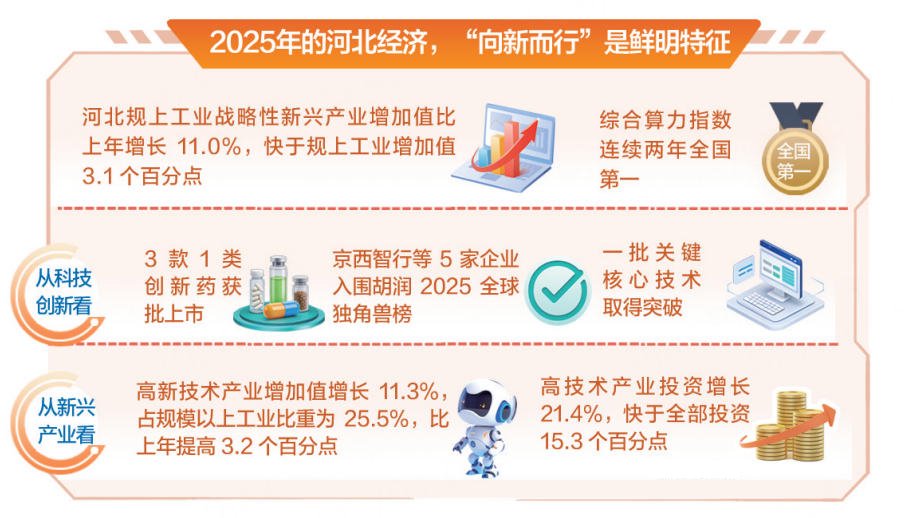
Core Viewpoint - The economic growth of Hebei in 2025 is characterized by a shift towards innovation and new production capabilities, with a GDP growth rate expected to rank among the top three in the country, driven by changes in industrial development models and accelerated innovation momentum [3][4]. Group 1: Economic Growth and Industrial Development - In 2025, the added value of strategic emerging industries in Hebei's regulated industrial sector is projected to grow by 11.0%, outpacing the overall industrial added value growth by 3.1 percentage points [3]. - The province's comprehensive computing power index has ranked first in the nation for two consecutive years, indicating a strong foundation for technological advancement [3]. - The revenue of the entire robot industry chain in Hebei has increased by 42.5% year-on-year, maintaining over 40% growth for three consecutive years [4]. Group 2: Innovation and Technology - Hebei has implemented policies to enhance the role of enterprises in technological innovation, optimizing the R&D expense deduction policy to create a favorable environment for technological progress [4][5]. - The province has developed 292 vertical large models in 26 fields, including steel and chemicals, to promote the deep integration of artificial intelligence with traditional industries [5]. - Three innovative drugs have been approved for market release, and five companies have entered the Hurun 2025 Global Unicorn List, showcasing significant advancements in high-tech industries [6]. Group 3: Consumer Trends and Market Dynamics - In 2025, the retail sales of new energy vehicles in Hebei are expected to grow by 7.8%, while the retail sales of energy-efficient home appliances are projected to increase by 91.6%, reflecting a shift in consumer demand towards quality and sustainability [6]. - The online retail sales in Hebei reached 5100.6 billion yuan, growing by 8.9% year-on-year, with physical goods online retail sales increasing by 5.2% [8]. - The province's express delivery volume reached 11.96 billion pieces, a year-on-year increase of 25.4%, ranking fourth in the nation, indicating robust growth in logistics and e-commerce sectors [8].
只争朝夕持续奋斗 确保“十五五”开好局起好步
Xin Lang Cai Jing· 2026-01-30 22:49
Group 1: Economic Development and Planning - The government work report emphasizes the importance of ensuring a strong start for the "15th Five-Year Plan" by focusing on the goals outlined in the plan [1] - The report highlights the need for high-standard and high-quality construction in the Xiong'an New Area, exploring a modern urban governance model with Chinese characteristics [1] - The report calls for deepening the collaborative development of key industrial chains such as new energy, smart connected vehicles, and robotics in the Beijing-Tianjin-Hebei region [2] Group 2: Robotics Industry Development - Tangshan High-tech Zone is identified as a key area for the development of the robotics industry chain within the "six chains and five clusters" framework of the Beijing-Tianjin-Hebei collaborative development [2] - The focus will be on creating a deep intelligence-driven robotics industry that emphasizes practical functionality, supported by a platform for regular supply-demand matching [2] - The government aims to enhance the "shared manufacturing" initiative, expanding its coverage from 107 key clusters to 280 clusters, promoting shared factories across multiple levels [2] Group 3: Technological Innovation - The report stresses the need to enhance the effectiveness of technological innovation, particularly in sectors like vaccines, cell and gene technology, robotics, satellite detection, and new chemical materials [3] - Collaboration with institutions such as Tsinghua University and Zhongguancun Development Group is encouraged to deepen the integration of innovation resources, financial resources, and industrial projects [3] Group 4: Consumer Economy - The report outlines plans to promote the transformation of cultural and tourism consumption in Handan from a "ticket economy" to a "comprehensive consumption" model [4] - The focus will be on leveraging core cultural resources to innovate and extend the consumption chain, enhancing the quality and effectiveness of cultural tourism [4] Group 5: Agricultural Modernization - The government aims to elevate agricultural modernization by focusing on quality, branding, channels, and integration, particularly in the fruit and vegetable industry [5] - Initiatives include the establishment of high-quality fruit and vegetable demonstration zones and the promotion of precision and standardization in agricultural practices [5] Group 6: Social Welfare and Employment - The report outlines plans for educational improvements, including the renovation of 50,000 classrooms and 500 sports facilities, with a completion target by the end of August [6] - A focus on healthcare training is highlighted, with plans to train over 11,000 rural doctors through both offline and online programs by 2025 [6]
张艺秋:GDP目标5%,北京底气从哪里来?
Xin Jing Bao· 2026-01-25 13:33
Economic Growth Goals - The economic growth target for Beijing in 2026 is set at around 5%, aiming to consolidate the positive trend of economic recovery [1] - The report highlights that 2026 marks the beginning of the "14th Five-Year Plan," amidst a period of both strategic opportunities and challenges [1] External Environment and Resilience - The global landscape is undergoing profound adjustments, with increasing uncertainties due to major power competition and geopolitical conflicts [2] - Despite these challenges, Beijing's economy demonstrated resilience with a growth rate of 5.4% in 2025, supported by a robust export performance [2][3] - The region's exports grew by 5.9% year-on-year in the first eleven months, achieving a historical high, with exports to Belt and Road countries increasing by 7.8% [2] Development Experience and Economic Performance - Over the past five years, Beijing's economy has crossed the 4 trillion yuan mark and reached a new level of 5 trillion yuan, with an average growth rate of 5.2% [3] - Per capita GDP increased from 176,000 yuan in 2020 to approximately 239,000 yuan in 2025, indicating significant economic advancement [3] Policy Support and Market Dynamics - The national policies for 2025, including "two new" and "two重" initiatives, aim to stabilize the market and expectations, with a focus on digital and green consumption [4] - The central economic work conference emphasized a more proactive fiscal policy for 2026, with expectations for increased fiscal deficit rates and the implementation of supportive projects [4] Regional Collaboration and Infrastructure Development - The Beijing-Tianjin-Hebei collaborative development has made significant progress, with major infrastructure projects enhancing connectivity [4][6] - The establishment of a one-hour transportation circle in the core region and a 1.5-hour circle between neighboring cities has been largely achieved [4] Innovation and Technology - Beijing is a major source of original innovation in China, with strong technological foundations and a vibrant innovation ecosystem [7] - The city has maintained a research and development intensity of over 6% for six consecutive years, ranking among the top global innovation cities [7] Consumer Market Potential - With per capita GDP reaching developed country levels, nearly 70% of the population falls into the middle-income category, driving consumption growth [8] - The shift in consumer focus towards higher-level demands, such as cultural and spiritual needs, is evident, with service consumption accounting for 59.3% of total household spending [8]
京津冀协同创新成效显著
Jing Ji Ri Bao· 2026-01-13 03:55
Core Insights - The "Beijing-Tianjin-Hebei Collaborative Innovation Index (2026)" was released to monitor and evaluate the collaborative innovation development in the region, showing significant growth from 100 in 2013 to 388 in 2024, with an average annual growth rate of 13.1% [1] Group 1: Innovation Index Growth - The index measures collaborative innovation across five dimensions: innovation capability, research cooperation, technology connections, innovation performance, and innovation environment [1] - Beijing's collaborative innovation index saw the largest increase, growing from 657.7 to 1198.4 from 2013 to 2024, indicating strong radiative power [1] Group 2: Regional Performance - Tianjin's collaborative innovation index increased by 14.7% in 2024 compared to 2023, while Hebei maintained a steady growth rate of 13.1% [2] - The gap in innovation indices between Beijing and Hebei has narrowed, while the gap between Beijing and Tianjin has widened [2] Group 3: Industry Collaboration - The three regions have formed a new development pattern characterized by mutual benefits and complementary advantages, leading to breakthroughs in industries, transportation, and environmental sectors [2] - Beijing leads in hydrogen and biomedicine, Tianjin in high-end industrial mother machines and cybersecurity, and Hebei in new energy and intelligent connected vehicles [2] Group 4: Technological Innovation - The technology innovation network in the region is primarily led by Beijing, which accounted for 40.9% of patent cooperation in 2024 [3] - The total value of technology contracts in the region reached 1.3 trillion yuan, representing nearly 20% of the national total [3] Group 5: Innovation Environment - The development of the "Beijing-Tianjin-Hebei on Tracks" initiative has facilitated smoother flow of innovation elements, supported by a combination of policies for high-quality innovation and entrepreneurship [3] - A total of 13 innovation platforms have been established across the three regions, accelerating the incubation and transformation of innovative results [3] Group 6: Future Development Strategies - Strengthening international technological capabilities and building a collaborative innovation network centered around leading technology enterprises is crucial for future development [4] - The strategy includes enhancing original and disruptive technological innovations and fostering a collaborative innovation community in the Beijing-Tianjin-Hebei region [4][5]
北京出台鼓励措施 重点产业中试平台最高补助1亿元
Zhong Guo Xin Wen Wang· 2026-01-04 13:23
Group 1 - Beijing plans to support the construction of pilot test platforms for key industries such as artificial intelligence, healthcare, green low-carbon technologies, robotics, and smart manufacturing, with subsidies of up to 100 million RMB, covering 35% of total investment for new projects [1][2] - The goal is to establish 10 national-level manufacturing pilot test platforms and 50 municipal-level platforms by 2030, forming a pilot test system that meets the requirements of the capital's modern industrial system [1] - The measures encourage collaboration among leading enterprises in the industry chain to co-build pilot production lines, support the establishment of comprehensive pilot public service institutions, and enhance the digital and green capabilities of existing platforms [1][2] Group 2 - The measures also emphasize the collaborative construction of pilot transformation bases in key areas such as hydrogen energy, biomedicine, cybersecurity, industrial internet, high-end equipment, new energy, and intelligent connected vehicles within the Beijing-Tianjin-Hebei region [2] - A service platform for matching supply and demand in pilot testing services will be established, along with a focus on strengthening financial investment in pilot services [2]
人民日报聚焦湖北武汉:锚定“五个中心”战略定位 奋力谱写高质量发展新篇章
Ren Min Wang· 2025-12-04 06:49
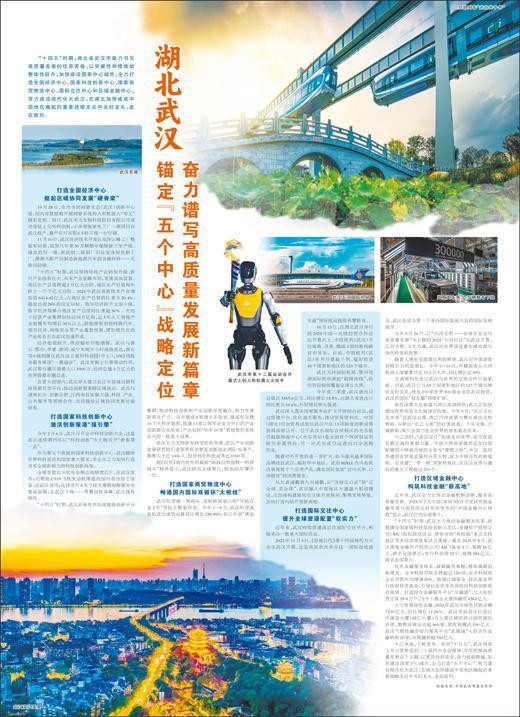
Core Insights - Wuhan is striving for high-quality development during the "14th Five-Year Plan" period, aiming to become a national central city and a key strategic hub in central China [1][4][13] Economic Development - Wuhan's GDP has surpassed 2 trillion yuan, with an annual increase of 100 billion yuan [4] - The high-tech industry added value reached 641.44 billion yuan, accounting for 30.4% of the GDP, exceeding the target of 28% [4] - The digital economy has ranked among the top ten in the country, contributing over 50% to the GDP [4] - The optical-electronic information industry cluster is advancing towards a trillion-level scale, with AI industry growth averaging over 30% annually [4] Regional Collaboration - Wuhan has established high-speed rail connections with nearby cities, enhancing regional collaboration [4] - The city is leading the creation of a technology resource-sharing platform in the middle reaches of the Yangtze River, promoting cross-regional innovation [5] Technological Innovation - Wuhan has been designated as a national technology innovation center, focusing on high-level innovation platforms and deep integration of technology and industry [6] - The city has launched several groundbreaking technologies, including the world's first high-precision chip and advanced processing equipment for aircraft engines [6] - Wuhan ranks eighth globally in the "2024 Nature Index - Research Cities" [6] Trade and Logistics - Wuhan's Yangluo Port saw a 258.86% increase in cargo volume in the first nine months of the year [8] - The city has established new routes for the China-Europe Railway Express, with over a thousand trips annually [8] - In the first three quarters, Wuhan's import and export value reached 336.96 billion yuan, accounting for 54.6% of Hubei's total [8] International Engagement - Wuhan has hosted significant international events, enhancing its global presence [10] - The city has established friendly relations with 127 cities in 65 countries, expanding its international network [10] Financial Development - Wuhan ranks tenth in the national financial center index, reflecting its growing financial services sector [12] - The city has launched several financial innovation initiatives, including a national-level technology insurance demonstration zone [12] - Green loans in Wuhan reached 723 billion yuan, with a year-on-year growth of 12.28% [13]
深圳市市场监管局宝安监管局创新质量标准服务助力产业高质量发展
Zhong Guo Zhi Liang Xin Wen Wang· 2025-11-25 09:50
Core Viewpoint - The Shenzhen Bao'an Market Supervision Bureau is enhancing quality standards and services to support high-quality industrial development in the Bao'an District, aiming to transform the manufacturing sector towards high-end, intelligent, and green practices by 2025 [1][10]. Group 1: Quality Standards and Services - Shenzhen Zhaowei Electromechanical Co., Ltd. won the Guangdong Provincial Government Quality Award, highlighting the district's commitment to quality and innovation [1]. - The Bao'an Market Supervision Bureau is implementing a "Standard+" strategy to improve the standard system and encourage enterprises to participate in the formulation of various standards, thereby providing a solid foundation for industrial upgrades [2][3]. - The bureau has rewarded 571 enterprises and individuals with a total of 187 million yuan for their contributions to standardization, ranking first among Shenzhen districts in terms of funding for standardization projects [2]. Group 2: Support for Emerging Industries - The bureau focuses on the "5+1" world-class industrial clusters, promoting the conversion of mature enterprise standards into industry standards to benefit small and medium-sized enterprises [4]. - Bao'an District has established five strategic emerging industry clusters with a value of over 100 billion yuan, nine clusters over 50 billion yuan, and 17 clusters over 10 billion yuan, fostering 277 specialized and innovative "little giant" enterprises [4]. Group 3: Quality Incentives and Development - Bao'an District has over 50,000 manufacturing enterprises, with significant contributions from key industries such as semiconductors, artificial intelligence, and new energy [5]. - The bureau is implementing high-quality enterprise incubation actions to introduce advanced quality management models and cultivate quality benchmark enterprises [5][6]. - The bureau has organized 261 specialized activities this year, serving 22,292 small and specialized enterprises to enhance their quality management capabilities [6]. Group 4: Quality Award System - The bureau has established a quality award tiered cultivation model, leading to the development of a complete cultivation system for quality awards at various levels [7]. - As of now, Bao'an District has nurtured five enterprises that received the Guangdong Provincial Government Quality Award and 14 that received the Shenzhen Mayor's Quality Award [7]. Group 5: Service Empowerment - The bureau has launched a comprehensive service model called "Assist Dragon + Assist Seedling + Protect Garden" to streamline regulatory services and support enterprise development [8]. - The bureau is enhancing the integration of inspection and testing services with advanced manufacturing, with 280 certified inspection and testing institutions in the district [9]. - During the "Quality Month," the bureau organized various quality safety activities to address enterprise concerns and assist them in compliance and quality improvement [9].

聚焦机器人等6大重点产业 京津冀协同强链补链
Bei Ke Cai Jing· 2025-10-29 10:49
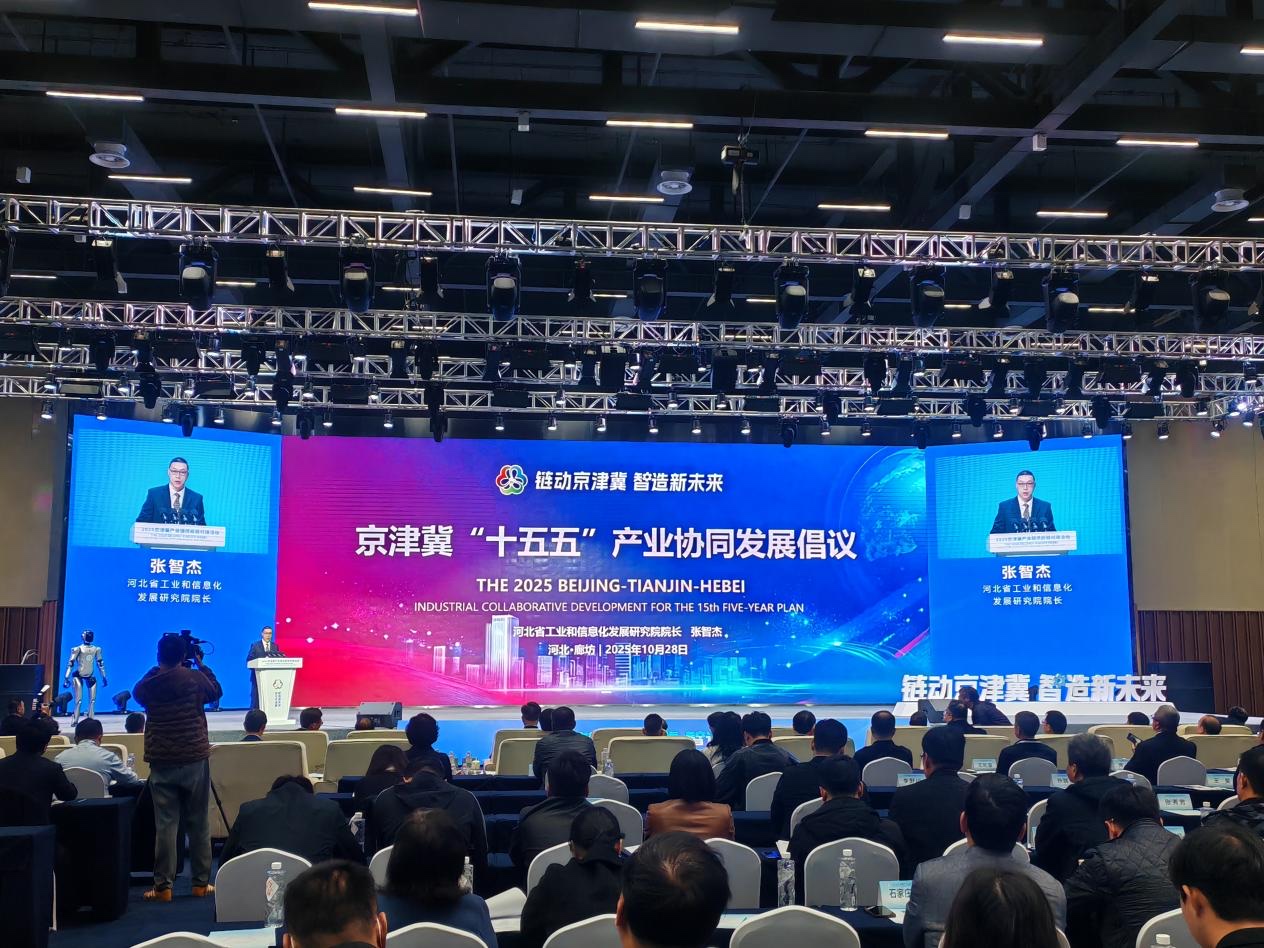
Core Insights - The 2025 Beijing-Tianjin-Hebei industrial chain supply chain docking event focuses on six key industrial chains: new energy and intelligent connected vehicles, robotics, industrial mother machines, cybersecurity and industrial internet, hydrogen energy, and biomedicine [1][3] Group 1: Industrial Collaboration - The event emphasizes the importance of industrial collaboration in the Beijing-Tianjin-Hebei region, which has entered a new stage of high-quality development [1][5] - The initiative aims to build a comprehensive and multi-level industrial collaboration system focusing on five core dimensions: large clusters, large chains, large projects, large platforms, and large patterns [6][7] Group 2: Key Industry Insights - Experts highlight the potential of magnesium materials in the new energy sector, particularly in lightweight applications for robotics and electric vehicles, suggesting that China should seize the opportunity to advance technology and application in this area [3] - The development of intelligent sensors is identified as a critical driver for the industrial chain's progress, with recommendations for enhanced research and application in this field [3] Group 3: Strategic Initiatives - The initiative proposes to create world-class industrial clusters centered around advanced manufacturing, enhance collaboration in technology, and promote significant application scenarios [6][7] - It also emphasizes the need for a monitoring system for industrial chains to facilitate deep integration of technological and industrial innovation, addressing key technical challenges and enhancing supply chain resilience [6][7]

推动京津冀协同发展迈上新台阶
Jing Ji Ri Bao· 2025-10-11 22:18
Core Viewpoint - The coordinated development of the Beijing-Tianjin-Hebei region is a significant national strategy aimed at enhancing regional strengths and achieving high-quality development, with a focus on optimizing the capital's core functions and addressing regional imbalances [1][2]. Economic Development - The GDP of the Beijing-Tianjin-Hebei region is projected to reach 11.5 trillion yuan in 2024, doubling since 2013 and accounting for 8.5% of the national total [3]. - The industrial structure has shifted from 6.2:35.7:58.1 in 2013 to 4.3:26.8:68.9 in 2024, with the tertiary sector in Beijing exceeding 80% [3]. - The region has established a collaborative industrial model characterized by "Beijing R&D, Tianjin and Hebei manufacturing" [3]. Innovation and Collaboration - The establishment of the Beijing-Tianjin-Hebei National Technology Innovation Center has facilitated regional innovation, with significant breakthroughs in key technologies [3]. - The three regions are working together to create a world-class port cluster and improve transportation integration, achieving a basic regional traffic circle within 1 to 1.5 hours [4]. Infrastructure and Public Services - By the end of 2024, 1,053 cross-province services will be operational, and 230 "same standards" items will be introduced in the Beijing-Tianjin-Hebei Free Trade Zone [4]. - The region has made significant progress in sharing educational and medical resources, with notable collaborations between Beijing and Hebei in establishing schools and healthcare facilities [10]. Industrial Transformation - The focus is on building a modern industrial system, emphasizing high-end, intelligent, and green development, with a strong push for technological and industrial innovation [5][6]. - The region is actively promoting the transformation of traditional industries and fostering strategic emerging industries [5]. Non-Capital Function Relief - The relief of non-capital functions in Beijing is crucial for enhancing the capital's core functions and optimizing the regional spatial structure [7]. - Over 3,000 general manufacturing enterprises and more than 1,000 markets have been relocated from Beijing, creating space for core functions [8]. Population and Talent Management - The population in Beijing is stabilizing, with a focus on attracting high-skilled and innovative talent, which is essential for the city's sustainable development [8][9]. Future Directions - The coordinated development strategy aims to make the Beijing-Tianjin-Hebei region a model for China's modernization, with ongoing efforts to enhance public services and achieve balanced development across the region [4][12].