
糖业

Search documents
巴西糖业巨头Raízen启动126亿美元债务重组,法国巴黎银行持债8亿美元居首
Hua Er Jie Jian Wen· 2026-03-11 23:55
Core Viewpoint - Raízen, a Brazilian sugar and ethanol producer, is undergoing an out-of-court debt restructuring process involving approximately 65 billion Brazilian Reais (about 12.6 billion USD) in debt, with major creditors including international and local financial institutions [1][2]. Group 1: Debt Restructuring Details - Raízen has agreed to initiate an out-of-court debt restructuring program, pausing repayments to seek creditor support for a more comprehensive restructuring plan within 90 days [2]. - The restructuring options may include capital injections from shareholders, converting some debt into equity, or asset sales [2]. - The disclosure of the creditor list provides clearer insight into the scale of risk faced by various financial institutions involved in this significant debt crisis [2]. Group 2: Major Creditors - The largest known creditor is BNP Paribas, holding approximately 4.2 billion Brazilian Reais (about 810 million USD) [3]. - Other banks, including Banco Bradesco, Banco Santander, Coöperatieve Rabobank, and Sumitomo Mitsui Banking Corp., each hold around 2 billion Brazilian Reais in debt [3]. - Itaú Unibanco, the largest private financial group in Brazil, has an exposure exceeding 1 billion Brazilian Reais [3]. Group 3: Financial Challenges - Raízen, once a leader in Brazil's biofuel sector, is now facing severe financial difficulties due to high interest rates, consecutive poor harvests, and large upfront investments that have yet to yield returns [5][6]. - The company's dollar-denominated bond prices have fallen to levels typically indicative of distress, and its credit rating has been significantly downgraded to junk status [6]. - Concerns about the scale of its debt continue to grow, compounded by protracted negotiations regarding support from major shareholders, which further heightens investor apprehension about the company's future [7].

强化科技创新和产业创新深度融合 ——各地因地制宜发展新质生产力实践观察
Ren Min Ri Bao· 2026-02-14 00:03
Group 1 - The development of new quality productivity is emphasized as an internal requirement and important focus for promoting high-quality development during the "14th Five-Year Plan" period [1] - Xi Jinping highlighted the need for integrating education, technology, and talent development, reinforcing the deep integration of technological and industrial innovation [1] - The concept of new quality productivity was first introduced by Xi Jinping during local inspections in 2023, which has since been elaborated upon in various contexts, enriching Xi Jinping's economic thought [1] Group 2 - The Tsinghua National Key Laboratory for Intelligent Green Vehicles and Transportation is one of the first laboratories to settle in the Tsinghua National Key Base, focusing on organized scientific research [3] - The Tsinghua National Key Base aims to facilitate the transition of innovations from laboratories to the market, enhancing the integration of technology and industry [2] - The park's design optimizes space for managing large equipment, promoting high-quality research and attracting more partners to complete the technology industry chain [3] Group 3 - The Tsinghua National Key Base is fostering a new momentum for the development of new quality productivity through a full-chain empowerment and full-cycle cultivation innovation model [4] - The integration of technology innovation resources is crucial for breaking barriers and promoting synergy, ensuring a continuous influx of innovative resources into the industry [5][6] - The establishment of shared factories in Anping is a strategic move to help traditional industries upgrade and adopt advanced production lines, addressing the challenges faced by small and medium-sized enterprises [10][11] Group 4 - The development of new quality productivity is tailored to local resource endowments, industrial foundations, and research conditions, emphasizing a targeted approach [7] - Hainan's deep-sea technology and industry development is accelerated by leveraging its vast maritime jurisdiction and establishing a national marine comprehensive test site [8][9] - The integration of local advantages and resources is essential for accurately positioning industrial layouts and promoting innovative development [9] Group 5 - The transformation and upgrading of traditional industries are vital for nurturing new quality productivity, with Xi Jinping stressing that traditional industries can also contribute to this development [10] - The shared factory model in Anping allows multiple enterprises to utilize advanced production lines, facilitating a shift towards intelligent and high-end manufacturing [11] - The focus on local characteristics and resource advantages is crucial for driving innovation and upgrading traditional industries [11] Group 6 - Emerging and future industries are seen as new engines for building a modern industrial system, with a strong emphasis on technological innovation [12] - The Suzhou International Science and Technology Park exemplifies how proximity to research and manufacturing can accelerate the transition from research to production [13] - The development of new quality productivity is supported by a complete industrial system in China, which provides a conducive environment for nurturing cutting-edge technologies [14] Group 7 - The integration of technology in agriculture and tourism is highlighted as a means to enhance productivity and consumer experience [15][16] - The use of digital technology in cultural tourism in Luoyang demonstrates how innovative approaches can transform traditional industries and attract visitors [17] - The emphasis on technology-driven innovation in traditional sectors is seen as a pathway to achieving high-quality development and expanding domestic demand [17]
南非糖业进口关税调整陷两难
Shang Wu Bu Wang Zhan· 2026-02-04 14:24
Group 1 - The core issue is that despite four increases in sugar import tariffs in 2025, South Africa has seen a significant surge in cheap imported sugar, with imports reaching 177,000 tons from January to November last year, compared to less than 3,000 tons in the same period of 2022, resulting in a loss of approximately 733 million rand for the local industry [1] - There is a serious division within the industry, with the South African Sugar Association requesting an increase in the tariff trigger price (DBRP) from the current $680/ton to $905/ton, while the South African Beverage Association is advocating for a reduction of 2%-19% to a range of $552-$650/ton, arguing that the current tariffs harm beverage producers and consumers [1] - The International Trade Administration Commission has decided to merge the evaluations of both requests and will reference the strategic goals outlined in the "2030 South African Sugar Industry Value Chain Master Plan" [1] Group 2 - A deeper issue lies in the outdated tariff adjustment mechanism, where the tariff was raised from 2,348.92 rand/ton to 3,773.50 rand/ton during a global sugar price crash in April 2025, but was subsequently lowered after a brief price recovery in May, leading to delays in necessary adjustments [2] - The Agricultural Business Association has pointed out that the legal requirement for tariff adjustments after triggers is to be completed within six weeks, but the inter-departmental approval process takes significantly longer, resulting in a lose-lose situation for the industry and potential government revenue loss [2] - The industry is calling for the government to establish a timely approval commitment to restore the adjustment cycle to within six weeks, as the current rigid system fails to provide the necessary timely protection for the industry [2]
生鲜软商品板块日度策略报告-20260115
Fang Zheng Zhong Qi Qi Huo· 2026-01-15 03:02
1. Report Industry Investment Rating No relevant content provided. 2. Core Views of the Report - The soft - commodity and fresh - produce sectors have different market logics and trading strategies. For example, Zheng sugar has limited downside space and is recommended for light - position short - term long positions; pulp has limited upside space and is advised to go short on rallies [3]. - In the fresh - produce sector, apples are expected to have a slow upward trend in the overall price center, and long positions can be held cautiously; jujubes are in a situation of supply and demand both being strong, and different trading strategies are proposed according to different positions [7][9]. 3. Summary by Relevant Catalogs 3.1 First Part: Sector Strategy Recommendation - **Fresh - produce Futures**: For Apple 2605, it is recommended to hold long positions cautiously, with a support range of 8800 - 8900 and a pressure range of 11000 - 11500. For Jujube 2605, short - term buying on dips is recommended, with a support range of 8700 - 9000 and a pressure range of 9500 - 9800 [17]. - **Soft - commodity Futures**: For Sugar 2605, light - position short - term long positions are recommended, with a support range of 5200 - 5230 and a pressure range of 5350 - 5380. For Pulp 2605, short - position operations within the range are recommended, with a support range of 5300 - 5350 and a pressure range of 5550 - 5700. For Double - offset Paper 2605, range operations are recommended, with a support range of 4000 - 4100 and a pressure range of 4300 - 4350. For Cotton 2605, long positions can be held cautiously, with a support range of 13500 - 13600 and a pressure range of 15400 - 15500 [17]. 3.2 Second Part: Market News Changes - **Apple Market**: In November 2025, the export volume of fresh apples increased. As of January 8, 2026, the inventory in the main producing areas decreased year - on - year. The spot price in Shandong and Shaanxi remained stable, and the sales area was also stable [18]. - **Jujube Market**: As of January 11, the sample - point inventory decreased month - on - month. The acquisition in the producing areas was basically over, and the market was expected to enter a peak sales period with the approach of the festival [21]. - **Sugar Market**: India, Thailand, and Brazil have different production and export situations. The global sugar supply is relatively sufficient, and the international sugar price is expected to be weak [22]. - **Pulp Market**: The price of needle and broad - leaf pulp increased, and the supply pressure gradually eased, but the upward space was limited due to the weak downstream market [3]. - **Double - offset Paper Market**: The operating rate of double - offset paper enterprises increased, the inventory decreased, but the overall demand was still under pressure [4]. - **Cotton Market**: In December 2025, the export volume of Bangladeshi clothing and Chinese textiles and clothing had different year - on - year and month - on - month changes [30]. 3.3 Third Part: Market Review - **Futures Market Review**: The closing prices, daily changes, and daily change rates of Apple 2605, Jujube 2605, Sugar 2605, Pulp 2605, and Cotton 2605 are provided [31]. - **Spot Market Review**: The spot prices, month - on - month changes, and year - on - year changes of apples, jujubes, sugar, pulp, double - offset paper, and cotton are presented [36]. 3.4 Fourth Part: Basis Situation No specific content summary provided in the given text, only relevant figure references. 3.5 Fifth Part: Inter - month Spread Situation - Apple 5 - 10 spread is expected to be oscillating strongly, and buying on dips is recommended. - Jujube 9 - 1 spread is expected to be range - oscillating, and it is recommended to wait and see. - Sugar 5 - 9 spread is expected to be oscillating, and it is recommended to wait and see. - Cotton 5 - 9 spread is expected to be oscillating weakly, and selling on rallies is recommended [55]. 3.6 Sixth Part: Futures Position Situation No specific content summary provided in the given text, only relevant figure references. 3.7 Seventh Part: Futures Warehouse Receipt Situation - The warehouse receipt quantities, month - on - month changes, and year - on - year changes of apples, jujubes, sugar, pulp, and cotton are given [84]. 3.8 Eighth Part: Option - related Data No specific content summary provided in the given text, only relevant figure references.
助力农业发展农民增收 守稳守好粮食安全“压舱石”
Xin Lang Cai Jing· 2026-01-13 21:58
Group 1 - The core viewpoint of the articles highlights that Nanning City has proactively allocated over 1 billion yuan in agricultural transfer payment funds for 2026, representing a 14% increase compared to the same period last year, which supports early initiation and implementation of agricultural production projects for high-quality development [1] Group 2 - In terms of food security, Nanning has allocated 498 million yuan for central farmland construction and utilization funds, which includes subsidies for farmland quality protection, directly increasing farmers' income and reducing costs [1] - The funds will also support the construction of high-standard farmland, improving infrastructure and enhancing the overall quality and production capacity of farmland [1] - Additionally, 62 million yuan has been allocated for grain and oil subsidies, promoting diverse planting strategies to ensure the completion of annual grain and oil production targets [1] Group 3 - To enhance industrial quality and efficiency, Nanning has allocated 275 million yuan for the promotion of sugarcane varieties and mechanization, supporting the entire sugar industry chain [2] - Other allocations include 19 million yuan for agricultural industry development, 42 million yuan for related transfer payments, and 21 million yuan for agricultural machinery purchase subsidies, all aimed at improving agricultural mechanization [2] - Funds totaling 36 million yuan have been designated for enhancing agricultural operational capabilities, focusing on increasing grain and oil yields and fostering high-quality farmers [2] Group 4 - Nanning City is strengthening fund management to ensure effective policy implementation, with the finance bureau enforcing strict fund management and performance monitoring [3] - The city is guiding local counties in budget execution and ensuring compliance with approval processes to maximize the effectiveness of subsidy funds [3] - This approach aims to provide solid financial support for the modernization of agriculture in Nanning [3]
沪指录得K线15连阳 红利低波ETF(512890)近20个交易日逆势2吸金18.08亿元
Xin Lang Cai Jing· 2026-01-08 08:08
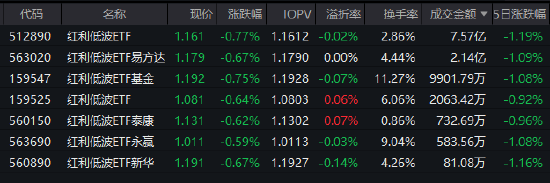
Core Viewpoint - The market is experiencing fluctuations, with the ChiNext Index dropping over 1% and the Shanghai Composite Index down 0.07%, while the Hongli Low Volatility ETF (512890) has seen a decline of 0.77% [1][11]. Fund Performance - The Hongli Low Volatility ETF (512890) is currently priced at 1.161 CNY, with a trading volume of 7.57 billion CNY and a turnover rate of 2.86% [1][11]. - Over the past five trading days, the fund has seen a net inflow of 297 million CNY, with a total net inflow of 1.808 billion CNY over the last 20 days and 5.172 billion CNY over the last 60 days [4][10]. - The fund's total return as of January 7, 2026, is 133.70%, outperforming its benchmark, ranking 98th among 502 funds [6][13]. Market Context - Morgan Stanley predicts that the CSI 300 Index will reach a target of 5200 points in 2026, indicating a potential increase of approximately 13.5% [6][13]. - The current market phase is transitioning from liquidity-driven growth to profit improvement-driven growth, suggesting a favorable environment for cyclical stocks [6][13]. - New regulations are expected to benefit sectors such as banking, public utilities, and coal, which are part of the dividend sector [6][13]. Top Holdings - The top ten holdings of the Hongli Low Volatility ETF include companies like COFCO Sugar, Nanjing Bank, and Agricultural Bank of China, with varying performance among these stocks [3][8].

牛脸能贷款,海域有“身份证”?广西这样唤醒“沉睡资产”→
Jin Rong Shi Bao· 2026-01-07 04:56
Core Insights - The article highlights the transformation of rural assets in Guangxi, China, through innovative financial practices that awaken dormant resources and stimulate economic growth [1] Group 1: Challenges Faced by Rural Industries - Rural industries in Guangxi face multiple challenges, including the difficulty of asset realization and the lack of standardized valuation systems for livestock, which limits access to financing [2][3] - Natural disasters and market volatility pose significant risks to agricultural production, making it difficult for farmers to sustain their livelihoods [4] Group 2: Financial Innovations and Solutions - Innovative financial practices, such as the issuance of property rights certificates for aquaculture, have enabled farmers to secure loans by transforming previously unrecognized assets into collateral [5][6] - The introduction of technology, such as AI-based identification systems for livestock, has improved the efficiency of insurance and financing processes, allowing for better risk management [6][12] Group 3: Integration of Financial Services - The development of supply chain finance and tailored credit products has facilitated better access to funding for rural enterprises, addressing issues of weak collateral and fragmented supply chains [7][8] - Collaborative efforts between banks, insurance companies, and local governments have created a supportive ecosystem for agricultural financing, enhancing the resilience and sustainability of rural economies [10][11] Group 4: Systematic Approach to Rural Development - Guangxi has shifted from targeted assistance to a more systematic approach in promoting rural development, with policies that encourage financial resources to flow into agriculture [10][12] - The establishment of digital credit profiles for farmers has enabled the provision of unsecured loans, fostering financial inclusion and supporting agricultural growth [11][13]

金融之力 破瘠成沃 八桂大地奏响乡村产业振兴进行曲
Jin Rong Shi Bao· 2026-01-07 02:10
Core Viewpoint - The article discusses the transformation of rural assets in Guangxi, China, through financial innovation and technology, addressing the challenges faced by the agricultural sector and enhancing the connection between finance and rural industries [1][6][12]. Group 1: Challenges in Rural Development - Rural industries in Guangxi face multiple challenges, including dormant assets that are difficult to monetize and a lack of standardized valuation systems for livestock and aquaculture [3][5]. - Natural and market risks significantly impact agricultural production, making it vulnerable to environmental changes and price fluctuations, which complicates traditional financing models [4][5]. - The local sugar industry, despite being a major contributor to national production, struggles with financing issues that hinder its competitiveness and growth [5]. Group 2: Financial Innovations and Solutions - To address these challenges, Guangxi has implemented innovative financial practices, such as issuing property rights certificates for aquaculture, which allows farmers to secure loans based on clearly defined assets [6][7]. - Advanced technologies, like AI facial recognition for livestock, have been introduced to create unique digital identities for animals, facilitating better insurance and financing options [7][12]. - A collaborative financial model has been developed, combining insurance, credit, and government support to provide comprehensive financial services to farmers, resulting in significant loan amounts being disbursed [8][11]. Group 3: Economic Growth and Sustainability - The integration of supply chain finance and the development of specialized credit products have been emphasized to support local agricultural sectors, ensuring timely payments and reducing financing costs for farmers [8][12]. - E-commerce initiatives have been established to enhance the marketing of local agricultural products, providing training for villagers to improve their sales techniques and increase income [9]. - The overall financial ecosystem in Guangxi is evolving towards a more systematic approach, focusing on long-term sustainability and resilience in rural economic development [10][12].
决胜“十四五” 擘画“十五五”·地方资本市场高质量发展之广西篇:资本助力八桂焕新 书写广西产业跃升“生动注脚”
证券时报· 2025-12-03 00:07
Core Viewpoint - During the "14th Five-Year Plan" period, Guangxi's capital market has achieved significant development, with 5 new listed companies, direct financing exceeding 300 billion yuan, and private equity fund net asset growth surpassing 100 billion yuan, reflecting a deep integration of capital markets with the real economy and supporting the construction of a modern industrial system in Guangxi [1][2]. Group 1: Direct Financing and Market Expansion - Guangxi's direct financing reached 300.8 billion yuan from 2021 to September 2025, marking a 21% increase compared to the "13th Five-Year Plan" period, with equity financing at 24.5 billion yuan and bond financing at 276.3 billion yuan, the latter seeing a growth of 38.87% [2]. - The number of listed companies in Guangxi increased by 5 during the "14th Five-Year Plan," including 2 on the ChiNext and 3 on the Beijing Stock Exchange, establishing a positive cycle of nurturing, applying, and listing companies [2]. - By the end of Q3 2025, Guangxi's listed companies had total assets of 601.48 billion yuan and net assets of 233.09 billion yuan, both showing over 20% growth compared to the end of the "13th Five-Year Plan" [2]. Group 2: Private Equity Fund Development - The private equity fund sector in Guangxi saw a net asset growth of 112.44 billion yuan during the "14th Five-Year Plan," with 60 private equity institutions managing a total of 163.12 billion yuan, a 215.37% increase from the end of the "13th Five-Year Plan" [3]. Group 3: Industry Empowerment and Innovation - Guangxi's capital market has tailored financing solutions to support high-quality industrial development, including the issuance of the first sugar warehouse CMBS in China, raising 201 million yuan to revitalize sugar industry assets [6]. - Companies like LiuGong and Beibu Gulf Port have utilized capital to drive digital transformation and smart manufacturing, with LiuGong raising 7.428 billion yuan for mergers and smart factory upgrades [5]. Group 4: Market Regulation and Risk Management - The Guangxi Securities Regulatory Bureau has emphasized a balance between regulation and development, effectively mitigating risks associated with high pledge stocks and illegal guarantees, leading to the delisting of 5 companies and the restructuring of 2 others [8]. - The bond market has seen robust risk management, with nearly 260 billion yuan in bond repayments and a zero-default rate for local financing platforms during the "14th Five-Year Plan" [8]. Group 5: Investor Protection and Market Growth - The overall market capitalization of Guangxi's listed companies increased from 291.6 billion yuan to 357.1 billion yuan, a growth of 22.46%, with 11 companies surpassing a market cap of 10 billion yuan [9]. - Cash dividends have become a significant method for companies to return value to investors, with 29 companies distributing a total of 23.581 billion yuan in cash dividends [10].
决胜“十四五” 擘画“十五五”·地方资本市场高质量发展之广西篇:资本助力八桂焕新 书写广西产业跃升“生动注脚”
Zheng Quan Shi Bao Wang· 2025-12-02 23:33
Core Viewpoint - During the "14th Five-Year Plan" period, Guangxi's capital market has achieved significant development, with a focus on integrating capital markets with the real economy to support the modernization of its industrial system [1] Group 1: Direct Financing and Market Expansion - Guangxi's direct financing reached 3008 billion yuan from 2021 to September 2025, marking a 21% increase compared to the "13th Five-Year Plan" period, with equity financing at 245 billion yuan and bond financing at 2763 billion yuan, the latter seeing a growth of 38.87% [2] - The number of listed companies in Guangxi increased by 5 during the "14th Five-Year Plan," including 2 on the Growth Enterprise Market and 3 on the Beijing Stock Exchange, establishing a positive cycle of nurturing, applying, and listing companies [2] Group 2: Financial Performance of Listed Companies - By the end of Q3 2025, Guangxi's listed companies had total assets of 6014.83 billion yuan and net assets of 2330.93 billion yuan, both showing over 20% growth since the end of the "13th Five-Year Plan" [3] - The cumulative operating revenue of listed companies during the "14th Five-Year Plan" reached 1.65 trillion yuan, a 62.81% increase compared to the "13th Five-Year Plan," with nearly half of the companies achieving a compound annual growth rate of over 5% in revenue [3] Group 3: Private Equity and Fund Growth - The net asset value of private equity funds in Guangxi increased by 1124.38 billion yuan during the "14th Five-Year Plan," with 60 private equity institutions managing a total of 1631.18 billion yuan, a growth of 215.37% compared to the end of the "13th Five-Year Plan" [3] Group 4: Industry Empowerment and Innovation - Guangxi's capital market has facilitated the transformation of traditional industries through innovative financing solutions, such as the issuance of the first sugar warehouse CMBS in China, raising 201 million yuan to support the sugar industry [4] - Companies like LiuGong and Beibu Gulf Port have utilized capital to enhance their digital transformation and smart manufacturing capabilities, showcasing successful case studies in advanced manufacturing [4][5] Group 5: Market Regulation and Risk Management - The Guangxi Securities Regulatory Bureau has implemented strict regulations to ensure market safety, successfully resolving risks associated with high pledge ratios and illegal guarantees, with 5 companies delisted and 2 undergoing bankruptcy restructuring [6][7] - The overall market capitalization of listed companies in Guangxi increased from 291.6 billion yuan to 357.1 billion yuan, a growth of 22.46%, with 11 companies surpassing a market value of 10 billion yuan [7] Group 6: Investor Returns and Market Practices - A total of 29 listed companies in Guangxi distributed cash dividends amounting to 235.81 billion yuan, with 16 companies maintaining a consistent dividend payout over three years [8] - Share buybacks and increases in holdings by major shareholders have also been significant, with 15 companies engaging in buybacks totaling 4.351 billion yuan since 2024 [8] Group 7: Futures Market Development - The futures market in Guangxi has expanded its service capabilities, successfully launching futures products for local industries such as live pigs and alumina, providing essential risk management tools [9] Group 8: Future Directions - The Guangxi Securities Regulatory Bureau plans to enhance the multi-level capital market's functions, focusing on supporting major projects in artificial intelligence and key metals, while also improving the quality of listed companies and managing risks effectively [10]