硬件设备

Search documents
自营大赚超1800亿,牛市旗手重仓股曝光
21世纪经济报道· 2025-11-01 14:39
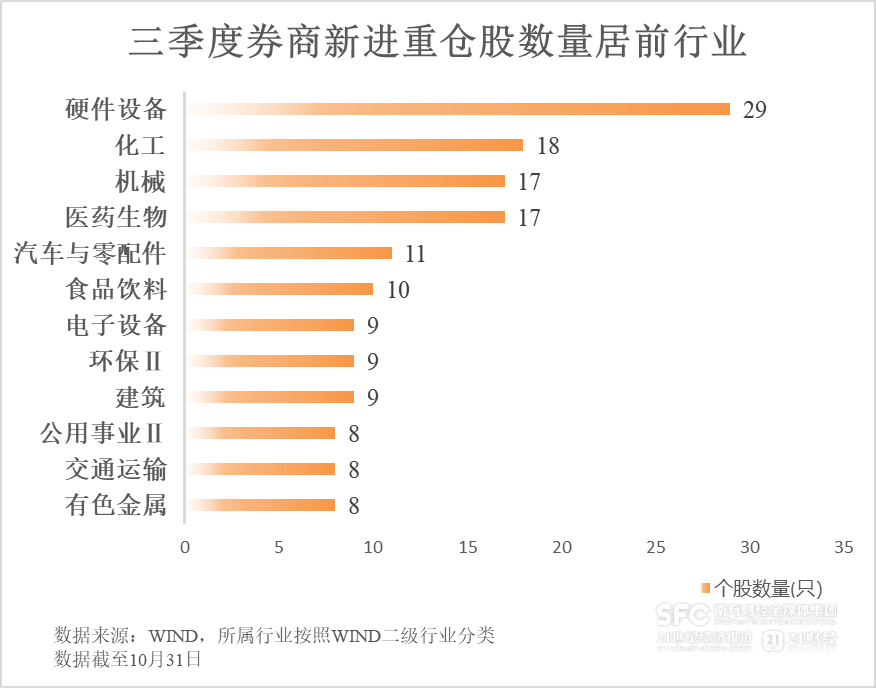
Core Viewpoint - The article highlights the significant changes in the stock holdings of brokerage firms in A-shares during the third quarter, emphasizing a strong focus on "hard technology" sectors and cyclical industries, alongside a notable increase in self-operated business revenues for these firms [1][13]. Group 1: Brokerage Holdings and Investment Trends - A total of 47 brokerage firms appeared among the top ten shareholders of 373 A-share listed companies, with a combined market value of approximately 66.73 billion yuan as of the end of the third quarter [1]. - The number of newly added heavy positions in the "hard technology" sector was the highest among brokerage firms, with hardware equipment, chemicals, machinery, and pharmaceutical biology leading the way [2][4]. - The hardware equipment sector saw the most new heavy positions, with 29 new stocks, benefiting from strong demand in AI servers, optical modules, PCBs, and consumer electronics, resulting in a year-to-date increase of over 60% in the Wind hardware equipment index [4]. Group 2: Specific Stock Movements - Notable new heavy positions included companies like Shaanxi Huada, Guanghong Technology, and Yachuang Electronics, which were newly added by two or more brokerages [5]. - In the chemical sector, stocks like Kai Meiteqi, benefiting from the "domestic lithography machine" trend, saw significant increases, with a stock price rise of over three times this year [5]. - Traditional sectors such as finance and energy also attracted attention, with Postal Savings Bank being a major new holding for Guotai Junan, which acquired 126.47 million shares, making it the largest new position for a single brokerage [5][6]. Group 3: Changes in Holdings - In the third quarter, 63 heavy stocks were increased by brokerages, while 62 were reduced, with the chemical and hardware equipment sectors seeing the most increases [7]. - The increase in holdings in the chemical sector is attributed to expectations of a recovery in cyclical sectors, with leading companies like Titan Chemical and Chuanheng Co. being core targets for some brokerages [7]. - The hardware equipment sector's increased holdings were linked to popular themes such as AI and humanoid robots, with companies like Aoshikang and Qingniao Fire Protection being notable mentions [7]. Group 4: Brokerage Strategies - Different-sized brokerages exhibited distinct strategies, with large brokerages adopting a "broad net" approach while smaller ones focused on "key breakthroughs" [12]. - Leading brokerages like Huatai Securities and CITIC Securities held the highest number of stocks, with significant market values, while smaller firms concentrated their investments in fewer stocks [12]. - The self-operated business remains the largest revenue contributor for brokerages, with 42 listed brokerages achieving a total revenue of 186.86 billion yuan, a year-on-year increase of 43.83% [13][15]. Group 5: Performance and Outlook - Six brokerages reported self-operated business revenues exceeding 10 billion yuan, with CITIC Securities leading at 31.60 billion yuan [15]. - Smaller brokerages like Changjiang Securities and Guolian Minsheng exhibited remarkable growth in self-operated business revenues, with increases of over 200% [16]. - The article notes a divergence in performance among brokerages, with some experiencing declines in self-operated business revenues, highlighting the importance of equity allocation capabilities [16][17].




自营大赚超1800亿!“牛市旗手”最新重仓股曝光
2 1 Shi Ji Jing Ji Bao Dao· 2025-11-01 08:17
Core Insights - The report highlights the significant shift in stock holdings by brokerage firms in the A-share market during the third quarter, with a focus on "hard technology" sectors and cyclical industries, as well as popular themes like AI and humanoid robots [1][4][8]. Brokerage Holdings - As of October 31, 47 brokerage firms appeared among the top ten shareholders of 373 A-share listed companies, with a total holding value of approximately 66.73 billion yuan [1]. - A total of 206 new stocks were added to the brokerage firms' heavy holdings, with the hardware equipment sector leading with 29 new stocks [3][4]. Sector Performance - The hardware equipment index has risen over 60% year-to-date, driven by strong demand in AI servers, optical modules, PCBs, and consumer electronics [3]. - Notable new heavy holdings include companies like Shaanxi Huada, Guanghong Technology, and Yachuang Electronics, which were favored by multiple brokerages [4]. Investment Strategies - Major brokerages adopted a "broad net" strategy, while smaller firms focused on "key bets," leading to a significant increase in self-operated business revenues, which reached 186.86 billion yuan, a year-on-year increase of 43.83% [1][13]. - The top six brokerages accounted for over half of the total self-operated business revenue, with notable performances from CITIC Securities and Guotai Junan [15]. Stock Adjustments - In the third quarter, 63 stocks saw increased holdings, while 62 experienced reductions, indicating a strategic shift towards sectors with structural opportunities [8][11]. - The chemical and hardware equipment sectors saw the most significant increases in holdings, with 10 and 7 stocks respectively being added [8]. Notable Stock Movements - Postal Savings Bank was the most heavily acquired stock by a single brokerage, with Guotai Junan acquiring 126.47 million shares [5][7]. - Inner Mongolia Huadian was the top stock in terms of increased holdings, with Dongfang Securities adding 21.94 million shares [10]. Market Outlook - The report suggests that the active A-share market has provided rich investment opportunities for brokerages, with a notable focus on sectors poised for recovery and growth [12][16].

QFII选股“各有所好” 第三季度超120只A股获增持
Zheng Quan Shi Bao· 2025-10-30 22:11
Core Insights - The China Securities Regulatory Commission (CSRC) has officially released the "Optimization Work Plan for the Qualified Foreign Institutional Investor (QFII) System," which simplifies the investment preparation process for QFII and implements a green channel for sovereign funds, international organizations, and pension charitable funds [1][7] - Since the introduction of the QFII system in 2002, it has become a significant channel for foreign capital to enter the A-share market, with distinct investment styles and preferences compared to domestic funds [1][7] Investment Trends - As of October 30, 2023, QFII has continued to increase its holdings in A-shares, with at least 121 stocks receiving additional investments in the third quarter [2][3] - The sectors with the highest QFII investments are not in semiconductors but rather in electrical equipment, machinery, chemicals, and hardware [2][3] - Major QFII players like Morgan Stanley, Abu Dhabi Investment Authority, and JPMorgan have shown a preference for a diversified portfolio, with Morgan Stanley holding 244 stocks and UBS increasing its holdings in 29 stocks [2][3] Individual Stock Movements - Notable stocks that received increased QFII investments include Nanjing Bank, China XD Electric, and Oriental Yuhong, with significant increases in shareholdings from various QFII institutions [2][3] - The Abu Dhabi Investment Authority has made strategic adjustments, increasing its holdings in stocks like Baofeng Energy and Hengli Hydraulic while reducing its stake in others like Zijin Mining [4][5] Sovereign Fund Strategies - Middle Eastern sovereign funds, such as the Abu Dhabi Investment Authority and Kuwait Investment Authority, tend to have a more concentrated investment approach compared to their Western counterparts [4][5] - The Abu Dhabi Investment Authority's A-share holdings have decreased in value from approximately 9 billion yuan last year to about half of that by October 29, 2023, indicating profit-taking or tactical trading [4][5] Future Outlook - The QFII system is expected to expand further, with over 900 qualified foreign investors already participating, including various types of funds and institutions [7] - The CSRC aims to enhance the attractiveness of the QFII system for long-term foreign capital over the next two years, promoting a balanced development of onshore and offshore channels [7]




券商第三季度重仓股调整 新进93只增持19只减持25只
Zheng Quan Ri Bao· 2025-10-28 17:32
Core Insights - The recent adjustments in brokerages' heavy holdings reflect significant changes in their investment strategies based on market conditions and internal needs [1][4] Group 1: New Holdings - Brokerages have newly held 93 stocks in the third quarter, with a total of 11.29 billion shares valued at 16.984 billion yuan [2][3] - The sectors with the highest number of stocks among the 132 heavy holdings are chemicals (21 stocks), hardware equipment (19 stocks), and pharmaceuticals (17 stocks) [2] Group 2: Increased Holdings - A total of 19 stocks saw increased holdings from brokerages, with notable increases in 佛燃能源 and 大中矿业 [3] - 佛燃能源 was increased by two brokerages, while 大中矿业 saw the largest single brokerage increase of 4.3756 million shares by 红塔证券 [3] Group 3: Decreased Holdings - Brokerages reduced their holdings in 25 stocks, with 华北制药 experiencing the largest decrease of 12.1 million shares [3] - 盈方微 was reduced by 国新证券 and 东方证券 by 8.3949 million shares and 3.5418 million shares respectively [3] Group 4: Institutional Strategies - 华泰证券 holds the most heavy stocks at 21, followed by 中信证券 with 19 [4] - The performance of brokerages' proprietary trading is closely linked to their heavy stock holdings, with many brokerages adopting unique strategies for proprietary investments [4] - 中信证券 focuses on the fundamentals of listed companies, particularly long-term free cash flow, while 长城证券 employs a "high dividend +" strategy [4] Group 5: Market Observations - Brokerages' heavy stock holdings serve as an important observation window for institutional fund allocation, reflecting their professional judgment on industry trends and stock fundamentals [4]
明星科技股盘初普涨 微软(MSFT.US)、苹果(AAPL.US)小幅上涨 市值均突破4万亿美元
Zhi Tong Cai Jing· 2025-10-28 14:15
Group 1 - The U.S. stock market opened slightly higher, with the Nasdaq up 0.47%, and notable tech stocks like Microsoft and Apple seeing gains, with Microsoft approaching a market cap of $4 trillion [1] - Microsoft signed a deal to purchase an additional $250 billion worth of Azure services from OpenAI, indicating strong demand for cloud services [1] - Apple's stock rose 0.2%, marking its market cap surpassing $4 trillion for the first time, making it the third company to reach this milestone [1] Group 2 - Morgan Stanley analyst Samik Chatterjee projected that Apple's services business will account for one-quarter of its total revenue, contributing up to 50% of profits, highlighting the strong user engagement with products like Apple Pay and iCloud [1] - The bullish sentiment on Wall Street is increasing rapidly due to favorable macroeconomic conditions, continuous capital inflows, and seasonal trends, with the S&P 500 index recently closing at a record 6875 points [1] - Many strategists believe the market is poised to break the 7000-point barrier, with 7500-7700 points being the next target range [1]


A股重回3900点,谁在扛大旗?
3 6 Ke· 2025-10-21 23:05
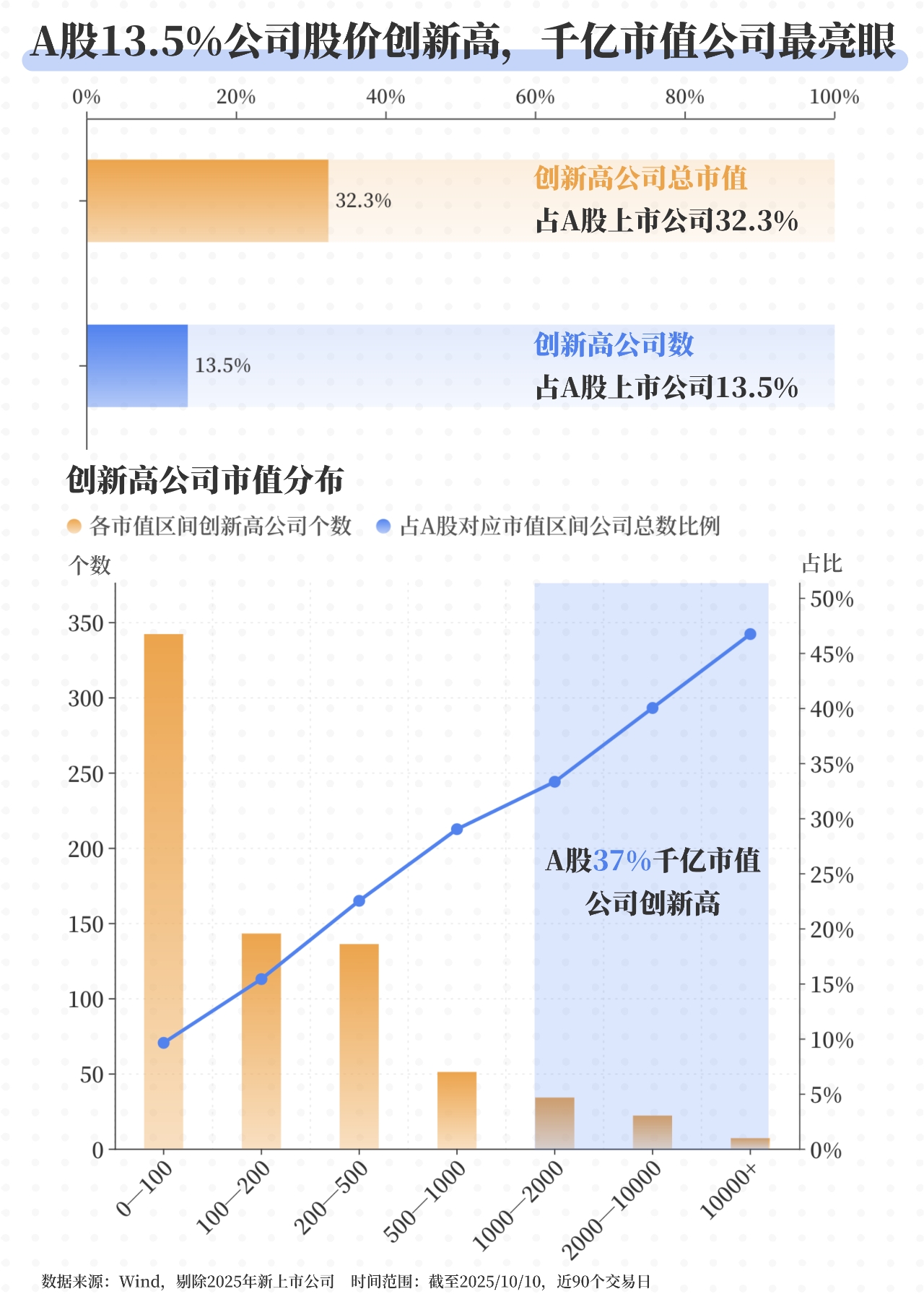
"透视图"是36氪新推出的轻量化数据图文栏目——以数据透视趋势,以图片呈现要点。"Talk is Cheap. Show me the data." 作者丨范亮 10月9日,上证指数成功突破3900点,创近十年新高。10月17日全线下跌,今日又回到3900点。 驱动本轮牛市的核心动力是什么?是否有足够的业绩支撑? 我们用数据分析来回答问题。以10月10日为基准,在剔除年内新股后,近90个交易日内共有735家公司股价创下新高。通过对这些"领涨者"的分析,可以发 现三大显著特征: 1. 大市值公司主导,头部效应显著。 这735家公司虽仅占A股总数的13.5%,却贡献了32.3%的总市值。其中,千亿市值公司中,有36.6%(63/172)在此期间创下新高,而百亿市值以下公司中, 该比例仅为9.6%(342/3550),市场风格高度集中于龙头企业。 3. 估值普遍偏高,股价与业绩出现背离。 735家创新高公司中,市盈率超过50倍的公司达到363家,市净率超过3倍的公司达到613家,呈现出明显的高估值特征。 36氪制图 2. 钱流向了硬科技。 超过半数的创新高公司(逾360家)集中在硬件设备、半导体、机械和汽车零部件等 ...
半年研发“烧掉”1900亿,哪家科技创新力最强?
和讯· 2025-10-21 09:00
榜单结果显示,通信设备、显示面板、服务器等硬件设备领域的龙头企业仍然在 科技 创新上保持领 先,半导体产业链公司展现出强劲的研发韧性与技术突破能力,而软件服务公司则在人工智能、大模 型、安全与金融科技等前沿领域不断涌现新成果。整体上,榜单不仅反映出硬科技企业在 人才积 累、研发强度、专利产出 等方面的真实情况,也折射出中国硬科技产业在2025年所展现出的 技术 进取心与产业竞争力 。 2025 中国硬科技上市公司价值榜 【子榜单2】 2025中国硬科技上市公司 科技创新力 CF行榜TOP30 01 | 中兴通讯 000063.SZ 通信设备与ICT解决方案供应商 无线/有线网络设备(基站、光传输、核心网)、算力与 服务器、终端产品(手机) 02 | 大华股份 002236.SZ 视频监控与智能安防产品与解决方案供应商 大华雷视融合一体机、热成像双目云台、智能PoE系列等 03 | 海康威视 002415.SZ 视频感知与智能物联(安防+AI)龙头 摄像机/视频编码、Al视频分析、大数据与云端平台等 04 | 科大讯飞 002230.SZ 人工智能与语音/大模型平台公司 在全球科技竞争加速、产业升级步伐加快的背 ...





数据折射资本市场助力科创实践轨迹:强化枢纽功能 A股含“科”量跃升
Zhong Guo Zheng Quan Bao· 2025-10-19 23:22
Group 1 - The core viewpoint of the articles highlights the significant role of the capital market in supporting technological innovation during the "14th Five-Year Plan" period, with a notable increase in direct financing and the issuance of various bonds [1][2][3] - The total financing in the stock and bond markets reached 57.5 trillion yuan over the past five years, with the proportion of direct financing rising to 31.6%, an increase of 2.8 percentage points compared to the end of the "13th Five-Year Plan" [1] - The bond market issued over 52.4 trillion yuan in various bonds during the "14th Five-Year Plan," with technology innovation corporate bonds totaling 1.77 trillion yuan, supporting the strategy of building a strong technological nation [1][4] Group 2 - The capital market's support for technological innovation is increasingly evident, with over 90% of companies listed on the Sci-Tech Innovation Board and the Beijing Stock Exchange receiving investment from private equity and venture capital funds [6][7] - The IPO landscape shows that the semiconductor, hardware, and electrical equipment sectors are leading in terms of IPO amounts, with over 90% of high-tech enterprises and more than half from strategic emerging industries [2][3] - The market capitalization of the technology sector in A-shares has surpassed 25%, significantly higher than the combined market capitalization of the banking, non-banking financial, and real estate sectors [3] Group 3 - Financial product innovation is ongoing, with the introduction of technology innovation bonds, ETFs, and REITs aimed at enhancing the capital market's alignment with technological innovation [4][5] - The issuance of technology innovation bonds has accelerated, with a total issuance of 1.77 trillion yuan, reflecting a strong policy push to support technology-driven enterprises [4][5] - The REITs market has seen significant growth, with 79 public REITs registered and nearly 200 billion yuan raised, indicating a trend towards integrating technology assets into the financial market [5] Group 4 - Long-term capital is increasingly directed towards the technology sector, with private equity and venture capital funds managing 14.4 trillion yuan and focusing on early-stage technology innovation [6][7] - The share of long-term funds in the A-share market has grown by 32% since the end of the "13th Five-Year Plan," with social security, insurance, and foreign capital acting as stabilizers [6][7] - The shift in trading structure is evident, with professional institutions increasing their holdings in A-shares, particularly in technology innovation companies, which now account for 48% of trading volume [7][8]
国泰海通|海外策略:中国科技资产成外资加仓共识
国泰海通证券研究· 2025-10-17 09:08
Group 1 - The core viewpoint of the article highlights the inflow and outflow trends of foreign capital in Hong Kong and A-shares during Q3, with a notable focus on technology assets [1][2] - In Hong Kong, foreign capital experienced a net outflow of approximately 841 million HKD in Q3, which is an improvement compared to Q2, with stable long-term foreign capital being the main contributor to the outflow [1] - The sectors attracting foreign capital in Hong Kong included software services (172 million HKD from stable foreign capital and 47 million HKD from flexible foreign capital) and hardware equipment (36 million HKD and 105 million HKD) [1] - Conversely, sectors that saw significant outflows included consumer discretionary retail (-472 million HKD), non-bank financials (-179 million HKD), and banks (-17 million HKD) [1] Group 2 - In A-shares, the Northbound capital saw an overall outflow of 158.2 billion CNY in Q3, with a net outflow of approximately 20.3 billion CNY when excluding Chinese custodial funds [2] - Long-term stable foreign capital accounted for a significant outflow of about 120.2 billion CNY, while short-term flexible foreign capital recorded an inflow of approximately 99.9 billion CNY [2] - Similar to Hong Kong, foreign capital in A-shares also increased its allocation to technology assets, particularly in new energy (up 3.7 percentage points for stable foreign capital and 1.1 percentage points for flexible foreign capital), electronics (up 2.3 percentage points and 1.1 percentage points), and machinery (up 0.8 percentage points and 0.9 percentage points) [2] - There was a reduction in allocation to banks (down 2.3 percentage points and 2.4 percentage points) and food and beverage sectors (down 1.5 percentage points and 1.2 percentage points) [2]

港股速报 | 港股全线下挫 中兴通讯H股跌超12%
Mei Ri Jing Ji Xin Wen· 2025-10-17 08:45
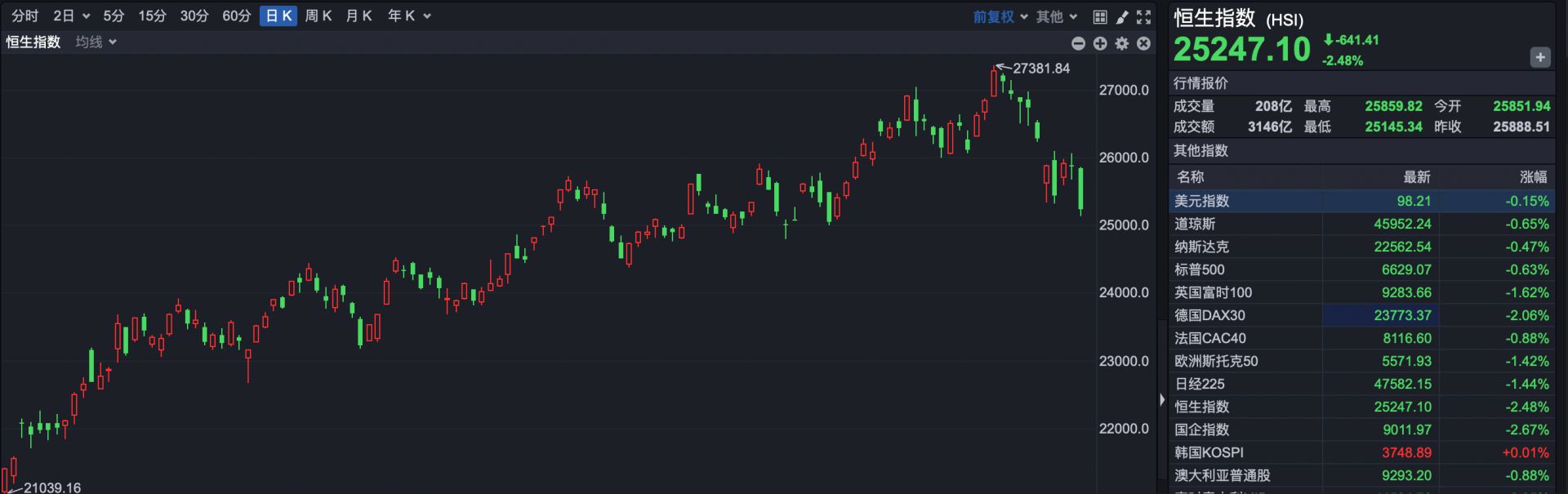
Market Overview - The Hong Kong stock market experienced a significant decline, with the Hang Seng Index closing at 25,247.10 points, down 641.41 points, representing a drop of 2.46%, marking the lowest closing since September 5 [1] - The Hang Seng Tech Index closed at 5,760.38 points, down 243.18 points, a decrease of 4.05%. Since the peak on October 2, the index has seen a cumulative decline of over 14% [3] Company Focus - ZTE Corporation's H-shares (00763.HK) fell over 12%, with an intraday maximum drop of 14%. The A-shares (000063.SZ) hit the daily limit down [5] - New consumption concept stocks also saw declines, with companies like Weilang Meishi (09985.HK) and Blukoo (00325.HK) dropping over 6%, while Nayuki Tea (02150.HK) and Pop Mart (09992.HK) fell over 4% [8] Sector Performance - All sectors in the Wind Hong Kong secondary industry index declined, with semiconductors, hardware equipment, and defense industries experiencing the largest drops [7] - Specific sector declines included: - Defense and military down 5.18% - Hardware equipment down 5.51% - Semiconductor down 3.55% [8] Other Notable Stocks - Tech stocks also faced declines, with Baidu, Alibaba, Meituan, and Kuaishou all dropping over 4%. Xiaomi and Bilibili fell over 3%, while Tencent decreased by over 1% [9] - Apple-related stocks, such as Q Technology, saw a drop of over 9%, and solar energy stocks continued their downward trend, with Sunshine Energy falling over 5% [9] Capital Flow - As of market close, southbound funds net bought over 6.3 billion HKD in Hong Kong stocks [9] Market Outlook - Short-term outlook for the Asia-Pacific market appears bleak due to increased uncertainty in news, leading to heightened risk aversion. Without new positive catalysts, the market may continue to experience volatility [11] - In the medium to long term, with the Federal Reserve entering a rate-cutting cycle, a "double easing" effect between China and the U.S. is expected, which may lead to sustained capital inflow and a gradual bullish trend for Hong Kong stocks [11]