
集成电路封装测试

Search documents
我国5月份核心CPI同比上涨0.6%
Qi Huo Ri Bao Wang· 2025-06-09 16:08
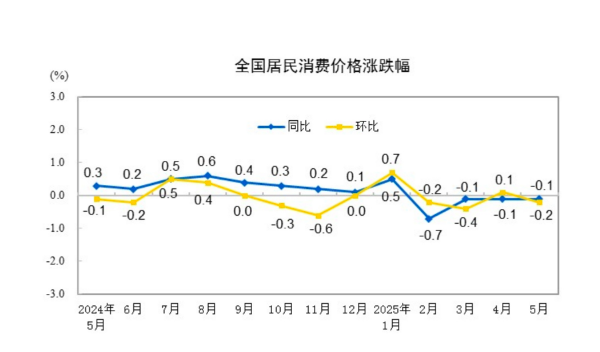
Group 1: CPI Analysis - In May, the Consumer Price Index (CPI) decreased by 0.2% month-on-month and 0.1% year-on-year, with energy prices dropping by 6.1% year-on-year, contributing approximately 0.47 percentage points to the CPI decline [1][2] - Core CPI increased by 0.6% year-on-year, with the growth rate expanding by 0.1 percentage points compared to the previous month, indicating resilience in domestic consumption [2][3] - Prices of gold jewelry, household textiles, and durable entertainment goods rose by 40.1%, 1.9%, and 1.8% respectively, while fuel and new energy vehicle prices fell by 4.2% and 2.8%, showing a narrowing decline [2][3] Group 2: PPI Analysis - The Producer Price Index (PPI) fell by 0.4% month-on-month and 3.3% year-on-year, with the year-on-year decline widening by 0.6 percentage points [1][3] - The decline in PPI is primarily attributed to weak commodity prices and significant input price pressures, particularly in the coal, steel, and cement sectors due to seasonal demand fluctuations [3][4] - Some sectors, such as high-end equipment manufacturing, saw price increases, with integrated circuit packaging and testing prices rising by 3.6% [3] Group 3: Future Outlook - The outlook for domestic prices suggests a likely moderate recovery in CPI, with food prices expected to remain stable and energy prices potentially rebounding [4] - PPI is anticipated to show marginal improvement, but it may take time to exit negative territory, influenced by external trade dynamics and domestic demand recovery [4] - Key areas to monitor include ongoing input price pressures, recovery in domestic demand, particularly in real estate, and trends in core consumption [4]
通富微电: 2024年年度权益分派实施公告
Zheng Quan Zhi Xing· 2025-06-09 13:44
Core Viewpoint - Tongfu Microelectronics Co., Ltd. has announced a profit distribution plan involving a cash dividend of 68,291,861.04 yuan (including tax) and a capital reserve conversion to increase share capital without issuing new shares [1][2]. Group 1: Profit Distribution Plan - The profit distribution plan includes a cash dividend of 68,291,861.04 yuan, which will be distributed based on the total number of shares held on the record date [1]. - The distribution ratio for shareholders is set at 0.405000 yuan for every 10 shares held, with different tax treatments for various types of investors [1][2]. Group 2: Key Dates - The record date for the rights distribution is June 16, 2025, and the ex-dividend date is June 17, 2025 [2]. Group 3: Distribution Objects - The distribution will be made to all shareholders registered with the China Securities Depository and Clearing Corporation Limited, Shenzhen Branch, as of the record date [2]. Group 4: Taxation Details - A differentiated tax rate will be applied for individual shareholders based on their holding period, with specific tax amounts outlined for different durations [2].

新华全媒+|物价总体稳定 供需有所改善——5月份物价数据透视
Sou Hu Cai Jing· 2025-06-09 09:31
Group 1 - The overall consumer price index (CPI) showed a slight decline in May, with a month-on-month decrease of 0.2% and a year-on-year decrease of 0.1%, influenced by seasonal factors and falling oil prices [1][2] - Core CPI, excluding food and energy, increased by 0.6% year-on-year, indicating a strengthening demand in certain sectors, supported by holiday consumption and a recovery in travel services [2][3] - Energy prices fell by 1.7% month-on-month, contributing significantly to the overall CPI decline, with a year-on-year decrease of 6.1% [1][2] Group 2 - Food prices decreased by 0.2% month-on-month, with fresh vegetable prices dropping by 5.9%, while some fresh fruits and fish saw price increases due to supply constraints [2][3] - The producer price index (PPI) decreased by 0.4% month-on-month and 3.3% year-on-year, but some sectors showed positive price trends, particularly in consumer goods [3][4] - Prices in high-tech industries, such as integrated circuits and wearable devices, increased year-on-year, reflecting a shift towards high-end, intelligent, and green production [4][5] Group 3 - The demand for high-tech products is growing, leading to price increases in related industries, while the prices in the solar and lithium battery sectors showed a narrowing decline [5] - The positive impact of macroeconomic policies is expected to further stimulate domestic demand and promote reasonable price recovery in the future [5]
能源价格拖累,5月份CPI环比下降0.2%
Di Yi Cai Jing· 2025-06-09 03:11
Core CPI and Economic Policy - The core CPI shows a steady upward trend, reflecting the effectiveness of macroeconomic policies and the increasing impact of domestic demand on prices [1][5] - In May, the core CPI excluding food and energy prices rose by 0.6% year-on-year, an increase of 0.1 percentage points from the previous month [2][4] CPI and PPI Trends - In May, the CPI decreased by 0.2% month-on-month and 0.1% year-on-year, while the PPI fell by 0.4% month-on-month and 3.3% year-on-year, with the year-on-year decline widening by 0.6 percentage points [2][7] - Energy prices dropped by 6.1% year-on-year, contributing approximately 0.47 percentage points to the CPI decline [4] Food Prices and Consumer Demand - Food prices decreased by 0.4% year-on-year, with pork prices rising by 3.1% but showing a decline in growth rate compared to the previous month [4] - The analysis indicates that consumer demand is in a critical recovery phase, with expectations of gradual improvement in consumption as counter-cyclical policies take effect [4][5] Sector-Specific Price Movements - Certain sectors are experiencing marginal price improvements, with some consumer goods seeing price stabilization or increases [8] - High-tech product demand is expanding, leading to price increases in sectors such as integrated circuits and aircraft manufacturing [8] Future Price Outlook - Short-term inflation may face dual pressures, with expectations of continued negative growth in CPI and PPI in the second and third quarters [9] - Recent financial policies may signal the start of a new round of incremental policies aimed at stabilizing employment, businesses, and market expectations [9]

国家统计局城市司首席统计师董莉娟解读2025年5月份CPI和PPI数据
Guo Jia Tong Ji Ju· 2025-06-09 01:44
Group 1: CPI Analysis - In May, the Consumer Price Index (CPI) decreased by 0.2% month-on-month and by 0.1% year-on-year, while the core CPI, excluding food and energy, increased by 0.6%, with the growth rate expanding by 0.1 percentage points compared to the previous month [1][2][3] - The month-on-month decline in CPI was primarily driven by a 1.7% decrease in energy prices, which accounted for approximately 70% of the total decline in CPI [2] - Food prices fell by 0.2%, with seasonal vegetables seeing a 5.9% price drop, while prices for eggs, pork, and poultry slightly decreased by 0.3% to 1.0% [2][3] Group 2: PPI Analysis - The Producer Price Index (PPI) decreased by 0.4% month-on-month and by 3.3% year-on-year, with the year-on-year decline expanding by 0.6 percentage points compared to the previous month [1][4][5] - The month-on-month PPI decline was influenced by international factors, including a 5.6% drop in oil and gas extraction prices and a 3.5% decrease in refined oil product manufacturing prices [4] - Some sectors showed marginal price improvements, with consumer demand policies positively impacting prices in certain industries, such as a 12.8% increase in the price of arts and crafts and a 0.8% rise in footwear manufacturing [5]
国家统计局:5月份CPI略有下降,核心CPI同比涨幅扩大
news flash· 2025-06-09 01:35
Group 1: CPI Analysis - The Consumer Price Index (CPI) decreased by 0.2% month-on-month and 0.1% year-on-year in May, with the core CPI (excluding food and energy) increasing by 0.6% year-on-year, an expansion of 0.1 percentage points from the previous month [1][2][3] - The month-on-month decline in CPI was primarily driven by a 1.7% decrease in energy prices, which accounted for approximately 70% of the total decline [2][3] - Food prices fell by 0.2%, with seasonal vegetables seeing a 5.9% price drop, while hotel accommodation and tourism prices rose by 4.6% and 0.8%, respectively, indicating a recovery in consumer demand [2][3] Group 2: PPI Analysis - The Producer Price Index (PPI) decreased by 0.4% month-on-month and 3.3% year-on-year, with the year-on-year decline expanding by 0.6 percentage points compared to the previous month [1][4][5] - The month-on-month PPI decline was influenced by international factors, including a 5.6% drop in oil and gas extraction prices, which contributed significantly to the overall decline [4][5] - Despite the overall decline, some sectors showed positive price movements, with consumer goods prices stabilizing and certain industries, such as high-end equipment manufacturing, experiencing price increases due to improved demand [5]
新恒汇: 募集资金具体运用情况
Zheng Quan Zhi Xing· 2025-05-29 13:24
Fundraising Utilization Plan - The company plans to invest the raised funds in two main projects: "High-Density QFN/DFN Packaging Material Industrialization Project" and "R&D Center Expansion and Upgrade Project" with a total investment of 518.63 million yuan [1][2] - The total amount of funds raised, after deducting issuance costs, will be fully allocated to these projects [2] Fund Management System - The company has established a management system for the raised funds, which includes regulations on special account storage, usage, changes in fund purposes, management, and supervision [2] - The board of directors is responsible for the effective execution of the fundraising management system, ensuring that the funds are stored in a designated special account [2] Project Timeline and Progress - The construction period for the High-Density QFN/DFN Packaging Material Industrialization Project is 24 months, involving engineering design, civil engineering, equipment procurement, and trial operation [2] - The R&D Center Expansion Project has a construction period of 18 months, focusing on engineering design, renovation, and equipment installation [2] Environmental Impact - The High-Density QFN/DFN Packaging Material Industrialization Project will produce minimal wastewater and waste, with noise levels meeting national standards [3] - The R&D Center Expansion Project will primarily generate solid waste such as paper, with no significant environmental pollution expected during its operation [3]
华维设计(833427) - 投资者关系活动记录表
2025-05-22 13:10
Group 1: Investor Relations Activity Overview - The investor relations activity was conducted online on May 21, 2025, as part of the "2025 Jiangxi Listed Companies Online Collective Reception Day" [3] - Participants included investors attending the online event, with key company representatives being General Manager Liao Yiqiang and Financial Officer Hou Changxing [3] Group 2: Key Investor Questions and Responses - **Question 1**: The company has approximately CNY 239 million in unconfirmed revenue orders as of the end of 2024, with future performance to be detailed in regular reports [5] - **Question 2**: The company plans to leverage government and client resources to support the development of Jiujing Huawi Chip, which focuses on integrated circuit packaging and testing [6] - **Question 3**: The main business direction remains engineering design, with the addition of integrated circuit services following the acquisition of a 51% stake in Jiujing Huawi Chip [7] - **Question 4**: The company emphasizes the importance of market value management, aiming to enhance information disclosure quality and investor relations [9] Group 3: Financial and Operational Goals - The company aims to maintain a differentiated business strategy while exploring new profit growth points under low-risk conditions [7] - Jiujing Huawi Chip is expected to benefit from a reduced corporate income tax rate of 15% from 2023 to 2025 due to its status as a high-tech enterprise [6]

我国经济展现强大韧性和抗冲击能力
Jin Rong Shi Bao· 2025-05-20 02:04
Economic Performance - In April, China's industrial added value above designated size grew by 6.1% year-on-year, with equipment manufacturing and high-tech manufacturing increasing by 9.8% and 10.0% respectively [1][3] - From January to April, infrastructure investment rose by 5.8% and manufacturing investment increased by 8.8%, indicating a stable growth trajectory [1][3] Trade and Export - Despite external pressures, China's foreign trade maintained steady growth, with total goods import and export value increasing by 2.4% year-on-year from January to April [3][5] - Exports of electromechanical products grew by 9.5% in the first four months, showcasing resilience in the face of trade tensions [5] Employment Situation - The urban unemployment rate in April was 5.1%, a slight decrease from the previous month, indicating overall stability in the job market [4] - However, structural employment issues persist, particularly among the youth, highlighting a mismatch in labor supply and demand [4] Consumer Market - Social retail sales increased by 5.1% year-on-year in April, supported by consumption policies, although the growth rate showed signs of slowing compared to previous months [7] - The sales of home appliances and related goods saw significant increases, with some categories growing by over 30% [7] Price Stability - The Consumer Price Index (CPI) in April showed a slight year-on-year decline of 0.1%, influenced by falling international oil prices, while core CPI remained stable [8] - Producer Price Index (PPI) experienced a year-on-year decline of 2.7%, indicating pressures on production costs [8] Macroeconomic Policies - The effectiveness of macroeconomic policies has been crucial in stabilizing the economy, with a series of measures aimed at boosting demand and supporting production [9][10] - The government has implemented policies to assist enterprises affected by tariffs, promoting diversification in foreign trade markets [10]
甬矽电子: 上海市方达(北京)律师事务所关于甬矽电子(宁波)股份有限公司2024年年度股东大会的法律意见书
Zheng Quan Zhi Xing· 2025-05-15 12:13
FANGDA PARTNERS http://www.fangdalaw.com 上海市方达(北京)律师事务所(以下简称"本所")是具有中华人民共和国 境内法律执业资格的律师事务所。根据相关法律顾问协议,本所指派律师出席甬 矽电子(宁波)股份有限公司(以下简称"公司")2024 年年度股东大会(以下简 称"本次股东大会"),并就本次股东大会的召集和召开程序、参与表决和召集会 议人员的资格、表决程序和表决结果等有关事宜出具本法律意见书。 本法律意见书依据《中华人民共和国公司法》 《中华人民共和国证券法》 《上 市公司股东会规则》及其他相关中华人民共和国境内已公开颁布并生效的法律、 法规、规章及规范性文件(以下合称"中国法律法规",仅为本法律意见书说明之 目的,不包括中国香港特别行政区、中国澳门特别行政区和中国台湾地区的法律、 法规)以及《甬矽电子(宁波)股份有限公司章程》(以下简称"《公司章程》") 的规定出具。 本法律意见书仅就本次股东大会的召集和召开程序、出席会议人员、召集人、 表决程序是否符合相关中国法律法规及《公司章程》的规定以及表决结果是否合 法、有效发表意见,并不对任何中国法律法规以外的国家或地区的 ...
