高技术制造

Search documents
中国制造业全球位势明显提升(锐财经)
Ren Min Ri Bao Hai Wai Ban· 2025-12-10 23:20
Core Insights - The Chinese industrial and information technology sector has made significant progress in 2020 despite challenges posed by the COVID-19 pandemic and external environmental changes [1][2][4]. Group 1: Industrial Economic Performance - In 2020, the industrial added value of large-scale industries increased by 2.8% compared to the previous year, with a quarterly recovery in growth rates [2][4]. - The Ministry of Industry and Information Technology (MIIT) coordinated financial institutions to provide over 350 billion yuan in new funding to support enterprises [2]. - The manufacturing Purchasing Managers' Index (PMI) was 51.9% in December 2020, remaining above the threshold for ten consecutive months, indicating improving business conditions [5]. Group 2: Support for Pandemic Response - The industrial and information technology system established a comprehensive emergency production system for medical supplies, significantly enhancing supply capabilities [2][4]. - The "Communication Big Data Travel Card" service was launched, with over 5.1 billion queries throughout the year, aiding in precise pandemic prevention efforts [2]. Group 3: Manufacturing Transformation and Upgrading - The integration of industrialization and informatization has accelerated, with new industries and business models experiencing growth. The added value of equipment manufacturing increased by 6.6%, and high-tech manufacturing grew by 7.1% in 2020 [4][5]. - High-tech manufacturing investment rose by 11.5%, driven by the rapid development of new infrastructure such as 5G and industrial internet [5][6]. Group 4: Development of Small and Medium Enterprises - Since the pandemic, various supportive policies have been implemented, leading to a steady recovery in the economic performance of small and medium enterprises (SMEs). From January to November 2020, profits of large-scale SMEs increased by 6.9% year-on-year [7]. - The MIIT aims to enhance the innovation capabilities of SMEs, with plans to cultivate 100,000 "specialized, refined, distinctive, and innovative" enterprises over the next three to five years [7][8]. Group 5: 5G and Digital Transformation - Over 600,000 new 5G base stations were built in 2020, achieving full coverage in all cities above the prefecture level, with over 200 million 5G terminal connections [6]. - The implementation of over 1,100 5G and industrial internet projects has accelerated the digital transformation across various industries [6]. Group 6: Overall Industrial Positioning - The achievements in 2020 mark the successful conclusion of the 13th Five-Year Plan, with significant advancements in key technologies and equipment manufacturing, enhancing China's position in the global industrial value chain [4][10].

11月PMI数据点评:价格改善加速,制造业PMI收缩放缓
Western Securities· 2025-12-02 02:40
Report Summary 1. Report Industry Investment Rating No industry investment rating information is provided in the report. 2. Core Viewpoints - In November, the manufacturing PMI contraction slowed down, with synchronized improvement in production and demand, accelerated improvement in the price index, and a slowdown in procurement contraction. Meanwhile, the service industry fell into the contraction range, and the construction industry remained below the boom - bust line for four consecutive months. More efforts are needed to promote various economic stabilization policies [1][5][35]. - In November, the bond market fell into a "ceiling - floor" oscillation pattern again due to the lack of strong policy and fundamental drivers. Most institutions are waiting for clear guidance from incremental information. The important meetings in December and subsequent key economic data releases are expected to determine the market direction. Historically in December, interest rates tend to decline, but the bullish sentiment in the market has concerns, and the year - end allocation market is yet to start [4][35]. 3. Summary by Directory I. November PMI Data Overview - Manufacturing: The manufacturing PMI in November was 49.2%, up 0.2 percentage points month - on - month, remaining below the boom - bust line for eight consecutive months. The production index reached the critical point, external demand improved significantly, the price index improved at an accelerated pace, finished - product destocking accelerated, and procurement contraction slowed [8]. - Non - manufacturing: The service industry fell into the contraction range, with its business activity index dropping 0.7 percentage points to 49.5%. The construction industry showed a slight recovery, with its business activity index rising 0.5 percentage points to 49.6%, remaining below the boom - bust line for four consecutive months [11]. II. Manufacturing: Synchronized Improvement in Production and Demand, Accelerated Improvement in Price Index - Production: The manufacturing PMI production index reached 50.0% in November, returning to the boom - bust line after a brief fall into the contraction range last month, up 0.3 percentage points month - on - month, but weaker than the seasonal performance [15]. - Demand: External demand improved significantly, driving overall demand to pick up. The new export order index rose notably, and demand improvement was higher than production. Small - enterprise PMI rebounded, and the high - energy - consuming industry's prosperity level rebounded from a low level [18]. - Price: The "anti - involution" policy advanced steadily, and with the coordinated stabilization of supply and demand, the price index improved at an accelerated pace. The main raw material purchase price index and the ex - factory price index rose by 1.1 and 0.7 percentage points respectively, and the index difference between them increased to 5.4 percentage points, indicating a narrowing profit margin for enterprises [21]. - Inventory: Finished - product destocking accelerated, and procurement contraction slowed. The raw material inventory index remained flat at 47.3%, and the finished - product inventory decreased by 0.8 percentage points. The enterprise procurement willingness increased, and the procurement volume index rose to 49.5% [24]. III. Non - manufacturing: Service Industry Falls into Contraction Range, Construction Industry Shows Slight Recovery - Service Industry: After the concentrated release of consumption demand during the National Day Golden Week last month, consumer - related service industries declined in the off - season, and the service industry fell into the contraction range. However, financial activities continued to strengthen, and new - energy industries maintained steady growth [28]. - Construction Industry: Construction activities recovered in November, with the construction business activity index rising 0.5 percentage points to 49.6%, remaining below the boom - bust line for four consecutive months. The business activity index of the housing construction industry increased significantly, and that of the civil engineering construction industry remained above 52% [31]. IV. Impact on the Bond Market - In November, the bond market was in a "ceiling - floor" oscillation pattern due to the lack of strong policy and fundamental drivers. Most institutions were in a wait - and - see mode. The important meetings in December and subsequent key economic data releases are expected to determine the market direction. Historically in December, interest rates tend to decline, but the bullish sentiment has concerns, and the year - end allocation market is yet to start [4][35].
宏观经济周报-20251201
工银国际· 2025-12-01 06:24
Economic Indicators - The ICHI Composite Economic Index slightly declined, indicating a phase of stable adjustment after previous expansion momentum[1] - The Consumer Confidence Index showed a minor drop but remains close to the expansion zone, reflecting resilient demand[1] - The Investment Confidence Index remained stable with slight contraction, particularly in infrastructure investment, which is expected to rebound under continued policy support[1] Industrial Profit Trends - From January to October 2025, profits of large industrial enterprises increased by 1.9% year-on-year, marking three consecutive months of recovery[2] - Manufacturing profits grew by 7.7%, while public utilities saw a 9.5% increase, indicating structural optimization in industrial profits[2] - Equipment manufacturing and high-tech manufacturing sectors were the main profit growth drivers, contributing 2.8 percentage points to overall industrial profit growth[2] Global Economic Context - In the U.S., September retail sales rose by only 0.2%, significantly below the expected 0.4%, indicating weakening consumer momentum[6] - The Producer Price Index (PPI) increased by 0.3% month-on-month, driven primarily by rising energy prices, with core PPI rising only 0.1%[6] - The U.S. economy faces a dual challenge of weakening employment and inflation pressures, with hiring intentions declining in half of the regions surveyed[7]
前10月规上工业企业利润同比增长1.9% 8月份以来累计增速连续3个月保持增长
Ren Min Ri Bao· 2025-11-30 22:11
Group 1 - The core viewpoint indicates that the profits of industrial enterprises above designated size increased by 1.9% year-on-year in the first ten months, maintaining growth for three consecutive months since August 2023 [1] - In October, the profits of industrial enterprises above designated size decreased by 5.5% year-on-year due to a higher base from the previous year and rapid growth in financial costs [1] - The equipment manufacturing industry showed significant profit growth, with a year-on-year increase of 7.8% in the first ten months, contributing 2.8 percentage points to the overall profit growth of industrial enterprises [1] Group 2 - The high-tech manufacturing sector performed well, with profits increasing by 8.0% year-on-year, surpassing the average growth rate of all industrial enterprises by 6.1 percentage points [2] - In the high-tech manufacturing sector, the smart electronics manufacturing industry saw remarkable growth, with profits from smart unmanned aerial vehicle manufacturing and smart vehicle-mounted equipment manufacturing increasing by 116.1% and 114.9%, respectively [2] - Traditional industries are showing signs of quality improvement and upgrading, with profits in the chemical and building materials sectors significantly exceeding the industry average, such as a 77.7% increase in graphite and carbon products manufacturing [2]
11月中国制造业PMI回升至49.2%
Zhong Guo Xin Wen Wang· 2025-11-30 16:03
Group 1 - The manufacturing Purchasing Managers' Index (PMI) for November in China is reported at 49.2%, an increase of 0.2 percentage points from the previous month, indicating an improvement in economic conditions [1] - The production index and new orders index for November are 50.0% and 49.2%, respectively, with increases of 0.3 and 0.4 percentage points from last month, suggesting improvements in both production and demand [1] - Industries such as agricultural and sideline food processing, as well as non-ferrous metal smelting and rolling processing, show production and new orders indices in the expansion zone, indicating active supply and demand [1] Group 2 - The PMI for large enterprises is 49.3%, a decrease of 0.6 percentage points from last month; medium enterprises' PMI is 48.9%, an increase of 0.2 percentage points; and small enterprises' PMI is 49.1%, an increase of 2.0 percentage points, reaching a six-month high [1] - The high-tech manufacturing PMI stands at 50.1%, remaining above the critical point for ten consecutive months, indicating continued growth in related industries [1] - The PMI for high-energy-consuming industries is 48.4%, an increase of 1.1 percentage points from last month, showing a low-level recovery in economic conditions [1] Group 3 - The production and business activity expectation index for manufacturing enterprises is 53.1%, an increase of 0.3 percentage points from the previous month, reflecting improved confidence among manufacturers [2] - Industries such as non-ferrous metal smelting and rolling processing, as well as railway, shipbuilding, and aerospace equipment, have production and business activity expectation indices above 57.0%, indicating a more optimistic outlook for industry development [2]
国家统计局服务业调查中心首席统计师霍丽慧解读2025年11月中国采购经理指数
Guo Jia Tong Ji Ju· 2025-11-30 02:03
Group 1: Manufacturing PMI Insights - The manufacturing Purchasing Managers' Index (PMI) rose to 49.2% in November, indicating a slight improvement in economic conditions [2][3] - Both production index and new orders index improved, reaching 50.0% and 49.2% respectively, with production index crossing the critical point [3] - Small enterprises showed significant recovery with a PMI of 49.1%, up 2.0 percentage points, marking a six-month high [3] - High-tech manufacturing PMI remained above the critical point at 50.1%, indicating continued growth in this sector [3] Group 2: Non-Manufacturing PMI Insights - The non-manufacturing business activity index fell to 49.5%, a decrease of 0.6 percentage points, reflecting a decline in economic activity [2][5] - The service sector's business activity index dropped to 49.5%, influenced by the end of holiday effects, with some industries like real estate showing weaker activity [5] - The construction sector's business activity index improved to 49.6%, with a business activity expectation index of 57.9%, indicating increased confidence in future growth [5] Group 3: Composite PMI Insights - The composite PMI output index decreased to 49.7%, down 0.3 percentage points, with manufacturing and non-manufacturing indices at 50.0% and 49.5% respectively [6]
稳定增长、促进消费、优化机制 借助关键词感知经济发展新“动”力
Yang Shi Wang· 2025-11-28 06:36
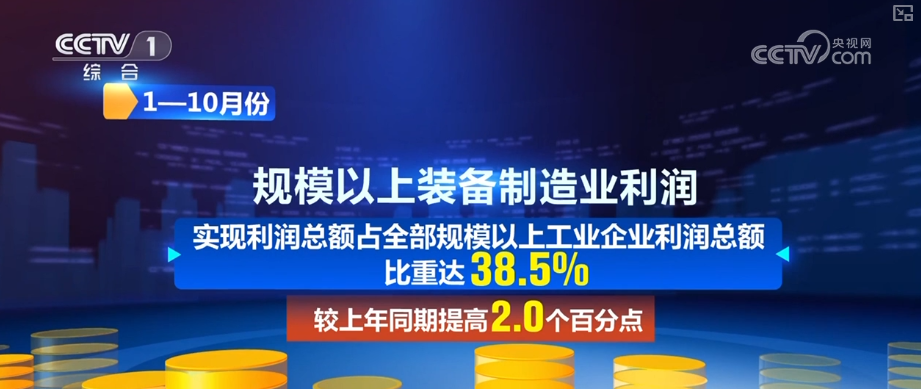
Group 1: Industrial Profit Growth - In the first ten months of the year, profits of large-scale industrial enterprises increased by 1.9% year-on-year, marking three consecutive months of growth since August 2025 [1] - Profits in the equipment manufacturing sector grew significantly, with a year-on-year increase of 7.8%, accounting for 38.5% of total profits in large-scale industrial enterprises, an increase of 2.0 percentage points from the previous year [3] - Seven out of eight major categories in the equipment manufacturing sector reported profit growth, particularly in railways, shipping, aerospace, and electronics, which saw double-digit profit increases [3] Group 2: High-tech Manufacturing Performance - Profits in the high-tech manufacturing sector rose by 8.0% year-on-year during the same period, with strong growth observed in smart electronics, unmanned aerial vehicles, smart vehicle equipment, semiconductor manufacturing, and precision instruments [5] Group 3: Consumption Promotion Policies - The Ministry of Industry and Information Technology, along with five other departments, introduced a plan to enhance the adaptability of supply and demand in consumer goods, aiming to boost consumption [6][10] - The plan outlines 19 key tasks across five areas, focusing on accelerating the application of new technologies and models, expanding the supply of unique and new products, and precisely matching the needs of different consumer segments [10] - By 2027, the goal is to establish three trillion-yuan consumption sectors and ten hundred-billion-yuan consumption hotspots, with a vision for a high-quality development pattern by 2030 [13][15] Group 4: Credit Repair Mechanism - The State Administration for Market Regulation announced a new Credit Repair Management Measures to assist more enterprises in correcting mistakes and restoring their credit [16][19] - The measures include a systematic approach to credit repair, detailing conditions, procedures, and special circumstances, allowing businesses to rebuild their credit in a structured manner [21] - The new regulations categorize violations into "minor, general, and serious," with varying public disclosure periods, and reduce the processing time for credit repair from 15 working days to 7 [23]
中信证券:供需回落导致行业利润增速分化
Zheng Quan Shi Bao Wang· 2025-11-28 00:24
Core Insights - The report from CITIC Securities indicates a decline in both profit and revenue growth rates for industrial enterprises in October, primarily due to a decrease in domestic and external demand [1] - State-owned enterprises maintained positive profit growth, while foreign-funded enterprises experienced the most significant profit decline [1] - The combination of declining revenue profit margins and a slowdown in industrial value-added growth contributed to the decrease in profit growth for industrial enterprises, highlighting insufficient demand and the lack of a steady recovery in profit margins despite PPI adjustments [1] Industry Analysis - There is a notable divergence in profit growth across industries, with midstream and downstream sectors experiencing a rapid decline in profit growth, suggesting that upstream price increases continue to squeeze profits in these sectors [1] - Conversely, the equipment manufacturing and high-tech manufacturing sectors are showing a positive profit growth trend [1] - Looking ahead, due to the high base of industrial enterprise profits from the same period last year, future profit performance may face pressure; however, emerging industries benefiting from structural booms, such as semiconductors and AI, are expected to maintain resilience in profits [1]

税收数据折射新质生产力发展成色
Ren Min Ri Bao· 2025-11-26 22:56
Core Insights - Tax data indicates that China's new quality productivity is growing, particularly in high-end manufacturing, innovative industries, and the integration of digital and physical economies, providing new vitality to economic development [1][2]. Group 1: High-End Manufacturing - In October, sales revenue in the equipment manufacturing sector increased by 7.3% year-on-year, consistently outperforming the average manufacturing growth rate, now accounting for nearly half of the manufacturing sector [1]. - Specific sectors such as computer and communication equipment manufacturing, shipbuilding, and battery manufacturing saw sales revenue growth of 10.1%, 24.4%, and 27.2% respectively, indicating strong development momentum [1]. Group 2: Innovative Industries - High-tech industries, including high-tech manufacturing and services, are accelerating, with sales revenue in October growing by 13.6% year-on-year [2]. - High-tech service revenue increased by 16.1%, while high-tech manufacturing revenue rose by 10.1%. Notably, sectors like integrated circuits, industrial robots, and drone manufacturing experienced sales growth of 32.5%, 41.7%, and 38.4% respectively [2]. Group 3: Digital Economy Integration - The core industries of the digital economy saw sales revenue increase by 8.5% in October, with enterprises' spending on digital technologies rising by 9.6%, reflecting ongoing advancements in digital industrialization and industrial digitalization [2]. - Revenue from digital product services and digital technology applications grew by 10.2% and 13.1% respectively, while the digital content and media sector saw a significant increase of 15.2% [2]. Group 4: Regional Innovation Initiatives - Various regions are establishing innovation hubs and industrial clusters to promote new quality productivity, such as Shanghai's focus on cell and gene technology and Jiangsu's push for practical applications of quantum technology [2]. - Chengdu is leveraging its computing power advantages to support AI technology solutions in industrial quality inspection and urban governance [2]. Group 5: Economic Transformation Insights - Experts highlight that the tax data from October reflects the success of China's industrial structure upgrade and economic transformation, particularly driven by the "Artificial Intelligence +" initiative, which fosters growth in frontier industries and deepens the integration of digital technology with the physical economy [3].
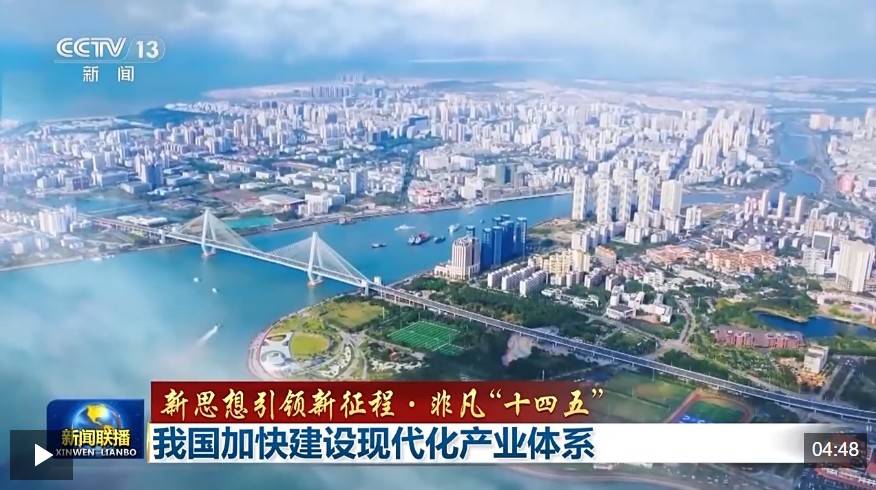
新思想引领新征程·非凡“十四五”丨我国加快建设现代化产业体系
Yang Shi Xin Wen Ke Hu Duan· 2025-11-26 01:21
Core Insights - The construction of a modern industrial system is emphasized as a material and technological foundation for a modernized nation, with a focus on the real economy to support the second centenary goal [2] - The "14th Five-Year Plan" period aims to accelerate the establishment of a modern industrial system driven by technological innovation and rooted in the real economy [2] Group 1: Industrial Development - The Yangtze River Delta's industrial internet platform processes 20,000 data sets every minute, with a refrigerator rolling off the production line every eight seconds [4] - In the eastern coastal bonded zones, cross-border data flows enable verification and customs clearance in just one second, facilitating rapid global distribution of Chinese manufacturing [6] - The Pearl River Delta's lighthouse factories offer 100,000 personalized options for customizing a car, showcasing advanced manufacturing capabilities [7] Group 2: Government Initiatives and Leadership - President Xi Jinping has consistently highlighted the importance of a modern industrial system supported by the real economy, making significant directives on its construction [9] - The modern industrial system reflects changes in industrial structure, development dynamics, and factor relationships, aligning with the context of Chinese-style modernization [11] Group 3: Progress and Achievements - In 2023, the construction of the modern industrial system has accelerated, with over 80% of steel companies establishing intelligent control centers and more than half of coal production capacity achieving digital mining [13] - The manufacturing sector remains the largest in the world, with over 10,000 provincial-level digital workshops and smart factories established, and 6,430 national-level green factories operational [14] - The first batch of leading smart factories has been announced, covering various sectors including steel and consumer goods, aiming to explore new manufacturing models [15] Group 4: Emerging Technologies and Economic Growth - In the first three quarters of the year, the value added of high-tech manufacturing increased by 9.6%, with industrial robot production rising nearly 30% and drone sales revenue growing by almost 70% [19] - The continuous optimization of industrial structure and the increasing proportion of high-tech and strategic emerging industries are driving high-quality economic development [21] Group 5: Future Planning - Regions are actively planning for the "15th Five-Year Plan," with Hunan Province allocating 50 billion yuan to support 1.89 million small and medium-sized enterprises, focusing on key industrial chains [23] - The "15th Five-Year Plan" emphasizes the construction of a modern industrial system and the strengthening of the real economy as primary strategic tasks [23]