智能硬件

Search documents
秦朔:从中国制造到中国创造&全球制造 | 出海峰会
吴晓波频道· 2025-06-24 00:52
Core Viewpoint - The article emphasizes the transition of Chinese manufacturing from being a global manufacturing hub to becoming a leader in global manufacturing, highlighting the need for Chinese companies to adopt a global mindset and explore new markets while leveraging their manufacturing capabilities [3][5][12]. Group 1: Global Manufacturing Transition - Chinese manufacturing has evolved from "global manufacturing in China" to "Chinese manufacturing for the world," indicating a shift towards innovation and quality [3][6]. - The ability of Chinese companies to drive globalization is primarily reflected in the manufacturing sector, where China has developed a comprehensive manufacturing capability system [6][12]. - The restructuring of global supply chains is underway, moving from offshore and efficiency-driven models to more autonomous and diversified approaches [10][11]. Group 2: Strategic Global Expansion - Chinese companies are encouraged to adopt a global perspective when selecting overseas markets, identifying regions with favorable tariff conditions such as the Middle East, Southeast Asia, and Latin America [16][19]. - The case of Zhejiang Tongxiang's China Jushi illustrates how tariffs can significantly impact business decisions, leading to the establishment of manufacturing facilities in countries with lower tariffs [17][18]. - Companies must navigate the complexities of different markets, balancing opportunities and risks while adapting to local conditions [21][22]. Group 3: Export and Outbound Investment - In 2024, China's goods trade export scale is projected to reach 25.45 trillion yuan, with a year-on-year growth of 7.1%, indicating resilience despite external challenges [34][35]. - China's outbound non-financial direct investment is expected to grow by 10.5% to $143.85 billion in 2024, showcasing a simultaneous increase in both exports and outbound investments [35]. - The home appliance industry exemplifies the dual strategy of expanding domestic demand while actively pursuing international markets, with significant growth in both revenue and exports [38][39]. Group 4: Case Studies of Successful Globalization - Lenovo serves as a prime example of a company that has successfully integrated global resources while maintaining core manufacturing in China, achieving a balance between local delivery and global supply chains [44][46]. - The article highlights the importance of new infrastructure capabilities, particularly in digital technology and renewable energy, as Chinese companies expand their influence globally [48][50]. - Emerging companies in smart hardware are leveraging China's supply chain to innovate and redefine industry standards, moving from imitation to original innovation [51][52]. Group 5: Strategic Considerations for Global Operations - Companies must find a balance between exporting and establishing local production to navigate trade barriers and optimize costs [56]. - Emphasizing local operations while maintaining a global strategy is crucial for long-term success, requiring cultural sensitivity and community engagement [57]. - Collaboration with international firms presents opportunities for joint market development, reinforcing the role of Chinese companies in stabilizing and accelerating global supply chains [58].


Z Explorer|05后,不限专业、地点、时间的实习,和我们一起了解世界!
Z Potentials· 2025-06-23 04:18
Core Viewpoint - The article emphasizes the importance of youth engagement in technology and business, highlighting the Z Explorer program as a platform for young individuals to explore opportunities and develop skills in these fields [2][7]. Group 1: Z Explorer Program - The Z Explorer program invites young individuals to explore unknown possibilities and engage with technology, finance, and consumer trends [3][4]. - Participants will have opportunities to collaborate with top university students, industry experts, and leading investors, gaining insights into the latest industry trends [4][8]. - The program aims to cultivate future leaders by enhancing participants' professional skills, technological sensitivity, and unique business insights [8]. Group 2: Target Audience and Recruitment - The program seeks highly motivated young individuals interested in technology, products, and business, who are willing to participate in activities connecting technology and entrepreneurs [11]. - Candidates are required to be fluent in English and commit 5-10 hours per week for a three-month remote participation [11]. Group 3: Organizational Background - The Z Explorer initiative is backed by a diverse group of professionals from prestigious universities and leading investment firms, focusing on various technology sectors including AI, robotics, and fintech [5][6]. - The initiative has collaborated with major companies like Google, Alibaba Cloud, and Amazon Web Services to host events and support innovation competitions [6].

比依股份: 浙江比依电器股份有限公司第二届监事会第十六次会议决议公告
Zheng Quan Zhi Xing· 2025-06-20 09:44
Group 1 - The company held the 16th meeting of the second supervisory board on June 17, 2025, with all three supervisors present, complying with relevant regulations and company articles [1][2] - The supervisory board approved the proposal to waive the priority rights for the acquisition and subscription of shares in the associated company, Li Pai Guang Jing, which is expected to enhance collaboration in AR smart glasses production [1][2] - The board concluded that the transaction and the waiver of rights would not adversely affect the company's operations or harm the interests of the company and its shareholders [1][2] Group 2 - The voting results for the proposal were unanimous, with 3 votes in favor, 0 against, and 0 abstentions [2] - The decision is documented in the minutes of the 16th meeting of the second supervisory board [2]

2025年第23周:数码家电行业周度市场观察
艾瑞咨询· 2025-06-20 09:08
Group 1: Kitchen Appliances and AI Integration - The kitchen appliance industry is facing challenges due to changing consumer preferences, with a focus on attracting younger users through AI-integrated smart products like the "Food God" model [1] - Companies are exploring diversification, optimizing designs, and accelerating international expansion to adapt to market conditions, including real estate downturns and overseas competition [1] - Future opportunities lie in expanding the food industry chain and leveraging AI to lower cooking barriers, reshaping market dynamics [1] Group 2: AI Glasses Market - The global sales of AI glasses are projected to reach 600,000 units in Q1 2024, marking a 216% year-on-year increase, significantly outpacing VR and AR products [2] - Despite the promising growth, challenges such as design balance, insufficient SKUs, and production capacity issues remain, with the upcoming 618 shopping festival being a critical test for domestic AI glasses [2] - The next two to three years are deemed crucial for competition in the AI glasses market, necessitating Chinese brands to enhance their efforts in rule-making and technological breakthroughs [2] Group 3: Space Computing - INAIR's new AI space computer emphasizes lightweight design and efficient multi-window operations, while Apple’s Vision Pro integrates digital and physical worlds but faces high pricing and limited battery life [4] - Meizu's StarV Air2 offers lightweight daily assistance but lacks capabilities for complex tasks, representing different approaches to space computing [4] - Success in this field will depend on meeting user needs and adapting to practical scenarios [4] Group 4: Bathroom Industry Trends - The bathroom industry is evolving from functional spaces to comfort-oriented environments, with trends focusing on scene-based, intelligent, and age-friendly designs [5] - Brands are showcasing comprehensive solutions and customized offerings at industry exhibitions, enhancing user experiences [5] - The shift from scale competition to value competition emphasizes technological depth and humanistic care to meet diverse consumer demands [5] Group 5: AI Glasses Market Challenges - The AI glasses market is experiencing rapid growth, with ten new products launched in May, and hardware performance aligning with high-end smartphones [6] - Despite advancements, the industry faces challenges such as the lack of "killer" features and insufficient user experience, with AR glasses dominating the market [6] - By Q1 2025, sales are expected to grow by 45%, but AI features are not the core selling point, indicating a need for practical optimization and scenario expansion [6] Group 6: AI Model Market Dynamics - The domestic AI model market is transitioning from a "hundred models war" to a consolidation phase, with major players like ByteDance, Alibaba, and Tencent competing through various strategies [7] - Emerging companies are rapidly gaining traction, while some established players are shifting focus towards application scenarios [7] - Future competition will prioritize technological implementation and productization capabilities, with resources and innovation being key determinants of success [7] Group 7: Automotive Industry and Humanoid Robots - The automotive sector is increasingly showcasing humanoid robots, with 19 major car manufacturers entering the field, driven by advancements in generative AI [8] - Despite having supply chain advantages, the industry faces challenges in supply chain management, commercial orders, and technical bottlenecks [8] - Overall, humanoid robots are still in the early stages, with technology and market acceptance being critical hurdles [8] Group 8: Data Industry and Economic Value - The global trend of restricting data flow is highlighted by the U.S. NIH's ban on Chinese access to key databases, prompting China to accelerate its digital economy initiatives [9] - By 2025, the goal is for the core digital economy sectors to account for over 10% of GDP, with the data industry projected to reach 7.5 trillion yuan by 2030 [9] - The establishment of high-quality data sets supports domestic model development, but challenges in data quality and utilization efficiency persist [9] Group 9: Refrigerator Market Innovations - The refrigerator market is expected to see growth in Q1 2025, driven by fiscal subsidies and technological innovations, with mid-to-high-end products leading the way [10] - Major brands like Haier and Bosch are focusing on differentiation through preservation, health management, and design [10] - Meeting the demands of younger consumers through preservation upgrades and AI applications is crucial for future growth [10] Group 10: Strategic Collaborations and Investments - Meitu and Alibaba have entered a strategic cooperation involving a $250 million convertible bond, focusing on e-commerce, AI technology, and cloud computing [14][15] - This partnership aims to enhance Meitu's capital structure and broaden its shareholder base while driving breakthroughs in respective fields [15] - Hong Kong Investment Management Company, known as "Hong Kong's Temasek," is actively investing in AI computing and hard technology, managing over HKD 62 billion [18] - Honor is entering the robotics sector with significant investments planned for AI research and hardware development, showcasing its technological capabilities [19]





石 头 科 技: 北京石头世纪科技股份有限公司2025年第二次临时股东会会议资料
Zheng Quan Zhi Xing· 2025-06-20 08:31
Core Viewpoint - The company plans to issue H-shares and list them on the Hong Kong Stock Exchange to enhance its global brand recognition, optimize capital structure, and expand financing channels [5][10][11]. Proposal Summaries - Proposal 1: Issuance of H-shares and listing on the Hong Kong Stock Exchange [1][4]. - Proposal 2: Plan for the issuance of H-shares [1][4]. - Proposal 3: Use of funds raised from the H-share issuance [1][10]. - Proposal 4: Application to convert to an overseas fundraising company [1][10]. - Proposal 5: Profit distribution plan before H-share issuance [1][10]. - Proposal 6: Proposal to cancel the supervisory board [1][12]. - Proposal 7: Amendments to the company's articles of association and related rules [1][12]. - Proposal 8: Draft amendments to the articles of association applicable after H-share issuance [1][14]. - Proposal 9: Amendments to internal governance systems applicable after H-share issuance [1][14]. - Proposal 10: Appointment of auditing firm for H-share issuance and listing [1][16]. - Proposal 11: Addition of directors [1][17]. - Proposal 12: Determination of director roles and members of the board committees [1][18]. - Proposal 13: Purchase of liability insurance for directors and senior management [1][18]. - Proposal 14: Authorization for the board to handle matters related to H-share issuance and listing [1][19]. Meeting Procedures - The meeting will be conducted with a combination of on-site and online voting [4][5]. - Attendees must register and confirm their participation before the meeting starts [2][3]. - Shareholders have the right to speak, inquire, and vote during the meeting [2][3]. Fundraising and Use of Proceeds - The funds raised will be used for international business expansion, product development, and general operational needs [10][11]. - The issuance will not exceed 15% of the total share capital post-issuance, with an option for over-allotment [6][7]. Governance Changes - The supervisory board will be abolished, with its functions transferred to the audit committee of the board [12][13]. - The board will increase its members from 6 to 8, with adjustments to the roles of non-executive and independent directors [17][18]. Compliance and Legal Framework - The issuance will comply with relevant laws and regulations, including those from the China Securities Regulatory Commission and the Hong Kong Stock Exchange [10][11][19]. - The company will appoint Ernst & Young as the auditing firm for the H-share issuance [16].
从1500个项目里,看见中国AI的未来
36氪· 2025-06-20 00:33
Core Insights - The article emphasizes the transformative potential of generative AI in enhancing productivity and operational efficiency across various industries, moving beyond mere concepts to practical applications [1][12][49] - It highlights the successful implementation of generative AI projects by companies like Anker Innovations, showcasing significant improvements in customer service and content production [7][9][12] Group 1: Generative AI Implementation - Anker Innovations has established a high-quality real-time knowledge base language model system with Amazon Web Services (AWS), deploying over 50 AI agents and achieving over 70% resolution rate in customer service inquiries [4][7] - The content production platform Vela has generated over 1.2 million images, and more than 20% of in-site advertisements are fully managed by AI [7][9] - The success rate of generative AI projects transitioning from proof of concept (PoC) to production is reported at 82%, significantly higher than the industry average of 41% [12][46] Group 2: Challenges and Considerations - Companies often struggle with defining clear objectives for AI projects, leading to misalignment between expectations and outcomes [16][17] - Common pitfalls include unclear project goals, high implementation costs, and treating AI initiatives as exploratory rather than strategic [17][18] - A comprehensive evaluation of AI application scenarios is crucial, as not all problems require generative AI solutions [25][26] Group 3: Methodology for Successful AI Deployment - The article outlines a methodology for successful generative AI deployment, emphasizing the importance of scenario assessment, technology selection, production optimization, and results monitoring [21][34][39] - Companies should evaluate AI projects based on seven key dimensions: team, timeline, risk, data, ROI, budget, and feasibility [26] - Continuous monitoring of project outcomes is essential to ensure alignment with business objectives and to make necessary adjustments [39][40] Group 4: Market Trends and Future Outlook - The generative AI market is experiencing explosive growth, with a projected market size of 7.1 billion RMB in China for 2024, reflecting a year-on-year increase of 215.7% [46] - The article notes a shift towards multi-model strategies among enterprises, with 80% expected to adopt this approach by 2027 [32] - The cost of training AI models has significantly decreased, enabling faster response times and real-time decision-making capabilities [49][50]


影石创新:滑滑梯搬进了办公区 ——对话科创板上市公司首位“90后”创始人刘靖康
Shen Zhen Shang Bao· 2025-06-19 16:48
Core Viewpoint - The successful listing of YingShi Innovation on the Sci-Tech Innovation Board marks a significant milestone for the company and highlights the growing influence of the "post-90s" generation in the tech industry [2][3]. Group 1: Company Overview - Liu Jingkang, the founder of YingShi Innovation, is recognized as the first "post-90s" founder to list on the Sci-Tech Innovation Board, reflecting a new wave of entrepreneurial spirit in China [2][3]. - The company specializes in innovative hardware products, particularly in the field of panoramic cameras, with its latest model, Insta360 X5, being showcased during the listing event [3][4]. Group 2: Product Development and Market Strategy - YingShi Innovation emphasizes thorough customer research and co-creation in product development, ensuring that new products meet genuine user needs rather than being based on arbitrary ideas [3][4]. - The product managers at YingShi are often experienced sports enthusiasts, which allows them to create products that effectively address real-world challenges faced by users [4]. Group 3: Corporate Culture and Environment - The company is known for its unconventional corporate culture, which includes unique employee benefits and creative initiatives, such as a two-story slide in the office [5][6]. - Liu Jingkang attributes the company's success to its location in Shenzhen, which provides a robust industrial ecosystem and talent pool essential for the development of smart hardware [6]. Group 4: Industry Context - The listing of YingShi Innovation contributes to the growing number of publicly listed companies in Bao'an District, with 82 companies now listed and over 800 in the pipeline for future listings [6]. - The district is recognized for its comprehensive manufacturing industry, housing over 54,500 manufacturing enterprises, which supports rapid product development and innovation [6].
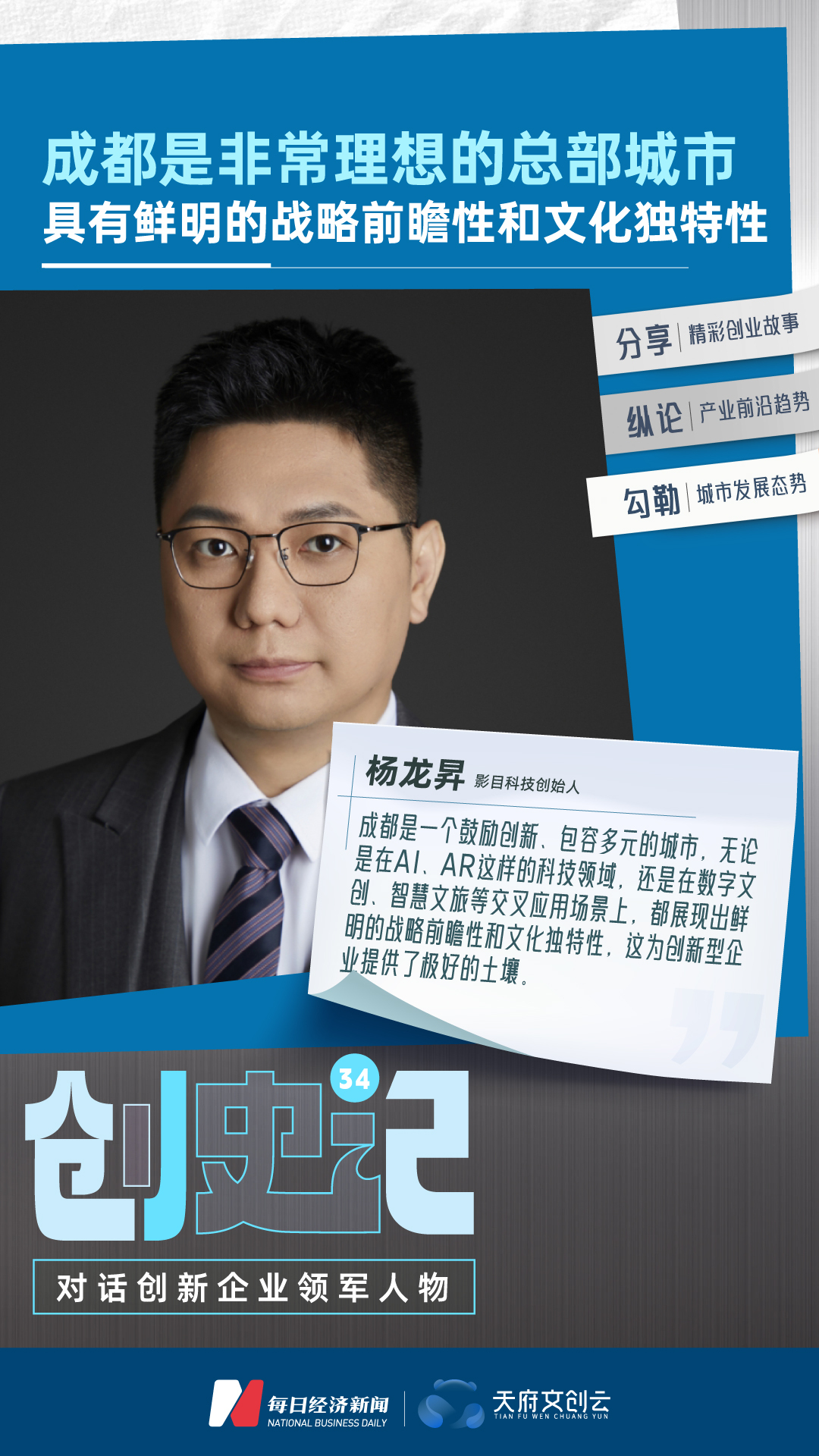
影目科技创始人杨龙昇: 成都是非常理想的总部城市,具有鲜明的战略前瞻性和文化独特性
Mei Ri Jing Ji Xin Wen· 2025-06-19 13:10
Core Insights - The global smart glasses shipment is expected to reach 12.8 million units by 2025, representing a 26% year-on-year growth, with Yingmu Technology leading the industry in Chengdu, aiming to create a 100 billion-level industrial cluster [1][2] - Chengdu is recognized as a vibrant city for innovation and entrepreneurship, with significant achievements in technology and a supportive government environment for high-tech enterprises [1][2] Industry Overview - The AR glasses market is transitioning from an introduction phase to a period of rapid growth, with increasing participation from major tech companies like Google, Huawei, Xiaomi, and Lenovo [6] - The user base for AR glasses is shifting from niche tech enthusiasts to mainstream consumers, as products become more practical and lightweight [6][10] - Key components of the AR glasses supply chain, such as optical displays and SoC chips, are improving, but there is still room for enhancement in cost control and user experience [7][10] Product Development - Yingmu Technology's INMO GO2, an AI translation glasses, has gained significant traction in the consumer market, demonstrating practical applications in various scenarios [8][10] - The upcoming INMO AIR3 aims to provide an integrated AR experience with advanced features for both work and entertainment, showcasing the potential for full-scene wearability [8][10] Challenges and Opportunities - The AR glasses industry faces challenges in ecosystem maturity, including the lack of unified standards and the need for user education on practical applications [11][12] - The industry is characterized by a long-term growth trajectory, requiring sustained investment and collaboration to establish a robust user base and ecosystem [12] Recommendations for Chengdu - To enhance the development of the smart hardware industry, Chengdu should focus on strengthening its supply chain, particularly in core components like optical modules and low-power SoCs [16] - Encouraging collaboration between leading enterprises and local startups can help create real-world application scenarios for AR glasses, driving product iteration and market adoption [16][17] - Promoting a more international and youthful innovation ecosystem can position Chengdu as a model city for integrating technology with lifestyle [17] Future Plans - Yingmu Technology plans to deepen its R&D investments in AI and AR in Chengdu, establish a smart glasses production line, and create experiential stores to explore next-generation applications [20] - The company aims to leverage Chengdu's technological foundation and policy support to build a leading AI+AR industry ecosystem in China, targeting a 100 billion-level industrial cluster [20]
影石的三大追问
雷峰网· 2025-06-19 12:08
Core Viewpoint - The article discusses the competitive landscape between Insta360 and DJI, highlighting the challenges Insta360 faces post-IPO and the strategies it employs to maintain its market position against DJI's aggressive tactics [2][3][14]. Group 1: Company Overview and Market Position - Insta360's market capitalization surged to nearly 80 billion yuan after its IPO, reflecting investor optimism despite the competitive pressures from DJI and other rivals [2]. - The company has undergone significant organizational restructuring to adapt to its growth and the competitive landscape, particularly in the panoramic camera segment [2][3]. - Insta360's current market share in the panoramic camera segment is projected to be 81.7% in 2024, with DJI expected to capture around 20% [16]. Group 2: Competitive Strategies - Insta360 has adopted a proactive approach by launching the Insta360 X5 ahead of schedule, reducing the product cycle from two years to one year [5]. - The company has significantly increased its marketing budget for the X5, utilizing various channels and KOLs to enhance brand recognition and consumer awareness [6][11]. - In contrast, DJI has historically been hesitant to invest heavily in marketing but has recently ramped up its efforts in response to the competitive threat posed by Insta360 [10][12]. Group 3: Product Development and Innovation - The Insta360 X5 features an upgraded 1/1.28-inch CMOS sensor, improving low-light performance and addressing issues seen in previous models [11][12]. - DJI's upcoming Osmo 360 is expected to face challenges in matching the performance of the X5 due to its current sensor specifications [12][13]. - Insta360's strategy focuses on continuous product innovation rather than engaging in price wars, which is seen as a more sustainable approach in the long term [26][27]. Group 4: Financial Valuation and Market Expectations - The current price-to-earnings (PE) ratio of 70 for Insta360 is considered excessive by some investors, with a more reasonable range suggested to be between 20-30 [15]. - Despite the high PE ratio, it reflects market confidence in Insta360's potential to navigate the competitive landscape effectively [15]. - The financial disparity between DJI and Insta360 is significant, with DJI's annual profits exceeding 10 billion yuan compared to Insta360's approximately 1 billion yuan [17][25]. Group 5: Management Perspective and Future Outlook - Insta360's management emphasizes the importance of product quality and innovation over price competition, aiming to avoid the pitfalls of a price war [26][27]. - The company is focused on expanding its product lines and enhancing its organizational structure to better compete in a rapidly evolving market [28]. - The entry of DJI into the panoramic camera market is viewed as a double-edged sword, potentially expanding the overall market while also intensifying competition [22].

华盛昌:全资子公司与关联方共同投资设立合资公司
news flash· 2025-06-18 11:24
Core Viewpoint - The company is accelerating its strategic layout in artificial intelligence glasses by establishing a joint venture focused on smart technology [1] Group 1: Investment Details - The wholly-owned subsidiary Shenzhen Deep Sensing Technology Co., Ltd. plans to jointly invest with Shenzhen Huamou Enterprise Management Partnership and Shenzhen Huajing Enterprise Management Partnership to establish Shenzhen Deep Boundary Intelligent Technology Co., Ltd. [1] - The registered capital of the joint venture is 10 million yuan, with Deep Sensing contributing 7 million yuan, holding a 70% stake [1] Group 2: Strategic Objectives - The investment aims to create a long-term incentive mechanism that closely binds the core team with the company's development outcomes, enhancing employee motivation [1] - The initiative is designed to achieve risk-sharing and benefit-sharing among key employees [1]