医药生物

Search documents
突然,这一股暴涨超80%!
Zheng Quan Shi Bao· 2025-11-17 04:39
消息面上,今天上午碳酸锂期货暴涨,国内碳酸锂期货主力合约盘中涨超8%,创出年内新高,盘中突破90000元/吨关口。 A股市场今天(11月17日)上午整体窄幅震荡。包括国防军工、计算机板块、锂矿概念等在内的多个板块掀起涨停潮,表现较好。 港股市场今天上午整体走低,恒生指数盘中跌幅一度超过0.8%。港股靖洋集团盘中一度大涨超过80%。 A股多个板块掀起涨停潮 A股市场今天上午整体窄幅震荡,主要指数不同程度走低。 主要行业板块和赛道方面,若按照申万一级行业划分,国防军工板块大涨,板块盘中涨幅一度超过2.5%。江龙船艇(300589)盘中触及"20cm"涨停,晨 曦航空(300581)、天和防务(300397)盘中涨幅超过10%。长城军工(601606)、航天发展(000547)盘中触及涨停。 计算机板块也掀起涨停潮,板块盘中涨幅一度接近2%。博睿数据盘中"20cm"涨停,海峡创新(300300)、东方国信(300166)、高伟达(300465)等多 股盘中涨幅超过10%。达华智能(002512)、华胜天成(600410)、三六零(601360)、直真科技(003007)、格尔软件(603232)、浪潮软件 (600 ...


大盘震荡调整,沪指失守4000点
Dongguan Securities· 2025-11-17 03:43
Market Overview - The A-share market is experiencing fluctuations, with the Shanghai Composite Index falling below 4000 points, closing at 3990.49, down 0.97% [1][2][4] - The Shenzhen Component Index and the ChiNext Index also saw significant declines, with the former down 1.93% and the latter down 2.82% [2][4] Sector Performance - Among the top-performing sectors, the comprehensive sector increased by 1.58%, followed by real estate at 0.39% and banking at 0.26% [3] - Conversely, the electronic sector saw a decline of 3.09%, with communication and media sectors also performing poorly, down 2.46% and 2.16% respectively [3] Economic Indicators - In October, the industrial added value for large-scale enterprises grew by 4.9% year-on-year, while retail sales totaled 46,291 billion yuan, reflecting a 2.9% increase [5] - Fixed asset investment from January to October reached 408,914 billion yuan, showing a decline of 1.7% year-on-year, with real estate development investment down 14.7% [5] Future Outlook - The market is expected to continue facing challenges, with a potential for a new round of sideways adjustments due to a lack of favorable news [6] - The report suggests maintaining a "barbell strategy" in investment, focusing on high-dividend defensive sectors while also exploring growth opportunities in AI-related infrastructure and applications [6]
2025年定增市场总结及2026年展望:乘势而上,均衡配置
Shenwan Hongyuan Securities· 2025-11-17 03:42
Group 1: Market Performance - The average absolute return of the 76 competitive projects that were unlocked in 2025 reached 31.61%, surpassing the industry average by approximately 15.90 percentage points[6] - 85.53% of the projects had a positive absolute return, indicating a significant profit effect[6] - The average price discount rate for competitive projects in 2025 was 13.99%, slightly higher than the previous year[10] Group 2: Subscription Market Dynamics - The average subscription premium rate increased to 10.17%, up by 2.17 percentage points from 2024, indicating heightened competition for quality projects[30] - The proportion of projects issued at the base price dropped to 11.90%, marking a new low since the new regulations were implemented[28] - Institutional investors showed differentiated strategies, with state-owned and public funds focusing on large-cap companies, while private equity targeted small to mid-cap firms[32] Group 3: Project Characteristics - As of October 2025, 63% of the competitive projects had a total market value of less than 10 billion yuan, with 34% in the range of 5 to 10 billion yuan[73] - The technology and high-end manufacturing sectors accounted for 42% of the competitive projects, highlighting a strategic focus on these areas[73] - 66% of the competitive projects outperformed the Shanghai and Shenzhen 300 Index, with an average outperformance of 57.53 percentage points[88] Group 4: Future Outlook and Risks - The number of projects approved and registered in 2025 doubled compared to 2024, indicating a faster review process[67] - The expected discount space for popular projects may further compress, with the competitive benchmark discount rate likely to remain around 10%[6] - Risks include potential delays in issuance and review processes, changes in market conditions, and fluctuations in secondary market stock prices[6]
【盘中播报】沪指跌0.50% 医药生物行业跌幅最大
Zheng Quan Shi Bao Wang· 2025-11-17 03:34
Market Overview - The Shanghai Composite Index decreased by 0.50% as of 10:29 AM, with a trading volume of 672.89 million shares and a turnover of 951.88 billion yuan, representing a 2.13% decrease from the previous trading day [1] Industry Performance - The top-performing sectors included: - Defense and Military Industry: Increased by 2.21% with a transaction amount of 404.44 billion yuan, led by Jianglong Shipbuilding which rose by 20.01% [1] - Computer: Increased by 0.83% with a transaction amount of 597.57 billion yuan, led by Haixia Innovation which rose by 15.13% [1] - Oil and Petrochemicals: Increased by 0.57% with a transaction amount of 76.18 billion yuan, led by Unified Shares which rose by 10.00% [1] - The sectors with the largest declines included: - Pharmaceutical and Biological: Decreased by 1.69% with a transaction amount of 680.11 billion yuan, led by Yao Yigou which fell by 7.34% [2] - Electric Power Equipment: Decreased by 1.39% with a transaction amount of 1,442.13 billion yuan, led by Xidian New Energy which fell by 9.98% [2] - Non-Bank Financial: Decreased by 1.26% with a transaction amount of 182.80 billion yuan, led by Northeast Securities which fell by 2.97% [2]
325只个股流通市值不足20亿元
Zheng Quan Shi Bao Wang· 2025-11-17 01:45
Core Insights - Small-cap stocks exhibit higher volatility and activity compared to large-cap stocks, making them more likely to become market leaders [1] Market Overview - As of November 14, there are 863 stocks with a circulating market value below 3 billion yuan, and 325 stocks with a circulating market value below 2 billion yuan [1] - A total of 1,590 stocks have a total market value below 5 billion yuan, with 472 stocks below 3 billion yuan [1] Smallest Stocks by Circulating Market Value - The three stocks with the smallest circulating market values are: - *ST元成: 189 million yuan - *ST苏吴: 690 million yuan - 坤泰股份: 691 million yuan [1] Smallest Stocks by Total Market Value - The three stocks with the smallest total market values are: - *ST元成: 189 million yuan - *ST苏吴: 690 million yuan - *ST长药: 802 million yuan [1] Selected Stocks with Low Market Values - A list of stocks with circulating market values below 1 billion yuan includes: - *ST元成: 189 million yuan, PE ratio: N/A, Industry: Construction Decoration - *ST苏吴: 690 million yuan, PE ratio: N/A, Industry: Pharmaceutical Biology - 坤泰股份: 691 million yuan, PE ratio: 50.28, Industry: Automotive - 康力源: 715 million yuan, PE ratio: 37.01, Industry: Light Industry Manufacturing - 科瑞思: 748 million yuan, PE ratio: 182.81, Industry: Communication [1][2]


13股获融资客逆市净买入超亿元
Zheng Quan Shi Bao Wang· 2025-11-17 01:44
Core Viewpoint - As of November 14, the total market financing balance is 2.47 trillion yuan, a decrease of 134.56 billion yuan from the previous trading day, indicating a trend of reduced market leverage [1] Group 1: Market Financing Overview - The financing balance in the Shanghai market is 1.25 trillion yuan, down by 54.28 billion yuan, while the Shenzhen market's financing balance is 1.21 trillion yuan, decreasing by 79.72 billion yuan [1] - The financing balance for the Beijing Stock Exchange is 7.84 billion yuan, a reduction of 56.59 million yuan [1] Group 2: Individual Stock Performance - On November 14, 1,484 stocks received net financing purchases, with 377 stocks having net purchases exceeding 10 million yuan, and 13 stocks exceeding 100 million yuan [1] - WuXi AppTec leads with a net purchase of 207 million yuan, followed by XianDao Intelligent and SMIC with net purchases of 202 million yuan and 186 million yuan, respectively [1] Group 3: Industry and Sector Analysis - The industries with the highest concentration of stocks receiving net financing purchases over 100 million yuan include electronics, power equipment, and non-ferrous metals, each with three stocks listed [1] - Among the major net purchase stocks, 9 are from the main board, 3 from the ChiNext board, and 1 from the Sci-Tech Innovation board [1] Group 4: Financing Balance and Market Capitalization - The average ratio of financing balance to circulating market value is 4.47%, with Heertai having the highest ratio at 8.67% [2] - Other stocks with significant financing balance ratios include Xingye Silver Tin at 6.06%, SMIC at 5.93%, and XianDao Intelligent at 5.62% [2]






72只股成交活跃,筹码大换手(附股)
Zheng Quan Shi Bao Wang· 2025-11-17 01:39
Core Viewpoint - The Shanghai Composite Index fell by 0.18% this week, with 72 stocks having a turnover rate exceeding 100%, indicating high trading activity in certain sectors [1]. Summary by Category Stock Performance - 72 stocks had a turnover rate over 100%, while 266 stocks had a turnover rate between 50% and 100%, and 2566 stocks had a turnover rate between 10% and 50% [1]. - The average increase for stocks with a turnover rate over 100% was 11.28%, with 55 stocks rising and 17 stocks falling [2]. Sector Analysis - The power equipment sector had the highest number of stocks with a turnover rate over 100%, totaling 17 stocks, followed by the pharmaceutical and basic chemical sectors, each with 9 stocks [1]. - Notable stocks with high turnover rates included: - Zhongneng Electric: 234.68% turnover, 2.02% price increase [1]. - Qingshuiyuan: 203.68% turnover, 17.12% price increase [1]. - Hailu Heavy Industry: 201.29% turnover, 8.55% price decrease [2]. Fund Flow - Zhongneng Electric experienced a net outflow of 102.23 million yuan in main funds, while Qingshuiyuan had a net outflow of 1.8 million yuan [1]. - Hailu Heavy Industry saw a significant net outflow of 894.64 million yuan in main funds [2]. Earnings Forecast - Among the stocks with a turnover rate over 100%, only two announced annual performance forecasts, with Danna Biological expected to have a net profit of 94.96 million yuan, reflecting an 8.92% year-on-year increase [2].


科技板块获逆势加仓 “哑铃策略”重回视野
Zhong Guo Zheng Quan Bao· 2025-11-16 20:09
Core Viewpoint - The A-share and Hong Kong stock markets experienced high-level fluctuations last week, showcasing a structural market with a focus on both growth and value sectors, leading to a renewed interest in the "barbell strategy" among investors [1][5]. Group 1: Market Performance - The A-share and Hong Kong markets displayed notable structural characteristics, with the Hong Kong innovation drug and gold sectors leading the market [2]. - The Hang Seng Innovation Drug ETF (159316) and other ETFs tracking the Hong Kong pharmaceutical sector saw weekly gains of around 7% [2]. - A500 ETF and other major ETFs in the A-share market recorded significant trading volumes, with A500 ETF achieving over 130 billion yuan in total trading [2]. Group 2: Investment Trends - Despite a general pullback in technology-themed ETFs, funds flowed into the Sci-Tech 50 index, which saw a net inflow of 2.3 billion yuan, making it the top equity index for net inflows [3]. - The AI-themed ETFs also attracted over 1 billion yuan in net inflows, indicating strong investor interest in emerging technology sectors [3]. - The overall liquidity in A-share and Hong Kong markets is expected to remain reasonably ample, with emerging industries like AI and innovative pharmaceuticals poised for further development [3]. Group 3: Barbell Strategy - The high dividend sectors in the Hong Kong market attracted significant capital, with products like the Hang Seng Dividend Low Volatility ETF gaining attention [5]. - The "barbell strategy," which combines technology growth and high dividend stocks, is being emphasized by various institutions as a key investment approach in the current market environment [5][6]. - The current allocation of public funds in the TMT sector has reached historical highs, indicating a potential shift in market dynamics and a focus on structural opportunities [5][6].
指数基金投资+:调入港股通互联网,量化全天候六周新高
Huaxin Securities· 2025-11-16 15:15
Group 1 - The report highlights the performance of the "Xinxuan ETF Absolute Return Strategy," which achieved an annualized return of 14.23% over the past three years, with a maximum drawdown of only 8.6% and a Sharpe ratio of 1.44 [10] - As of 2024, the total return of the Xinxuan ETF portfolio is 54.04%, outperforming the equal-weighted ETF by 11.1%, with a Sharpe ratio of 1.55 and a maximum drawdown of 6.3% [10] - The latest holdings of the Xinxuan ETF strategy include various ETFs such as the Innovation Drug ETF (15%) and the Bank ETF (10%) [11] Group 2 - The "All-Weather Multi-Asset Risk Parity Strategy" has yielded a return of 27.75% since the beginning of 2024, with a maximum drawdown of 3.62% and a Sharpe ratio of 2.56 [13] - This strategy diversifies across different assets and strategies, including gold ETFs and U.S. equity ETFs, to enhance returns while reducing overall portfolio volatility [15] Group 3 - The "Recovery Fixed Income+" strategy aims to balance inflation and credit factors while maintaining liquidity, utilizing a monthly rotation among 15 high-liquidity ETFs in the Hong Kong market [19] - Since 2021, this strategy has achieved an annualized return of 7.63% with a volatility of 7.06% and a Sharpe ratio of 1.07 [19] Group 4 - The "China-U.S. Core Asset Portfolio" includes strong trend assets such as liquor, dividends, gold, and the Nasdaq, achieving an annualized return of 33.66% since early 2015, outperforming equal-weighted indices by 12.11% [21] - The latest holdings in this portfolio include the Dividend ETF [23] Group 5 - The "High Prosperity/Dividend Rotation Strategy" has generated an annualized return of 25.49% since early 2021, significantly outperforming equal-weighted indices by 22.91% [26] - The strategy adjusts holdings based on economic signals, switching between high-growth ETFs and dividend ETFs [26] Group 6 - The "Double Bond LOF Enhancement Strategy" has achieved an annualized return of 6.43% since early 2019, with a Sharpe ratio of 2.48 and a maximum drawdown of 2.42% [29] - This strategy focuses on increasing the weight of bonds in the portfolio while maintaining exposure to other assets [29] Group 7 - The "Structured Risk Parity Strategy (QDII)" has yielded a return of 28.53% since the beginning of 2024, with a maximum drawdown of 2.38% and a Sharpe ratio of 2.57 [32] - This strategy combines domestic long-term bond ETFs with QDII equity products and gold to enhance returns [32] Group 8 - The report indicates that 24 new public funds were established this week, raising a total of 141.73 billion yuan, with 14 new index funds accounting for 65.90 billion yuan of this total [39] - The new index funds include various themes such as technology, agriculture, and energy [39] Group 9 - As of November 14, 2025, A-share, bond, commodity, and cross-border ETFs saw net subscription amounts of 122.0 billion yuan, -2.7 billion yuan, 59.4 billion yuan, and 102.4 billion yuan, respectively [49] - In the A-share ETF segment, the net inflow was led by sectors such as electric power equipment and new energy [50]
晓数点丨一周个股动向:最牛股周涨近80% 宁德时代获主力加仓居首
Di Yi Cai Jing· 2025-11-16 12:25
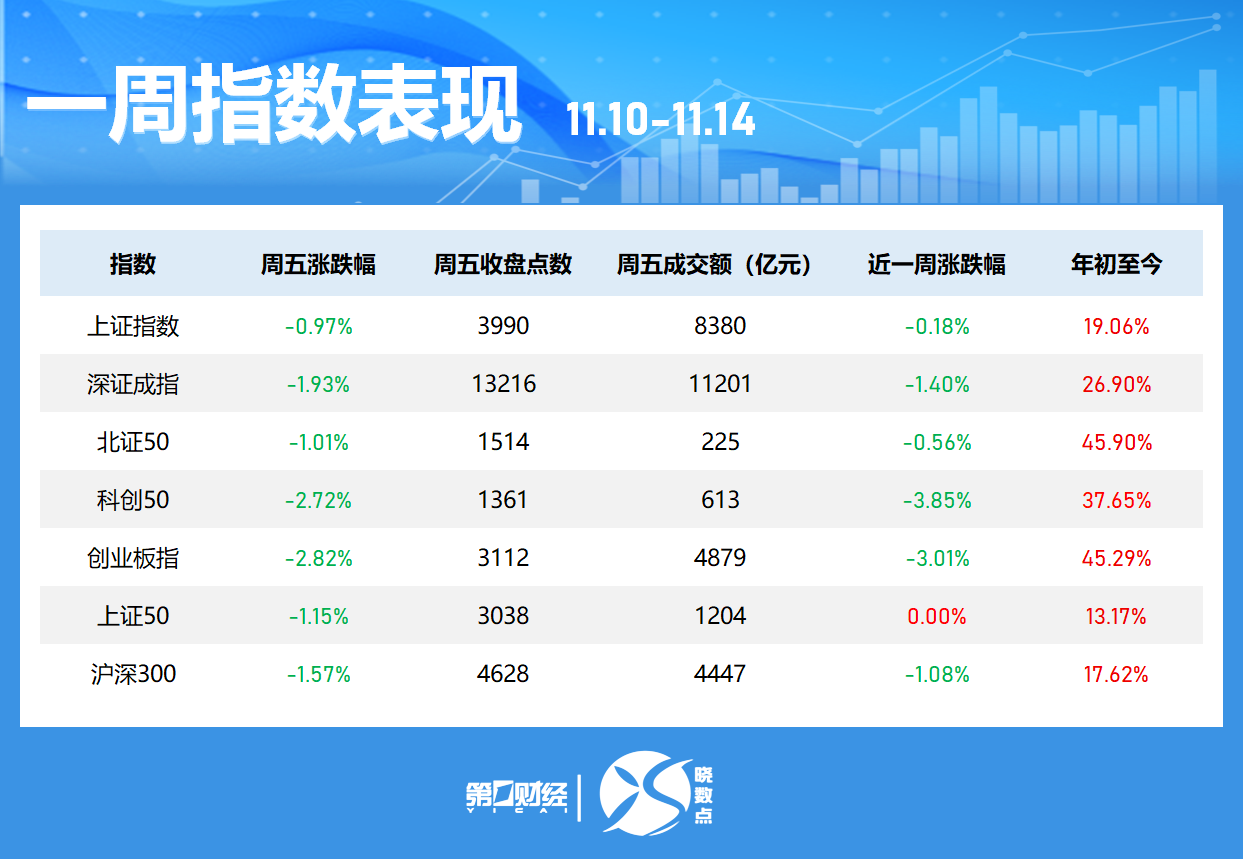
多图速览>> 本周(11月10日至14日)五个交易日内,三大指数均下跌,沪指跌0.18%,深成指跌1.40%,创业板指跌3.01%。 | 指数 | 周五涨跌幅 | 周五收盘点数 | 周五成交额 (亿元) | 近一周涨跌幅 | स्टः | | --- | --- | --- | --- | --- | --- | | 上证指数 | -0.97% | 3990 | 8380 | -0.18% | TK | | 深证成指 | -1.93% | 13216 | 11201 | -1.40% | 2 | | 北证50 | -1.01% | 1514 | 225 | -0.56% | | | 科创50 | -2.72% | 1361 | 613 | -3.85% | | | 创业板指 | -2.82% | 3112 | 4879 | -3.01% | 4 | | 上证50 | -1.15% | 3038 | 1204 | 0.00% | 11 | | 沪深300 | -1.57% | 4628 | 4447 | -1.08% | 1 | Wind数据显示,本周(11月10日至11月14日)共有18只个股涨幅超40%,1 ...