
建筑

Search documents
山东出台13条针对性措施推动建筑业高质量发展
Da Zhong Ri Bao· 2025-09-07 01:00
Core Viewpoint - Shandong Province has introduced a comprehensive set of 13 targeted measures to promote high-quality development in the construction industry, aiming to stabilize the economy and enhance market vitality [2][3]. Group 1: Support for Private Enterprises - The construction industry in Shandong is significantly supported by private enterprises, which contributed 73% of employment and 59% of output value in the first half of the year [3]. - The government aims to create a fair competitive environment for private construction companies by breaking down market barriers and enhancing service quality [3][4]. - A qualification pre-selection mechanism will ensure that at least 40% of private enterprises or joint ventures are included in the bidding for state-funded projects [4][5]. Group 2: Financial Support and Payment Issues - The construction industry faces challenges such as slow payment and high financing costs, which hinder healthy development [6]. - Measures will be implemented to streamline payment processes and ensure timely settlement of accounts, including the promotion of undisputed price settlement [6][7]. - Financial resources will be increased for quality projects, particularly for private enterprises, through new loans, optimized interest rates, and supply chain financial products [6][7]. Group 3: Brand Promotion and Evaluation - The province will enhance the promotion of the "Qilu Construction" brand and recognize leading cities, counties, and enterprises in the construction industry [8]. - The evaluation process for leading regions and enterprises will consider various indicators, including development scale and government support, to stimulate growth in the construction sector [8][9]. - Continuous support will be provided to both leading and emerging enterprises to maintain the construction industry's status as a pillar of the provincial economy [9].
阿联酋与安哥拉签署全面经济伙伴关系协定
Shang Wu Bu Wang Zhan· 2025-09-06 17:51
Core Insights - The comprehensive economic partnership agreement (CEPA) between the UAE and Angola aims to enhance economic cooperation and expand ties with emerging markets in Africa [1] - The bilateral non-oil trade between the UAE and Angola is projected to reach $2.17 billion in 2024, reflecting a year-on-year growth of 2.6%, and has already reached $1.4 billion in the first half of 2025, marking a significant increase of 29.7% [1] - The agreement is a crucial step towards achieving the UAE's goal of a total foreign trade volume of 4 trillion dirhams by 2031, with expectations that non-oil trade will exceed $10 billion by 2033, contributing approximately $1 billion to each country's GDP and creating around 30,000 jobs [1] Trade and Economic Impact - Angola primarily exports diamonds and gold to the UAE, while the UAE's exports include light oil fractions, steel, machinery, and consumer goods [1] - The agreement will also enhance cooperation in various service sectors, including logistics, construction, healthcare, education, finance, and tourism [2] Implementation and Benefits - The agreement will take effect immediately after the approval process is completed, with benefits such as tariff reductions, simplified procedures, and improved market access expected to manifest quickly [3]
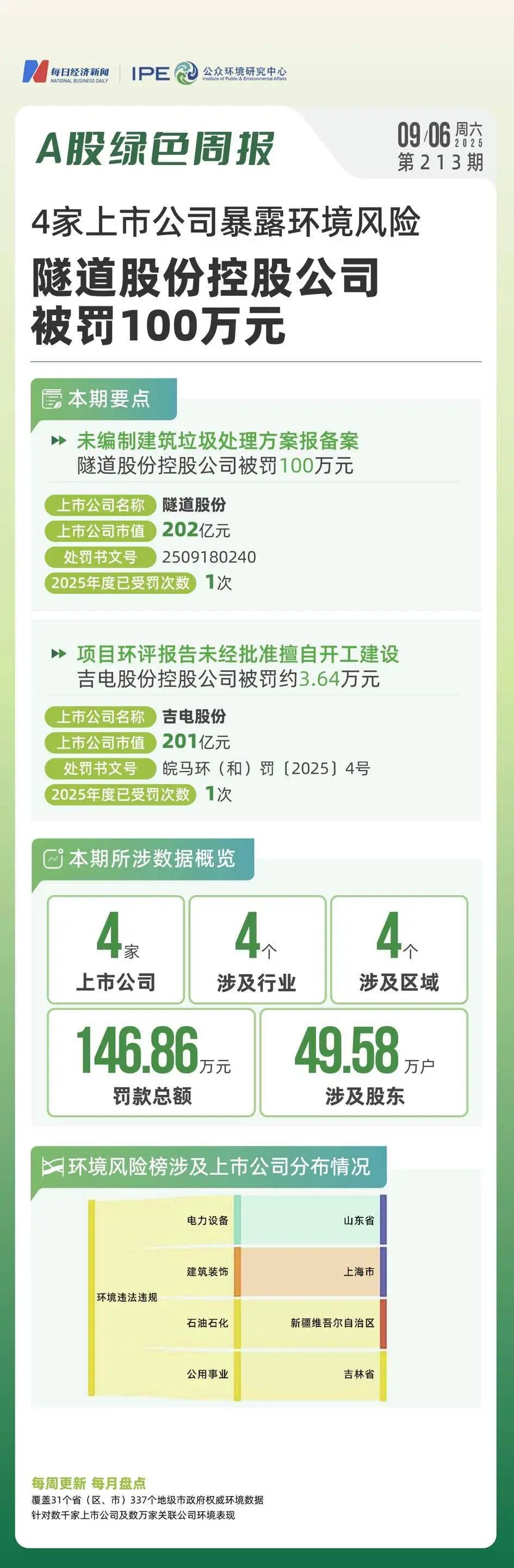
4家上市公司暴露环境风险 隧道股份控股公司被罚100万元
Mei Ri Jing Ji Xin Wen· 2025-09-06 14:39
Core Points - Four listed companies have recently exposed environmental risks, highlighting the increasing importance of environmental responsibility in corporate governance [10][11][13] - The report is part of the A-share Green Weekly, which analyzes environmental information from thousands of listed companies based on data from various government sources [9][18] Company Summaries - Tunnel Holdings Co., Ltd. was fined 1 million yuan for failing to prepare a construction waste disposal plan for filing [4][9] - Jidian Co., Ltd. was fined approximately 36,400 yuan for starting construction without an approved environmental impact assessment report [16][17] - Shida Shenghua Co., Ltd. was penalized for not providing self-monitoring reports for emissions during the first five months of 2025, resulting in a fine of 36,200 yuan [15] - The environmental violations of these companies may pose investment risks for their 495,800 shareholders [14]


纪念抗战胜利80周年丨继往开来谱写复兴伟业新华章——习近平总书记在纪念中国人民抗日战争暨世界反法西斯战争胜利80周年大会上的重要讲话激励中管企业、中管金融企业和中管高校干部职工踔厉奋发共创未来
Xin Hua She· 2025-09-06 10:11
Group 1 - The speech by General Secretary Xi Jinping at the 80th anniversary of the victory in the Chinese People's Anti-Japanese War and the World Anti-Fascist War has inspired strong reactions among employees of state-owned enterprises, financial institutions, and universities, emphasizing unity and the spirit of the great anti-war struggle [1][4][7] - The China Bank has seen an increase in its internationalization, being recognized as a globally significant bank for 14 consecutive years, reflecting China's deep integration into the world economy [3] - The China Life Insurance Company has been focusing on reform and innovation, managing pension assets exceeding 2 trillion yuan, and aims to enhance financial services to meet the growing needs of the people [8] Group 2 - The speech highlighted the importance of historical memory and its role in guiding future actions, with various sectors expressing commitment to contribute to national development and modernization [6][9] - The agricultural sector is also responding positively, with professionals pledging to uphold the spirit of the anti-war struggle and contribute to rural revitalization and the real economy [6][8] - The education sector is actively engaging in instilling a sense of national pride and responsibility among students, preparing them to take on the mission of national rejuvenation [4][8]
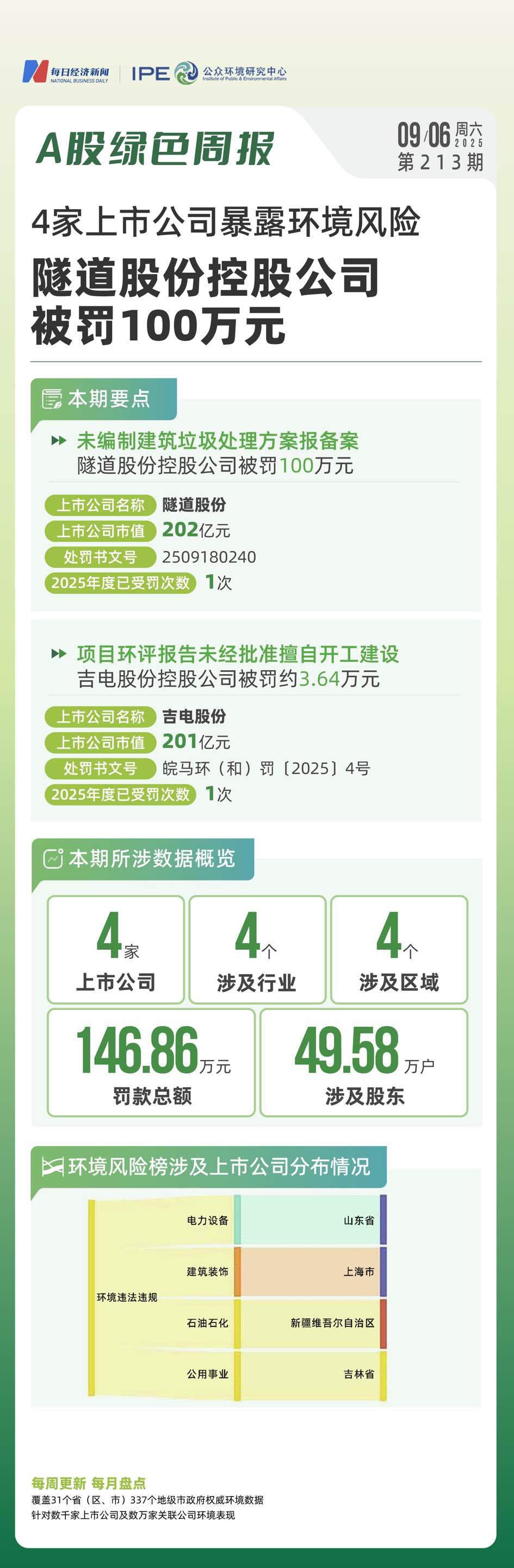
A股绿色周报丨4家上市公司暴露环境风险 隧道股份控股公司被罚100万元
Mei Ri Jing Ji Xin Wen· 2025-09-06 08:55
Core Viewpoint - Four listed companies in A-shares have recently exposed environmental risks, highlighting the increasing importance of environmental responsibility in corporate operations [7][10]. Group 1: Environmental Violations and Penalties - Tunnel Holdings Co., Ltd. was fined 1 million yuan for failing to prepare a construction waste disposal plan for filing [7][11]. - Jidian Co., Ltd. was fined approximately 36,400 yuan for starting construction without an approved environmental impact assessment report [4][13]. - The penalties reflect a growing trend of regulatory scrutiny on environmental compliance among listed companies [8][10]. Group 2: Company Details and Financial Impact - Tunnel Holdings has a market capitalization of 20.2 billion yuan [3]. - Jidian Co., Ltd. has a market capitalization of 2.017 billion yuan [4]. - The environmental risks associated with these companies may affect approximately 495,800 shareholders, potentially leading to investment risks [11]. Group 3: Regulatory Context and Trends - The report emphasizes the increasing focus on ESG (Environmental, Social, and Governance) investment principles, which are becoming crucial for investors assessing corporate sustainability [15]. - The legal framework for environmental information disclosure has been strengthened, promoting transparency and public participation in environmental protection [15].
2025年二季度蒙古农林牧渔业就业人数同比增长2.5%
Shang Wu Bu Wang Zhan· 2025-09-05 17:34
Group 1 - The employment in Mongolia's agriculture, forestry, animal husbandry, and fishery sector reached approximately 366,000 in Q2 2025, accounting for 26.3% of the total labor force, with a year-on-year growth of 2.5% [1] - The manufacturing, construction, crafts, and related jobs employed around 160,000 people, representing 11.5% of the workforce [1] - The service trade industry had approximately 187,000 employees, making up 13.4% of the total labor force [1] Group 2 - The number of machinery equipment operators and assembly workers was about 141,000, which is 10.2% of the total employment [1] - Professional technical personnel numbered around 232,000, accounting for 16.7% of the workforce [1] - Individual and ordinary workers totaled approximately 122,000, representing 8.8% of the labor force [1] Group 3 - The management sector employed about 92,000 individuals, which is 6.6% of the total workforce [1] - Other industries accounted for approximately 90,000 employees, making up 6.5% of the labor force [1]
加纳启动技能培训项目
Shang Wu Bu Wang Zhan· 2025-09-05 17:28
Core Insights - Ghana has launched a comprehensive apprenticeship program aimed at assisting 1.2 million young people who are unemployed or working in unstable informal jobs [1] - Approximately 70% of young people in Ghana are employed in the informal sector, lacking job security and clear advancement opportunities [1] - The official unemployment rate for youth aged 15 to 24 is 5.4%, but when considering unstable informal employment, the unemployment rate rises to 38.8% [1] Program Details - The national apprenticeship program aims to provide skills training to 10,000 beneficiaries aged 15 to 25, aligning with the demands of the modern labor market [1] - Training will cover key economic sectors such as agriculture and agro-processing, information technology, renewable energy, hospitality, fashion, beauty, construction, traditional crafts, and creative industries [1] - The focus areas of the program are aligned with sectors that Ghana identifies as having growth potential and the ability to create job opportunities [1]
文莱央行:今年经济有望温和复苏
Shang Wu Bu Wang Zhan· 2025-09-05 17:28
Economic Outlook - The Brunei economy is expected to maintain moderate growth in 2025 despite facing dual challenges from international and domestic factors [1] - In the first quarter of this year, Brunei's GDP contracted by 1.8%, with the oil and gas sector declining by 1.5% and the non-oil sector by 2.0% [1] - Economic recovery is anticipated due to the gradual restoration of oil and gas production, along with the expansion of sectors such as construction, tourism, trade, and information and communication technology [1] Investment and Growth Drivers - Ongoing foreign direct investment projects, particularly in the petrochemical, halal food, and manufacturing sectors, are expected to contribute to economic growth [1] Inflation and Monetary Policy - The average inflation rate for the first half of the year was -0.4%, influenced by government subsidies, price controls, and a global easing of inflation [1] - The central bank's latest forecast for the annual inflation rate ranges from -0.6% to 0.4% [1] Financial System Stability - The financial system remains robust, with total industry assets growing by 1.3% to reach 24.6 billion Brunei dollars by the end of the second quarter [1] - Islamic financial assets account for 14.6 billion Brunei dollars, while traditional financial assets total 10 billion Brunei dollars [1] - The banking capital adequacy ratio stands at a healthy 19.6% [1] Regulatory Developments - The central bank has recently revised the minimum cash reserve requirements and introduced a liquidity coverage ratio standard [1] - Traditional banks are encouraged to establish Islamic finance windows to promote financial inclusivity [1] - To foster digital finance development, the central bank has approved the launch of the "tarus" digital payment system and mandated the use of standardized QR codes for all transactions [1]
9月5日上市公司晚间重要公告一览-股票-金融界
Jin Rong Jie· 2025-09-05 12:33
Major Events - Kweichow Moutai's controlling shareholder obtained a loan of 2.7 billion yuan to increase holdings [1] - SMIC is actively promoting the purchase of 49% equity in SMIC North, but the transaction plan is still under discussion [1] - Guokai Microelectronics is advancing the issuance of shares and cash payment for asset acquisition and fundraising [1] - Aerospace Hongtu signed a strategic cooperation agreement with Pakistan, but the formal contract signing remains uncertain [1] - Sinopec announced a cash dividend of 0.088 yuan per share (before tax) for A-shares [1] - Hikvision's chairman proposed a mid-2025 dividend plan of 4 yuan for every 10 shares [1] - Anzheng Fashion reported no undisclosed major events [1] - China State Construction is acquiring equity in a Shanghai real estate project for approximately 15.478 billion yuan [1] - Guokai Co., Ltd. changed its stock name to Guokai Electronics [1] - Kailuan Co. completed the change in the equity structure of China Cinda [1] - Unification Co. completed the change in the equity structure of its controlling shareholder [1] - ST Xin Dongli's stock may face delisting risk warning [1] - Jinlang Technology reported normal recent operations with no significant changes in the internal and external environment [1] - Sungrow Power Supply confirmed normal operations with no undisclosed major events [1] - Tiantong Co. reported normal production and operations with no significant changes [1] - Keyuan Pharmaceutical received a decision letter on the anti-monopoly review without further examination [1] - Zhizheng Co. was approved to issue shares for asset acquisition and fundraising [1] - Amlogic plans to issue H-shares and list on the Hong Kong Stock Exchange [1] - Digital Certification's controlling shareholder changed to Beijing Data Group [1] - ST Songfa signed a contract for two 30.6 million-ton ultra-large crude oil tankers with Hengli Shipbuilding [1] - Guangqi Technology signed a contract worth 1.278 billion yuan for the mass production of metamaterials [1] - Hongrun Construction won a bid for the Ningbo Ring City South Road East Extension Phase I project with a bid price of 388 million yuan [1] Performance - Muyuan Foods reported sales revenue of 11.85 billion yuan from live pigs in August, a year-on-year decrease of 12.30% [1] - Ankai Bus's cumulative production increased by 68.06% this year [1] - Shuguang Co. reported a 45.58% increase in axle sales in August [1] - Jinxinnong reported sales revenue of 121 million yuan from live pigs in August [1] Buyback - Yingke Medical adjusted the upper limit of its share repurchase price from 26.51 yuan per share to 41.88 yuan per share [2]




9.5犀牛财经晚报:多家券商保证金产品短暂下调管理费率 华夏银行被罚8725万元
Xi Niu Cai Jing· 2025-09-05 10:32
Group 1 - Several brokerage firms have recently adjusted management fees for margin products in response to declining yields, with Shenyin Wanguo Asset Management announcing a management fee adjustment to 0.30% for its money market fund starting September 2 [1] - The adjustment of management fees is closely related to the decline in yields, as many asset management contracts stipulate that fees will be adjusted if the calculated yield falls below twice the current deposit rate [1] - Brokerage margin products are favored for their liquidity services, including T+0 real-time redemption and unlimited withdrawals, which enhance their competitive edge in the market [1] Group 2 - The domestic silicon wafer production plan for September has been raised for the first time, with an overall output increase compared to August, as many silicon wafer companies raise their operating rates due to price increases [2] - The global battery cell production is expected to reach approximately 60GW in September, a 2.3% increase from August, with domestic production also showing a similar increase [2] - The semiconductor industry is experiencing a structural recovery, with the analog chip sector seeing a significant rebound in profitability, with a nearly fourfold increase in net profit in the second quarter compared to the previous quarter [2] Group 3 - A new study has identified a weak point in certain blood cancers that can be targeted by drugs, potentially allowing for the selective elimination of cancer cells without harming healthy cells [3] - The research emphasizes the urgent need for new drugs with fewer side effects and stronger targeting capabilities, particularly for conditions like myelodysplastic syndromes [3] Group 4 - Deep Insight Technology announced that its subsidiary has received regulatory approval for a mobile MRI system, making it the first company in China to master and register this core technology [4] - The latest version of the Kimi K2 model has been released, extending the context length to 256K and supporting high output speeds [4] Group 5 - Alibaba and other shareholders have exited Yuanrong Qihang, with the company stating that this is part of its restructuring process [5] - White Elephant's e-commerce subsidiary has been fined for false advertising, highlighting regulatory scrutiny in the sector [5] Group 6 - Zhongshan Securities' Hefei branch has been ordered to rectify its operations due to violations related to investor solicitation activities [6] - Huaxia Bank has been fined 87.25 million yuan for imprudent management of loans and related business [7] Group 7 - Hangzhou Bank's approval for a shareholding change has been revoked due to failure to complete the change within the stipulated time [8] - Yunnan Energy Investment's subsidiary has received a subsidy of 309 million yuan for renewable energy, contributing to its total subsidies of 591 million yuan for the fiscal year [15] Group 8 - The market saw a significant increase in the ChiNext index, with a rise of 6.55%, driven by strong performance in the solid-state battery sector [17] - The overall market showed a positive trend with over 4,800 stocks rising, while only a small number of stocks declined [17]
