数据中心

Search documents
详解美国数据中心狂潮:45GW,2.5万亿美元投资,谁在建设,谁在掏钱?
Hua Er Jie Jian Wen· 2025-11-02 10:45
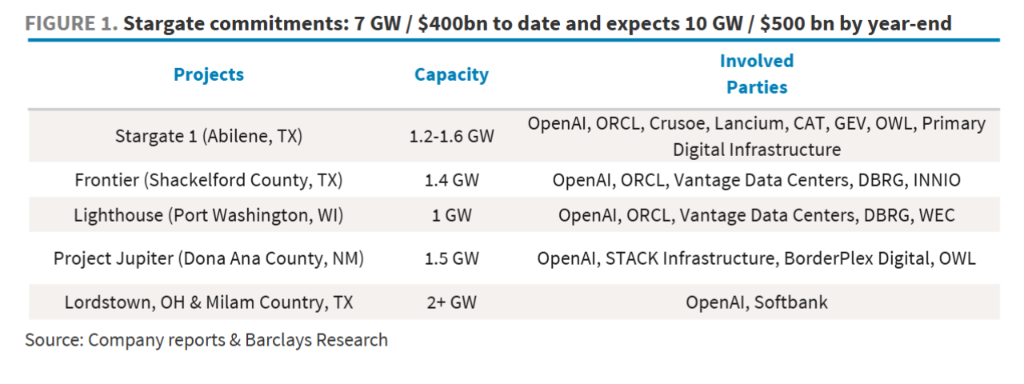
Core Insights - A significant infrastructure race driven by artificial intelligence is unfolding in the United States, with planned large data center projects exceeding 45 GW and attracting over $2.5 trillion in investments [1][2] Group 1: Major Players and Projects - The primary drivers of this expansion include OpenAI's Stargate project, Amazon, Meta, Microsoft, and Elon Musk's xAI, all of which are rapidly planning and constructing computing clusters to support increasingly complex AI models [1][2] - Key projects include Stargate 1 (1.2-1.6 GW), Frontier (1.4 GW), Lighthouse (1 GW), Project Jupiter (1.5 GW), and a combined capacity of over 2 GW in Lordstown, OH, and Milam County, TX, with significant involvement from OpenAI and various partners [3][5] Group 2: Financial Aspects - The construction cost for data centers has surpassed $1.7 million per MW, with OpenAI's Stargate project alone representing a commitment of over $400 billion for a 7 GW capacity, translating to approximately $5.7 million per MW [3][5] - Financing structures are complex, with private equity firms and infrastructure funds playing crucial roles, such as Blue Owl Capital's $15 billion joint venture with Crusoe for the Stargate 1 project [7] Group 3: Power Supply Challenges - The existing power grid poses significant challenges, leading companies to adopt "Bring-Your-Own-Power" strategies, including on-site power generation to ensure reliability and expedite energization timelines [1][4] - For instance, the Stargate 1 project plans to deploy approximately 350 MW of on-site natural gas generation despite having grid access approved for 1.2 GW [4] Group 4: Supply Chain Issues - The explosive demand for power generation equipment has strained supply chains, with heavy gas turbine prices increasing by 50% in less than two years and extended delivery times [8] - Companies are resorting to acquiring second-hand or "off-the-shelf" new equipment to mitigate long order queues, exemplified by Fermi America's acquisition of a Siemens gas turbine from an unused LNG project [8]





润泽科技(300442):REITs收益大幅增厚利润,资产规模快速扩张
Changjiang Securities· 2025-11-02 09:43
Investment Rating - The investment rating for the company is "Buy" and is maintained [9]. Core Insights - In Q3 2025, the company's revenue performance met expectations, with a significant increase in net profit primarily due to substantial investment income from REITs issuance. The company achieved a revenue of 39.8 billion yuan, a year-on-year increase of 15.0%, and a net profit of 47.0 billion yuan, a year-on-year increase of 210.7% [6][12]. - The gross margin decreased quarter-on-quarter, likely due to the increased proportion of leasing business, while the fixed asset scale expanded rapidly driven by the development of leasing business and IDC scale delivery [2][12]. - The successful issuance and listing of public REITs allowed the company to effectively revitalize its existing assets and establish a light-asset operation platform [2][12]. - The company has rich experience in liquid cooling delivery and a leading strategic layout, which positions it to benefit continuously amid the AI arms race among domestic cloud vendors [2][12]. Summary by Sections Revenue and Profitability - For the first three quarters of 2025, the company achieved a total revenue of 39.8 billion yuan, up 15.0% year-on-year, and a net profit of 47.0 billion yuan, up 210.7% year-on-year. The net profit for Q3 alone reached 38.2 billion yuan, reflecting a year-on-year increase of 598.4% [6][12]. - The investment income for Q3 was 37.6 billion yuan, mainly from the transfer of a wholly-owned subsidiary to the Southern Runze Technology Data Center REIT, resulting in significant equity disposal gains [12]. Asset Management and REITs - The company successfully issued a public REIT on August 8, raising 4.5 billion yuan, which activated quality existing assets and optimized the capital structure [12]. - The REIT platform supports a full-cycle capital operation system, enhancing the company's sustainable operational capabilities [12]. Strategic Developments - The company has been proactive in deploying liquid cooling technology, having collaborated with clients since early 2021. It has delivered the industry's first large-scale liquid-cooled intelligent computing center, establishing a strong trust foundation with clients [12]. - The company is currently advancing the construction of a 200MW intelligent computing center project in Langfang, designed to liquid cooling standards, which is expected to respond quickly to large-scale liquid cooling demand [12].

润泽科技(300442):REITS项目发行增厚股权处置收益
Xin Lang Cai Jing· 2025-11-02 00:41
Core Viewpoint - The company reported significant growth in revenue and net profit for the first three quarters of 2025, driven by the issuance of public REITS projects and increased demand for intelligent computing resources in the AIGC wave [1][4]. Group 1: Financial Performance - For the first nine months of 2025, the company's revenue increased by 15.05% year-on-year to 3.977 billion yuan, while net profit attributable to shareholders surged by 210.74% to 4.704 billion yuan [1]. - In the third quarter of 2025, revenue rose by 14.61% year-on-year to 1.481 billion yuan, and net profit increased by 598.4% to 3.822 billion yuan, primarily due to the recognition of equity disposal gains of 3.759 billion yuan [1][3]. - The company's gross margin for the first nine months of 2025 was 48.11%, a decrease of 8.87 percentage points year-on-year, while the gross margin for the third quarter was 45.95%, down 10.85 percentage points year-on-year [2]. Group 2: Strategic Positioning - The company is a leading player in the domestic data center industry, strategically establishing large-scale computing centers in key regions such as Beijing-Tianjin-Hebei, Yangtze River Delta, and Greater Bay Area [2]. - The company has been recognized as an industry leader at the "2025 Global Digital Economy Conference" held in July 2025, highlighting its competitive edge in scarce cabinet resources amid stricter land and energy consumption regulations [2]. Group 3: Future Outlook - The company anticipates continued growth in demand for intelligent computing related to AIGC, which will benefit its IDC and AIDC businesses [4]. - The issuance of REITS projects is expected to enhance investment returns, leading to an upward revision of profit forecasts for 2025, with projected net profits of 5.300 billion yuan for 2025 [4]. - The company is assigned a target price of 66.28 yuan per share based on a 24 times EV/EBITDA valuation for 2026, reflecting the strong demand for AI applications and the scarcity of its core computing center resources [4].
数据港(603881):整体业绩表现稳健 践行绿色低碳发展路径
Xin Lang Cai Jing· 2025-11-01 08:35
Core Viewpoint - As the business demands from end customers gradually increase, the data center cabinets that have been put into operation are being powered on, further driving the company's steady growth in performance [1][5] Financial Performance - In the first three quarters of 2025, the company achieved operating revenue of 1.241 billion yuan, a year-on-year increase of 4.93%; net profit attributable to the parent company was 120 million yuan, up 14.05%; and net profit excluding non-recurring items was 99 million yuan, an increase of 7.09% [2][3] - In the third quarter of 2025, the company reported operating revenue of 430 million yuan, a year-on-year increase of 6.49%; net profit attributable to the parent company was 35 million yuan, up 1.13%; and net profit excluding non-recurring items was 29 million yuan, an increase of 0.97% [2] Operational Progress - The Langfang project is progressing as planned, with the external power supply and civil construction completed and solidified as of June 2025, while the remaining mechanical and electrical parts are under construction, with good contract execution, which will further strengthen the company's computing power supply capacity in core areas [4][5] - The Guangdong Heyuan data center has been included in the "2025 National Green Data Center List," showcasing the company's leading position in the construction and operation of green data centers [4] Investment Outlook - With the continuous promotion of Digital China and the explosive demand for intelligent computing driven by AI, the company is expected to benefit in the long term [5] - The company forecasts net profits attributable to the parent company for 2025-2027 to be 174 million yuan, 198 million yuan, and 239 million yuan, corresponding to current market valuations of 137 times, 120 times, and 100 times PE, respectively, maintaining a "buy" rating [5]

谷歌百亿美元砸向印度 围绕“数据中心”的AI投资洪流席卷印度股市
Zhi Tong Cai Jing· 2025-11-01 07:37
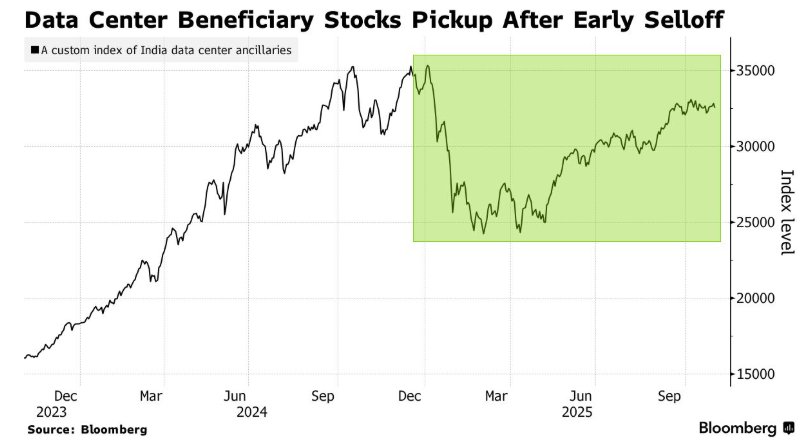
Group 1: AI Infrastructure Investment in India - Major US tech companies, including Google, Microsoft, and OpenAI, are committing over $10 billion to build AI infrastructure in India, attracting investor interest in local companies linked to data center construction [1][5] - The investment in AI infrastructure is expected to drive the development of auxiliary businesses related to data centers, including core power equipment manufacturers and large power generation companies, with the Indian data center market projected to exceed $100 billion by 2027 [1][2] Group 2: Investment Opportunities in Indian Stock Market - The creation of an AI ecosystem in India offers significant investment opportunities in the $5.4 trillion Indian stock market, which has lagged behind global markets due to a lack of pure AI hardware companies [2] - Investors are shifting focus to local data center auxiliary companies, which are expected to benefit substantially from the infrastructure development for AI data centers, making it one of the hottest equity trades globally [2] Group 3: Key Players and Their Investments - Google plans to invest approximately $15 billion in AI infrastructure in southern India, while Microsoft has announced an initial investment of around $3 billion to expand its cloud computing and AI capabilities [5] - AdaniConneX, a joint venture involving Adani Enterprises and Bharti Airtel, is collaborating with Google on a large AI project, while Reliance Industries is expected to invest up to $15 billion in a one-gigawatt AI data center [6] Group 4: Electrical and Core Power Equipment - A significant portion of capital expenditure related to AI data centers is expected to flow into electrical and core power equipment, including manufacturers of core switchgear, transformers, and distribution systems [8] - Notable Indian stocks in this sector include Hitachi Energy India Ltd., Siemens Ltd., Schneider Electric Infrastructure Ltd., and ABB India Ltd., with the power and related costs accounting for about 40% of data center capital expenditure [8] Group 5: Liquid Cooling Solutions - The high energy consumption of AI workloads generates substantial heat, necessitating advanced liquid cooling systems, with Blue Star Ltd. and Voltas Ltd. being major local providers of such solutions [9] Group 6: Servers and Cloud Infrastructure - Large-scale AI data centers require extensive physical computing infrastructure, with Netweb Technologies India Ltd. recognized as a key player in servers, storage, and AI supercomputing solutions [10] - E2E Networks Ltd. focuses on providing cloud-based AI computing infrastructure and high-performance computing solutions [10]
润泽科技下“笨功夫”角逐算力赛道
Zheng Quan Ri Bao· 2025-10-31 16:17
Core Insights - The essence of the competition in computing power has evolved beyond just chips and servers to a deeper contest of technological foundation and operational capabilities [1] - Runze Technology has made significant strides in the AI computing power sector by focusing on technological innovation, green low-carbon initiatives, and talent strategies [1][2] Group 1: Company Overview - Runze Technology was founded in 2009, recognizing the impending demand for data storage due to the internet explosion, and strategically located in Langfang to serve major internet companies while reducing operational costs by over 20% compared to Beijing [2] - The company’s flagship project, Runze International Information Port, covers an area of 2.62 million square meters with a total investment of 9.8 billion yuan, equivalent to two Chicago data centers [2] - Runze Technology transitioned from traditional data centers to intelligent computing infrastructure, achieving a significant milestone with its listing on the ChiNext board in 2022 [2][3] Group 2: Financial Performance - In 2023, Runze Technology reported a revenue of 4.351 billion yuan, a year-on-year increase of 60.27%, with a net profit of 1.762 billion yuan [3] - For 2024, the company expects stable operations with projected revenue of 4.365 billion yuan and a net profit of 1.79 billion yuan [3] - In the first three quarters of 2025, revenue reached 3.977 billion yuan, reflecting a year-on-year growth of 15.05%, while net profit surged to 4.704 billion yuan, a remarkable increase of 210.74% [3] Group 3: Business Segments - Runze Technology operates two main business segments: Internet Data Centers (IDC) and Artificial Intelligence Data Centers (AIDC), with AIDC being the core growth driver [3] - The company has established seven AIDC computing power clusters across key regions, planning for 320,000 cabinets to create an integrated computing center system [3] Group 4: Talent Development - The company has built a highly specialized operational team of over 1,000 members, adhering to international standards such as ITIL and Uptime, to provide reliable operational services [4] - Runze Technology has implemented a performance-based compensation system and established a dual career path for technical personnel, promoting innovation and talent retention [5] Group 5: Technological Innovation - To address the dual challenges of computing power escalation and green transformation, Runze Technology focuses on technological advancements, including the development of liquid cooling technology to enhance cooling efficiency and reduce energy consumption [6] - The company’s intelligent low-carbon cooling system has achieved a Power Usage Effectiveness (PUE) of 1.15, positioning it as an industry leader [6] Group 6: Future Projects - The Runze Artificial Intelligence Application Center project is in its final stages, expected to be operational by the end of 2025, capable of supporting over 100,000 computing clusters for complex AI model training [7] - This project aims to become a national-scale intelligent computing center, providing comprehensive support for various AI technologies [7]
奥飞数据(300738):毛利率持续提升,固定资产快速扩张
Changjiang Securities· 2025-10-31 14:41
Investment Rating - The investment rating for the company is "Buy" and is maintained [8]. Core Insights - The company's performance in Q3 2025 met expectations, with revenue and profit showing significant growth both year-on-year and quarter-on-quarter. Revenue for the first three quarters reached 1.82 billion yuan, a year-on-year increase of 15.3%, while net profit attributable to shareholders was 145 million yuan, up 37.3% year-on-year [6][13]. - The gross margin for Q3 2025 improved to 37.55%, benefiting from a rapid increase in the delivery project's launch rate. The company is experiencing a significant expansion in fixed assets, with a total fixed asset scale reaching 9.442 billion yuan by the end of Q3 2025, an increase of 1.561 billion yuan from Q2 2025 and 3.161 billion yuan from the end of 2024 [2][13]. - The company is capitalizing on the current AI demand surge, focusing on "ensuring delivery and promoting launches," with new project construction and delivery expected to be core growth drivers in the future [2][13]. Summary by Sections Financial Performance - In Q3 2025, the company achieved revenue of 676 million yuan, a year-on-year increase of 29.9% and a quarter-on-quarter increase of 10.4%. The net profit for Q3 was 58 million yuan, reflecting a year-on-year growth of 90.4% and a quarter-on-quarter growth of 59.2% [6][13]. - The gross margin for Q3 2025 saw a significant year-on-year increase of 8.76 percentage points and a quarter-on-quarter increase of 2.38 percentage points [13]. Asset Expansion - The company is in a major delivery year for its IDC projects, with the current delivery pace aligning with initial plans. The company has delivered parts of data centers in Langfang, Tianjin, and Baoding [2][13]. - The operational scale is expanding, with ongoing construction of the Hebei Huailai data center project, which is set to become a large data center with 15,000 cabinets [13]. Future Outlook - The company expects net profits for 2025-2027 to be 223 million yuan, 383 million yuan, and 533 million yuan, respectively, with corresponding year-on-year growth rates of 79%, 72%, and 39% [13].

奥飞数据(300738):业绩超预期,重视公司可持续交付势能
Shenwan Hongyuan Securities· 2025-10-31 13:18
Investment Rating - The report maintains a "Buy" rating for the company, indicating a strong performance relative to the market [5]. Core Insights - The company reported better-than-expected performance for the first three quarters of 2025, with total revenue reaching 1.824 billion yuan, a year-on-year increase of 15.3%, and a net profit attributable to shareholders of 145 million yuan, up 37.3% year-on-year [5]. - The growth in revenue and net profit is attributed to timely data center deliveries and the transition of computing power services to more stable leasing contracts, leading to steady expansion [5]. - The company's gross margin improved significantly, reaching 35% for the first three quarters of 2025, a year-on-year increase of 9.4 percentage points, with a gross margin of 37.6% in Q3 2025, reflecting strong operational performance and high utilization rates of new delivery assets [5]. - The balance sheet indicates strong long-term delivery potential for data centers, with new fixed assets of 3.161 billion yuan added in the first three quarters of 2025, laying a foundation for future revenue [5]. - The company is positioned well in the market, with key assets in regions like South China and North China, benefiting from a favorable supply-demand balance and strong relationships with major clients [5]. Financial Data and Earnings Forecast - Total revenue projections for 2025 are estimated at 2.512 billion yuan, with a year-on-year growth rate of 16.0% [4]. - The net profit attributable to shareholders is forecasted to be 208 million yuan for 2025, reflecting a significant year-on-year increase of 67.6% [4]. - The EBITDA for 2025 is expected to be approximately 12.62 billion yuan, indicating a strong operational quality and cash generation capability [5]. - The report outlines a consistent growth trajectory for the company, with projected net profits of 2.08 billion yuan, 3.22 billion yuan, and 4.12 billion yuan for 2025, 2026, and 2027 respectively [5].
奥飞数据(300738):业绩超预期 重视公司可持续交付势能
Xin Lang Cai Jing· 2025-10-31 12:48
Core Insights - The company reported better-than-expected performance for Q3 2025, with revenue of 1.824 billion and a year-on-year growth of 15.3% [1] - The net profit attributable to shareholders reached 145 million, reflecting a year-on-year increase of 37.3% [1] - In Q3 2025 alone, the company achieved revenue of 676 million, a year-on-year growth of 29.9% and a quarter-on-quarter increase of 10.4% [1] - The net profit for Q3 2025 was 58 million, showing a remarkable year-on-year growth of 90.4% and a quarter-on-quarter growth of 59.2% [1] Revenue and Profit Growth - The revenue and net profit growth were primarily driven by timely data center deliveries and the transition of computing power services to more certain leasing contracts, allowing for steady expansion [1] - The gross margin for the first three quarters of 2025 was 35%, an increase of 9.4 percentage points year-on-year, while Q3 2025 gross margin reached 37.6%, up 2.4 percentage points quarter-on-quarter [1] - The EBITDA for the first three quarters of 2025 is estimated at approximately 944 million, indicating a continuous improvement in operational quality and cash generation capability [1] Asset and Infrastructure Development - The balance sheet reflects strong mid-to-long-term delivery potential for data centers, with 3.161 billion in new fixed assets added in the first three quarters of 2025, laying the foundation for current and future revenue [2] - As of Q3 2025, construction in progress reached 1.782 billion, indicating ongoing data center deliveries and rolling development of mid-to-long-term resource reserves [2] - The company holds scarce assets in key regions, with strong operational performance driven by both stock optimization and new growth in South China, as well as strategic assets in North China [2] Market Position and Future Outlook - The company is expected to benefit from the scarcity of existing resources and the transition to intelligent computing, with close ties to major clients like Baidu [2] - The company maintains its previous profit forecasts for 2025-2027, projecting net profits of 208 million, 322 million, and 412 million for those years, respectively [2] - The current stock price corresponds to an EV/EBITDA of 21, 16, and 13 times for 2025, 2026, and 2027, respectively, maintaining a "buy" rating [2]
AI基建狂潮,根本停不下来!
Zhi Tong Cai Jing· 2025-10-31 11:32
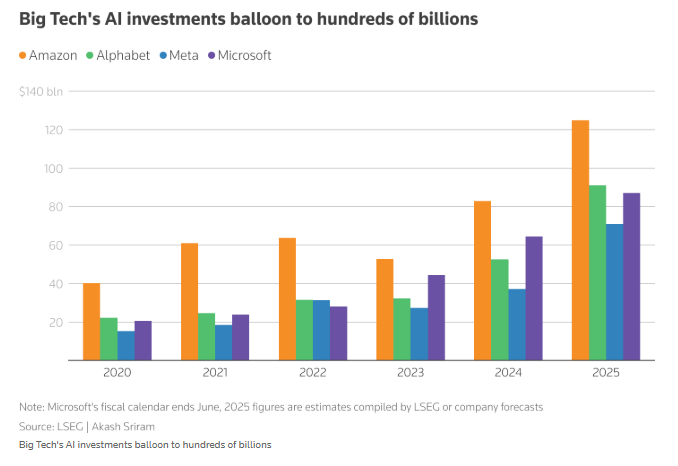
微软、谷歌(GOOGL.US)等科技巨头营收的飙升,本在市场预期之内。但本周,包括霍尼韦尔 (HON.US)、涡轮机制造商GE Vernova(GEV.US)以及重型设备生产商卡特彼勒(CAT.US)在内的逾百家非 科技行业全球企业,均在季度财报会议上提及数据中心业务。 这些进展,连同众多的财报电话会议和高管访谈都清晰地表明,AI已稳固成为全球企业投资的最大催 化剂和股市上涨的引擎,即便有人对这两者的可持续性提出质疑。 投资热潮持续不退 卡特彼勒数据中心设备供应部门在上一季度销售额增长31%。该公司首席执行官Joseph Creed本周表 示:"我们对数据中心备用电源业务的发展前景充满信心。" Wealth Enhancement Group投资组合经理Ayako Yoshioka表示:"如今AI供应链已涵盖能源、工业制造与 冷却技术等领域,投资者关注的是整个生态系统,而非仅限于核心科技板块。" 科技行业刚刚经历了意义深远的一周,种种迹象表明,尽管存在泡沫论调,但人工智能(AI)基建热潮丝 毫没有放缓的迹象。 作为AI革命核心的英伟达(NVDA.US),其市值率先突破5万亿美元大关;微软(MSFT.US)与O ...