
非银金融

Search documents
每日复盘-20250929
Guoyuan Securities· 2025-09-29 14:43
Market Performance - On September 29, 2025, the market opened high and closed higher, with the Shanghai Composite Index rising by 0.90%, the Shenzhen Component Index increasing by 2.05%, and the ChiNext Index up by 2.74%[3] - The total market turnover reached 21,781.39 billion yuan, an increase of 120.36 billion yuan compared to the previous trading day[3] Sector Performance - The non-bank financial sector led the gains with an increase of 3.84%, followed by non-ferrous metals at 3.74% and electric equipment & new energy at 2.78%[3] - Conversely, the coal sector declined by 0.90%, banks fell by 0.49%, and consumer services dropped by 0.30%[3] Capital Flow - On September 29, 2025, the net inflow of main funds was 95.27 billion yuan, with large orders seeing a net inflow of 173.64 billion yuan, while medium and small orders experienced net outflows of 203.19 billion yuan and net inflows of 107.92 billion yuan respectively[4] - Major ETFs such as the Huaxia SSE 50 ETF and the Huatai-PB CSI 300 ETF saw significant increases in trading volume, with changes of +24.79 billion yuan and +22.76 billion yuan respectively[4] Global Market Trends - On September 29, 2025, major Asia-Pacific indices showed mixed results, with the Hang Seng Index up by 1.89% and the Nikkei 225 down by 0.69%[5][6] - European indices also saw gains, with the DAX rising by 0.87% and the FTSE 100 increasing by 0.77%[6] Risk Considerations - The report emphasizes that the data presented is for reference only and does not constitute investment advice[7]
9月第4期:延续分化
Tai Ping Yang Zheng Quan· 2025-09-29 14:12
Group 1 - The market shows valuation differentiation, with the Sci-Tech 50 and ChiNext Index performing the best, while consumer and stable indices lag behind [9][12] - The overall market ERP has decreased and is near the negative one standard deviation level since 2021 [2][18] - The performance of major indices is mixed, with the Sci-Tech 50 and ChiNext Index leading, while the consumer sector and the National 2000 Index show the weakest performance [9][12] Group 2 - Valuation changes across industries are evident, with power equipment and non-ferrous metals leading in gains, while social services and retail sectors perform the weakest [12][33] - The relative PE of the ChiNext Index to the CSI 300 has increased, indicating a rise in growth expectations [17] - The overall valuation of major indices is at a high percentile compared to the past year, with the Sci-Tech 50 showing particularly high valuations [24][25] Group 3 - The current valuation of the financial and real estate sectors is above the 50% historical percentile, while materials, equipment manufacturing, and technology sectors are at or below the 50% level [26] - The lowest valuations are found in the non-bank financial, agriculture, and food and beverage sectors, which are at their lowest in the past year [33][36] - The semiconductor and technology sectors are experiencing high valuations, with many sub-sectors at three-year historical highs [44] Group 4 - Profit expectations across industries have seen slight changes, with non-ferrous metals experiencing the largest upward adjustment and construction materials the largest downward adjustment [46]
大连商品交易所ETF日报-20250929
天府证券· 2025-09-29 10:58
Report Summary 1. Market Overview - On September 29, 2025, the Shanghai Composite Index rose 0.90% to 3862.53 points, the Shenzhen Component Index rose 2.05% to 13479.43 points, and the ChiNext Index rose 2.74% to 3238.01 points. The total trading volume of A-shares in the two markets was 2178.4 billion yuan. The top-performing sectors were non-bank finance (3.84%), non-ferrous metals (3.78%), and power equipment (3.07%), while the worst-performing sectors were coal (-0.84%), banking (-0.46%), and social services (-0.24%) [2][6] 2. Stock ETFs - The top-traded stock ETFs were Cathay CSI All-Share Securities Company ETF (up 5.00% with a discount rate of 5.09%), Southern CSI A500 ETF (up 1.74% with a discount rate of 1.87%), and Huaxia CSI A500 ETF (up 1.39% with a discount rate of 1.52%) [3][7] 3. Bond ETFs - The top-traded bond ETFs were Haifutong CSI Short-term Bond ETF (up 0.01% with a discount rate of 0.01%), Cathay CSI AAA Science and Technology Innovation Corporate Bond ETF (up 0.01% with a discount rate of 0.01%), and Huatai-PineBridge CSI AAA Science and Technology Innovation Bond ETF (unchanged with a discount rate of -0.01%) [4][9] 4. Gold ETFs - Gold AU9999 rose 1.16% and Shanghai Gold rose 1.17%. The top-traded gold ETFs were Huaan Gold ETF (up 1.21% with a discount rate of 1.16%), E Fund Gold ETF (up 1.19% with a discount rate of 1.12%), and Bosera Gold ETF (up 1.24% with a discount rate of 1.16%) [12] 5. Commodity Futures ETFs - Dacheng Non-ferrous Metals Futures ETF fell 0.23% with a discount rate of -0.32%, Huaxia Feed Soybean Meal Futures ETF fell 0.51% with a discount rate of 2.33%, and Jianxin Yisheng Zhengzhou Commodity Exchange Energy and Chemical Futures ETF fell 0.15% with a discount rate of -0.38% [13] 6. Cross-border ETFs - The previous trading day, the Dow Jones Industrial Average rose 0.65%, the Nasdaq Composite rose 0.44%, the S&P 500 rose 0.59%, and the German DAX rose 0.87%. On September 29, the Hang Seng Index rose 1.89% and the Hang Seng China Enterprises Index rose 1.62%. The top-traded cross-border ETFs were E Fund CSI Hong Kong Securities Investment Theme ETF (up 6.63% with a discount rate of 7.63%), GF CSI Hong Kong Innovative Drugs ETF (up 0.74% with a discount rate of 1.71%), and Huaxia Hang Seng Tech ETF (up 0.71% with a discount rate of 2.41%) [15] 7. Money Market ETFs - The top-traded money market ETFs were Silver Hua Dayi ETF, Huabao Tianyi ETF, and Money Market ETF Jianxin Tianyi [17]
主力资金 | 5股尾盘获主力资金大幅抢筹
Zheng Quan Shi Bao· 2025-09-29 10:48
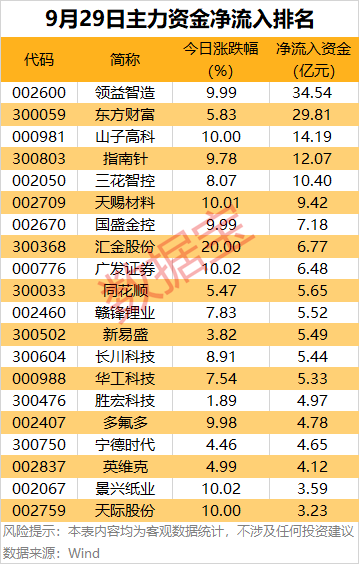
Market Overview - The three major indices showed a strong upward trend on September 29, with the Shenzhen Component Index and the ChiNext Index both rising over 2% [1] - The lithium battery sector experienced a surge, with over 10 stocks hitting the daily limit up, including Wanrun New Energy and Yicheng New Energy [1] Fund Flow Analysis - The net outflow of main funds in the Shanghai and Shenzhen markets was 3.385 billion yuan for the day [1] - Among 11 industries, non-bank financial and computer sectors saw the highest net inflows, amounting to 5.099 billion yuan and 1.256 billion yuan respectively [1] - Other sectors with net inflows exceeding 300 million yuan included power equipment, home appliances, automobiles, and steel [1] Individual Stock Performance - Five stocks received net inflows exceeding 1 billion yuan, with Lingyi Zhi Zao leading at 3.454 billion yuan [3] - Dongguan Lingzhi Innovation Robot Technology Co., Ltd. was established in partnership with Zhiyuan, focusing on industrial robot product development [1] - Dongfang Caifu followed with a net inflow of 2.981 billion yuan, benefiting from the surge in brokerage stocks [2] Net Outflow Rankings - The electronic industry had the highest net outflow, totaling 2.612 billion yuan, followed by communication, defense, and pharmaceutical sectors, each exceeding 1 billion yuan [1] - Leading stocks with significant net outflows included Xian Dao Intelligent and Woer Nuclear Materials, both exceeding 1 billion yuan [4][5] Tail-End Fund Flow - At the end of the trading day, the main funds saw a net inflow of 237 million yuan, with the computer, automotive, non-ferrous metals, electronics, and machinery sectors attracting over 100 million yuan each [6] - Individual stocks with notable tail-end inflows included Sanhua Intelligent Control and Beifang Huachuang, each exceeding 100 million yuan [7] Summary of Key Stocks - The top five stocks with net inflows included: - Lingyi Zhi Zao: 3.454 billion yuan - Dongfang Caifu: 2.981 billion yuan - Shanzi Gaoke: 1.419 billion yuan - Zhinanzhen: 1.207 billion yuan - Yihua Zhikong: 1.040 billion yuan [3] - Conversely, the top five stocks with net outflows included: - Xian Dao Intelligent: 1.531 billion yuan - Woer Nuclear Materials: 1.027 billion yuan - He Er Tai: 0.953 billion yuan - Haiguang Information: 0.596 billion yuan - Zhongji Xuchuang: 0.438 billion yuan [5][9]






【29日资金路线图】非银金融板块净流入逾200亿元居首 龙虎榜机构抢筹多股
证券时报· 2025-09-29 10:40
盘后数据出炉。 9月29日,A股市场整体上涨。截至收盘,上证指数报3862.53点,上涨0.9%;深证成指报13479.43点,上涨2.05%;创业板指报3238.01点,上涨2.74%; 北证50指数上涨0.69%。A股市场合计成交21783.94亿元,较上一交易日增加120.53亿元。 1.A股市场主力资金净流出33.85亿元 今日A股市场主力资金开盘净流出58.09亿元,尾盘净流入2.37亿元,A股市场全天主力资金净流出33.85亿元。 2.沪深300今日主力资金净流入63.21亿元 沪深300今日主力资金净流入63.21亿元,创业板净流入9.22亿元,科创板净流出45.54亿元。 | | 各板块最近五个交易日主力资金净流入数据(亿元) | | | | --- | --- | --- | --- | | 日期 | 沪深300 | 创业板 | 科创板 | | 2025-9-29 | 63. 21 | 9.22 | -45. 54 | | 2025-9-26 | -197. 33 | -326. 76 | -30. 57 | | 2025-9-25 | -6. 27 | -89.27 | -33. 46 | ...

证券ETF爆发;公募规模突破36万亿再创新高
2 1 Shi Ji Jing Ji Bao Dao· 2025-09-29 10:35
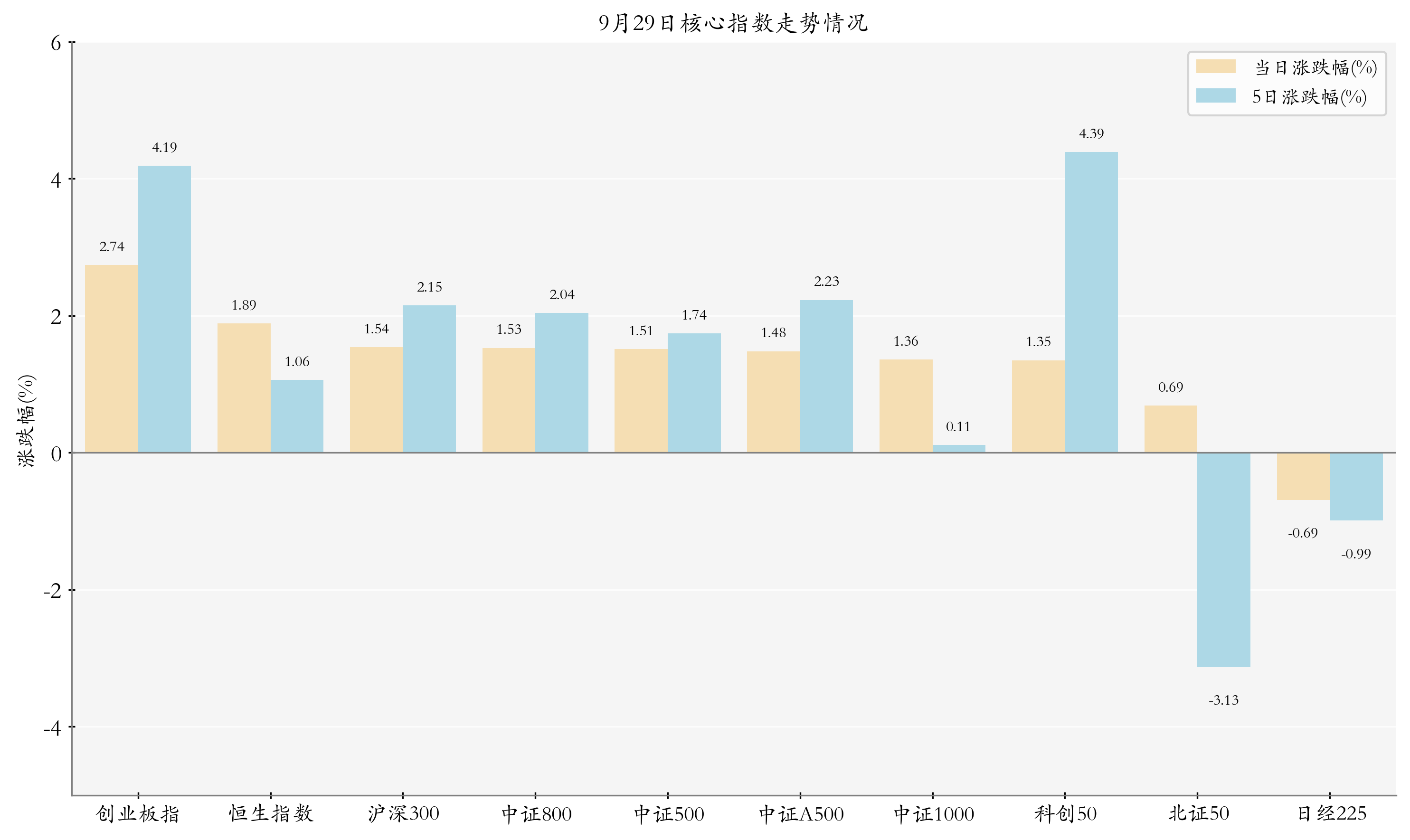
Group 1: ETF Industry News - The three major indices collectively rose, with the Shanghai Composite Index increasing by 0.9%, the Shenzhen Component Index by 2.05%, and the ChiNext Index by 2.74. Notably, several non-bank financial sector ETFs surged, including the leading securities ETF (159993.SZ) which rose by 5.61% [1][4] - The total scale of public funds in China surpassed 36 trillion yuan, marking a new historical high for the fifth time this year. The growth was primarily driven by actively managed equity funds, with stock fund net value increasing by 12.76% month-on-month [1][4] Group 2: Market Performance Overview - On September 29, all three major indices in A-shares and overseas core indices rose, with the Shanghai Index closing at 3862.53 points, the Shenzhen Component at 13479.43 points, and the ChiNext Index at 3238.01 points. The highest intraday points were 3881.0, 13531.98, and 3259.42 respectively [1][4] - In the past five trading days, the top performers included the ChiNext 50, ChiNext Index, and CSI A500, with respective gains of 4.39%, 4.19%, and 2.23% [1][4] Group 3: ETF Market Performance - The average performance of different categories of ETFs showed that thematic stock ETFs performed the best with an average increase of 1.53%, while bond ETFs had the worst performance with an average increase of only 0.01% [7] - The top three performing stock ETFs today were the securities ETF (159993.SZ) with a gain of 5.61%, the battery 50 ETF (159796.SZ) with 5.20%, and the broker ETF (159842.SZ) with 5.19% [10] Group 4: ETF Trading Volume - The top three ETFs by trading volume were the securities ETF (512880.SH) with a trading volume of 7.892 billion yuan, the A500 ETF from Southern Fund (159352.SZ) with 6.056 billion yuan, and the A500 ETF fund (512050.SH) with 5.728 billion yuan [15]
股指期货?报:轻仓过节,可尝试双买期权
Nan Hua Qi Huo· 2025-09-29 09:12
Report Summary 1. Report Industry Investment Rating No relevant content provided. 2. Core Viewpoints - The stock market rose overall today, with the CSI 300 Index hitting a new high, indicating positive market sentiment. The upward movement was mainly driven by the non - banking financial and non - ferrous metal sectors. The non - banking financial sector was influenced by the central bank's meeting, and the market is optimistic about brokerage performance in Q4. The non - ferrous metal sector was pulled up by the strong gold market and the rise of the solid - state battery concept. However, due to uncertainties during the double - festival period, there may be a post - holiday correction, so it is recommended to hold a light position during the holiday [3]. 3. Summary by Related Catalogs Market Review - The stock index showed a strong trend today. Taking the CSI 300 Index as an example, it closed up 1.54%. The trading volume of the two markets increased by 14.576 billion yuan, and all futures index varieties rose with increased volume [2]. Important Information - The National Development and Reform Commission is promoting new policy - based financial tools worth 500 billion yuan for project capital replenishment. It also supports private enterprises' participation in the "AI +" action. In August, the economy was generally stable, but there are still risks and challenges, and the NDRC will continue to implement macro - policies [3]. - The Ministry of Industry and Information Technology issued a satellite mobile communication business license to China Mobile [3]. Strategy Recommendation - A light - position purchase of the straddle option strategy is recommended [4]. Market Data - **Futures Index Market Analysis** - The intraday percentage changes of the main contracts of IF, IH, IC, and IM were 1.53%, 0.89%, 1.90%, and 2.00% respectively. The trading volumes were 1.66084 million lots, 0.85621 million lots, 1.60425 million lots, and 2.84619 million lots respectively, with corresponding volume increases of 0.44999 million lots, 0.37395 million lots, 0.2439 million lots, and 0.41629 million lots. The open interests were 2.84149 million lots, 1.13877 million lots, 2.56603 million lots, and 3.67256 million lots respectively, with increases of 0.24225 million lots, 0.17889 million lots, 0.04379 million lots, and 0.02392 million lots [6]. - **Spot Market Analysis** - The Shanghai Composite Index rose 0.90%, and the Shenzhen Component Index rose 2.05%. The ratio of rising to falling stocks was 2.19. The trading volume of the two markets was 2.161461 trillion yuan, an increase of 14.576 billion yuan [6].
今日123.48亿元主力资金潜入非银金融业
Zheng Quan Shi Bao Wang· 2025-09-29 09:12
Core Insights - The non-bank financial sector experienced the highest net inflow of capital today, amounting to 12.348 billion yuan, with a price change of 3.84% and a turnover rate of 2.41% [1][2] - The electronic industry faced the largest net outflow of capital, totaling -2.811 billion yuan, with a price change of 1.58% and a turnover rate of 3.62% [1][2] Industry Summary - **Non-Bank Financial**: - Trading volume: 99.94 billion shares - Change in trading volume: +157.03% - Turnover rate: 2.41% - Price change: +3.84% - Net capital inflow: 12.348 billion yuan [1] - **Electronic**: - Trading volume: 99.89 billion shares - Change in trading volume: -9.55% - Turnover rate: 3.62% - Price change: +1.58% - Net capital outflow: -2.811 billion yuan [1][2] - **Other Notable Industries**: - **Non-Ferrous Metals**: - Net inflow: 2.986 billion yuan, price change: +3.78% [1] - **Computer**: - Net inflow: 1.849 billion yuan, price change: +1.31% [1] - **Power Equipment**: - Net inflow: 1.819 billion yuan, price change: +3.07% [1] - **Automobile**: - Net inflow: 0.994 billion yuan, price change: +1.21% [1] - **Steel**: - Net inflow: 0.855 billion yuan, price change: +2.49% [1] - **Industries with Significant Outflows**: - **Real Estate**: - Net outflow: -7.222 billion yuan, price change: +0.86% [2] - **Banking**: - Net outflow: -7.61 billion yuan, price change: -0.46% [2] - **Media**: - Net outflow: -1.417 billion yuan, price change: +0.04% [2] - **Telecommunications**: - Net outflow: -1.465 billion yuan, price change: +1.24% [2] - **Pharmaceuticals**: - Net outflow: -1.640 billion yuan, price change: +0.17% [2]
主力动向:9月29日特大单净流入174.38亿元
Zheng Quan Shi Bao Wang· 2025-09-29 09:10
特大单净流入资金排名 | 代码 | 简称 | 收盘价(元) | 涨跌幅(%) | 特大单净流入(亿元) | 行业 | | --- | --- | --- | --- | --- | --- | | 002600 | 领益智造 | 16.18 | 9.99 | 37.86 | 电子 | | 300059 | 东方财富 | 27.58 | 5.83 | 31.14 | 非银金融 | | 000981 | 山子高科 | 3.85 | 10.00 | 15.62 | 汽车 | | 600030 | 中信证券 | 30.41 | 5.88 | 13.65 | 非银金融 | | 002050 | 三花智控 | 46.60 | 8.07 | 12.23 | 家用电器 | | 601688 | 华泰证券 | 21.77 | 10.01 | 12.00 | 非银金融 | | 002709 | 天赐材料 | 37.59 | 10.01 | 10.33 | 电力设备 | | 300803 | 指南针 | 166.81 | 9.78 | 10.30 | 计算机 | | 002670 | 国盛金控 | 22.13 | 9.99 | 8 ...



博时市场点评9月29日:两市震荡上涨,创业板涨2.74%
Xin Lang Ji Jin· 2025-09-29 08:53
Group 1: Industrial Profit Trends - In August, industrial enterprises' profits increased by 20.4% year-on-year, marking a significant improvement compared to July and reaching a year-to-date high [1] - Cumulative profits from January to August showed a reversal from the continuous decline since May, with a total profit growth of 0.9% year-on-year [2] - The rebound in industrial profits is primarily attributed to a low base effect from the previous year, along with improved supply and demand dynamics driven by "anti-involution" policies [1][2] Group 2: Policy Impact on Nonferrous Metals Industry - The Ministry of Industry and Information Technology and other departments issued a growth plan for the nonferrous metals industry, targeting an average annual growth of around 5% in value-added from 2025 to 2026 [2] - The plan aims to support high-end material innovation and green low-carbon transformation, which is expected to benefit the nonferrous metals supply chain, particularly in copper, aluminum, and lithium sectors [2] - The policy is anticipated to enhance market sentiment in related A-share sectors in the short term while promoting resource independence and industry upgrades in the long term [2] Group 3: Market Performance - On September 29, the three major A-share indices rose, with the Shanghai Composite Index up by 0.90% and the Shenzhen Component Index up by 2.05% [3] - Non-bank financials, nonferrous metals, and electric equipment sectors led the gains, with increases of 3.84%, 3.78%, and 3.07% respectively [3] - A total of 3,576 stocks rose while 1,657 stocks declined, indicating a positive market sentiment overall [3] Group 4: Market Activity - The market turnover reached 21,781 billion, showing an increase compared to the previous trading day [4] - The margin trading balance reported at 24,244.58 billion, reflecting a decrease from the previous trading day [4]
