自动驾驶

Search documents
2025年还存活的自动驾驶公司......
自动驾驶之心· 2025-12-14 02:03
Group 1: Industry Overview - The penetration rate of L2 autonomous driving is rapidly increasing, while L3 is on the verge of implementation and L4 is breaking through in scale [2] - The autonomous driving industry is undergoing a new round of reshuffling and resource integration, with some companies exiting the market, others merging or acquiring, and new players emerging [2] Group 2: New Forces in Autonomous Driving - Key new players in the autonomous driving sector include NIO, Xpeng, Li Auto, Xiaomi, Leap Motor, Didi, WM Motor, Niu Chuang, Zeekr, Avita, Lantu, Qianli Technology, and Jiyue [4] Group 3: Tier 1 Suppliers - Major Tier 1 suppliers in the industry consist of Huawei, Baidu, DJI, ZTE, Tencent (smart cockpit/high-precision maps/simulation toolchain), SAIC Lingxu, Jianzhi Robotics, Momenta, Bosch China, Magna, and Youjia Innovation Minieye [6] Group 4: Robotaxi Companies - Companies involved in the Robotaxi segment include Baidu, Pony.ai, Shanghai Zhaofu Intelligent Technology (Hello Robotaxi), WeRide, Didi, Momenta, Qizhou Zhihang, and Yushi Technology [8] Group 5: Robotruck Companies - Key players in the Robotruck sector are Carl Power, Zhijia Technology, Winche Technology, Pony.ai, Mainline Technology, Sien Intelligent Driving, Xijing Technology, Feibu Technology, MuYue Technology (WeRide), Zitu Technology, Changxing Intelligent, Huanyu Zhixing, Xidi Intelligent Driving, Qianhua, Xingxing, Youdao Zhitu, Karui Zhixing, Qianchen, Weidu, Geely Remote, Hengrun, Hongjing, Xidi, and Qingtian Zhika [10] Group 6: Other Autonomous Driving Applications - Companies involved in various applications of autonomous driving include Meituan, Jiushi Intelligent, JD.com, Suning, Alibaba Cainiao, China Post, Baidu Apollo, VIA Technologies, Baixiniu, Zhixingzhe, Yushi Technology, Xingshen Intelligent, Jiazhi Technology, and Xiaoshi Technology [12] - Traditional automakers in the industry include SAIC, Changan, GAC (Aion), BAIC (Extreme Fox), FAW, Great Wall, BYD, Geely (Furuitai), Dongfeng, Chery, and Geely (Zeekr) [14] - Companies focusing on agricultural autonomous driving include Fengjiang Intelligent, Zoomlion, China Yituo, Wuniu Intelligent, Zhongke Yuandong, Leiwo Heavy Industry, Chaoxing Intelligent, Bochuang Liandong, and Haoxing Technology [16] - Companies in the mining autonomous driving sector include Yikong Zhijia, Taga Zhixing, Huituo Intelligent, Lukai Zhixing, Bolai Technology, Mengshi Technology, and Qingzhi Technology [18] - Companies in the sanitation autonomous driving sector include Zhixingzhe, Kuwa, Xiantou, Gaoxian Robotics, Shenlan Technology, Haorui Intelligent, Yuwan Zhijia, and Yunchuang Zhixing [20] - Companies involved in parking solutions include Baidu, Zhuishi, Desai Xiwai, Dongsoft Ruichi, Hedu Technology, Niuli Technology, Hengrun Technology, Lingshi Technology, Moshih Intelligent, Oteming, Zhixingzhe, and Yushi Technology [22] Group 7: High-Precision Mapping - Major players in high-precision mapping include Baidu, Amap, Four-Dimensional Map New, Tencent, Huawei, Didi, JD.com, Meituan, Kuandeng, Shendong, Zhonghaiting, and Yikaton [24] Group 8: Vehicle-to-Everything (V2X) Collaboration - Companies involved in vehicle-to-everything collaboration include Mushroom Car Union, Juefei Technology, Baidu, Huawei, Datang High-Tech, Huali Zhixing, Alibaba, Hikvision, Xingyun Interconnect, and Yunjing Zhixing [24]


主线科技冲刺港股IPO:营收毛利双增 亏损收窄估值超38亿
Sou Hu Cai Jing· 2025-12-13 17:09
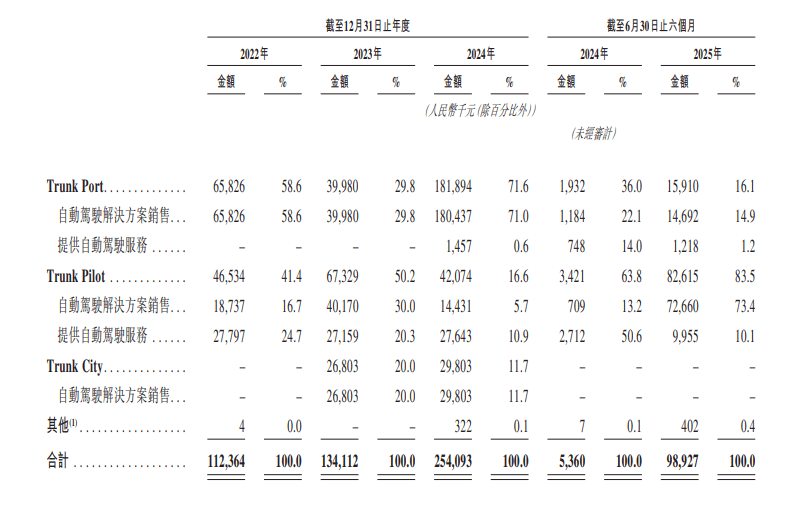
L4无人卡车领域迎来重要动态,主线科技(北京)股份有限公司近日正式向港交所递交招股书,开启上市征程。这家成立于 2017年的企业,在自动驾驶卡车赛道持续发力,展现出强劲的发展势头。 | | | | 截至12月31日止年度 | | | | | 截至6月30日止六個月 | | | | --- | --- | --- | --- | --- | --- | --- | --- | --- | --- | --- | | | 2022年 | | 2023年 | | 2024年 | | 2024年 | | 2025年 | | | | 金額 | କ୍ଷ | 슬額 | ్య | 金額 | క్ష | 金額 | କ୍ଷ | 金額 | રહ્યુ | | | | | | | (人民幣千元(除百分比外) | | | | | | | | | | | | | | (未經濟計) | | | | | Trunk Port | 65.826 | 58.6 | 39.980 | 29.8 | 181,894 | 71.6 | 1.932 | 36.0 | 15.910 | 16.1 | | 自動駕駛解決方案銷售 .. | 65.826 | ...
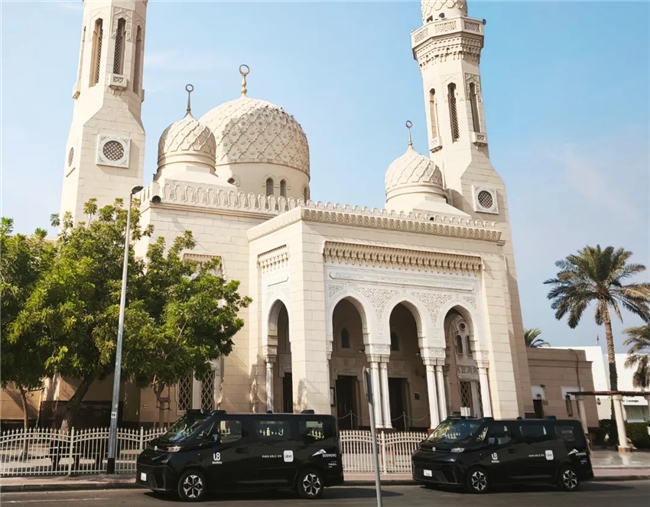
文远知行推出迪拜首个公开运营Robotaxi服务!迪拜26年初有望跟上阿布扎比
Jin Tou Wang· 2025-12-13 04:23
Core Insights - WeRide and Uber have officially launched Robotaxi services in Dubai through the Uber App, supporting Dubai's "2030 goal of 25% automated travel" [1][5] - The Robotaxi service is now available in popular areas such as Umm Suqeim and Jumeirah, enhancing the scale of smart mobility in the Middle East [1][5] Group 1 - WeRide and Uber announced the launch of L4 level fully autonomous Robotaxi commercial operations in Abu Dhabi, marking the first pure autonomous operation in the Middle East [3] - Abu Dhabi is the first city outside the U.S. to offer this service on the Uber platform, receiving the first city-level permit for pure autonomous Robotaxi operations outside the U.S. [3] - The collaboration between WeRide and Uber began in April, involving multiple pilot runs and road tests to ensure a safe transition to practical applications of autonomous driving [3] Group 2 - Dubai's population exceeds 4 million, with a strong demand for transportation, projected to reach 153 million trips in 2024, including a 28% year-on-year growth in shared mobility users [5] - The introduction of Robotaxi services aligns with the increasing travel demands of residents and tourists, providing a crucial boost to Dubai's automation goals [5] - Uber's global head of autonomous driving expressed excitement about the rapid advancement of autonomous driving in the UAE and the Middle East, reaffirming the company's commitment to supporting the region's future mobility vision [5]

迪拜联合 Uber 与文远知行推出 Robotaxi 试点服务
Shang Wu Bu Wang Zhan· 2025-12-13 02:14
Core Viewpoint - Dubai has launched a pilot service for AI-driven Robotaxi in collaboration with Uber and WeRide, marking a significant step towards achieving the goal of 25% autonomous driving by 2030 [1] Group 1: Pilot Service Details - The Robotaxi service is available for booking through the Uber app in Umm Suqeim and Jumeirah, with users able to select "Autonomous" for immediate orders [1] - Currently, the vehicles are equipped with safety drivers, with plans to achieve fully autonomous driving by early 2026 [1] Group 2: Strategic Goals and Expansion - WeRide aims to support rapid expansion in the Middle East with its globally validated autonomous driving technology, targeting the deployment of "tens of thousands" of Robotaxis worldwide by 2030 [1] - Uber's initiative reflects its accelerated focus on autonomous driving and alignment with the UAE's future transportation vision [1] Group 3: Market Context - WeRide currently operates approximately 150 autonomous vehicles in the Middle East, including over 100 Robotaxis [1] - With Dubai's population exceeding 4 million and a projected 28% year-on-year growth in shared mobility demand by 2024, the pilot is seen as a crucial transition towards full autonomy by 2026 [1]
最近前馈GS的工作爆发了,我们做了一份学习路线图......
自动驾驶之心· 2025-12-13 02:04
Core Insights - The article highlights the advancements in 3D Gaussian Splatting (3DGS) technology, particularly its application in autonomous driving, and emphasizes the need for structured learning pathways in this rapidly evolving field [2][4]. Group 1: 3DGS Technology and Developments - Tesla's introduction of 3D Gaussian Splatting at ICCV has garnered significant attention, indicating a shift towards feed-forward GS algorithms in the industry [2]. - The rapid iteration of 3DGS technology includes static reconstruction (3DGS), dynamic reconstruction (4DGS), and surface reconstruction (2DGS), showcasing the need for effective learning resources [4]. Group 2: Course Offering - A comprehensive course titled "3DGS Theory and Algorithm Practical Tutorial" has been developed to provide a structured learning roadmap for newcomers, covering essential theories and practical applications [4]. - The course is designed to help participants understand point cloud processing, deep learning, real-time rendering, and coding practices, with a focus on hands-on experience [4]. Group 3: Course Structure - The course consists of six chapters, starting with foundational knowledge in computer graphics and progressing to advanced topics such as feed-forward 3DGS and its applications in autonomous driving [8][9][10][11][12]. - Each chapter includes practical assignments and discussions to enhance understanding and application of the concepts learned [8][9][10][11][12]. Group 4: Target Audience and Prerequisites - The course is aimed at individuals with a background in computer graphics, visual reconstruction, and programming, particularly those interested in pursuing careers in the 3DGS field [17]. - Participants are expected to have a foundational understanding of probability, linear algebra, and programming languages such as Python and PyTorch [17].
南洋理工&哈佛提出OpenREAD:端到端RL统一认知与轨迹规划
自动驾驶之心· 2025-12-13 02:04
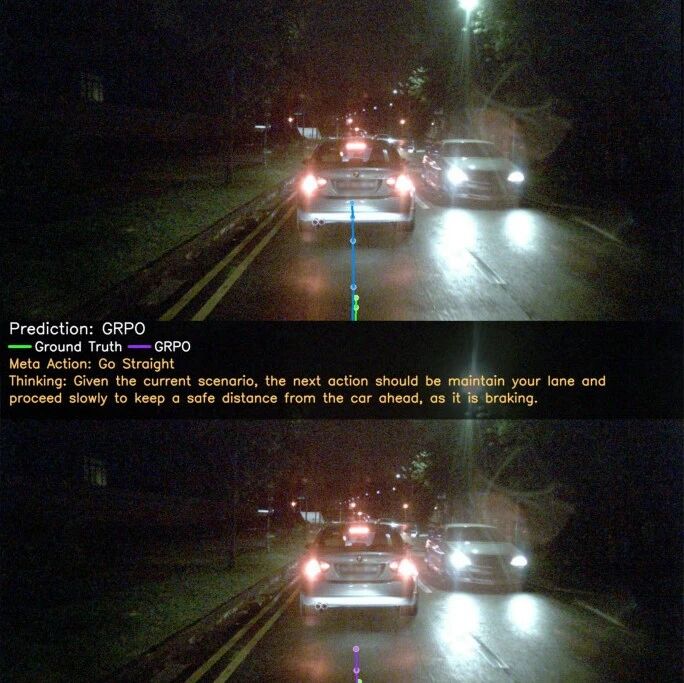
Core Viewpoint - The article discusses the introduction of OpenREAD, a new framework developed by Nanyang Technological University and Harvard University, which utilizes reinforcement learning (RL) to enhance the reasoning capabilities of visual language models (VLM) in the context of autonomous driving [4][28]. Group 1: Methodology - OpenREAD incorporates Qwen3-LLM as an "evaluation expert," expanding the application of RL from traditional verifiable downstream tasks to open-ended tasks such as "driving suggestions" and "scene analysis," achieving end-to-end reinforcement fine-tuning from high-level semantic reasoning to low-level trajectory planning [6][28]. - The framework addresses the challenge of designing reward functions for open-ended driving knowledge learning, where multiple expressions can represent the same reference answer, complicating the RL process [7]. - Two preparatory steps were taken: (1) Constructing knowledge data with explicit chains of thought (CoT) using GPT-4 to annotate driving knowledge data covering perception and decision-making tasks [8]; (2) Converting the OmniDrive dataset into a format suitable for RL training, structured as "thinking + answering" [9]. Group 2: Experimental Results - OpenREAD was evaluated on the LingoQA and NuScenes datasets, demonstrating superior performance compared to traditional supervised fine-tuning (SFT) methods in trajectory error, collision rates, and knowledge evaluation metrics [19][20]. - The results indicate that the introduction of driving knowledge significantly enhances the effectiveness of RL fine-tuning, as evidenced by improvements in trajectory error and collision rates [19][20]. - In comparison with existing methods, OpenREAD exhibited better collision control capabilities, ensuring safer driving outcomes [20]. Group 3: Conclusion - OpenREAD successfully implements collaborative reinforcement learning fine-tuning for driving knowledge and trajectory planning, expanding the boundaries of RL applications in end-to-end autonomous driving [28].
汽车早报|赛力斯非执行董事尤峥因工作调整辞职 东风商用车将明年销量目标定为17.6万辆
Xin Lang Cai Jing· 2025-12-13 00:38
Group 1: Regulatory Developments in the Automotive Industry - The State Administration for Market Regulation is seeking public opinion on the "Guidelines for Compliance with Pricing Behavior in the Automotive Industry," which aims to standardize pricing practices from vehicle production to parts manufacturing [1] - The guidelines emphasize full-process price management, requiring a comprehensive pricing management system covering vehicle sales and financial services [1] - The guidelines also prohibit price collusion between producers and parts manufacturers, and mandate clear communication of pricing for paid features to protect consumer rights [1] Group 2: Corporate Governance and Management Changes - Dongfeng Motor Group's former deputy general manager of the Special Equipment Division, Xiao Jinghua, is under investigation for serious violations of discipline and law [2] - Seres announced the resignation of non-executive director You Zheng due to work adjustments, with a new candidate, Yang Yanding, proposed for the board [3] Group 3: Financial and Operational Updates - Seres has completed its "Factory Intelligent Upgrade and Electric Drive Production Line Construction Project," reallocating surplus funds of 19.462 million yuan to the "Electric Vehicle Model Development and Product Platform Technology Upgrade Project" [4] - Dongfeng Commercial Vehicle has set a sales target of 176,000 units for 2026, planning to launch 214 new products across various energy types [5] Group 4: Strategic Partnerships and Technological Advancements - Black Sesame Intelligence and Yuanrong Qixing have signed a cooperation agreement to promote the mass production of advanced driver assistance technologies [6][7] - Uber plans to launch autonomous taxi services in over 10 markets by the end of next year, with ongoing operations in the U.S. and Middle East [7]

小马智行王皓俊:有望2030年前盈亏平衡
Xin Lang Cai Jing· 2025-12-12 15:03
12月11日,在小马智行2025媒体沟通会上,小马智行联合创始人、首席财务官王皓俊介绍,小马智行的 Robotaxi(自动驾驶出租车)车队规模从去年的200多辆到今年年底近1000辆,到2026年底会达到3000 辆。关于实现盈利需要多久,王皓俊从小马智行运营情况来看,"预期2030年到10万辆级,所以时间点 应该是在2030年前,公司实现盈亏平衡。"对于投资摩尔线程,王皓俊提到,参与了摩尔线程的早期投 资,当时不是财务投资,更多是战略考虑。 ...
IPO观察|又一L4玩家赴港IPO,董事长曾为百度无人车元老,公司三年半亏损近8亿元
Sou Hu Cai Jing· 2025-12-12 13:15
Core Viewpoint - Mainline Technology (Beijing) Co., Ltd. has submitted its listing application to the Hong Kong Stock Exchange, aiming to raise funds for enhancing R&D capabilities, building production and supply chain systems, market expansion, and strategic investments [1][5]. Company Overview - Mainline Technology is a provider of L4 autonomous driving trucks and solutions, recognized as the first in China to commercialize unmanned transport solutions in port scenarios [1][3]. - The company was founded in 2017 by Zhang Tianlei, a PhD from Tsinghua University and a founding member of Baidu's autonomous vehicle team [10][12]. Financial Performance - The company's revenue for the years 2022 to 2025 (first half) is projected to be CNY 112.36 million, CNY 134.11 million, CNY 254.09 million, and CNY 99.92 million respectively, showing significant growth driven by the commercialization of autonomous driving products [5][6]. - The gross profit margin has improved from 3.7% in 2022 to 30.3% in 2025, although the company remains in a net loss position with losses of CNY 278.17 million, CNY 212.63 million, CNY 187.18 million, and CNY 96.4 million over the same period [7][9]. R&D and Market Position - R&D expenditures have been substantial, amounting to CNY 1.47 billion, CNY 1.19 billion, CNY 1.15 billion, and CNY 0.6 billion, representing 131%, 89%, 45.3%, and 60.9% of revenue respectively [9]. - As of December 5, 2025, the company has delivered 830 autonomous trucks and 349 smart terminals, with 821 trucks and 920 terminals on order, positioning it as the largest L4 autonomous truck provider in closed road scenarios in China [6][8]. Business Segments - In 2024, 71.6% of the company's revenue is expected to come from logistics hub operations, while 16.6% will be from highway logistics, and 11.7% from urban traffic [6][8]. - The number of projects executed has increased from 24 in 2022 to 48 in 2024, with 28 projects completed in the first half of 2025 [5].
上市首日振幅30%,量化系统提前三天预警
Sou Hu Cai Jing· 2025-12-12 13:07
Group 1 - The core viewpoint of the article highlights the potential pitfalls for retail investors in the context of the IPO of Xidi Zhijia, emphasizing the disparity between impressive revenue growth and significant net losses [1][3] - Xidi Zhijia's IPO showcases a textbook example of capital operation, with notable institutional backing from investors like Sequoia and Baidu, indicating a strong institutional support model [3][10] - The article draws parallels between the current market conditions and past IPOs, warning that retail investors may be drawn to the hype without recognizing underlying risks, as seen in the case of NIO [3][4] Group 2 - The article discusses the "bull market adjustment" phenomenon, where the Hang Seng Tech Index experiences significant fluctuations while institutions continue to buy on dips, suggesting a complex market dynamic [4][10] - It notes that despite Xidi Zhijia's overall losses, projections for revenue in the first half of 2024 are nearly equal to the total revenue for 2023, indicating potential turning points hidden in financial reports [7][10] - The article emphasizes that true stock price trends are driven by capital behavior rather than technical analysis, advocating for a quantitative approach to understanding market movements [8][10] Group 3 - Xidi Zhijia's market share in the autonomous mining truck sector is reported at 16.8%, but the marginal efficiency improvement of only 104% raises concerns about potential "high open low walk" scenarios for institutional arbitrage [10][11] - The article draws a comparison between the operational needs of autonomous mining trucks and the necessity for continuous monitoring in quantitative trading, suggesting that investors should adopt similar vigilance [11][13] - It concludes with three key pieces of advice for investors: be wary of "scene limitations," understand the "mining efficiency" of capital, and establish a personal monitoring system for trading behaviors [13]