建筑

Search documents
“人工智能+”行动推进,建筑全产业链受益
Changjiang Securities· 2025-08-28 15:36
Investment Rating - The report maintains a "Positive" investment rating for the construction and engineering industry [10]. Core Insights - The release of the "Artificial Intelligence+" action plan by the State Council on August 26, 2025, aims to integrate AI across various sectors, leading to a transformative shift in productivity and economic structure [2][7]. - By 2027, the plan targets over 70% penetration of AI applications in six key areas, with a goal of exceeding 90% by 2030, indicating significant infrastructure development opportunities [7][13]. - The rapid development of AI is expected to create new demands for infrastructure, including intelligent upgrades in scientific research platforms and municipal facilities [13]. - The report highlights that design firms are likely to benefit significantly from the AI-driven initiatives, enhancing their operational efficiency and capabilities [13]. Summary by Sections Event Description - The "Artificial Intelligence+" action plan aims to deeply integrate AI into various sectors, reshaping production and living paradigms [7]. Event Commentary - The plan emphasizes the need for intelligent urban planning and governance, which is expected to directly benefit the construction industry [13]. - It outlines key actions for AI integration in design, production, and service operations, enhancing overall industry efficiency [13]. Future Opportunities - Companies specializing in planning and design, such as Huasheng Group and Huayang International, are identified as potential beneficiaries of the AI initiatives [13]. - The report suggests that state-owned design platforms are also exploring AI applications to enhance digital infrastructure and urban intelligence [13].
奥邦建筑(01615)发布中期业绩,股东应占溢利澳门币31.4万元,同比下降91.8%
智通财经网· 2025-08-28 12:56
Core Viewpoint - Aobo Construction (01615) reported a significant increase in revenue for the first half of 2025, driven by successful execution of renovation projects and expansion in building materials trading [1] Financial Performance - Revenue reached MOP 171 million, representing a year-on-year growth of 189.9% [1] - Profit attributable to owners decreased to MOP 314,000, a decline of 91.8% compared to the previous year [1] - Basic earnings per share stood at MOP 0.05 [1]
波黑塞族共和国最高薪行业平均工资达2007马克
Shang Wu Bu Wang Zhan· 2025-08-28 12:01
Core Insights - The average net salary for employees in the Republika Srpska in July was 1556 marks, with the highest average salary in the financial and insurance sector at 2007 marks, while the construction sector had the lowest average salary at 1206 marks [1] Salary and Consumer Prices - In July, the price of a basket of consumer goods in the Republika Srpska was 2750 marks, indicating that the average net salary only covered 57% of the cost of this basket [1] - The highest proportion of household spending was on food, averaging 1269 marks, followed by housing and utilities at 667 marks, transportation at 226 marks, clothing and footwear at 221 marks, and household maintenance at 161 marks [1]
日照市获评2024年度全省建筑业跨越发展市
Qi Lu Wan Bao Wang· 2025-08-28 11:49
Core Viewpoint - Rizhao City has been recognized as a leading city in the construction industry in Shandong Province, reflecting its significant progress in high-quality development through reforms and targeted policies [1] Group 1: Policy and Development Initiatives - The Shandong Provincial Housing and Urban-Rural Development Department issued a notice recognizing Rizhao City and Donggang District for their achievements in the construction industry [1] - Rizhao City has focused on the transformation and upgrading of the construction industry, emphasizing "industrialization, digitalization, and greening" as key directions for development [1] - The city has implemented several measures to support high-quality development in the construction sector, including the issuance of policies to guide industrial transformation [1] Group 2: Infrastructure and Enterprise Development - Rizhao City has established a national prefabricated construction industrial base, two provincial labor output bases, and one provincial new-type construction industrialization base [1] - Fourteen enterprises have been recognized as leading backbone enterprises in the construction industry, while eight have been designated as intelligent construction pilot enterprises [1] - Eleven enterprises have been included in the "Qilu Construction" brand list, enhancing the reputation and competitiveness of local companies [1] Group 3: Future Directions - The recognition as a leading city in the construction industry is seen as a validation of Rizhao City's efforts and marks the beginning of a new phase in high-quality development [1] - The city plans to optimize its industrial structure further and create a unique "geese formation" of enterprises and industrial clusters [1] - There is a commitment to expanding the visibility, influence, and coverage of the "Rizhao Construction" brand in the future [1]
招聘需求超9.5万人次!百日千万招聘专项行动推出4个专场
Yang Shi Wang· 2025-08-28 10:51
Group 1 - The "Hundred Days of Millions of Recruitment Special Action" launched online recruitment events for four industries: artificial intelligence, modern services, light industry, and construction, with over 6,800 employers participating and a recruitment demand exceeding 95,000 positions [1] - The artificial intelligence sector will have 71 employers offering positions such as pre-sales solution managers, digital engineers, AI application engineers, and algorithm engineers, with a recruitment demand of over 900 positions [1] - The modern services sector will feature 38 employers providing roles like marketing specialists, after-sales engineers, and interior designers, with a recruitment demand exceeding 1,000 positions [1] - The light industry sector will involve over 6,700 employers offering positions such as mechanical engineers, process engineers, product quality inspectors, and polymer materials engineers, with a recruitment demand exceeding 93,000 positions [1] - The construction sector will have 68 employers offering roles like engineering technicians, project managers, mechanical designers, and cost estimators, with a recruitment demand exceeding 1,000 positions [1] Group 2 - The "Employment Online" platform hosted a live-streaming recruitment event featuring employment officials from Jiangxi, Hubei, and Hunan provinces, focusing on industries such as manufacturing, wholesale and retail, and information technology services [2] - Employers in the live-streaming event offered positions including equipment engineers, production managers, quality directors, electrical engineers, and software development engineers [2] - Job seekers can access recruitment events through various online platforms, including the China Public Recruitment Network and the National Talent Network, as well as the main event page of the special action [2]
2025年马来西亚国际建筑与基础设施技术展山东参展成果丰硕
Qi Lu Wan Bao· 2025-08-28 10:21
Core Points - The 2025 Malaysia International Construction and Infrastructure Technology Exhibition opened in Kuala Lumpur, focusing on green building, smart construction, and new building materials [1] - Shandong Province organized nearly 80 enterprises in construction materials, engineering machinery, and smart construction to participate, forming a significant exhibition group [1] Group 1 - The exhibition featured 80 booths covering an area of approximately 800 square meters, showcasing representative new technologies and products such as new steel structure materials, energy-saving doors and windows, high-performance concrete, smart engineering machinery, construction robots, and BIM technology systems [1] - During the exhibition, Shandong participating enterprises received over 4,200 professional visitors from more than 10 countries and regions, achieving export intention orders of approximately 48 million USD [1] - Products such as prefabricated building components, smart tower crane equipment, environmentally friendly building materials, and digital construction management systems were particularly favored, demonstrating the strong competitiveness of "Shandong Construction" in the international market [1] Group 2 - The participation in the exhibition effectively enhanced the brand awareness and influence of Shandong's construction materials and engineering machinery in the Southeast Asian market, laying a solid foundation for deepening regional economic and trade cooperation and expanding international collaboration [2] - The successful participation will further promote the transformation and upgrading of Shandong's construction industry and international capacity cooperation, helping enterprises seize opportunities in the "Belt and Road" market [2]
建鹏控股(01722.HK)中期总收入同比增加3.1%至约3.49亿澳门元
Ge Long Hui· 2025-08-28 09:47
Core Viewpoint - Jianpeng Holdings (01722.HK) reported a 3.1% year-on-year increase in total revenue to approximately 349 million Macanese Patacas for the six months ending June 30, 2025, primarily due to the scale of construction and supporting service projects undertaken during the period [1] Financial Performance - The group's comprehensive income totaled approximately 400,000 Macanese Patacas, compared to a comprehensive loss of about 11.3 million Macanese Patacas for the six months ending June 30, 2024, mainly due to the impact of the aforementioned projects [1] - Basic earnings per share were approximately 0.04 Macanese cents, a significant improvement from a basic loss per share of about 1.02 Macanese cents for the six months ending June 30, 2024 [1] Dividend Policy - The board of directors does not recommend the payment of an interim dividend for the six months ending June 30, 2025, consistent with the previous period where no dividend was declared [1]
国内高频 | 暑期人流持续高位(申万宏观·赵伟团队)
赵伟宏观探索· 2025-08-28 00:15
Group 1: Industrial Production - Industrial production has shown signs of recovery, with the blast furnace operating rate increasing by 1.1 percentage points year-on-year to 5.9% [2][6] - Midstream production shows a mixed outlook, with PTA and automotive production performing poorly, down 6.6% and 5.9% year-on-year respectively, while soda ash and polyester filament production improved, up 0.1% to 5.8% and 0.9% to 3.1% respectively [2][16] - Cement production continues to improve, with the national grinding operating rate down 1.5 percentage points year-on-year to -5.6%, and cement shipment rates slightly up by 0.8% to -2.9% [28][32] Group 2: Demand Tracking - Daily average transaction area of new homes remains weak, up 2.9 percentage points year-on-year to -6.3%, with first-tier cities showing some recovery [52] - Port cargo throughput related to exports has significantly increased, with cargo throughput and container throughput up 7.1% to 9.7% and 6.1% to 14.8% year-on-year respectively [61][68] - The national migration scale index has decreased by 5.2 percentage points year-on-year to 16.6%, but domestic flight operations have increased by 1.0% to 2.7% [73] Group 3: Price Trends - Agricultural product prices are showing divergence, with pork and fruit prices down 0.1% and 0.8% respectively, while egg and vegetable prices increased by 1.7% and 2.5% [3][101] - The industrial product price index has generally declined, with the Nanhua industrial product price index down 1.4% [113] - The energy and chemical price index decreased by 0.9%, and the metal price index fell by 1.7% [113][120]

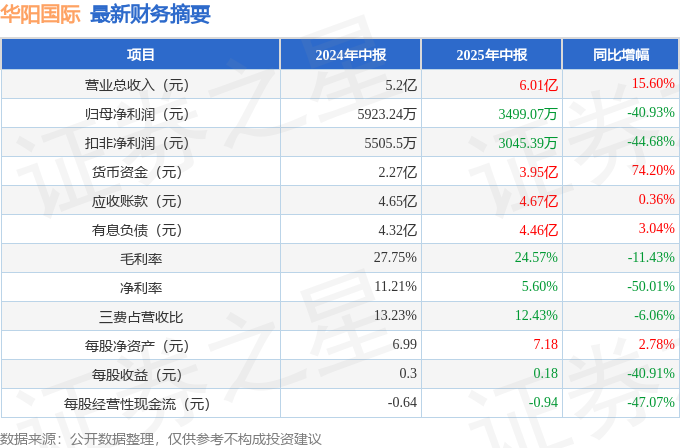
华阳国际2025年中报简析:增收不增利,公司应收账款体量较大
Zheng Quan Zhi Xing· 2025-08-27 22:56
Core Viewpoint - Huayang International (002949) reported mixed financial results for the first half of 2025, with revenue growth but a significant decline in net profit compared to the previous year [1] Financial Performance - Total revenue for the first half of 2025 reached 601 million yuan, a year-on-year increase of 15.6% [1] - Net profit attributable to shareholders was 34.99 million yuan, down 40.93% year-on-year [1] - In Q2 2025, total revenue was 337 million yuan, up 15.79% year-on-year, while net profit was 32.51 million yuan, down 42.07% year-on-year [1] - Gross margin decreased to 24.57%, down 11.43% year-on-year, and net margin fell to 5.6%, down 50.01% year-on-year [1] - Total operating expenses (selling, administrative, and financial) amounted to 74.63 million yuan, accounting for 12.43% of revenue, a decrease of 6.06% year-on-year [1] Balance Sheet Highlights - Accounts receivable increased, with a ratio to net profit reaching 372.71% [1][12] - Cash and cash equivalents increased by 100.52% due to the redemption of financial products and reduced dividends [11] - Inventory surged by 141.68% due to investments in short drama productions [3] - Contract assets rose by 11.07% due to extended settlement cycles [2] Cash Flow and Investment - Operating cash flow per share was -0.94 yuan, down 47.07% year-on-year [1] - Investment cash flow increased by 301.27% due to increased redemptions of financial products [11] - Financing cash flow rose by 58.54% due to reduced rent payments and lower dividends compared to the previous year [11] Operational Insights - The company's return on invested capital (ROIC) was 7.26%, indicating average capital returns [11] - The historical median ROIC since listing is 16.56%, suggesting generally good investment returns [11] - Analysts expect 2025 performance to reach 108 million yuan, with an average earnings per share of 0.55 yuan [12]
今年收益46%,我的投资体系及兵器库大公开
集思录· 2025-08-27 13:30
Core Viewpoint - The article emphasizes a diversified asset allocation strategy that aims for absolute returns rather than relying on a single asset class or index, utilizing various strategies across multiple asset types to enhance overall returns and reduce volatility [1]. Group 1: Equity Strategies - The equity strategy involves a high allocation to stock index options (150% to 200% position), utilizing a combination of long and short options to manage risk and capture upside potential [2]. - A high-dividend stock rotation strategy is employed with a 10% allocation, focusing on a diversified portfolio of around 100 high-dividend stocks to achieve excess returns over dividend indices, targeting an annualized excess return of 5% to 10% [3]. Group 2: Convertible Bonds - The convertible bond strategy has been cleared out due to high valuations, with a focus on low-risk, fundamentally sound bonds previously held to enhance returns through rotation [4][5]. Group 3: Commodity Futures - A 20% allocation to commodity futures is based on value investing principles, targeting commodities at historical lows, particularly those below production costs, to minimize risk and enhance long-term returns [6]. Group 4: Arbitrage Strategies - The remaining capital is allocated to various low-risk arbitrage strategies, which contribute significantly to overall returns, with recent performance showing a 9% weekly return and a 46% annual return, exceeding expectations [7].